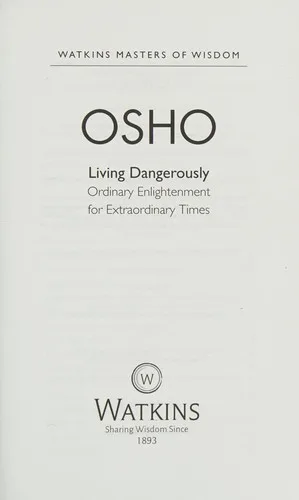
Osho - Living Dangerously
 82
82

Osho - Living Dangerously
Alan Jacobs’ compilation, Osho – Living Dangerously, offers a potent distillation of Osho’s philosophy, focusing on the necessity of embracing life’s inherent uncertainties. The strength lies in Osho’s characteristic directness, which cuts through intellectualizations to confront the reader with immediate existential questions. A particularly arresting section discusses the illusion of safety provided by societal constructs, positing that true aliveness emerges only when one steps beyond these perceived boundaries. However, the work’s limitation is its inherent nature as a collection of talks; without the original context of Osho’s delivery and audience interaction, some passages can feel repetitive or lack the full impact of their original performance. The editor’s choice to focus on the theme of "danger" is effective, framing Osho’s often radical ideas within a coherent, if challenging, conceptual umbrella. The book serves as a powerful, if sometimes abrasive, reminder to live with full engagement.
📝 Description
82
### What It Is Osho - Living Dangerously, authored by Alan Jacobs and Osho, first published in 2018, presents a collection of talks and teachings from the Indian mystic Osho (Rajneesh Chandra Mohan Jain). The work focuses on Osho's philosophy concerning consciousness, societal norms, and the individual's quest for liberation. It is not a narrative biography but rather a compilation of Osho's characteristic style of direct, often provocative, discourse aimed at challenging conventional thinking.
### Who It's For This book is suited for individuals exploring alternative spiritual paths and those interested in Eastern philosophies, particularly the teachings of Osho. It appeals to readers seeking to question established beliefs and societal conditioning, and who are drawn to a more introspective and existential approach to life. Those who appreciate direct, unvarnished communication and a radical perspective on freedom will find it engaging.
### Historical Context The teachings compiled in 'Living Dangerously' stem from Osho's prolific output during the latter half of the 20th century. He rose to prominence in the 1970s and 80s, establishing a significant commune in Pune, India, and later in Oregon, USA. His controversial style and ideas often clashed with mainstream religious and political establishments, leading to periods of persecution and legal challenges. His work exists within a broader context of post-colonial spiritual movements and the global interest in Eastern mysticism that gained traction in the West from the 1960s onwards.
### Key Concepts The book explores Osho's radical perspective on existence, emphasizing the importance of living fully in the present moment and embracing life's uncertainties. Central to his philosophy is the idea of "danger" not as a threat, but as an intrinsic aspect of authentic living, a necessary component for growth and self-discovery. He critiques the "safety" offered by societal structures and religious dogma, arguing they stifle individual potential. The work also touches upon meditation as a tool for inner awareness and a means to transcend the ego's limitations.
💡 Why Read This Book?
• Learn to reframe "danger" not as a threat but as an essential catalyst for genuine living, drawing from Osho's discussions on embracing uncertainty as detailed in the book's core message. • Discover how societal expectations and rigid belief systems can stifle individual freedom, a concept Osho elaborates on when critiquing conventional "safety nets." • Cultivate a more present-moment awareness by understanding Osho's emphasis on meditation as a tool to transcend the ego, as explored in his talks.
⭐ Reader Reviews
Honest opinions from readers who have explored this book.
❓ Frequently Asked Questions
What is the core philosophy presented in Osho - Living Dangerously?
The book centers on Osho's philosophy that true living involves embracing life's inherent uncertainties and "dangers" rather than seeking a false sense of security in societal norms or rigid doctrines.
Who was Osho and when did he teach?
Osho, born Rajneesh Chandra Mohan Jain, was an Indian mystic and spiritual teacher who taught primarily from the 1960s until his death in 1990, gaining international recognition for his controversial teachings.
What is the significance of "danger" in Osho's teachings as presented in this book?
In Osho's view, "danger" represents the unknown and the potential for growth, which must be faced to achieve authentic self-discovery, contrasting with the stultifying "safety" of conformity.
Is this book a biography of Osho?
No, 'Living Dangerously' is a compilation of Osho's discourses and teachings, not a biographical account. It focuses on his philosophical and spiritual insights.
What role does meditation play in the concepts discussed?
Meditation is presented as a crucial practice for developing inner awareness and detaching from the ego, enabling individuals to confront life's challenges more directly and authentically.
When was Osho - Living Dangerously first published?
The book 'Osho - Living Dangerously' was first published in 2018, compiling earlier teachings by Osho.
🔮 Key Themes & Symbolism
Embracing Uncertainty
The core of Osho's message here is that life's true vitality is found not in predictable safety, but in the courage to face the unknown. The book argues that societal structures and personal habits often create an illusion of security, which ultimately inhibits growth and authentic experience. By 'living dangerously,' Osho means engaging with life fully, accepting its inherent risks, and discovering one's own resilience and truth beyond conditioned responses. This theme challenges readers to question their reliance on external validation and predictable routines.
The Illusion of Safety
This theme scrutinizes the comfort zones that individuals and societies construct. Osho posits that these 'safe' environments—whether religious dogma, social conventions, or personal routines—prevent genuine self-realization. The book explores how the fear of the unknown drives people to seek these illusions, thereby sacrificing freedom and spontaneity. The compilation encourages a dismantling of these self-imposed limitations, advocating for a direct confrontation with existence as it is, without the buffer of artificial security.
Authentic Living and Awareness
Osho connects authentic living directly to a heightened state of awareness, often achieved through practices like meditation. The work suggests that by cultivating present-moment consciousness, individuals can break free from past conditioning and future anxieties. This awareness allows one to respond to situations authentically rather than reacting out of habit or fear. The pursuit of this unmediated experience of reality is presented as the ultimate goal, leading to a more vibrant and meaningful existence.
Critique of Societal Norms
A recurring element is Osho's sharp critique of established social, religious, and political systems. He viewed many of these as mechanisms designed to control rather than liberate individuals. The book presents his arguments against blind adherence to tradition and dogma, positing that these frameworks suppress individuality and critical thinking. The emphasis is on the individual's responsibility to seek their own truth, free from external authority, even if it means challenging the prevailing order.
💬 Memorable Quotes
“Life is not a problem to be solved, but a reality to be experienced.”
— This statement captures Osho's core philosophy of embracing existence directly rather than attempting to analyze or control it. It suggests that the pursuit of answers can distract from the richness of lived experience.
“The greatest fear in the world is the opinion of others, and the moment you are unafraid of the crowd, you are no longer a sheep, you become a lion.”
— This highlights Osho's emphasis on individual liberation from social conditioning. He contrasts the passive conformity of the masses ('sheep') with the courageous independence of the self-realized individual ('lion').
“When you are in the world, be in the world, but don't let the world be in you.”
— This encapsulates the idea of engaged detachment. It advocates for active participation in life's affairs without allowing external influences or worldly concerns to compromise one's inner peace or authentic self.
“Don't seek, just look. Don't ask, just listen. Don't demand, just receive.”
— This instruction points towards a receptive state of being, encouraging non-striving and open observation. It suggests that truth and understanding are found not through active pursuit, but through passive, mindful presence.
“If you are not living dangerously, you are not living at all.”
— This is the central thesis of the book, arguing that a life lived entirely within comfort zones and without risk is a life unlived. True vitality, according to Osho, requires embracing the unknown and the challenges it presents.
🌙 Esoteric Significance
Tradition
Osho's work draws heavily from Eastern spiritual traditions, particularly Zen Buddhism and Tantra, while also incorporating elements of Taoism, Sufism, and even Western psychology. He is not strictly bound by any single lineage but synthesizes diverse practices and philosophies into his own unique approach. His emphasis on direct experience over dogma aligns with certain mystical interpretations within these traditions, yet his radical critique of societal norms and his embrace of 'danger' often push beyond conventional esoteric boundaries.
Symbolism
While Osho's discourse is often more philosophical than symbolic in a traditional sense, the concept of 'danger' itself functions as a potent symbol for the unknown and the threshold of transformation. His frequent use of metaphors contrasting the 'sheep' with the 'lion' symbolizes the shift from passive conformity to active, courageous self-realization. The idea of shedding societal 'masks' or illusions can also be seen as a symbolic shedding of the false self to reveal the true, unconditioned essence.
Modern Relevance
Osho's ideas on mindfulness, the critique of consumerism and societal conditioning, and the importance of individual authenticity continue to resonate. Contemporary thinkers and practitioners in fields ranging from mindfulness-based stress reduction to existential psychology and alternative spirituality often engage with his concepts. His challenge to established norms and his emphasis on experiential truth remain relevant for individuals seeking meaning beyond conventional structures in an increasingly complex world.
👥 Who Should Read This Book
• Individuals seeking to question established societal norms and personal comfort zones, who are drawn to philosophies that challenge conventional thinking and encourage radical self-inquiry. • Students of Eastern spirituality and mysticism, particularly those interested in figures like Osho, who wish to understand his unique synthesis of Zen, Tantra, and existential thought. • Those grappling with feelings of existential unease or seeking a deeper, more engaged way of living, who are prepared to confront challenging ideas about freedom, fear, and authentic existence.
📜 Historical Context
Osho's teachings, compiled in works like 'Living Dangerously' (first published 2018), emerged from a period of significant global spiritual exploration in the latter half of the 20th century. His rise in the 1970s and 80s occurred alongside a burgeoning Western interest in Eastern mysticism, influenced by figures like Maharishi Mahesh Yogi and the broader counterculture movement. Osho's unique, often provocative style differentiated him from more conventional gurus. His commune in Oregon, established in the early 1980s, became a focal point of controversy, attracting both devoted followers and intense scrutiny from authorities. This period also saw intense debate between established Western psychological and religious frameworks and the influx of Eastern spiritual philosophies. Osho's methods and teachings were frequently met with resistance, including legal battles and media criticism, making his work a subject of significant societal debate and censorship concerns, particularly during his time in the United States.
📔 Journal Prompts
Reflect on the "danger" inherent in embracing new experiences versus the stagnation of perceived safety.
Analyze how societal opinions influence your daily decisions and personal sense of freedom.
Consider the concept of "living dangerously" as an active engagement with existence, not mere recklessness.
Explore the role of meditation in fostering awareness to distinguish authentic responses from conditioned reactions.
Identify one societal norm you unquestioningly accept and explore the potential "danger" in challenging it.
🗂️ Glossary
Awareness
In Osho's context, awareness refers to a state of alert, present-moment consciousness, free from judgment and identification with thoughts or emotions. It's about observing without interference.
Ego
The sense of self constructed from societal conditioning, personal history, and desires. Osho viewed the ego as an illusion that must be transcended to achieve true spiritual realization.
Meditation
Osho advocated for various active and passive meditation techniques designed to quiet the mind, increase self-awareness, and facilitate direct experience of reality beyond thought.
Conditioning
The process by which individuals internalize beliefs, behaviors, and values from their environment (family, society, religion) often without conscious choice, shaping their perception of reality.
Safety
The perceived security derived from conformity, predictability, and adherence to societal norms or established doctrines. Osho critiques this as an illusion that hinders true living.
Authenticity
Living in accordance with one's true nature, free from external pressures and societal conditioning. It involves direct experience and honest self-expression.
Existence
The state of being alive and experiencing reality directly, as opposed to analyzing, theorizing about, or trying to control it. Osho emphasizes experiencing life fully.