Omens and superstitions of southern India

 80
80

Omens and superstitions of southern India
Edgar Thurston's "Omens and Superstitions of Southern India" is an invaluable, if sometimes stark, compilation. Its strength lies in its sheer breadth; Thurston's dedication to cataloging the minutiae of regional beliefs is astonishing. For instance, his extensive section on the significance of lizard falls as omens, detailing different body parts and their varied interpretations, offers a window into a perception of reality deeply interconnected with the environment. However, the work's primary limitation is its late-colonial perspective. While meticulously recorded, the observations are often framed through a lens that implicitly views these beliefs as mere superstition rather than complex systems of meaning or coping mechanisms. A passage detailing the fear associated with eclipses, linking them to demonic influences on the sun and moon, exemplifies this, highlighting the cultural distance between observer and observed. This book is a crucial primary source, but one that demands critical engagement with its framing.
📝 Description
80
Edgar Thurston's 1912 study documents omens and superstitions across southern India.
Published in 1912, Edgar Thurston's Omens and Superstitions of Southern India is a detailed ethnographic account of popular beliefs in the region. Thurston, an administrator and ethnographer, collected observations on charms, portents, and superstitions found among various communities. The book records beliefs about the natural world, animal behavior, and celestial events, all interpreted as indicators of future happenings.
This work reflects the anthropological interests of the late Victorian and Edwardian eras, a time when scholars often cataloged the customs of colonial territories. It stands as a record of practices and ideas prevalent before significant changes in ethnographic methods. Thurston's research was part of a wider academic interest in Indian folk traditions during this period, with contemporaries also publishing on similar subjects.
This book documents folk divination practices, a subset of esoteric traditions focused on understanding and predicting future events through signs and omens. It details how communities interpreted natural phenomena, animal actions, and celestial occurrences as messages. While not a grimoire or a manual for practitioners, its systematic cataloging of these beliefs provides insight into the historical belief systems that informed popular spirituality and magical thinking in southern India.
💡 Why Read This Book?
• Gain insight into specific South Indian divination practices, such as interpreting the flight patterns of birds or the meaning of dreams, as documented by Thurston in the early 20th century. • Understand the historical context of ethnographic research, learning how beliefs were cataloged and presented by colonial administrators like Thurston in 1912. • Explore the cultural significance of everyday occurrences, like sneezing or encountering specific animals, and how they were interpreted as omens by communities in regions like Madras Presidency.
⭐ Reader Reviews
Honest opinions from readers who have explored this book.
❓ Frequently Asked Questions
What types of omens does Edgar Thurston document in Southern India?
Edgar Thurston's work meticulously records omens derived from animal behavior (birds, snakes, lizards), celestial events (eclipses, comets), natural phenomena (winds, earthquakes), and human actions (sneezing, dreams), offering a comprehensive look at early 20th-century belief systems.
When was 'Omens and Superstitions of Southern India' first published?
The book was first published in 1912, placing it within the early period of extensive ethnographic documentation in British India.
Who was Edgar Thurston and what was his role?
Edgar Thurston was a British administrator and ethnographer who served in India. He was Superintendent of the Madras Museum and dedicated much of his career to documenting the peoples, customs, and beliefs of Southern India.
What historical period does this book primarily cover?
The book focuses on the beliefs and superstitions prevalent in Southern India during the late 19th and early 20th centuries, as observed and recorded by Thurston prior to its 1912 publication.
Can this book be considered an academic study or a collection of folklore?
It functions as both. It's an academic study in its systematic cataloging and ethnographic approach, but its content is primarily a collection of folklore, superstitions, and popular beliefs from Southern India.
Are the superstitions mentioned in the book still practiced today?
While many specific practices may have faded or transformed, the book provides a historical record. Some underlying beliefs or sensitivities to omens might persist in modified forms within certain communities in Southern India.
🔮 Key Themes & Symbolism
Animal Portents
The work dedicates significant attention to the interpretation of animal behavior as omens. This includes the calls of specific birds like crows and peacocks, the sighting of snakes in particular contexts, and the significance attributed to lizard falls on different parts of the body. Thurston documents how these natural occurrences were perceived by communities not as random events, but as direct communications or indicators of future fortune, misfortune, or the presence of spiritual forces. This theme highlights a worldview where the boundary between the natural and the supernatural was fluid and constantly negotiated through observation.
Celestial and Natural Phenomena
Beyond animal signs, the book explores beliefs surrounding larger cosmic and terrestrial events. Eclipses, comets, and unusual weather patterns like specific wind directions or earthquakes were often imbued with profound meaning, frequently interpreted as divine displeasure or harbingers of significant societal change. Thurston records the rituals and anxieties associated with these phenomena, illustrating how communities sought to understand and placate perceived supernatural forces influencing their world. This theme underscores a deep-seated human tendency to find order and meaning in grand, often unpredictable, natural occurrences.
Charms and Protective Rituals
A substantial portion of the book details the array of charms, amulets, talismans, and protective rituals employed by the people of Southern India. These range from simple household practices designed to ward off evil spirits to more elaborate ceremonies invoked during times of crisis or significant life events. Thurston documents the materials used, the incantations or prayers involved, and the specific purposes of these practices, such as ensuring fertility, averting disease, or guaranteeing a safe journey. This theme reveals the practical application of belief systems in daily life.
Dream Interpretation and Divination
The book studies the significance of dreams as a source of omens and divine communication. Thurston records various interpretations of dream imagery, where specific symbols or scenarios were believed to predict future events, reveal hidden truths, or offer guidance. Alongside dream analysis, the work touches upon other forms of divination, illustrating the diverse methods people employed to seek knowledge beyond the immediate and the observable. This highlights the human desire for foresight and understanding of the unknown.
💬 Memorable Quotes
Direct passages from the work, attributed to the author.
“The falling of a lizard on any part of the body is an omen.”
— This simple statement expresses a core aspect of the book: the belief that seemingly random physical occurrences, like a lizard's fall, carry specific predictive meanings. It highlights a detailed system of interpretation tied to the body and environment.
“Omens were drawn from the flight of birds.”
— This points to the widespread practice of observing avian behavior as a form of divination. The direction, type of bird, and context of its flight were all factors considered significant in predicting future events or the success of undertakings.
“Dreams were considered prophetic.”
— This interpretation underscores the importance placed on the subconscious or dream state as a channel for divine messages or premonitions. The content of dreams was meticulously analyzed for clues about the future.
“Certain natural phenomena were viewed with apprehension.”
— This refers to the cultural responses to events like eclipses or earthquakes, which were often interpreted as signs of displeasure from deities or malevolent forces, prompting specific rituals or expressions of fear.
“Amulets and charms were used for protection.”
— This highlights the practical application of belief systems, where physical objects were employed to ward off negative influences, attract good fortune, or provide spiritual security in daily life.
🌙 Esoteric Significance
Tradition
While not strictly within a single defined esoteric lineage like Hermeticism or Kabbalah, Thurston's work touches upon universal themes found in folk magic and divination traditions worldwide. It can be seen as a rich source for comparative studies within the broader field of esoteric history, particularly concerning practices that seek to understand or influence the manifest world through subtle observation and ritual. It provides empirical data for traditions that value sympathetic magic and the interconnectedness of all phenomena, a concept explored in various mystical philosophies.
Symbolism
The book details numerous symbols embedded in everyday life. For example, the specific meaning attributed to the fall of a lizard on different parts of the body transforms the creature into a symbolic messenger. Similarly, the flight and calls of birds, like the crow, become potent symbols of impending events, whether positive or negative. These elements demonstrate how natural beings and occurrences are imbued with symbolic meaning, acting as a lexicon for understanding the unseen forces at play in the world.
Modern Relevance
Contemporary practitioners of comparative mythology, folklore studies, and even certain branches of New Age spirituality may draw on Thurston's meticulously gathered data. His work provides a historical baseline for understanding how ancient belief systems interact with daily life. Researchers exploring the roots of contemporary divination techniques or the evolution of folk psychology in South Asia find his detailed cataloging indispensable for tracing cultural continuities and transformations over the last century.
👥 Who Should Read This Book
• Anthropologists and historians of South Asia seeking primary source material on early 20th-century belief systems and cultural practices. • Folklorists and scholars of comparative mythology interested in cataloged traditions of omen interpretation and divination. • Researchers of magic, ritual, and esoteric history looking for ethnographic data on popular religious and supernatural beliefs in a specific cultural context.
📜 Historical Context
Edgar Thurston's "Omens and Superstitions of Southern India" was published in 1912, a period when ethnographic studies of colonial territories were common, reflecting a strong academic and imperial interest in cataloging the cultures of subjugated peoples. This era saw the rise of anthropology as a discipline, often characterized by a positivist approach that sought to classify and understand diverse human societies. Thurston, as Superintendent of the Madras Museum, was part of a generation of scholars meticulously documenting indigenous practices. His work stands alongside that of contemporaries like William Crooke, who focused on Northern India, contributing to a broad academic discourse on Indian folklore and belief systems. The prevailing intellectual currents were influenced by evolutionary theories of culture, often implicitly positioning Western societies as more 'advanced' than those being studied. Reception of such works was generally positive within academic circles interested in imperial administration and the exotic, though modern scholarship critically examines their colonial biases and methodologies.
📔 Journal Prompts
The significance of lizard falls as omens.
Interpreting the calls of specific birds as portents.
The cultural response to celestial events like eclipses.
The role of dreams in predicting the future.
The perceived efficacy of protective charms and amulets.
🗂️ Glossary
Omen
An event or circumstance believed to be a sign or warning of a future occurrence, often interpreted as having supernatural significance.
Superstition
A belief or practice resulting from ignorance, fear of the unknown, trust in magic or chance, or a false conception of causation.
Divination
The practice of seeking knowledge of the future or the unknown by supernatural means, such as interpreting omens, dreams, or celestial events.
Charm
A small object or device believed to possess magical powers, typically used to ward off evil or bring good luck.
Amulet
An ornament or item worn, typically around the neck, believed to protect the wearer from evil or danger.
Portent
A sign or warning that something, especially something momentous or calamitous, is likely to happen.
Folklore
The traditions, beliefs, customs, stories, and sayings of a community, passed down through generations.
🔮 Readers Also Liked
Browse all →









More by Edgar Thurston
All books →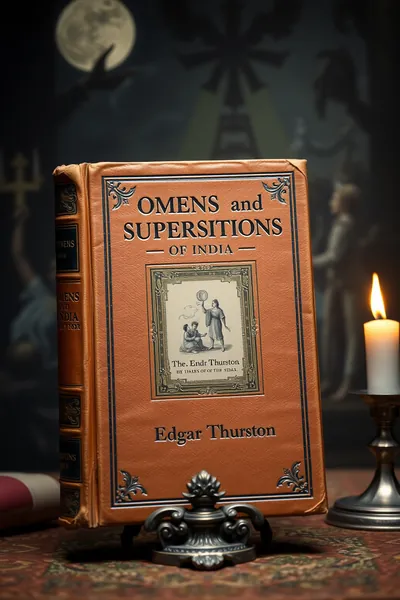
More Free Occult Philosophy Books
View all →