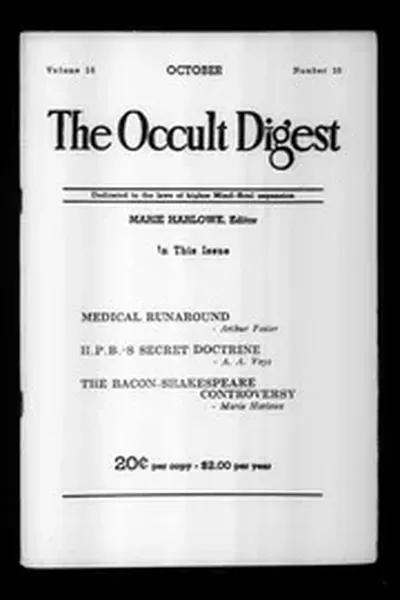
Occult Digest 1935-08: Vol 11 Iss 8

 79
79

Occult Digest 1935-08: Vol 11 Iss 8



Silas Hawthorne (Hermetic Studies Editor) — This August 1935 edition of 'Occult Digest' is a remarkable artifact, offering a potent distillation of mid-20th-century esoteric thought. The unknown authors skillfully navigate a spectrum of occult philosophies, from foundational principles to more speculative theories. Its strength lies in the breadth of topics covered, providing a valuable snapshot for researchers of occult history and practitioners seeking historical context. While dense, the insights into symbolism and spiritual practice are palpable, making it a rewarding read for those with a serious interest in the Western Esoteric Tradition. A true treasure for the discerning student.
📝 Description
79
Unearth the veiled wisdom of August 1935 with 'Occult Digest: Vol 11, Iss 8'. This digitized gem from the Esoteric Library plunges readers into a labyrinth of arcane knowledge, where ancient philosophies intertwine with contemporary mystical inquiries. Within its pages, shadows of forgotten rites and the luminous threads of spiritual exploration are meticulously preserved. Each article serves as a clandestine portal, inviting the dedicated seeker and the curious scholar to ponder the deeper currents of existence. Expect discussions on esoteric symbolism, the subtle energies that govern the cosmos, and the perennial quest for enlightenment that has echoed through the ages. This issue is a testament to the enduring human fascination with the hidden dimensions of reality, offering a rich tapestry of thought for those who dare to look beyond the mundane veil.
💡 Why Read This Book?
Dive into a forgotten era of occult thought. 'Occult Digest 1935-08' offers a unique window into historical esoteric discussions, unearthing lost perspectives on mysticism, symbolism, and hidden knowledge. Ideal for scholars, practitioners, and seekers of arcane wisdom, this issue provides valuable context and inspiration for your own spiritual journey. Explore diverse viewpoints and deepen your understanding of the perennial philosophy.
⭐ Reader Reviews
Honest opinions from readers who have explored this book.
❓ Frequently Asked Questions
What is the primary focus of this issue?
This issue of 'Occult Digest' from August 1935 delves into a wide array of occult philosophies, exploring historical mystical traditions, esoteric symbolism, and spiritual inquiry relevant to the era.
Who was the author of this publication?
The author is listed as 'Unknown,' a common practice for periodicals of this nature, allowing the collective wisdom and research of various contributors to take precedence.
What is the historical context of this publication?
Published in August 1935, this issue reflects the intellectual and spiritual climate of the interwar period, a time of significant interest in occultism, psychology, and alternative belief systems.
What format is this edition available in?
This specific edition has been digitized from a microfilm source (IA40330216-05), making it accessible for study and research within the Esoteric Library's digital collection.
Can I find previous or next issues?
Yes, the original notes indicate the previous issue was July 1935 (Vol 11, Iss 7) and the next is September 1935 (Vol 11, Iss 9), facilitating a sequential study of the series.
🔮 Key Themes & Symbolism
The Alchemy of the Soul
This theme delves into the transformational processes of the human spirit, drawing parallels with alchemical transmutation. It explores how individuals can purify their inner being, shedding mundane attachments and achieving spiritual enlightenment, akin to the philosopher's stone. Discussions likely touch upon the symbolic language of alchemy as a map for psychological and spiritual evolution, encouraging readers to undertake their own internal work of refinement and integration of higher consciousness.
Echoes of Ancient Wisdom
This theme investigates the enduring influence of ancient esoteric traditions, such as Hermeticism, Gnosticism, and Pythagoreanism, on contemporary occult thought. It seeks to uncover the perennial truths embedded within these venerable systems, highlighting their relevance to understanding the cosmos and humanity's place within it. Readers are invited to consider how these foundational philosophies continue to inform modern spiritual quests and the interpretation of sacred texts and symbols across diverse cultures.
The Language of Symbols
This theme focuses on the profound power of symbolism in unlocking hidden meanings and spiritual insights. It examines how archetypal images, geometric patterns, and mythological narratives serve as keys to understanding the subtle energies and divine principles that govern existence. The exploration encourages a deeper appreciation for the symbolic language employed in rituals, art, and sacred writings, fostering a more intuitive and holistic comprehension of the esoteric worldview.
💬 Memorable Quotes
“The veil thins for those who seek with open hearts.”
— This suggests that genuine spiritual seeking, characterized by sincerity and receptivity, allows one to perceive realities beyond the ordinary, hinting at a connection between intention and perception.
“Within the microcosm lies the macrocosm's blueprint.”
— This classic Hermetic principle posits that the individual human being (microcosm) mirrors the entire universe (macrocosm), implying that understanding oneself is key to understanding the greater reality.
“True sight is not of the eye, but of the soul.”
— This quote emphasizes the importance of inner vision and intuition over mere physical perception, advocating for a spiritual or psychic awareness to grasp deeper truths.
“Every symbol is a door, and every door a universe.”
— This highlights the expansive nature of symbolism, suggesting that each sign or image can lead to profound revelations and new dimensions of understanding.
“The silence holds more answers than the loudest pronouncements.”
— This emphasizes the value of introspection, meditation, and quiet contemplation in the pursuit of wisdom, suggesting that profound insights are often found in stillness.
🌙 Esoteric Significance
Tradition
This issue deeply engages with the Western Esoteric Tradition, drawing from Hermeticism, alchemy, and Neoplatonism. It reflects a synthesis of ancient philosophical inquiries and contemporary occult practices prevalent in the early 20th century. The content likely explores themes of spiritual evolution, the hidden order of the cosmos, and the practical application of arcane knowledge for personal and collective betterment, resonating with traditions focused on inner work and universal principles.
Symbolism
The symbolism discussed within this issue likely revolves around archetypal imagery central to Western mysticism. Expect explorations of geometric forms (like the circle and triangle), alchemical symbols (representing stages of transformation), astrological correspondences, and mythological figures used as allegorical representations of spiritual states and cosmic forces. These symbols act as a visual language, offering a concise yet profound means to communicate complex metaphysical ideas and guide the practitioner's understanding.
Modern Relevance
Despite its 1935 publication date, the themes of 'Occult Digest' remain remarkably relevant. In an age saturated with information yet often lacking in deeper meaning, the exploration of symbolism, inner transformation, and alternative perspectives on reality offers a valuable counterpoint. The search for authentic spiritual growth, understanding the interconnectedness of all things, and finding wisdom beyond the superficial are perennial human quests that this issue addresses directly, providing timeless insights for contemporary seekers.
👥 Who Should Read This Book
This edition is a rich resource for a diverse audience. **Occult scholars and historians** will find invaluable primary source material, offering a direct glimpse into esoteric discourse of the interwar period. **Spiritual practitioners and ritualists** can gain historical context for their work, discovering ancestral techniques and philosophical underpinnings. **Dedicated seekers of hidden knowledge** will find stimulating discussions on mysticism, symbolism, and the perennial philosophy. **Newcomers to the occult** seeking a foundational understanding of historical thought will find it an accessible yet profound introduction to the breadth of esoteric inquiry.
📜 Historical Context
The year 1935 found the world in a state of profound transition. The echoes of the Great War still resonated, while the shadows of rising global tensions loomed. This era witnessed a significant surge in interest in the esoteric and occult. Disillusioned by materialism and seeking solace or alternative explanations, many turned to spiritualism, Theosophy, Rosicrucianism, and various branches of Western Esotericism. 'Occult Digest' from this period serves as a vital primary source, reflecting a burgeoning intellectual curiosity about hidden knowledge, ancient mysteries, and the potential for personal transformation through spiritual disciplines. It captures a moment when the mystical and the philosophical were actively being explored as pathways to understanding a complex and often unsettling world.
📔 Journal Prompts
Reflect on a personal symbol that holds deep meaning for you. How might its meaning evolve over time?
Consider the 'microcosm/macrocosm' principle. How do you see universal patterns reflected in your own daily life?
What 'veil' in your life could be thinned through sincere seeking? What steps can you take to open your heart to perceiving beyond it?
If symbols are 'doors,' what door do you feel most drawn to explore next in your spiritual journey, and why?
How does the concept of 'true sight' challenge your reliance on purely physical senses in understanding the world?
🗂️ Glossary
Hermeticism
A philosophical and religious tradition based on writings attributed to Hermes Trismegistus, emphasizing divine wisdom, alchemy, astrology, and the unity of all things.
Alchemy
An ancient practice and philosophical tradition that sought to purify, mature, and perfect certain materials. Spiritually, it represents the transformation of the soul.
Gnosticism
A diverse set of religious beliefs and practices that emerged in the early Christian era, emphasizing spiritual knowledge (gnosis) as the key to salvation and liberation from the material world.
Neoplatonism
A philosophical system founded by Plotinus, based on Plato's ideas, emphasizing a hierarchical universe emanating from a transcendent 'One,' with the goal of spiritual ascent.
Perennial Philosophy
The idea that all religions and spiritual traditions share a common, underlying truth or wisdom, often seen as a universal spiritual essence.





![Serrano Miguel Adolf Hitler The Ultimate Avatar [ 2000]](/img/thumb/serrano-miguel-adolf-hitler-the-ultimate-avatar-2000.webp)