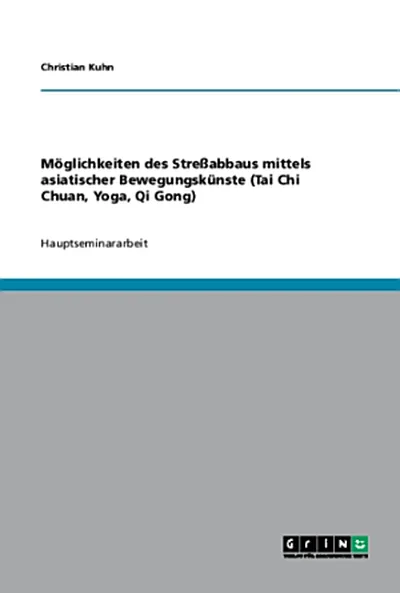
Möglichkeiten des Streßabbaus mittels asiatischer Bewegungskünste (Tai Chi Chuan, Yoga, Qi Gong)
 79
79

Möglichkeiten des Streßabbaus mittels asiatischer Bewegungskünste (Tai Chi Chuan, Yoga, Qi Gong)
Christian Kuhn’s exploration of stress reduction through Asian movement arts, "Möglichkeiten des Streßabbaus mittels asiatischer Bewegungskünste," offers a grounded perspective that moves beyond mere spiritual platitudes. Its strength lies in its direct linkage to sport psychology research, particularly the initial observation regarding competitive boxing and stress. The work effectively positions Tai Chi Chuan, Yoga, and Qi Gong not just as physical exercises but as sophisticated systems for cultivating mental fortitude. A minor limitation is that, as a 2007 publication, some of the contemporary research cited might feel dated, though the core principles remain robust. The detailed explanation of how the slow, deliberate movements in Tai Chi can regulate the nervous system is particularly compelling. Kuhn’s approach is commendably practical, avoiding overly esoteric jargon. This book serves as a clear, accessible guide for anyone seeking to integrate these practices into a modern, stress-filled life.
📝 Description
79
<p>### What It Is</p><p></p><p>Möglichkeiten des Streßabbaus mittels asiatischer Bewegungskünste, first published in 2007 by Christian Kuhn, examines the practical application of Eastern movement practices for stress reduction. Drawing from a sport psychology seminar that highlighted the need for effective stress management in competitive sports, this work proposes Asian martial arts as a direct solution. It moves beyond theoretical discussions to explore how disciplines like Tai Chi Chuan, Yoga, and Qi Gong offer tangible methods for mitigating the effects of stress.</p><p></p><p>### Who It's For</p><p></p><p>This book is intended for individuals seeking practical, embodied techniques to manage stress and enhance well-being. It will appeal to athletes, particularly those in competitive fields, who require robust coping mechanisms. Furthermore, it is relevant for practitioners of martial arts, yoga enthusiasts, and anyone interested in the intersection of physical discipline and mental health. Those curious about the scientific underpinnings of these ancient practices will also find value.</p><p></p><p>### Historical Context</p><p></p><p>The book emerges from a context where sport psychology began to formally recognize the profound impact of stress on performance and athlete welfare. Kuhn's work situates Asian movement arts within this discourse, acknowledging their growing popularity in Western cultures since the latter half of the 20th century. The original research for this book likely stemmed from observations within academic settings, bridging the gap between sports science and Eastern contemplative traditions.</p><p></p><p>### Key Concepts</p><p></p><p>The core concepts revolve around the principle that deliberate, mindful movement can directly counter physiological and psychological stress responses. Kuhn explores how the structured forms of Tai Chi Chuan, the breath-synchronous postures of Yoga, and the energy cultivation of Qi Gong all serve as potent tools. The book emphasizes the integration of mind, body, and breath as central to achieving a state of calm and resilience, thereby offering a holistic approach to stress management.</p>
⭐ Reader Reviews
Honest opinions from readers who have explored this book.
❓ Frequently Asked Questions
What specific Asian movement arts does Christian Kuhn discuss for stress relief?
Christian Kuhn focuses on three primary Asian movement arts in his book: Tai Chi Chuan, Yoga, and Qi Gong. These disciplines are presented as effective methods for stress reduction, drawing from their combined emphasis on physical movement, breath control, and mental focus.
What is the origin of the research presented in "Möglichkeiten des Streßabbaus"?
The research originated from a sport psychology seminar where the need for effective stress management methods in competitive sports, using boxing as an example, was highlighted. This led to an exploration of martial arts as a means of stress reduction.
When was Christian Kuhn's book on stress reduction first published?
Christian Kuhn's book, "Möglichkeiten des Streßabbaus mittels asiatischer Bewegungskünste," was first published in 2007. This places its publication during a period of increasing interest in holistic health and mind-body practices.
How does the book relate stress reduction to competitive sports?
The book explicitly connects stress management techniques to competitive sports by first identifying the heightened stress levels experienced by athletes. It then proposes Asian movement arts as practical solutions to help athletes cope with and reduce this pressure.
Does the book offer practical exercises or just theory?
The book aims to offer practical applications. While grounded in theoretical concepts from sport psychology and Eastern traditions, it focuses on how disciplines like Tai Chi Chuan, Yoga, and Qi Gong can be actively used for stress relief, implying practical guidance.
What is the core principle behind stress reduction discussed in Kuhn's work?
The core principle is that mindful, deliberate movement, as practiced in Tai Chi Chuan, Yoga, and Qi Gong, can directly counteract the physiological and psychological effects of stress. It emphasizes the integration of mind, body, and breath.
🔮 Key Themes & Symbolism
Embodied Stress Management
This work posits that stress is not merely a mental phenomenon but is deeply embodied. Kuhn explores how deliberate physical practices like Tai Chi Chuan's slow, flowing movements, Yoga's postures (asanas), and Qi Gong's coordinated breath and movement can directly influence the body's stress response. The book moves beyond talk therapy to offer tangible, physical methods for achieving a state of calm, emphasizing that the act of moving mindfully is itself a therapeutic intervention against the pressures of modern life.
Sport Psychology Integration
A significant aspect of this book is its foundation in sport psychology. Kuhn draws from observations within competitive sports, specifically referencing boxing, to establish the critical need for effective stress-coping mechanisms. This perspective lends a scientific and performance-oriented angle to the study of Asian movement arts, framing them not just as spiritual pursuits but as vital tools for enhancing resilience and well-being, particularly for athletes facing high-pressure situations.
Holistic Mind-Body Discipline
The book champions a holistic approach where the mind, body, and breath are intrinsically linked. Practices such as Yoga, Tai Chi Chuan, and Qi Gong are presented as systems that cultivate this integration. By focusing on coordinated movement, conscious breathing, and mental focus, these disciplines work synergistically to foster a balanced state. This integrated approach is key to achieving lasting stress reduction and overall well-being, moving beyond fragmented solutions to a unified practice.
Accessibility of Eastern Practices
Kuhn addresses the growing presence and applicability of Eastern movement arts in Western contexts. The book serves to demystify disciplines like Tai Chi Chuan, Yoga, and Qi Gong, presenting them as accessible and practical methods for stress relief for a broad audience, not just seasoned practitioners. It highlights how these ancient traditions offer relevant solutions to contemporary challenges, bridging cultural divides through shared human needs for balance and tranquility.
💬 Memorable Quotes
“The elevated need for effective stress management methods for sports became evident.”
— This statement captures the book's origin point: the recognition, within a sport psychology context, that athletes face significant stress and require practical coping strategies. It sets the stage for exploring movement arts as a solution.
“Asian martial arts themselves represent a possibility for stress reduction.”
— This highlights the central thesis of Kuhn's work, positioning practices like Tai Chi Chuan and Qi Gong not just as physical disciplines but as direct instruments for mitigating psychological and physiological stress.
“Structured movement forms can counter stress responses.”
— This paraphrased concept underscores the book's focus on the efficacy of disciplined physical practices. It suggests that the very structure and mindfulness inherent in Tai Chi or Yoga are key to their stress-reducing benefits.
“The integration of mind, body, and breath is central to achieving calm.”
— This interpretation encapsulates a core tenet of the discussed practices. It emphasizes the holistic nature of stress reduction, where coordinated mental focus, physical posture, and respiratory control work together.
“Asian movement arts are increasingly relevant in Western cultures.”
— This reflects the book's acknowledgment of the global spread and adaptation of these practices. It positions Kuhn's work as bridging Eastern traditions with the needs of a modern, Western audience seeking stress relief.
🌙 Esoteric Significance
Tradition
While not strictly adhering to a single esoteric lineage, Kuhn's work taps into the broad currents of Taoist and Buddhist philosophies that underpin many Asian movement arts. The emphasis on Qi (vital energy), the cultivation of inner harmony, and the understanding of the body as a microcosm of the universe align with Hermetic and Gnostic principles of interconnectedness. The book bridges these ancient contemplative traditions with modern scientific inquiry, positioning the practices as accessible paths to spiritual and psychological well-being.
Symbolism
Key symbolic motifs revolve around the concept of Qi, the vital life force that flows through all things, particularly emphasized in Qi Gong. The flowing, circular movements of Tai Chi Chuan symbolize the Taoist principle of "wu wei" (effortless action) and the balance of Yin and Yang. Yoga's postures (asanas) can be seen as symbolic representations of stability, strength, and surrender, often invoking imagery related to nature and the cosmos, connecting the practitioner to universal forces.
Modern Relevance
Kuhn's work remains relevant for contemporary thinkers and practitioners exploring somatic psychology, embodied cognition, and trauma-informed care. Modern proponents of mindfulness-based stress reduction (MBSR) and integrative medicine often cite the principles discussed in such texts. Furthermore, coaches and sports psychologists continue to draw on the integration of physical discipline and mental resilience that Kuhn highlights, making his 2007 publication a foundational text for understanding the enduring efficacy of these practices.
👥 Who Should Read This Book
['• Athletes and coaches seeking evidence-based methods to manage performance anxiety and enhance mental resilience, building on the sport psychology context Kuhn establishes.', '• Individuals experiencing chronic stress who are looking for practical, embodied techniques beyond conventional therapies, drawn to the specific practices of Tai Chi Chuan, Yoga, and Qi Gong discussed.', "• Students of comparative philosophy and traditional medicine interested in the intersection of Eastern movement arts and Western scientific understanding of well-being, appreciating the book's original research basis."]
📜 Historical Context
Published in 2007, Christian Kuhn's "Möglichkeiten des Streßabbaus mittels asiatischer Bewegungskünste" emerged during a period of burgeoning interest in mind-body practices within Western academia and popular culture. The early 21st century saw a significant increase in research on the physiological and psychological benefits of disciplines like Yoga and Tai Chi, moving them from the fringes of esoteric study into mainstream wellness discourse. Kuhn's work is situated within this trend, drawing explicitly from sport psychology, a field that had been actively investigating the impact of stress on athletic performance since the 1970s. While contemporaries like Herbert Benson had already popularized the "relaxation response" in the 1970s, Kuhn’s focus remained specifically on the structured, embodied methodologies of Asian movement arts. The book's publication predates the widespread digital saturation that would further amplify access to these practices, making its structured approach particularly relevant for readers seeking grounded information.
📔 Journal Prompts
The integration of mind, body, and breath in Tai Chi Chuan.
The sport psychology seminar's findings on competitive stress.
Cultivating Qi through mindful movement.
The efficacy of Yoga postures for stress relief.
Comparing Qi Gong's energy cultivation with Western concepts.
🗂️ Glossary
Tai Chi Chuan
A traditional Chinese martial art practiced for both its defense training and its health benefits. It involves slow, flowing, deliberate movements coordinated with breath and focused awareness.
Yoga
A group of physical, mental, and spiritual practices or disciplines originating in ancient India. In the West, it is most commonly associated with physical postures (asanas), breathing techniques (pranayama), and meditation.
Qi Gong
A component of traditional Chinese medicine, Qi Gong involves coordinated body posture and movement, breathing, and meditation used for health, spirituality, and martial arts training. It focuses on cultivating and balancing Qi.
Qi
In traditional Chinese culture, Qi (or Chi) is considered the vital life force or energy that flows through all living things. Its balance and unobstructed flow are essential for health and well-being.
Sport Psychology
An interdisciplinary science that draws from psychology, kinesiology, and medicine to study the triggers of behavior and thought in sports and exercise contexts, focusing on performance enhancement and mental well-being.
Stress Management
The range of techniques and strategies employed to reduce or cope with undesirable stress, focusing on improving physical, mental, and emotional well-being by managing responses to stressors.
Asanas
The physical postures or poses practiced in Yoga. They are designed to promote strength, flexibility, balance, and relaxation, serving as a key component of the physical practice of Yoga.