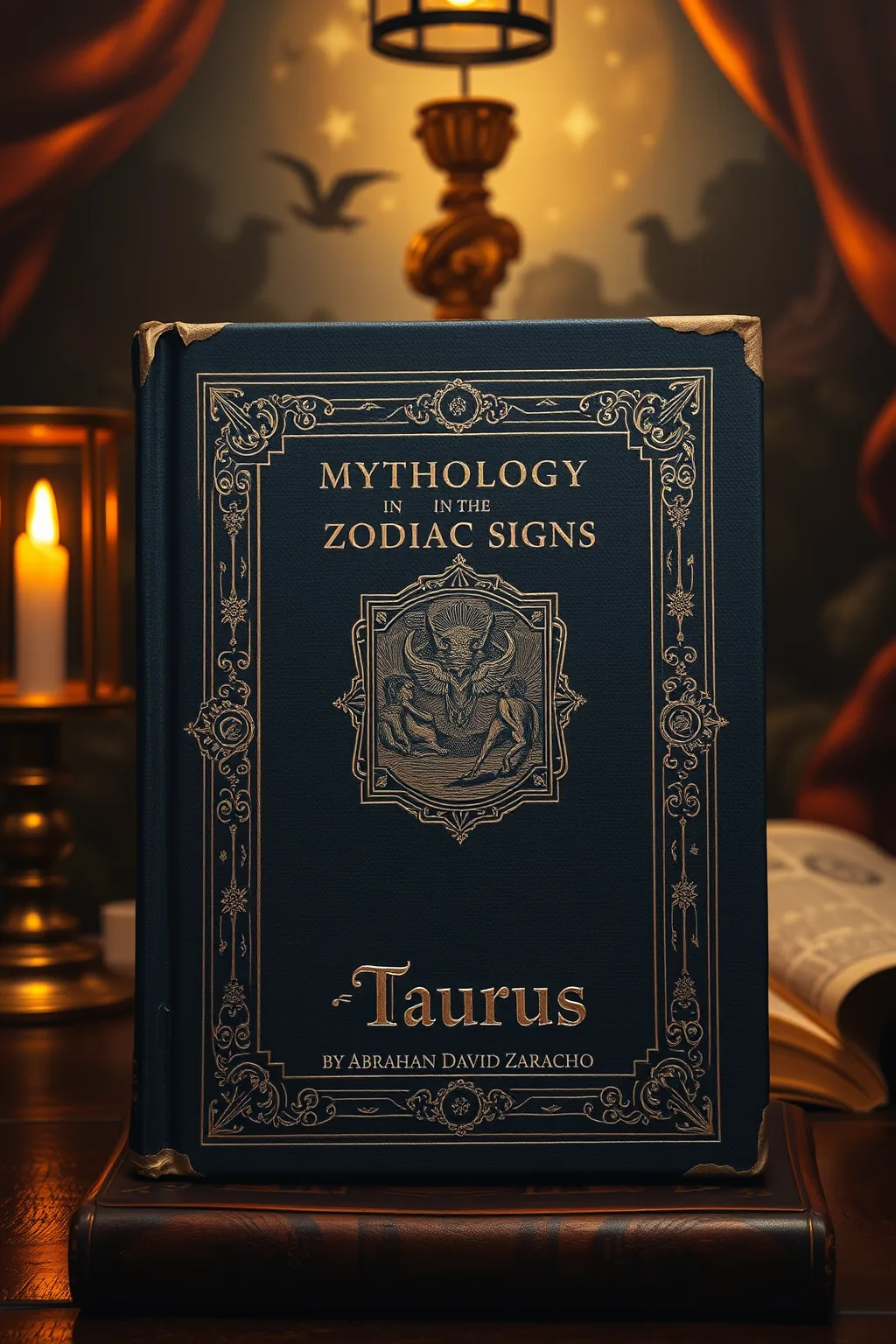
Mythology in the Zodiac Signs: Taurus
 81
81

Mythology in the Zodiac Signs: Taurus
Zaracho's "Mythology in the Zodiac Signs: Taurus" offers a focused examination of the constellation's titular myth, specifically the Europa abduction narrative. The author anchors the bull's origin to the period between King Agenor and King Theseus, a commendable attempt to historicize a legend. A particular strength lies in connecting this myth to the subsequent founding of cities and the lineage of the Minotaur, demonstrating how a single mythical act could ripple through ancient history. However, the work occasionally feels constrained by its singular focus; while the Europa myth is central, the broader astrological significance of Taurus beyond this specific narrative could have been more extensively explored. The detailed account of the bull's role as the Minotaur's father is compelling, illustrating the monstrous consequences of divine caprice. Zaracho presents a solid, if specialized, contribution to mythological studies. The book effectively argues for the foundational impact of the Europa myth on early Aegean civilization.
📝 Description
81
### The Bull's Mythic Genesis Abrahan David Zaracho's "Mythology in the Zodiac Signs: Taurus" traces the lineage of the bull constellation's origin myth. It posits the creature's creation for King Agenor's purpose: the abduction of Princess Europa. This act, the book argues, catalyzed significant geopolitical shifts, prompting the establishment of settlements and nations in its wake. The work details the bull's role as progenitor to the Minotaur, a figure of immense dread.
### For the Astrologically Curious and Mythographers This text is intended for individuals interested in the foundational myths underpinning astrological signs, specifically Taurus. Readers who engage with comparative mythology, ancient Near Eastern narratives, and the origins of Western constellations will find particular value. It appeals to those seeking to understand the symbolic weight carried by celestial figures and their terrestrial manifestations.
### Minoan Crete and Athenian Foundations The narrative framework places the bull's mythic existence between the reigns of King Agenor and King Theseus of Athens. This temporal positioning connects the story to the Bronze Age Aegean, specifically the Minoan civilization and the nascent periods of Athenian history. The book examines how these events, rooted in myth, influenced the development of early Greek city-states and their foundational legends.
### The Europa Abduction and Minotaur's Lineage Central to Zaracho's exploration is the myth of Europa's abduction by a divine bull, an event that reshaped royal dynasties. The work also focuses on the bull's role as the sire of the Minotaur, a creature born of Pasiphae and the Cretan Bull. This lineage highlights themes of divine intervention, bestiality, and the monstrous.
💡 Why Read This Book?
• Understand the specific myth of Europa's abduction by the bull, its impact on King Agenor's dynasty, and its role in establishing ancient cities, offering a concrete origin story for the Taurus constellation. • Explore the lineage of the Minotaur, tracing its parentage back to the divine bull and Pasiphae, providing a visceral connection between celestial symbolism and monstrous figures. • Grasp the historical positioning between King Agenor and King Theseus, illuminating how this specific myth connects Bronze Age Crete with the early Athenian period, offering a distinct chronological anchor.
⭐ Reader Reviews
Honest opinions from readers who have explored this book.
❓ Frequently Asked Questions
What specific historical period does Abrahan David Zaracho place the bull myth in?
The book situates the mythic existence of the bull between the time of King Agenor and the era of King Theseus of Athens, connecting it to the Bronze Age Aegean.
What is the primary mythical event associated with the Taurus bull in this book?
The central event is the bull's role in the abduction of Princess Europa, an act that Zaracho argues spurred significant political and social developments.
How does the book link the Taurus bull to the Minotaur?
Zaracho details the Taurus bull's paternity of the Minotaur, born from the union with Pasiphae, thereby establishing a direct mythological lineage.
Who were the key figures mentioned in relation to the Taurus bull's myth?
Key figures include King Agenor, Princess Europa, King Theseus, and Pasiphae, all connected to the bull's narrative arc and its consequences.
What is the broader impact of the bull myth discussed in the book?
The book posits that the myth's events led to the establishment of villages, towns, cities, and nations, demonstrating its foundational influence on civilization.
When was "Mythology in the Zodiac Signs: Taurus" first published?
The book was first published on November 15, 2021.
🔮 Key Themes & Symbolism
The Abduction of Europa
This theme centers on the powerful myth of Zeus, disguised as a bull, abducting the Phoenician princess Europa. Zaracho examines how this event, occurring between the eras of King Agenor and King Theseus, is presented as a catalyst for geopolitical shifts and the establishment of new settlements. The work explores the divine intervention and its human consequences, positioning the bull not merely as an animal but as an agent of fate and societal change within the early Aegean context.
Progenitor of the Minotaur
The book highlights the Taurus bull's role as the mythical father of the Minotaur. Born from the unnatural union between Pasiphae, wife of King Minos of Crete, and the divine bull, this monstrous offspring represents a dark and terrifying aspect of the bull's symbolism. Zaracho analyzes how this lineage connects the celestial bull to themes of divine punishment, forbidden desire, and the creation of nightmares that haunted ancient Crete.
Foundation of Civilizations
A significant focus is placed on how the myth of the bull, particularly the abduction of Europa, is depicted as a foundational event for early civilizations. The narrative suggests that the search for Europa and the subsequent establishment of her brother Cadmus's kingdom (Thebes) and other settlements, including Athens, were direct results of this mythic act. This underscores the book's argument for the socio-political impact of ancient legends.
Astrological Symbolism
While primarily focused on myth, the work implicitly explores the astrological significance of Taurus by dissecting its originating narrative. The bull's attributes—strength, divine power, fertility, and potential for chaos—are examined through the lens of the Europa and Minotaur stories. This provides a mythological grounding for the zodiacal sign, connecting its traditional characteristics to specific ancient tales and their cultural resonance.
💬 Memorable Quotes
“The bull created to kidnap Princess Europa unleashed the movement of kings and princes.”
— This statement encapsulates the book's central thesis: that the mythic Taurus bull was not just a creature but a powerful force that initiated dynastic shifts and territorial expansion.
“Due to it and in search for it, villages, towns, cities, and nations were established.”
— This highlights the socio-political consequence of the Europa myth, suggesting that the pursuit and aftermath of the abduction directly led to the formation of early human settlements and states.
“It was the father of Minotaur, a nightmare for the Cretan people.”
— This points to the bull's dual nature, linking its role in founding myths with its terrifying paternity of the Minotaur, a symbol of dread and monstrous progeny.
“The mythical creature that lived between the times of King Agenor and the old days of King Theseus of Athens.”
— This quote provides a specific chronological anchor for the myth, placing the bull's narrative within a period bridging Phoenician and early Athenian history.
“The origin and the mythical evolution of the figure in which the identification of the astrological constellation of Taurus is based.”
— This phrase defines the core objective of the book: to meticulously trace the genesis and development of the myth associated with the Taurus constellation.
🌙 Esoteric Significance
Tradition
This work fits within the broader tradition of Western Esotericism that seeks to uncover hidden meanings and ancient wisdom within myths and symbols. While not explicitly Hermetic or Kabbalistic, it aligns with the Theosophical and Neoplatonic interest in myth as a vehicle for spiritual truth and understanding cosmic patterns. It departs from purely academic mythological studies by framing these ancient stories as foundational to astrological understanding, suggesting an underlying energetic or archetypal reality.
Symbolism
The primary symbol is the divine bull itself, representing immense power, fertility, divine force (Zeus), and the generative principle. Its abduction of Europa symbolizes the forceful imposition of divine will upon the human realm and the subsequent disruption of existing orders. As the sire of the Minotaur, the bull embodies the shadow aspect, representing uncontrollable primal urges, the monstrous consequences of divine intervention, and the terrifying potential hidden within seemingly stable forms.
Modern Relevance
Contemporary practitioners of archetypal astrology and depth psychology, particularly those influenced by Jungian thought, can find value in Zaracho's detailed exploration. Thinkers interested in comparative mythology and the enduring power of ancient narratives to shape consciousness continue to draw on such works. The book's focus on myth as a precursor to astrological interpretation resonates with modern movements seeking to revitalize or re-contextualize traditional astrological systems with deeper symbolic meaning.
👥 Who Should Read This Book
• Students of comparative mythology interested in the specific origins of Greek myths and their connection to celestial bodies, seeking a detailed account of the Europa abduction narrative. • Astrologers and esoteric students looking to deepen their understanding of the Taurus sign beyond basic personality traits, by exploring its rich mythological and historical underpinnings. • Researchers of ancient Near Eastern and Aegean civilizations who wish to examine how foundational myths were perceived to influence the establishment and development of early city-states and dynasties.
📜 Historical Context
Published in 2021, Abrahan David Zaracho's work emerged in an era of renewed interest in mythology and its connection to cultural identity. It engages with classical scholarship on Aegean Bronze Age narratives, particularly the myths surrounding Crete and Athens. The book implicitly positions itself against purely astronomical interpretations of zodiacal signs, advocating for a deep dive into their mythopoetic roots. While not directly engaging with a specific competing school of thought by name, it contrasts with modern, secularized astrology by emphasizing ancient mythological origins. The period between King Agenor and King Theseus, roughly spanning the Minoan and early Mycenaean/Greek Dark Ages, is a complex historical and mythological nexus. The work contributes to understanding how foundational myths like Europa's abduction might have shaped early Greek perceptions of their own history and divine connections, potentially influencing later philosophical currents.
📔 Journal Prompts
The bull's role in the abduction of Princess Europa and its impact on King Agenor's lineage.
The monstrous progeny: exploring the symbolic meaning of the Minotaur's birth from the divine bull.
Connecting the mythic bull's actions to the establishment of settlements between King Agenor's time and King Theseus's reign.
Reflecting on the dual nature of the bull symbol: divine power and terrifying shadow.
How the myth of the Taurus bull might inform our understanding of the zodiacal sign today.
🗂️ Glossary
King Agenor
A mythical Phoenician king, father of Europa and Cadmus. His lineage and the fate of his children are central to the myth explored in the book.
Princess Europa
The Phoenician princess abducted by Zeus in the form of a bull. Her myth is directly linked to the origin of the Taurus constellation and significant geopolitical events.
King Theseus
A legendary king of Athens. The book places the bull myth within a timeline extending to his era, connecting it to the development of Athenian history.
Minotaur
A monstrous creature with the body of a man and the head of a bull. The book details its paternity by the divine bull and Pasiphae.
Pasiphae
Wife of King Minos of Crete, who, with divine intervention, conceived the Minotaur with the Cretan bull.
Cretan Bull
The divine bull associated with Crete, often identified with Zeus's form during the abduction of Europa and later the sire of the Minotaur.
Astrological Constellation
A defined area of the celestial sphere, in this context, the pattern of stars recognized as Taurus, whose mythology is explored.