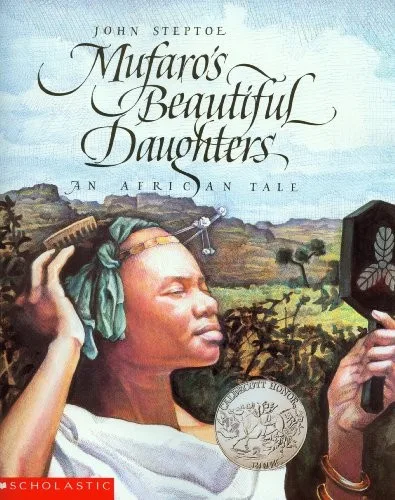
Mufaro's Beautiful Daughters
 81
81

Mufaro's Beautiful Daughters
John Steptoe’s Mufaro’s Beautiful Daughters is a striking example of how a folktale can be elevated through artful illustration and a clear, resonant narrative. The story’s strength lies in its elegant simplicity, presenting a moral dichotomy between two sisters vying for royal favor. The depiction of Nyasha’s gentle interactions with various characters, culminating in her encounter with a hungry boy and a fearsome snake, serves as a powerful illustration of her inner grace. The book’s primary limitation, however, is its somewhat predictable resolution; the virtuous character’s triumph, while satisfying, offers little surprise. Yet, the visual storytelling, particularly the opulent portrayal of the King’s city, compensates for any narrative straightforwardness. Steptoe’s original vision, completed by his children, offers a visually rich and morally instructive experience.
It’s a valuable addition for its cultural representation and clear moral compass.
📝 Description
81
John Steptoe published Mufaro's Beautiful Daughters in 1985, a reimagining of an African folktale.
This book tells the story of Mufaro, a village chief with two daughters, Manyara and Nyasha. When Mufaro decides to find a husband for one of his daughters, he sends them on separate journeys to the Great King's city. Manyara, the proud daughter, travels ahead, while the kind Nyasha follows. Along their paths, each sister encounters challenges and opportunities that reveal their true characters. The narrative contrasts Manyara's selfish actions with Nyasha's generosity and compassion.
The story culminates in a choice made by the Great King, who observes the sisters' behavior and decisions. Mufaro's Beautiful Daughters is known for its striking illustrations and its focus on character development. The tale examines the difference between outward appearances and inner qualities, showing how kindness and humility lead to a favorable outcome.
As an esoteric work, Mufaro's Beautiful Daughters draws on archetypal patterns common in world mythology. The sisters' journeys function as initiatory rites, testing their virtues and revealing their destinies. The narrative structure echoes the hero's journey, where obstacles serve to refine the protagonist. The story's resolution suggests a form of cosmic justice or fate, where true worth is recognized and rewarded. It aligns with traditions that view life experiences as spiritual lessons designed to cultivate inner qualities.
💡 Why Read This Book?
• You will learn to distinguish between superficial appearances and genuine inner virtue, as exemplified by Nyasha's compassionate encounters on her journey to the King's city in 1985. • You will gain an appreciation for the archetypal hero's journey through the contrasting paths of Manyara and Nyasha, understanding how trials reveal true character. • You will experience a vivid portrayal of African folklore, appreciating how John Steptoe's illustrations bring the narrative to life, offering a unique cultural perspective distinct from European fairy tales.
⭐ Reader Reviews
Honest opinions from readers who have explored this book.
❓ Frequently Asked Questions
When was Mufaro's Beautiful Daughters first published?
Mufaro's Beautiful Daughters was first published in 1985, marking its introduction to a wider audience.
Who wrote and illustrated Mufaro's Beautiful Daughters?
The book was written and illustrated by John Steptoe, with contributions from his children, Joe Steptoe and Robin Miles, who completed the work after his passing.
What is the origin of the story?
The story is based on a traditional Shona folktale from Zimbabwe, adapted and retold by John Steptoe.
What are the main themes in Mufaro's Beautiful Daughters?
Key themes include inner beauty versus outward appearance, the importance of kindness and humility, and the testing of character.
Is Mufaro's Beautiful Daughters based on a specific historical event?
No, the story is a folktale, not based on a specific historical event, though it draws from Zimbabwean cultural traditions.
What makes the illustrations in Mufaro's Beautiful Daughters notable?
The illustrations are noted for their vibrant colors, detailed depiction of African settings and people, and their role in conveying the characters' emotions and the story's atmosphere.
🔮 Key Themes & Symbolism
Inner vs. Outer Radiance
The narrative starkly contrasts the superficial pride of Manyara with the genuine kindness of Nyasha. While Manyara focuses on outward displays and self-importance, Nyasha demonstrates her worth through selfless acts and a humble demeanor, even when facing hardship. This theme underscores the esoteric principle that true value and spiritual alignment stem from internal disposition rather than external presentation. The King's test, designed to reveal character, highlights this, suggesting that virtues like compassion and humility are the keys to true recognition and worthiness.
The Archetypal Journey
Mufaro's daughters undertake individual journeys, mirroring the classic hero's quest structure. Each sister encounters obstacles and individuals who test their character, revealing their true natures. Nyasha’s path, marked by acts of generosity towards a hungry boy and a snake, illustrates the trials often faced by those on a spiritual path. This reflects initiatory journeys found in various esoteric traditions, where challenges serve to purify and prepare the aspirant for higher understanding or attainment, leading to a profound realization of self.
Wisdom and Divine Providence
The story suggests an underlying force or wisdom guiding events, particularly evident in the way Nyasha's kindness is ultimately rewarded. The King, disguised as a commoner, observes the sisters' actions, implying that true merit is recognized by a higher power or discerning authority. This aligns with esoteric concepts of divine order and karmic recompense, where virtuous actions are met with favorable outcomes, and the universe responds to one's inner state. The narrative implies that alignment with virtue leads to a fated, positive destiny.
Cultural Storytelling and Moral Inheritance
As a retelling of a Shona folktale, the book serves as a vessel for cultural transmission, preserving and sharing traditional wisdom. John Steptoe's adaptation emphasizes the enduring relevance of these ancestral narratives for contemporary audiences. The story functions as a moral inheritance, passing down ethical principles through an accessible, engaging format. It highlights how oral traditions and folklore serve as foundational texts for understanding cultural values and societal expectations across generations.
💬 Memorable Quotes
Direct passages from the work, attributed to the author.
“Nyasha was a kind and gentle person. She was loved by all the people of the village.”
— This statement establishes Nyasha's core virtue, positioning her kindness not merely as a personal trait but as a widely recognized quality that earns her the affection of her community, setting the stage for her righteous journey.
“The King was wise and good. He wanted to find a wife who was as wise and good as he was.”
— This describes the King's motivation for seeking a bride, framing his quest not as a matter of mere preference but as a search for a partner embodying specific virtues, thus elevating the importance of the daughters' character.
“She saw a hungry boy and gave him food.”
— This action by Nyasha exemplifies her inherent generosity. It's a concrete demonstration of her virtue, presented as a simple yet significant act that reveals her compassionate nature during her journey.
“She saw a snake and was afraid, but she did not harm it.”
— This moment highlights Nyasha's restraint and lack of cruelty, even when faced with something potentially dangerous. Her fear is acknowledged, but her gentle disposition prevents her from acting out of malice, further proving her worthiness.
💡 Key Ideas
Editorial paraphrase of the work's core concepts — not direct quotes.
Manyara was proud and selfish. She did not care for anyone but herself.
This quote starkly defines Manyara's character, highlighting her self-absorption and lack of empathy. It creates a direct contrast with her sister, immediately establishing the central moral conflict of the narrative.
🌙 Esoteric Significance
Tradition
While not explicitly aligned with a single esoteric lineage, Mufaro's Beautiful Daughters draws heavily on archetypal narratives and moral principles found across various wisdom traditions. Its emphasis on inner virtue, the testing of character, and a guiding providence echoes Gnostic and Hermetic ideas regarding the soul's journey and the discernment of truth beyond superficial appearances. The story functions as a folk allegory, demonstrating universal spiritual laws accessible to all, independent of specific dogma.
Symbolism
The two daughters, Manyara and Nyasha, symbolize the dual paths available to the soul: one driven by ego and illusion (Manyara), the other by humility and truth (Nyasha). The King represents divine wisdom or ultimate reality, discerning the true nature of those who seek union with it. The journey itself symbolizes the spiritual quest, where trials and encounters serve to purify and reveal the aspirant's readiness for enlightenment or integration.
Modern Relevance
Contemporary movements focused on mindfulness, ethical living, and the power of positive psychology can find resonance in Nyasha's unwavering kindness and integrity. Educators and storytellers exploring comparative mythology and archetypal psychology continue to utilize this tale for its clear illustration of fundamental human virtues and their rewards. Its enduring appeal lies in its ability to convey profound moral and spiritual lessons through a culturally specific, yet universally understood, narrative framework.
👥 Who Should Read This Book
• Educators and librarians seeking culturally rich stories that impart strong moral lessons about character and integrity. • Young readers transitioning to chapter books who appreciate vibrant illustrations and classic fairy tale structures. • Adults interested in comparative folklore and the study of archetypal narratives within African traditions.
📜 Historical Context
Published in 1985, John Steptoe’s Mufaro’s Beautiful Daughters emerged during a critical juncture in children's literature, characterized by a growing demand for diverse voices and stories. Steptoe, already recognized for works like *Stevie* (1969) and *The Story of Jumping Mouse* (1969), was a significant figure in this movement, advocating for authentic representation of Black culture. This period saw a broader engagement with non-Western narratives, moving away from colonial perspectives. The book's origin in a Shona folktale from Zimbabwe offered a distinct cultural counterpoint to the prevailing Eurocentric fairy tales. While not facing significant censorship, its success contributed to the broader acceptance and commercial viability of books featuring African settings and characters, challenging the dominance of publishers like Macmillan Education which had historically focused on British and American markets.
📔 Journal Prompts
The contrasting qualities of Manyara and Nyasha in their journey.
Nyasha's interactions with the hungry boy and the snake.
The King's observation of his potential brides.
The concept of true worth versus outward appearance.
Reflections on the rewards of kindness as demonstrated by Nyasha.
🗂️ Glossary
Mufaro
The name of the village chief and father in the story, signifying a respected elder or leader within his community.
Nyasha
The younger daughter, whose name means 'grace' or 'mercy' in Shona. She embodies kindness, humility, and inner beauty.
Manyara
The elder daughter, whose name implies 'proud' or 'ashamed'. She represents superficiality, selfishness, and vanity.
Great King
The ruler of the land, who seeks a wife. He represents wisdom, discernment, and ultimate authority, testing the character of those who approach him.
Shona
An ethnic group native to Southern Africa, primarily Zimbabwe. The story is based on a folktale from their traditions.
Folktale
A traditional story originating in popular culture, typically passed on by word of mouth and often containing moral or cultural lessons.
Archetype
A recurring symbol, character type, or narrative pattern that is considered a universal example within literature and mythology.
🔮 Readers Also Liked
Browse all →









More by John Steptoe, Joe Steptoe, Robin Miles
All books →
More Free Occult Philosophy Books
View all →