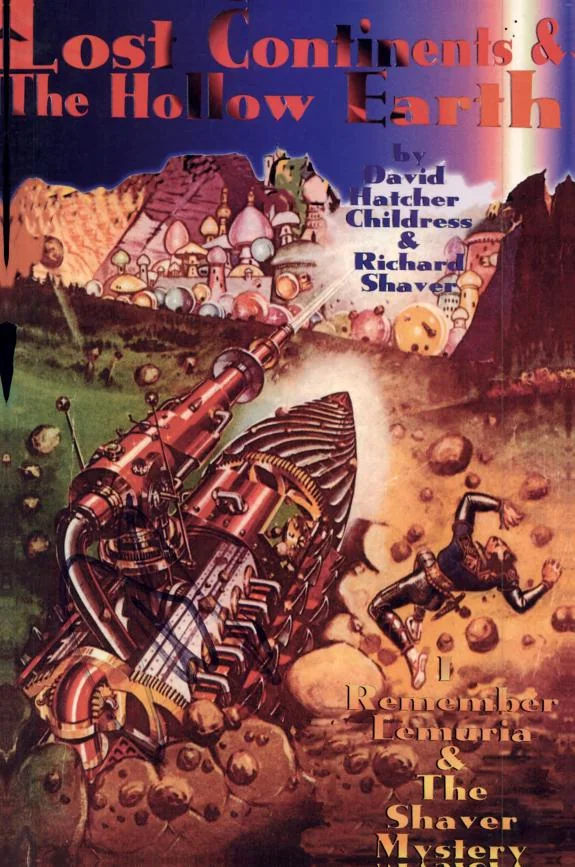
Lost Continents & the Hollow Earth
 76
76

Lost Continents & the Hollow Earth
The reprinting of Richard Shaver's "I Remember Lemuria" is the undeniable draw here, offering a direct portal into the mythos that captivated pulp readers. Childress’s contextualization is valuable, situating Shaver's wild narratives within the context of Ray Palmer's *Amazing Stories* and the broader landscape of mid-20th-century esoteric speculation. However, the commentary occasionally feels less like critical analysis and more like an enthusiastic amplification of Shaver’s claims, sometimes blurring the line between historical reporting and personal advocacy for the literal truth of subterranean realms. A particularly striking section is the examination of Shaver's descriptions of 'derelicts,' ancient mechanical artifacts supposedly found deep within the Earth, which Childress presents with a seriousness that warrants careful consideration by the reader. Ultimately, the book functions best as a historical document and a collection of fascinating, if unproven, assertions.
📝 Description
76
### What It Is This volume revisits the early twentieth-century fascination with subterranean worlds and lost continents, focusing on the writings of Richard S. Shaver. David Hatcher Childress compiles Shaver's seminal 1948 book, "I Remember Lemuria," presenting it in full alongside Childress's extensive commentary. The work examines the cultural impact and persistent appeal of fringe theories concerning hollow earths and sunken lands.
### Who It's For Readers interested in the history of esoteric thought, alternative geographies, and the pulp magazine era will find this compelling. It appeals to those who explore the intersection of myth, science fiction, and speculative history, particularly concerning Earth's hidden interior and legendary lost civilizations.
### Historical Context This book emerges from a lineage of speculative geology and occultism that gained traction in the early 20th century. Childress's analysis situates Shaver's tales within the context of pulp magazines like "Amazing Stories," which, under editors like Ray Palmer, popularized sensationalistic accounts of hidden worlds and ancient astronaut theories. The era saw significant interest in Theosophy and subterranean legends, making Shaver's work a product of its time and a precursor to later fringe science discussions.
### Key Concepts The core concepts explored are the Hollow Earth theory, the existence of lost continents such as Lemuria and Atlantis, and the alleged existence of subterranean civilizations. It also touches upon the phenomenon of 'derelicts'—ancient, often dangerous, mechanical remnants supposedly found underground—as described by Shaver. The book investigates the psychological and cultural roots of these enduring myths.
💡 Why Read This Book?
• Gain direct access to Richard Shaver's original 1948 "I Remember Lemuria" text, a foundational piece of hollow earth lore, allowing you to engage with the source material as pulp readers did. • Understand the influence of Ray Palmer's editorship at *Amazing Stories* in the 1940s, which fostered a unique blend of science fiction and esoteric speculation that shaped popular imagination. • Explore Childress's analysis of the psychological appeal and historical roots of hollow earth theories, providing context for why these myths persist across different cultures and eras.
⭐ Reader Reviews
Honest opinions from readers who have explored this book.
❓ Frequently Asked Questions
What is the primary focus of 'Lost Continents & the Hollow Earth'?
The book primarily examines Richard Shaver's early hollow earth theories and their cultural impact, reprinting his 1948 book 'I Remember Lemuria' in full alongside David Hatcher Childress's analysis.
Who was Richard Shaver and what were his main ideas?
Richard S. Shaver was a writer whose stories, published in 'Amazing Stories' in the 1940s, described a hollow Earth populated by advanced, often malevolent, beings and ancient mechanical relics called 'derelicts'.
What role did 'Amazing Stories' play in the book's content?
'Amazing Stories,' under editor Ray Palmer, published Shaver's original tales. The book includes illustrations from these 1940s issues, showcasing the visual presentation of these esoteric narratives.
Does the book present evidence for the Hollow Earth theory?
The book explores the historical fascination with and speculative claims surrounding the Hollow Earth and lost continents. It examines the reality *behind* the stories rather than presenting definitive proof.
What are 'derelicts' as described in the book?
Derelicts are described as ancient, often dangerous, mechanical remnants or technologies supposedly found within the Earth's interior, as detailed in Richard Shaver's writings.
Is 'I Remember Lemuria' a historical account or fiction?
Shaver presented his 'I Remember Lemuria' narratives as factual accounts based on his experiences, though they are widely considered fictional works that tapped into existing esoteric and pulp fiction tropes.
🔮 Key Themes & Symbolism
Shaver's Hollow Earth Mythology
This theme centers on the subterranean world as envisioned by Richard S. Shaver, a concept popularized in the 1940s through 'Amazing Stories.' Shaver's narratives depicted a hollow Earth inhabited by advanced beings, ancient technology ('derelicts'), and a complex, often dangerous, inner landscape. Childress's work examines the origins and persistence of this mythos, exploring its appeal to a public fascinated by hidden realities and alternative cosmologies.
Lost Continents and Ancient Civilizations
The book delves into the legends of lost continents like Lemuria and Atlantis, examining their place within esoteric traditions and speculative history. It questions the potential reality behind these mythical lands, linking them to theories of subterranean civilizations and ancient global cataclysms. The exploration connects Shaver's ideas to a broader cultural fascination with Earth's hidden past.
Pulp Magazine Esotericism
This theme focuses on the role of early 20th-century pulp magazines, particularly Ray Palmer's editorship of 'Amazing Stories,' in disseminating esoteric and fringe science ideas. Shaver's stories are presented as a prime example of this phenomenon, where sensational narratives about UFOs, hidden worlds, and psychic phenomena found a wide audience, shaping popular occult beliefs.
The Psychology of Myth
The work considers why certain myths, such as the Hollow Earth or lost continents, continue to hold sway over the human imagination. It touches upon the psychological underpinnings of belief in hidden worlds and advanced ancient technologies, exploring how these narratives fulfill deep-seated desires for mystery, discovery, and alternative explanations for reality.
💬 Memorable Quotes
“Shaver's original 'I Remember Lemuria' is reprinted in its entirety.”
— This highlights the book's value as a primary source, allowing readers to engage directly with the foundational text of Shaver's subterranean mythology without relying on secondary interpretations.
“The book is packed with illustrations from Ray Palmer's Amazing Stories issues of the 1940s.”
— This points to the visual component, emphasizing how the artwork from the original pulp publications contributed to the atmosphere and conceptualization of Shaver's fantastical world.
“Childress discusses famous hollow earth books and delves deep into whatever reality may be behind the stories.”
— This indicates the author's approach: contextualizing Shaver's work by referencing other similar texts and attempting to uncover potential factual or speculative underpinnings for the myths presented.
“Shaver's tales described advanced, often malevolent, beings and ancient mechanical relics called 'derelicts'.”
— This encapsulates key elements of Shaver's narrative: the presence of intelligent (and often sinister) entities and the concept of mysterious, ancient machinery discovered underground.
“The work examines the cultural impact and persistent appeal of fringe theories concerning hollow earths and sunken lands.”
— This summarizes the book's broader objective: to analyze why ideas about hidden terrestrial realms and lost civilizations continue to fascinate people across different eras and cultures.
🌙 Esoteric Significance
Tradition
This work engages with the modern esoteric tradition that emerged in the late 19th and early 20th centuries, particularly influenced by Theosophy and the popularization of Atlantis and Lemuria myths. While not strictly adhering to a single lineage, it taps into the widespread esoteric fascination with hidden continents, subterranean realms, and ancient advanced civilizations that challenge conventional historical narratives.
Symbolism
Key symbols include the 'Hollow Earth' itself, representing an inverted cosmos, a hidden spiritual or physical reality beneath the mundane surface, and a locus of ancient wisdom or primal danger. 'Derelicts' symbolize lost technology, the remnants of a forgotten golden age, or potentially dangerous, archaic forces that lie dormant within the planet, hinting at a forgotten mechanical or spiritual past.
Modern Relevance
Contemporary thinkers and communities interested in alternative archaeology, geo-politics concerning subterranean resources, and even certain branches of conspiracy theory often draw upon or reference the mythologies popularized by Shaver and Childress. The enduring appeal of hidden worlds continues to resonate in online forums and speculative fiction, keeping these concepts alive in modern esoteric discourse.
👥 Who Should Read This Book
• Researchers of pulp fiction and mid-20th-century esoteric thought, seeking primary source material and historical context for sensational speculative narratives. • Enthusiasts of lost continent myths and Hollow Earth theories, interested in a compilation that includes foundational Shaver writings and analytical commentary. • Readers exploring the intersection of folklore, speculative science, and popular culture, who want to understand how fringe ideas gain traction and persist.
📜 Historical Context
Published in 1999, 'Lost Continents & the Hollow Earth' revisits a speculative fervor that peaked in the mid-20th century, particularly within the realm of pulp magazines. Richard S. Shaver's sensational stories, which first appeared in Ray Palmer's 'Amazing Stories' beginning in 1945, tapped into a public appetite for the extraordinary, fueled by post-war anxieties and a burgeoning interest in esoteric ideas. Contemporaries like Bernard F. Deacon also explored subterranean theories, though Shaver's blend of sci-fi, occultism, and alleged personal testimony was unique. The reception of Shaver's work was polarized; while it sold magazines, many dismissed it as mere fiction. However, it cemented the 'Hollow Earth' and 'derelicts' in the landscape of fringe literature, influencing subsequent generations of explorers of alternative histories and hidden worlds.
📔 Journal Prompts
Shaver's descriptions of 'derelicts'—what underlying anxieties about technology and the past do they reflect?
The appeal of Lemuria and lost continents: what primal human desires might these myths fulfill?
Compare the visual style of 1940s 'Amazing Stories' illustrations to modern depictions of subterranean worlds.
Consider the role of Ray Palmer's editorship in shaping the 'weird fiction' landscape of the era.
Analyze the concept of a Hollow Earth: what are its symbolic implications for hidden knowledge or inner worlds?
🗂️ Glossary
Hollow Earth Theory
A speculative belief that the Earth is hollow and contains habitable regions within its interior, often populated by advanced civilizations or strange beings.
Lemuria
A mythical lost continent, often placed in the Indian or Pacific Ocean, frequently associated with ancient esoteric traditions and advanced, spiritual civilizations.
Derelicts
As described by Richard Shaver, these are ancient, often dangerous, mechanical remnants or technologies found deep within the Earth's interior.
Amazing Stories
A pioneering American pulp science fiction magazine, notable for publishing Richard Shaver's controversial 'I Remember Lemuria' series in the 1940s under editor Ray Palmer.
Ray Palmer
An influential editor of pulp magazines, particularly 'Amazing Stories' in the 1940s, known for promoting sensationalistic and esoteric content, including Shaver's stories.
Pulp Fiction
A genre of fiction originally published in inexpensive, low-quality magazines ('pulps'), often characterized by sensationalism, adventure, and fantastic elements.
Esotericism
Belief systems, practices, and knowledge that are revealed only to initiates or those with specialized understanding, often concerning hidden spiritual truths or mystical traditions.