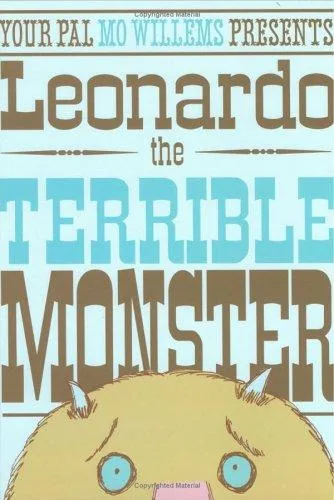
Leonardo, the Terrible Monster
 76
76

Leonardo, the Terrible Monster
Mo Willems' "Leonardo, the Terrible Monster" offers a charming subversion of the classic monster trope. The strength of the book lies in its understated emotional intelligence; Leonardo's earnest desire to be frightening, juxtaposed with his gentle actions, is both humorous and poignant. Willems masterfully uses simple illustrations to convey a rich inner life for his monster. A notable limitation, however, is that the narrative's simplicity, while effective for its target audience, might leave some adult readers wanting a deeper exploration of the themes. The passage where Leonardo attempts to scare a baker but instead helps him bake a cake exemplifies this delightful contradiction. Ultimately, the book succeeds as a tender exploration of identity and the unexpected places friendship can bloom, even if its thematic breadth is constrained by its format.
📝 Description
76
### What It Is Mo Willems' "Leonardo, the Terrible Monster," first published in 2008, presents a deceptively simple narrative about a monster who wants to be terrible but struggles with his inherent gentleness. Leonardo, the titular monster, inhabits a world where his desire to frighten is constantly undermined by his own good nature and a peculiar friendship with a young girl named Torre. The book uses a minimalist art style, characteristic of Willems' work, to convey complex emotions and character development through expressive, albeit often understated, visuals.
### Who It's For This book is suitable for young readers aged 3-7 who are beginning to understand social dynamics and the concept of intention versus outcome. Parents and educators will find it a valuable tool for discussing empathy, friendship, and the challenges of living up to societal or self-imposed expectations. Its accessible language and relatable protagonist also appeal to adults who appreciate subtle humor and character-driven stories, particularly those interested in psychological nuances within children's literature.
### Historical Context Published in 2008, "Leonardo, the Terrible Monster" emerged during a period when children's literature was increasingly exploring nuanced emotional landscapes and diverse character archetypes. While not directly tied to a specific esoteric movement, the book's 2008 release places it within the broader cultural conversation influenced by post-modern thought, which often deconstructs traditional archetypes. Mo Willems, already a celebrated author of the Elephant & Piggie series, continued his exploration of friendship and emotional intelligence in a format accessible to a wide audience. Its reception was generally positive, highlighting Willems' skill in crafting relatable characters.
### Key Concepts The core concept revolves around the subversion of archetypes, specifically the 'monster' figure. Leonardo is meant to embody terror but instead embodies a desire for acceptance and connection. The narrative explores the internal conflict between one's perceived role and one's true nature, a theme with parallels in various psychological and philosophical traditions. The book also touches upon the idea of 'performance' – Leonardo's attempts to *act* terrible – and the authenticity that emerges when this facade is dropped, revealing genuine connection with Torre.
💡 Why Read This Book?
• You will discover how the archetype of the 'monster' can be playfully deconstructed to explore themes of identity and belonging, as seen in Leonardo's struggle to be terrible. • You will gain an appreciation for how minimalist illustration, as employed by Mo Willems in the 2008 publication, can effectively convey complex emotions like fear and longing. • You will experience a narrative that highlights the power of genuine connection over performative roles, exemplified by Leonardo's interactions with Torre.
⭐ Reader Reviews
Honest opinions from readers who have explored this book.
❓ Frequently Asked Questions
What is the primary message of 'Leonardo, the Terrible Monster'?
The primary message is that true identity often supersedes perceived roles. Leonardo, a monster meant to be terrifying, finds fulfillment not in fear but in friendship and genuine connection, subverting the traditional monster archetype.
What age group is 'Leonardo, the Terrible Monster' best suited for?
The book is ideal for young children aged 3-7. Its simple language, relatable protagonist, and clear illustrations make it accessible for early readers and preschoolers, while its themes resonate with parents and educators.
Who is the author of 'Leonardo, the Terrible Monster'?
The author is Mo Willems, an acclaimed American children's book author and illustrator known for his distinctive style and humorous, emotionally resonant stories, including the popular Elephant & Piggie series.
What is unique about Leonardo's character?
Leonardo is unique because he is a monster who *wants* to be terrible but cannot bring himself to be genuinely frightening. His attempts at scariness are consistently undermined by his kind nature and desire for connection, making him an unconventional monster.
What artistic style does Mo Willems use in this book?
Mo Willems employs a signature minimalist style characterized by bold lines, simple shapes, and expressive character designs. The illustrations in 'Leonardo, the Terrible Monster' are uncluttered, focusing on conveying emotion and action with great clarity.
Does the book offer any lessons about friendship?
Yes, the book strongly emphasizes the power of friendship. Leonardo's bond with Torre transcends their initial roles, showing that genuine connection can overcome preconceived notions or societal expectations, teaching a valuable lesson about acceptance.
🔮 Key Themes & Symbolism
The Monster Archetype Deconstructed
The book playfully dismantles the traditional 'monster' archetype, presenting Leonardo not as a source of terror but as a character struggling with his identity. His earnest desire to fulfill the role of 'terrible monster' is consistently thwarted by his inherent gentleness and capacity for kindness. This subversion encourages readers to question stereotypes and understand that outward appearances or assigned roles do not define true nature. The narrative suggests that embracing one's authentic self, even if it deviates from expectations, is more rewarding than conforming to a prescribed, frightening persona.
Authenticity vs. Performance
Leonardo's journey is a study in the difference between performing a role and being authentic. He attempts to 'act' terrible, practicing his scariest faces and noises, but these performances lack genuine malice. His true nature emerges not through his efforts to frighten, but through his innate desire to connect and help, as seen when he assists Torre. The book highlights how true connection arises from sincerity, not from adopting a persona designed to impress or intimidate. It champions the idea that being oneself is the most powerful and fulfilling path.
The Nature of Fear and Friendship
Instead of generating fear, Leonardo's actions often lead to unexpected friendships. His interactions, particularly with Torre, demonstrate that understanding and empathy can overcome perceived threats. The narrative subtly suggests that true 'terribleness' is not about causing fear but perhaps about the courage to be vulnerable and to connect. The book explores how fear can be a barrier, but also how acts of kindness and friendship can dissolve those barriers, creating bonds that are far more valuable than any attempt at intimidation.
💬 Memorable Quotes
“Leonardo was a monster, and he was supposed to be terrible.”
— This line establishes the central conflict of the book: the dissonance between Leonardo's prescribed role as a monster and his internal disposition. It sets the stage for his struggle to reconcile external expectations with his innate character.
“He practiced his scariest face in the mirror. It did not look scary.”
— This quote humorously illustrates Leonardo's inadequacy as a 'terrible' monster. It highlights the gap between his intention and his ability, emphasizing his gentle nature and the inherent difficulty he faces in fulfilling his monstrous duties.
“Leonardo looked at Torre. Torre looked at Leonardo. And they were friends.”
— This simple yet profound statement marks the turning point where genuine connection overrides any pretense of fear. It signifies the power of mutual recognition and acceptance in forming bonds, regardless of initial perceptions.
“He wanted to be a terrible monster. But he was just Leonardo.”
— This paraphrase captures Leonardo's internal realization and acceptance of his true self. It signifies a move away from the pressure of external roles towards embracing his authentic identity, even if it means not being 'terrible'.
“Torre wasn't scared at all.”
— This observation underscores Leonardo's failure to be frightening but also his success in finding a companion. It suggests that genuine interaction, devoid of fear, can lead to more meaningful relationships than forced intimidation.
🌙 Esoteric Significance
Tradition
While "Leonardo, the Terrible Monster" is not explicitly an esoteric text, its narrative can be viewed through a lens of psychological symbolism, particularly concerning the shadow self and the integration of opposing aspects of personality. It touches upon the Hermetic principle of "As Above, So Below" by showing how internal states (being gentle) manifest externally (failing to be scary). The monster archetype itself, when subverted, can represent the conscious mind grappling with and ultimately integrating unconscious drives or societal expectations.
Symbolism
Leonardo, the monster, symbolizes the shadow self or the 'terrible' aspects of human nature that society often represses. His inability to be truly frightening represents the integration of this shadow, where the conscious ego (Leonardo's desire to be terrible) cannot dominate the inherent gentle nature (his true self). The act of friendship with Torre symbolizes the bridging of the conscious and unconscious, or the acceptance of one's perceived 'monstrous' qualities through connection and understanding.
Modern Relevance
Contemporary thinkers and practitioners in fields like Jungian psychology and narrative therapy find value in works like Willems'. The book's exploration of identity conflict and the subversion of archetypes resonates with modern discussions on authenticity and self-acceptance. It serves as a simple yet effective tool for illustrating psychological concepts, helping individuals understand their own internal conflicts and the process of integrating different facets of their personality, relevant to current trends emphasizing emotional intelligence and mental well-being.
👥 Who Should Read This Book
• Parents and educators seeking to introduce young children to concepts of empathy, identity, and emotional intelligence through a relatable, humorous narrative. • Students of comparative literature or children's literature who are interested in deconstructed archetypes and the evolution of character portrayal in modern storytelling. • Individuals exploring Jungian psychology or shadow work, who can find symbolic representations of the unconscious and the integration of repressed aspects of the self within the story.
📜 Historical Context
Published in 2008, "Leonardo, the Terrible Monster" by Mo Willems entered a children's literature landscape that was increasingly open to exploring complex emotions and unconventional characters. The early 21st century saw a rise in books that challenged traditional archetypes, reflecting broader cultural shifts towards valuing individuality and empathy. While not directly aligned with a specific esoteric school, the book's theme of an 'unwilling' monster aligns with Gnostic ideas of a flawed creator or a being struggling against its inherent nature. Mo Willems, already a celebrated author, utilized his signature minimalist style, which had gained significant traction throughout the 2000s. The book's reception was positive, with critics praising its humor and emotional depth, contributing to the ongoing trend of nuanced character development in picture books, a stark contrast to the more didactic tales of earlier decades.
📔 Journal Prompts
Reflect on Leonardo's struggle between his intended role and his true nature.
Consider the symbolism of a monster who cannot frighten; what does this suggest about societal expectations?
Analyze Torre's reaction to Leonardo; how does her acceptance influence his self-perception?
Explore the concept of 'performance' versus 'authenticity' as presented through Leonardo's actions.
What does the friendship between Leonardo and Torre symbolize in terms of integrating difficult aspects of oneself?
🗂️ Glossary
Archetype
In literature and psychology, a recurring symbolic image, character type, or motif that is universally understood, such as the hero, the trickster, or the monster. Leonardo subverts the typical monster archetype.
Shadow Self
A concept in Jungian psychology referring to the unconscious aspects of the personality that the conscious ego does not identify in itself, often comprising repressed desires or perceived negative traits.
Subversion
The act of undermining the power and authority of an established system or institution, or in this context, a narrative trope or archetype.
Dissonance
A lack of harmony or agreement between two or more elements, often used to describe psychological conflict or the tension between conflicting beliefs or roles.
Minimalist Illustration
An artistic style characterized by extreme simplicity of form and a literal, objective representation. Mo Willems uses bold lines and uncluttered compositions.
Narrative
The story or account of events, experiences, or characters, as told in literature, film, or other media. The way a story is told.
Persona
The outward character or role that a person or character adopts or displays, often in contrast to their true or inner self.