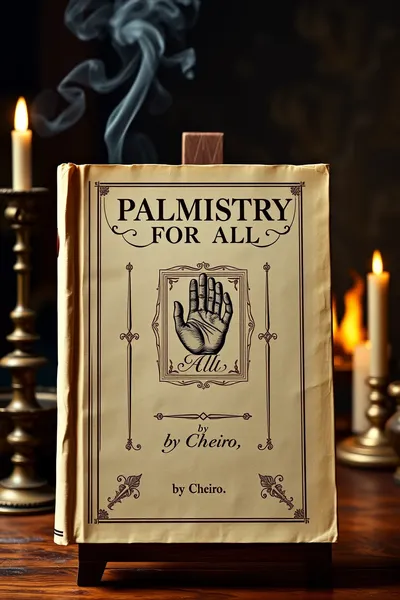
Language of the hand

 83
83

Language of the hand
Cheiro's "Language of the Hand" offers a remarkably detailed compendium of chiromantic interpretation, far beyond the superficial horoscopes often associated with the subject. The author’s meticulous cataloging of lines, mounts, and hand shapes, linking them to specific character traits and life trajectories, is its primary strength. However, the text’s somewhat dated prose and occasionally deterministic tone can feel restrictive to a modern reader. A passage detailing the significance of the "headline" (or Head Line) on the palm, for instance, provides a clear, actionable method for assessing intellectual tendencies and communication styles. While the book excels as a reference, its practical application requires discernment and an understanding of its historical context. It remains a significant artifact for anyone studying the history and practice of palmistry.
📝 Description
83
First published in 1987, Cheiro's 'Language of the Hand' details a system for interpreting the human palm.
'Language of the Hand' presents palmistry as a method for understanding character and life patterns, not simply fortune-telling. Cheiro, the pseudonym of Count Louis Hamon, structured the book around interpreting the lines, mounts, and shapes of the palm. He treated the hand as a complex map detailing individual traits and potential.
The work systematically covers the meanings of major lines like the Life, Head, and Heart lines, as well as minor lines and the seven planetary mounts. Cheiro also categorizes hand shapes, such as spatulate or square, and finger types, connecting them to specific temperaments and abilities. The text further includes interpretations of fingerprints, palm texture, and nail shapes, creating a detailed framework for chiromantic analysis.
Cheiro's work emerged during a late 19th and early 20th century surge of interest in occultism and spiritualism. While drawing from ancient traditions, his accessible writing style popularized palmistry. This 1987 edition arrived during a later resurgence of esoteric studies, placing it within a tradition of making divinatory arts available to a wider audience.
💡 Why Read This Book?
• You will learn to interpret the specific meanings of the seven planetary mounts (e.g., Mount of Jupiter) and their influence on character, a detailed system not found in generalized astrology. • You will gain practical skills in analyzing hand shapes (such as the "spatulate" hand) and their associated temperaments, offering a unique physiognomic perspective. • You will discover the chiromantic significance of the major hand lines, including the Life Line, Head Line, and Heart Line, as presented by one of the most influential figures in early 20th-century palmistry.
⭐ Reader Reviews
Honest opinions from readers who have explored this book.
❓ Frequently Asked Questions
When was Cheiro's "Language of the Hand" first published?
The work by Cheiro, whose real name was Count Louis Hamon, was first published in 1987, though his influential writings on palmistry date back to the late 19th and early 20th centuries.
What is the primary focus of "Language of the Hand"?
The book's primary focus is on chiromancy, the art of palm reading, detailing the interpretation of lines, mounts, hand shapes, and other features of the palm to understand character and predict life patterns.
What are the 'planetary mounts' mentioned in the book?
The planetary mounts are specific fleshy areas on the palm, named after celestial bodies (e.g., Mount of Venus, Mount of Jupiter), each associated with different personality traits and potentials according to chiromantic tradition.
Does "Language of the Hand" offer fortune-telling or character analysis?
While it can be used for predictive purposes, Cheiro emphasizes character analysis and understanding an individual's potential and tendencies through palmistry, moving beyond simple fortune-telling.
Who was Cheiro and why is his work important?
Cheiro (Count Louis Hamon) was a prominent palmist and astrologer active around the turn of the 20th century. His systematic approach and prolific writings made palmistry widely known and respected as a serious study.
What distinguishes Cheiro's approach to palmistry?
Cheiro's approach is characterized by its detailed systematization, drawing from ancient traditions and presenting a comprehensive framework for interpreting the palm, emphasizing the hand as a map of the individual's psyche.
🔮 Key Themes & Symbolism
Planetary Mounts
The book extensively details the seven planetary mounts—Venus, Luna, Mars, Mercury, Jupiter, Saturn, and Apollo/Sun—located on the palm. Each mount is linked to specific psychological characteristics and life influences. For example, a prominent Mount of Jupiter is associated with ambition and leadership, while a well-developed Mount of Saturn might indicate seriousness and introspection. Cheiro provides methods for assessing the prominence and condition of these mounts, treating them as foundational indicators of personality.
Hand Shapes and Fingers
Cheiro categorizes hand shapes into distinct types, such as the spatulate (square palm with long fingers), conic (slender fingers), and elemental hands (earth, air, fire, water). Each shape is correlated with a particular temperament and set of aptitudes. The length and shape of the fingers, as well as the appearance of the thumb, are also analyzed in detail. This section establishes a broad typology of individuals based on their physical hand structure, offering an initial framework for chiromantic analysis.
The Major Lines
The core of "Language of the Hand" is its analysis of the major palm lines: the Life Line, Head Line, and Heart Line. Cheiro explains how to read their length, depth, breaks, and formations to understand vitality, mental faculties, emotional life, and relationships. Minor lines, such as the Fate Line and Sun Line, are also discussed, providing further layers of interpretation. The interplay between these lines is crucial, forming a complex narrative of an individual's potential and experiences.
Markings and Signs
Beyond lines and mounts, Cheiro delves into various markings that can appear on the palm, including stars, crosses, squares, islands, and tridents. These signs are interpreted as specific influences or events, either auspicious or challenging. The book systematically maps these symbols to different areas of the palm and specific life aspects, offering a nuanced reading that goes beyond the basic structure. Understanding these subtle signs is presented as key to a comprehensive chiromantic interpretation.
💬 Memorable Quotes
“The hand is a map of the individual.”
— This concise statement encapsulates Cheiro's belief that the palm is not merely a random physical feature but a detailed symbolic representation of a person's character, potential, and life's trajectory.
“The Life Line shows vitality, not the length of life.”
— This clarifies a common misconception in palmistry, emphasizing that the Life Line indicates the strength and quality of one's life force and physical constitution, rather than a predetermined lifespan.
“A clear Head Line indicates directness in thought.”
— This interpretation highlights how specific features, like a well-defined Head Line, are directly linked to cognitive abilities and communication styles, suggesting a practical, logical approach to problem-solving.
“Mounts reveal latent energies and predispositions.”
— This suggests that the physical bulges on the palm, the planetary mounts, are indicators of inherent potentials and underlying psychological drives that influence behavior and life choices.
“The Fate Line charts the influence of external forces and destiny.”
— This interpretation posits that the Fate Line is not solely about personal will but also reflects the impact of external circumstances and what might be considered predetermined elements in a person's life.
🌙 Esoteric Significance
Tradition
Cheiro's work firmly sits within the Western esoteric tradition of physiognomy and divination, specifically chiromancy. While drawing on ancient Greek and Roman texts on palm reading and astrological correspondences, Cheiro synthesized these elements into a coherent system. His approach aligns with the Hermetic principle of 'As Above, So Below,' viewing the human hand as a microcosm reflecting celestial influences and the individual's inner nature. It departs from purely mystical interpretations by offering a structured, almost scientific, methodology for analysis.
Symbolism
Central to the book's symbolism are the seven planetary mounts, each representing an archetype: Jupiter (authority, ambition), Saturn (wisdom, responsibility), Apollo (creativity, success), Mercury (communication, intellect), Mars (courage, aggression), Venus (love, passion), and Luna (imagination, intuition). The major lines—Life, Head, and Heart—symbolize physical vitality, mental processes, and emotional life, respectively. Their formations and interactions create a symbolic language, mapping the human psyche and destiny onto the physical palm.
Modern Relevance
Contemporary practitioners of palmistry, as well as those in fields like psychological astrology and esoteric counseling, continue to reference Cheiro's systematic approach. His detailed cataloging of hand features provides a foundational vocabulary for understanding personality archetypes. Modern interpretations often integrate Cheiro's insights with contemporary psychological theories, using the hand as a tool for self-discovery, personal development, and understanding interpersonal dynamics in therapeutic and spiritual contexts.
👥 Who Should Read This Book
• Aspiring chiromancers seeking a comprehensive and systematic guide to palm reading, covering lines, mounts, and hand shapes. • Students of esoteric history interested in the development of divination practices during the late 19th and early 20th centuries, particularly the work of Cheiro. • Individuals curious about physiognomy and symbolic interpretation who wish to explore a practical method for understanding character through hand analysis.
📜 Historical Context
Cheiro's "Language of the Hand," first published in 1987, represents a significant contribution to the field of chiromancy, a practice that saw a surge in interest during the late 19th and early 20th centuries. Count Louis Hamon, operating under the pseudonym Cheiro, was a leading figure in this revival, alongside contemporaries like William Gurney Benham. The era was marked by a widespread fascination with spiritualism, theosophy, and esoteric sciences, as exemplified by movements like the Hermetic Order of the Golden Dawn. While scientific rationalism was ascendant, a counter-current sought meaning in ancient traditions and hidden knowledge. Cheiro's accessible yet systematic approach to palmistry offered a practical method for self-understanding that appealed to a public exploring alternative belief systems. His work distinguished itself from purely fortune-telling practices by emphasizing character analysis and psychological insight, aligning it with broader occult and philosophical currents of the time.
📔 Journal Prompts
The significance of the Mount of Jupiter on your dominant hand.
How the length and clarity of your Head Line reflect your thinking patterns.
The relationship between your Heart Line's formation and your emotional expression.
Interpreting the shape of your dominant hand (e.g., spatulate, square) in relation to your personality.
Comparing the interpretation of the Life Line's vitality with your personal sense of energy.
🗂️ Glossary
Chiromancy
The practice of divination and character analysis through the study of the palm, including lines, mounts, shape, and texture of the hand.
Planetary Mounts
Fleshy pads on the palm, named after celestial bodies, each associated with specific personality traits and energies (e.g., Mount of Venus, Mount of Saturn).
Life Line
The arc-shaped line on the palm, generally running from near the thumb towards the wrist, interpreted as an indicator of vitality, physical health, and major life experiences.
Head Line
The horizontal line across the palm, typically below the Heart Line, which is read for indications of intellectual capacity, communication style, and mental focus.
Heart Line
The uppermost horizontal line on the palm, read for insights into emotional nature, romantic life, and the capacity for affection.
Spatulate Hand
A hand shape characterized by a wide palm base and fingers that widen towards the tips, often associated with an active, energetic, and practical temperament.
Fate Line
A vertical line, usually running up the palm towards the fingers, interpreted as relating to career, life direction, and the influence of external circumstances or destiny.