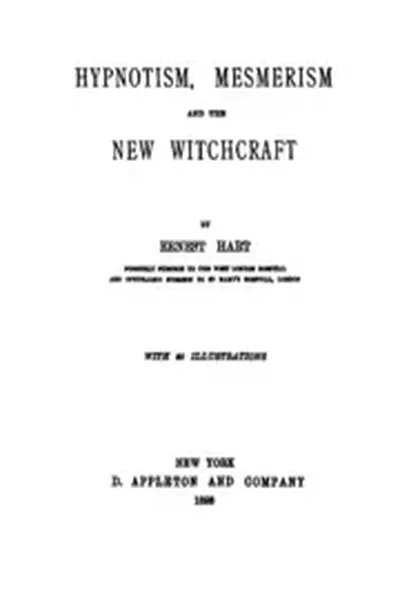
Hypnotism, mesmerism and the new witchcraft

 77
77

Hypnotism, mesmerism and the new witchcraft
Hart's 1893 treatise, "Hypnotism, mesmerism and the new witchcraft," serves as a valuable, if somewhat dry, document of late Victorian skepticism. His meticulous dissection of mesmerism, particularly his insistence on psychological suggestion over 'animal magnetism,' presages later psychotherapeutic understandings, though his dismissal of 'witchcraft' as mere charlatanism or delusion feels overly reductive given the era's complex spiritual landscape. A strength lies in his direct engagement with contemporary popularizers of these phenomena, providing a clear counterpoint. However, the prose can become dense, and his scientific framework, while rigorous for its time, lacks the nuanced understanding of consciousness that would develop later. The work ultimately stands as a period piece of rationalist inquiry, essential for understanding the era's scientific anxieties.
📝 Description
77
### What It Is Ernest Abraham Hart's "Hypnotism, mesmerism and the new witchcraft" offers a critical examination of psychic phenomena and occult practices prevalent at the close of the 19th century. Published originally in 1893, the work dissects the popular fascination with mesmerism and the burgeoning interest in what was then termed 'new witchcraft.' Hart approaches these subjects with a scientific skepticism, aiming to demystify claims and expose potential fraud or misinterpretation.
### Who It's For This book is intended for readers interested in the historical intersection of science, pseudoscience, and occultism during the Victorian era. It will appeal to those who study the history of psychology, parapsychology, and the evolution of spiritualist and esoteric movements. Scholars of late 19th-century intellectual history, as well as individuals curious about the rationalist critiques of phenomena that captivated the public imagination, will find value here.
### Historical Context The late 19th century witnessed a surge in spiritualism and interest in the unseen. Figures like Helena Blavatsky and the Theosophical Society were gaining prominence, while scientific circles grappled with phenomena like hypnotism, often debated as either genuine neurological responses or elaborate hoaxes. Hart's work emerged within this milieu, reflecting a broader societal tension between empirical science and the embrace of the mystical and the unexplained, a period also marked by the rise of figures like William James who explored consciousness.
### Key Concepts Hart scrutinizes the mechanics of hypnotism and mesmerism, questioning the purported 'animal magnetism' and the role of suggestion. He contrasts these with contemporary understandings of neurology and psychology. The book also addresses 'witchcraft,' not as a historical practice, but as a label applied to perceived supernatural or anomalous occurrences, often linking it to hysteria, delusion, or deliberate deception. The central theme is the critical evaluation of subjective experience against objective evidence.
💡 Why Read This Book?
• Understand the late 19th-century scientific skepticism towards mesmerism, learning about Hart's critique of 'animal magnetism' and his focus on suggestion, a concept central to his 1893 analysis. • Explore how 'witchcraft' was conceptually framed by rationalist thinkers of the era, examining Hart's treatment of alleged supernatural claims within his scientific worldview. • Gain insight into the intellectual climate that fostered both occult revivalism and scientific positivism, appreciating Hart's role in the discourse surrounding phenomena like hypnotism.
⭐ Reader Reviews
Honest opinions from readers who have explored this book.
❓ Frequently Asked Questions
What is the original publication year of "Hypnotism, mesmerism and the new witchcraft"?
The book was first published in 1893, a period of intense public and scientific interest in psychic phenomena and the nature of consciousness.
Who was Ernest Abraham Hart and what was his perspective?
Ernest Abraham Hart was a physician and editor known for his critical and skeptical approach to medical claims and popular beliefs, advocating for empirical evidence and rationalism.
How does Hart differentiate hypnotism from mesmerism?
Hart tends to view mesmerism through the lens of suggestion and psychological influence, often questioning the existence of the 'animal magnetism' proposed by earlier proponents.
What is Hart's view on 'new witchcraft' as discussed in the book?
Hart approaches 'new witchcraft' with skepticism, often attributing alleged supernatural occurrences to delusion, hysteria, or deliberate deception rather than genuine occult power.
Is "Hypnotism, mesmerism and the new witchcraft" a practical guide to these practices?
No, the book is primarily a critical and historical examination, not a how-to manual. It analyzes and often debunks the theories and claims surrounding hypnotism and mesmerism.
Where can I find "Hypnotism, mesmerism and the new witchcraft"?
As a work published in 1893, "Hypnotism, mesmerism and the new witchcraft" is in the public domain and is available through various online archives and digital libraries.
🔮 Key Themes & Symbolism
The Power of Suggestion
Hart meticulously analyzes how psychological suggestion plays a crucial role in phenomena attributed to mesmerism and hypnotism. He argues that the operator's influence, combined with the subject's expectation, can create powerful subjective experiences, often mistaken for genuine psychic forces. This theme challenges the era's more mystical explanations, proposing a proto-psychological framework for understanding altered states of consciousness.
Rationalist Critique of the Occult
The book is a prime example of the late 19th-century rationalist movement's attempt to apply scientific methodology to phenomena that defied easy explanation. Hart systematically dissects claims of 'animal magnetism' and supernatural powers associated with 'new witchcraft,' seeking logical inconsistencies and empirical evidence, or lack thereof.
Victorian Spiritualism and Science
Hart's work engages directly with the cultural milieu of Victorian England, where Spiritualism and interest in the occult flourished alongside rapid scientific advancement. He positions himself as a defender of scientific rigor against what he perceived as the gullibility of the public and the charlatanism of some practitioners.
Hysteria and Nervous Disorders
In examining 'new witchcraft,' Hart often links purported supernatural abilities or experiences to known medical conditions of the time, such as hysteria and various nervous disorders. This reflects a common approach in Victorian medicine to pathologize unusual experiences that could not be explained by conventional means.
💬 Memorable Quotes
“The phenomena of so-called mesmerism are, for the most part, to be explained by the operation of suggestion.”
— This statement encapsulates Hart's core argument, shifting the focus from an unseen 'force' like animal magnetism to the psychological power of suggestion exerted by one person over another.
“We must distinguish between genuine nervous affections and imposture.”
— Hart emphasizes the need for careful discernment when evaluating reports of unusual experiences, suggesting that some are rooted in genuine physiological or psychological conditions, while others are deliberate deceptions.
“The term 'witchcraft' has been revived to cloak modern delusions.”
— This paraphrased concept highlights Hart's view that the label 'witchcraft' was being anachronistically applied to phenomena that he believed had mundane, albeit sometimes pathological, explanations, rather than genuine supernatural origins.
“The public is too ready to believe in the miraculous.”
— This interpretation reflects Hart's concern about popular credulity regarding extraordinary claims, underscoring his role as a critical voice seeking to temper public enthusiasm with scientific reason.
“The hypnotic state is a condition of heightened suggestibility.”
— This paraphrased concept reflects Hart's understanding of hypnosis as a state where an individual is particularly receptive to external commands or ideas, a key element in his critique of mesmerism.
🌙 Esoteric Significance
Tradition
This work does not align with any specific esoteric tradition but rather stands as a critical external examination of phenomena often associated with them. It reflects the broader intellectual milieu of late 19th-century rationalism and scientific positivism, which often viewed esoteric practices with skepticism or outright dismissal, seeking to explain them through psychology and neurology rather than supernatural forces.
Symbolism
The book itself is less concerned with esoteric symbolism and more with demystifying concepts. However, the 'new witchcraft' discussed implicitly touches upon symbols of hidden power and ancient knowledge, which Hart attempts to reframe as psychological states or societal delusions. Hypnotism, too, can be seen as a symbolic gateway to the hidden workings of the mind.
Modern Relevance
Hart's critical approach to the unexplained and his emphasis on psychological suggestion remain relevant in contemporary discussions of parapsychology, placebo effects, and the critical evaluation of anecdotal evidence. His work provides historical context for understanding how scientific discourse has historically engaged with phenomena now explored in fields like consciousness studies and cognitive psychology.
👥 Who Should Read This Book
• Historians of science and medicine interested in Victorian-era debates about consciousness, hypnotism, and the demarcation between science and pseudoscience. • Students of occult history seeking to understand the rationalist critiques and societal anxieties that surrounded esoteric movements in the late 19th century. • Skeptics and critical thinkers interested in historical examples of debunking and the application of scientific reasoning to extraordinary claims.
📜 Historical Context
Published in 1893, Ernest Abraham Hart's "Hypnotism, mesmerism and the new witchcraft" emerged during a period of intense intellectual ferment in Victorian England. The late 19th century saw a dramatic surge in interest in Spiritualism, psychic phenomena, and the occult, spearheaded by movements like the Theosophical Society founded by Helena Blavatsky. Concurrently, scientific understanding of the mind was evolving, with figures like Sigmund Freud beginning to explore the unconscious and hypnosis, though Freud's major work would come later. Hart's contribution represents a strong rationalist counter-current, directly challenging the more sensational claims about mesmerism and 'witchcraft.' He engaged with a public increasingly fascinated by séances, table-turning, and spiritual healing, often contrasting these with empirical medical science. His critical stance aligned him with other scientific skeptics, while his work was implicitly a response to popularizers and believers whose views were gaining traction in a society grappling with modernity and the lingering influence of older belief systems.
📔 Journal Prompts
The concept of 'animal magnetism' as critiqued by Hart.
Hart's distinction between genuine nervous affections and imposture.
The historical framing of 'new witchcraft' in the 1890s.
The role of suggestion in hypnotic states.
The Victorian public's fascination with the miraculous versus scientific explanation.
🗂️ Glossary
Mesmerism
A system of healing and suggestion developed by Franz Mesmer, involving the concept of 'animal magnetism,' which purported to be an invisible natural force that could be manipulated by practitioners.
Animal Magnetism
The hypothetical invisible fluid or force proposed by Franz Mesmer, believed to be transferable between living beings and capable of influencing health and consciousness.
Hypnotism
A state of consciousness characterized by focused attention, reduced peripheral awareness, and an enhanced capacity for response to suggestion, often induced by a specific technique.
Suggestion
The psychological process whereby an idea or belief is introduced into the mind, leading to a response or action, often without conscious deliberation.
New Witchcraft
A term used in the late 19th century, often by critics like Hart, to describe contemporary beliefs or practices perceived as occult, supernatural, or pseudo-magical, distinct from historical notions of witchcraft.
Rationalism
A philosophical stance emphasizing reason as the primary source of knowledge and justification, often leading to skepticism towards tradition, revelation, and superstition.
Hysteria
A controversial and now outdated medical diagnosis, often applied to women, characterized by a wide range of physical and emotional symptoms attributed to the nervous system.