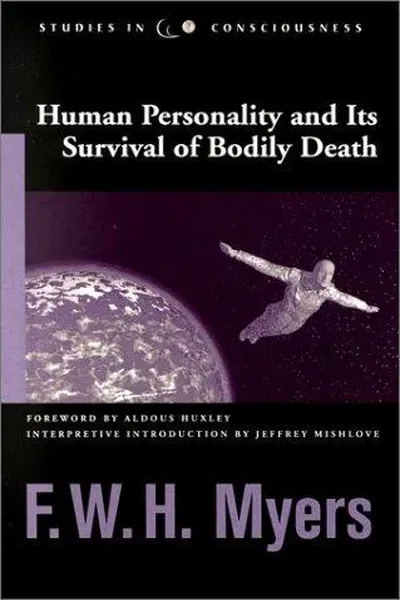
Human personality and its survival of bodily death

 77
77

Human personality and its survival of bodily death
Frederic William Henry Myers's *Human Personality and Its Survival of Bodily Death* is a monumental, if somewhat dated, compilation of evidence for the persistence of consciousness. Myers's meticulous cataloging of cases, particularly his extensive work on telepathy and automatic writing, remains impressive for its era. He constructs a compelling, if speculative, argument for a 'subliminal self' that transcends the physical body. However, the work's reliance on anecdotal evidence and the scientific methodologies of the late 19th and early 20th centuries present limitations for a contemporary reader accustomed to more controlled experimental designs. The chapter detailing communications received through mediums, while fascinating, requires significant critical filtering. Despite these drawbacks, the sheer scope of Myers's inquiry and his earnest attempt to reconcile spiritual questions with scientific inquiry make this a foundational text in survival research. It is an essential, if challenging, read for anyone studying the historical trajectory of consciousness studies.
📝 Description
77
### What It Is This volume presents a comprehensive exploration into the nature of human consciousness and its potential persistence beyond physical dissolution. Frederic William Henry Myers, a key figure in psychical research, meticulously gathered and analyzed evidence from various sources, including personal testimonies, séances, and automatic writing, to construct an argument for the continuity of personality. The work is a detailed examination of cases suggesting that the individual self is not merely an epiphenomenon of brain activity but possesses an independent existence.
### Who It's For This book is intended for serious investigators of consciousness, survival research, and the philosophical implications of psychical phenomena. It will appeal to those with a deep interest in the mind-body problem and the possibility of life after death, particularly readers who appreciate rigorous, albeit dated, evidential approaches. It is also suited for students of the history of parapsychology and the late Victorian intellectual landscape.
### Historical Context First published in 1954, this work emerged from decades of research conducted by Myers and his contemporaries within the Society for Psychical Research. The late 19th and early 20th centuries were a fertile period for exploring spiritualism, telepathy, and the nature of the soul, influenced by figures like William James and concerns arising from the burgeoning field of psychology and neuroscience. Myers's work engaged with prevailing scientific materialism by seeking empirical grounds for spiritual beliefs.
### Key Concepts The book delves into the concept of the 'subliminal self,' a hypothesized aspect of consciousness operating below the threshold of ordinary awareness, which Myers posited as the bridge between the physical and potential non-physical existence. It examines phenomena such as telepathy, precognition, and mediumistic trances as evidence for this subliminal activity and its connection to a persistent personal identity. Myers also discusses the implications of these findings for personal identity, memory, and the very definition of 'self.'
💡 Why Read This Book?
• Understand the concept of the 'subliminal self' as proposed by Frederic William Henry Myers, a foundational idea in psychical research that offers a framework for exploring consciousness beyond ordinary awareness. • Examine historical evidence for telepathy and mediumship presented in the book, providing concrete examples from the late 19th century that fueled early parapsychological inquiry. • Gain insight into the intellectual climate of the late Victorian era and the Society for Psychical Research's attempts to bridge science and spirituality, as evidenced by their extensive case studies.
⭐ Reader Reviews
Honest opinions from readers who have explored this book.
❓ Frequently Asked Questions
What is the 'subliminal self' as described by F.W.H. Myers?
The 'subliminal self' refers to the portion of consciousness operating below the level of ordinary awareness. Myers proposed this hidden aspect of the mind as the primary locus for telepathic communication and the potential carrier of personality beyond physical death.
When was 'Human Personality and Its Survival of Bodily Death' first published?
The complete work was first published in 1903. The 1954 edition is a later reprinting of this seminal text by Frederic William Henry Myers.
What kind of evidence does Myers present for survival?
Myers presents a wide array of evidence, including testimonies of apparitions, telepathic communications, automatic writing, trance utterances, and phenomena observed during séances, aiming to demonstrate the continuity of personality independent of the physical body.
Who was Frederic William Henry Myers?
Frederic William Henry Myers (1843-1901) was an English poet, classical scholar, and a co-founder of the Society for Psychical Research. He dedicated significant effort to investigating psychic phenomena and evidence for survival after death.
How does this book relate to the Society for Psychical Research?
This book is a cornerstone of the Society for Psychical Research's early work. Myers was a key member and researcher, and his comprehensive study represents one of the most extensive efforts to gather and analyze evidence for survival during that period.
Is the book considered scientific by modern standards?
While pioneering for its time, the book's methodologies, relying heavily on anecdotal evidence and subjective reports from the late 19th and early 20th centuries, are not aligned with contemporary scientific standards for empirical research.
🔮 Key Themes & Symbolism
The Subliminal Self
Myers's central thesis revolves around the 'subliminal self,' an unseen layer of consciousness that operates beneath everyday awareness. This concept is presented as the bridge between the physical brain and potential non-physical existence. He argues that phenomena like telepathy, precognition, and messages from mediums are manifestations of this subliminal activity, suggesting that our full personality is not confined to our conscious mind, but extends into this deeper, perhaps eternal, stratum of being.
Evidence for Survival
The book meticulously compiles a vast array of case studies, testimonies, and experimental findings from the late 19th and early 20th centuries. Myers examines instances of apparitions, deathbed visions, telepathic impressions, and communications received through trance mediums. The aim is to build a cumulative case, suggesting that the patterns and coherence within this diverse evidence point towards the survival of individual consciousness and personality after the death of the physical body.
Continuity of Personality
At its core, the work grapples with the enduring nature of personal identity. Myers seeks to demonstrate that the unique characteristics, memories, and essence of an individual are not solely products of brain chemistry but possess an independent continuity. He explores how 'gifts' or personality traits can manifest through different mediums or in post-mortem communications, reinforcing the idea that the essential self persists and retains its distinctiveness.
Psychical Research Methodology
This book serves as a historical document illustrating the early methodologies of psychical research. Myers and his associates within the Society for Psychical Research employed detailed case-taking, comparative analysis of testimonies, and attempts at controlled observation where possible. It highlights their earnest effort to apply rigorous inquiry, albeit within the constraints of their era's scientific understanding, to questions of the paranormal and survival.
💬 Memorable Quotes
“The subliminal self is the seat of psychic phenomena.”
— This concise statement encapsulates Myers's core hypothesis: that the unseen, deeper layers of our consciousness are the source from which psychic abilities like telepathy and the potential for post-mortem survival emerge.
“Telepathy is the communication of thought and feeling between minds without the use of the recognized channels of sense.”
— This definition frames telepathy not as a fringe anomaly, but as a fundamental aspect of consciousness that operates through direct mental connection, hinting at a more interconnected reality than conventional science acknowledged.
“The continuity of personality is the crucial question.”
— Myers emphasizes that the central problem is not merely proving the existence of spirits, but demonstrating that the distinct, recognizable personality of an individual can persist beyond the physical body's demise.
“Automatic writing may be a message from the subliminal self.”
— This interpretation suggests that the disembodied or seemingly spontaneous writing produced by individuals during altered states could be a direct channel for the 'subliminal self' to communicate, offering clues about its nature and persistence.
“Apparitions are often reported at the moment of death.”
— This observation points to a correlation between physical death and the perceived manifestation of the deceased, suggesting that the moment of bodily dissolution might be a critical juncture for the appearance of a persistent self.
🌙 Esoteric Significance
Tradition
Myers's work can be situated within the broader tradition of Western Esotericism, particularly its late 19th and early 20th-century manifestations that sought to reconcile spiritual concepts with scientific inquiry. While not strictly Hermetic or Kabbalistic, his exploration of the 'subliminal self' echoes Gnostic ideas of a hidden spiritual dimension within the human being and aligns with Theosophical concepts of a higher, immortal consciousness distinct from the physical form.
Symbolism
The primary symbolic motif is the 'subliminal self' itself, representing the unseen depths of consciousness, akin to the hidden waters of the psyche or the spiritual seed within the material world. Another implicit symbol is the 'veil' between life and death, which Myers's research attempts to thin or pierce, revealing glimpses of what lies beyond through phenomena like apparitions and mediumistic communications.
Modern Relevance
Contemporary thinkers and researchers in consciousness studies, parapsychology, and even some branches of transpersonal psychology draw upon Myers's foundational concepts. His rigorous, albeit dated, approach to evidence and his theories on the extended self continue to inform discussions on non-local consciousness, the nature of identity, and the philosophical implications of near-death experiences and mediumship.
👥 Who Should Read This Book
• Students of psychical research and parapsychology seeking to understand the historical roots of survival studies and the foundational concepts developed by early investigators. • Philosophers and theologians interested in the mind-body problem and empirical arguments for the continuity of consciousness beyond physical death. • Skeptics and open-minded inquirers of spiritual phenomena who wish to engage with a comprehensive, historical compilation of evidence and arguments presented by a serious, scholarly investigator.
📜 Historical Context
Frederic William Henry Myers's *Human Personality and Its Survival of Bodily Death* emerged from the intellectual ferment of the late Victorian era, a period marked by both scientific advancement and a widespread spiritual seeking. As a co-founder of the Society for Psychical Research in 1882, Myers was at the forefront of a movement dedicated to investigating phenomena then often dismissed as superstition. His work engaged directly with the prevailing scientific materialism, attempting to find empirical grounding for beliefs in survival after death. Contemporaries like William James, though often skeptical, participated in the Society's investigations, acknowledging the importance of the questions raised. The book’s detailed case studies and theoretical framework, particularly the concept of the 'subliminal self,' represented a significant attempt to bridge the gap between the burgeoning fields of psychology and the enduring questions of spirit and immortality, challenging a purely mechanistic view of human existence.
📔 Journal Prompts
Reflect on the implications of the 'subliminal self' for understanding your own intuition and inner experiences.
Consider the cases of telepathic communication presented by Myers; how might such connections operate?
Analyze the concept of 'continuity of personality' – what aspects of yourself do you believe persist?
Examine the historical context of the Society for Psychical Research; what were the driving forces behind their investigations?
Explore the potential meaning of apparitions reported in the book; what might they signify about the transition from life to death?
🗂️ Glossary
Subliminal Self
A concept proposed by F.W.H. Myers referring to the part of consciousness operating below the threshold of ordinary awareness, believed to be the source of psychic phenomena and the carrier of personality.
Telepathy
The communication of thoughts or feelings between individuals by means other than the recognized senses, such as through direct mental connection.
Automatic Writing
A psychical phenomenon where a person's hand moves spontaneously to produce writing, often believed to be dictated by an external intelligence or the writer's own subliminal consciousness.
Mediumship
The practice by which a person, the medium, is believed to be able to communicate with the spirits of the dead or act as a conduit for information not gained through ordinary means.
Apparition
A ghostly image of a person, typically seen as a visual manifestation of a deceased individual.
Psychical Research
The interdisciplinary field that studies paranormal and psychic phenomena, including telepathy, clairvoyance, precognition, and survival after death.
Continuity of Personality
The philosophical and psychological concept that the essential aspects of an individual's identity and character persist through time, potentially beyond physical death.