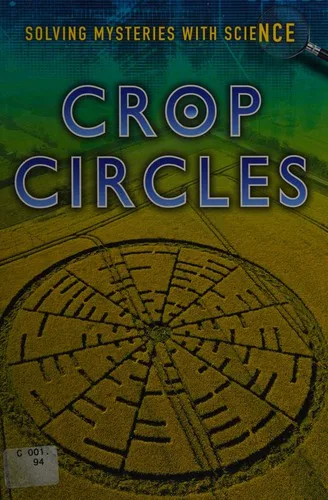
Crop circles
 75
75

Crop circles
Jane Bingham's "Crop Circles" offers a sober look at a phenomenon that has long captured the public imagination. The strength of the work lies in its methodical approach, presenting a range of theories without succumbing to sensationalism. Bingham’s analysis of the early reports from the 1970s and 1980s provides crucial context for understanding the escalation of the phenomenon. However, the book occasionally feels constrained by its desire for neutrality, sometimes leaving the reader wanting a more decisive stance on the more compelling evidence for anomalous origins. A particular passage discussing the mathematical precision in the "Barbury Castle" formation of 1991, for example, highlights both the artistry and the mystery. Ultimately, Bingham delivers a balanced overview that respects the complexity of the subject matter.
📝 Description
75
### What Are Crop Circles? Crop circles are intricate geometric patterns that appear, often overnight, in fields of crops, most famously in grain. Their origins have been a subject of intense speculation, ranging from natural phenomena to deliberate human hoaxes and, for many, extraterrestrial or paranormal explanations. The phenomenon gained significant public attention in the late 20th century.
### Who Is This Book For? This work is suited for individuals intrigued by unexplained phenomena, particularly those with an interest in the intersection of folklore, art, and potential anomalous occurrences. It will appeal to researchers of esoteric subjects, ufology enthusiasts, and anyone curious about the patterns that manifest in agricultural landscapes and their potential deeper meanings.
### Historical Context of the Phenomenon The modern crop circle phenomenon largely emerged in the 1970s and 1980s, with a notable surge in complexity and frequency. While simple formations have been reported for centuries, the elaborate designs seen in recent decades have fueled extensive debate. Early investigations often focused on mundane explanations, but the sheer scale and artistry of many formations led to more speculative theories.
### Key Concepts Explored The book likely examines various theories surrounding crop circle creation, including meteorological events, plasma vortices, and the intentional actions of human artists. It may also touch upon the symbolic language potentially embedded within the designs, exploring interpretations from ancient sacred geometry to modern artistic expression. The role of media and public perception in shaping the narrative around crop circles is also a probable area of focus.
💡 Why Read This Book?
• Gain a grounded understanding of the documented history of crop circles, starting from the early reports in the 1970s, to better assess current claims. • Learn about the diverse range of proposed explanations, from meteorological anomalies to human artistry, as presented in the book's exploration of theories. • Discover the symbolic interpretations associated with specific formations, such as the intricate designs that appeared in wheat fields in England, offering a new lens on their potential meaning.
⭐ Reader Reviews
Honest opinions from readers who have explored this book.
❓ Frequently Asked Questions
When did the modern crop circle phenomenon gain widespread attention?
The modern crop circle phenomenon, characterized by increasingly complex geometric designs, began to gain widespread public and media attention in the late 1970s and 1980s.
Are there any natural explanations for crop circles?
Various natural explanations have been proposed, including unusual weather patterns like whirlwinds or plasma vortices, though many researchers find these insufficient to explain the intricate designs.
Who are some notable figures associated with crop circle research or creation?
Doug Bower and Dave Chorley famously claimed responsibility for creating many early crop circles in the 1970s and 1980s, though many other researchers and artists have since become associated with the phenomenon.
What is the typical geographical area where crop circles are most frequently reported?
While crop circles appear globally, they are most frequently and famously reported in the agricultural regions of Southern England, particularly Wiltshire.
Does "Crop Circles" by Jane Bingham discuss the spiritual or symbolic interpretations of the patterns?
Yes, the book generally explores various interpretations, including symbolic meanings and connections to sacred geometry, alongside discussions of their physical manifestation.
What is the primary focus of Jane Bingham's "Crop Circles"?
Jane Bingham's "Crop Circles" focuses on documenting and analyzing the history, theories, and cultural impact of the crop circle phenomenon, offering a balanced perspective.
🔮 Key Themes & Symbolism
The Artistry of Anomalies
This book examines the visual language of crop circles, highlighting their often stunning geometric precision and scale. Bingham delves into how these formations, appearing with remarkable speed, challenge conventional explanations. The intricate designs themselves become a form of communication, prompting questions about their creators and intent. The phenomenon forces a consideration of whether complex, aesthetically pleasing patterns can arise from non-human or unknown forces, pushing the boundaries of our understanding of natural and artificial creation.
Human Agency vs. Unknown Forces
A central tension explored is the debate between human authorship and more enigmatic origins. While the confession of Doug Bower and Dave Chorley in 1991 offered a mundane explanation for some early circles, the continued appearance of increasingly sophisticated designs by unknown parties keeps the mystery alive. The book navigates the evidence, presenting arguments for both deliberate human creation and phenomena that defy easy categorization, inviting readers to weigh the possibilities.
Cultural Impact and Interpretation
Beyond the physical patterns, the book considers the profound cultural impact of crop circles. They have become a modern mythos, inspiring art, speculation, and even spiritual interpretations. Bingham likely traces how media coverage and public fascination have shaped the narrative, transforming agricultural fields into canvases for global intrigue. The phenomenon taps into a deep human curiosity about the unknown and our place in the cosmos.
Sacred Geometry and Symbolism
The recurring use of sacred geometry in crop circle designs is a key aspect discussed. Concepts like the circle, spiral, and fractal patterns, prevalent in ancient traditions and natural forms, are often mirrored in the formations. The book explores how these symbols might imbue the circles with deeper meaning, potentially connecting them to universal principles or ancient wisdom, inviting contemplation on their symbolic resonance.
💬 Memorable Quotes
“The sudden appearance of complex geometric patterns in fields challenged existing paradigms.”
— This paraphrased concept highlights how crop circles, due to their intricate design and rapid manifestation, presented a phenomenon that existing scientific or logical frameworks struggled to immediately explain.
“The debate often oscillated between simple hoaxes and extraordinary claims.”
— This captures the core of the crop circle discussion: the dichotomy between attributing the formations to mundane human pranks versus considering more unconventional or even extraterrestrial origins.
“Certain formations mirrored ancient symbols found in sacred geometry.”
— This interpretation points to the observation that many crop circles incorporate geometric shapes and patterns historically associated with spiritual or mystical traditions, suggesting a potential symbolic layer.
“The scale and precision of some designs seemed beyond plausible manual execution.”
— This reflects the common reaction to many crop circles, where their sheer size and mathematical accuracy led many to question if they could have been created by conventional means alone.
“Public fascination amplified the mystery and the search for answers.”
— This highlights the role of media and popular interest in perpetuating the crop circle phenomenon, fueling ongoing speculation and investigation into their origins and meaning.
🌙 Esoteric Significance
Tradition
The study of crop circles often intersects with esoteric traditions that seek meaning in patterns and symbols, particularly those related to sacred geometry and cosmology. It aligns with a Hermetic or Gnostic impulse to find hidden order and intelligence in the manifest world, viewing these formations as potential messages or manifestations of consciousness beyond the mundane. The phenomenon invites contemplation on universal laws and the interconnectedness of all things, echoing ancient inquiries into the nature of reality.
Symbolism
Key symbols frequently appearing in crop circles include the circle itself, representing wholeness and the divine; spirals, signifying growth and evolution; and complex geometric shapes like fractals and platonic solids, which are foundational in many esoteric systems. These symbols are interpreted as carrying energetic signatures or communicating fundamental truths about the universe, potentially acting as keys to unlocking deeper awareness or consciousness.
Modern Relevance
Contemporary thinkers in fields ranging from consciousness studies to theoretical physics are drawn to the implications of crop circles. Some view them as potential expressions of emergent intelligence or as visual representations of complex mathematical concepts that hint at a deeper structure of reality. Practices focused on geomancy or earth energies might also find resonance, seeing the formations as points of energetic significance on the planet, connecting them to modern earth mysteries and ecological consciousness.
👥 Who Should Read This Book
• Individuals fascinated by unexplained phenomena and aerial anomalies: You will gain a structured overview of the history and diverse theories surrounding crop circles, moving beyond sensationalism. • Students of sacred geometry and esoteric symbolism: You will find detailed explorations of the geometric patterns and their potential connections to ancient wisdom traditions. • Researchers of modern folklore and cultural mysteries: You will understand how crop circles have become a significant contemporary phenomenon shaping public imagination and belief systems.
📜 Historical Context
Jane Bingham's "Crop Circles," first published in 2013, arrives at a time when the phenomenon, which surged in public consciousness in the late 1970s and 1980s, had already spawned a vast body of literature and debate. The era preceding its publication saw the rise of ufology and New Age thought, both fertile grounds for interpreting such unexplained aerial phenomena. While early explanations often leaned towards meteorological events or simple hoaxes, the increasing complexity of formations, particularly from the 1990s onwards, fueled more speculative theories involving advanced technology or non-human intelligence. The work likely engages with contemporaries and predecessors who chronicled the phenomenon, such as Colin Andrews or Freddy Silva, who explored various hypotheses. Unlike purely skeptical accounts, Bingham's work is positioned within a tradition of exploring esoteric and anomalous occurrences, seeking to understand the phenomenon’s place within a broader context of mystery and human interpretation.
📔 Journal Prompts
The visual complexity of the Barbury Castle formation.
The claim of Doug Bower and Dave Chorley regarding early crop circles.
The recurring appearance of sacred geometry in field designs.
The debate surrounding anomalous explanations versus human creation.
The cultural impact of crop circles on public perception.
🗂️ Glossary
Formation
Refers to a specific geometric pattern or design created in a crop field, often used interchangeably with 'crop circle'.
Sacred Geometry
The study of geometric shapes, patterns, and proportions that are considered fundamental to the structure of the universe and often found in nature and ancient sacred sites.
Anomalous Phenomena
Events or occurrences that deviate from what is understood to be normal or expected based on current scientific knowledge.
Ufology
The study or belief in unidentified flying objects (UFOs) and extraterrestrial life, often examining related phenomena like crop circles.
Plasma Vortex Theory
A hypothesis suggesting that crop circles could be formed by unusual atmospheric electrical phenomena, such as spinning columns of ionized gas.
Hoax
An act of deception or trickery; in the context of crop circles, it refers to deliberately creating the patterns to mislead observers.
Geometric Precision
The high degree of accuracy and mathematical exactitude observed in the design and execution of many crop circle formations.