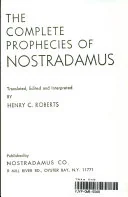
Complete Prophecies of Nostradamus
 76
76

Complete Prophecies of Nostradamus
The sheer volume of text in *The Complete Prophecies of Nostradamus* is its primary strength, offering an unparalleled resource for those dedicated to deciphering its dense verses. However, its unadorned presentation, while perhaps faithful to the source, lacks the scholarly apparatus that would greatly aid navigation. The quatrain concerning the "great war" and "the eagle" (Century II, Quatrain 31) exemplifies the work's notorious ambiguity; its repeated reinterpretations across centuries, from Napoleon to World War II and beyond, highlight both its enduring mystique and its inherent resistance to definitive exegesis. Without extensive annotation or comparative historical analysis, the reader is left largely adrift in a sea of symbolic potential. The book serves as a formidable archive, but demands significant external scholarship to yield meaningful insight.
📝 Description
76
### What It Is
The Complete Prophecies of Nostradamus presents the collected quatrains attributed to the 16th-century French astrologer and physician, Michel de Nostredame. This edition compiles his cryptic verses, often structured in quatrains (four-line poems), which have been interpreted for centuries as predictions of future events. The compilation aims to provide a comprehensive collection of these challenging texts, allowing readers direct access to the raw material of prophetic interpretation.
### Who It's For
This volume is intended for serious students of prophecy, historical occultism, and comparative esotericism. It appeals to those who engage with prophetic traditions not merely for predictive accuracy but for their historical context and symbolic language. Researchers of Renaissance intellectual history, or individuals fascinated by the enduring legacy of prophetic literature, will find substantial material for study. It is not for casual readers seeking simple answers.
### Historical Context
Michel de Nostredame published his prophecies during a period of significant religious and political upheaval in Europe. His first almanac appeared in 1533, but the more famous *Centuries* (collections of quatrains) began appearing in 1555. These works emerged during the French Wars of Religion and the broader context of the Reformation, a time when astrological and prophetic discourse was common among scholars and royalty alike, though often viewed with suspicion by religious authorities. The work was controversial even in its own time.
### Key Concepts
The prophecies are characterized by their allegorical and often obscure language, employing anagrams, astrological references, and allusions to classical mythology and biblical texts. Nostradamus frequently used anagrams of names and places, and referred to celestial configurations to date events. The quatrains themselves are typically grouped into "Centuries" (hundreds), though not always precisely. Understanding the work requires familiarity with Renaissance French, Latin, Greek, and the prevalent astrological and symbolic systems of the 16th century.
💡 Why Read This Book?
• Gain direct access to the entirety of Nostradamus's quatrains, allowing for independent analysis of the text that has fascinated scholars since its 1555 publication, moving beyond secondary interpretations. • Study the linguistic and symbolic patterns employed by Nostradamus, understanding his use of anagrams and astrological references that are crucial for deconstructing his cryptic verses. • Explore the historical reception of the prophecies, examining how figures like Catherine de' Medici sought interpretations during the volatile 16th century.
⭐ Reader Reviews
Honest opinions from readers who have explored this book.
❓ Frequently Asked Questions
When were the prophecies of Nostradamus first published?
The initial collection of Nostradamus's prophecies, known as the *Centuries*, began publication in 1555. Subsequent editions and additions continued to appear throughout his lifetime and after.
What is the structure of Nostradamus's prophecies?
The prophecies are primarily composed of quatrains, which are four-line poems. These quatrains are often grouped into "Centuries," with each Century containing approximately 100 quatrains, though the numbering and organization can be inconsistent.
What languages did Nostradamus use in his prophecies?
Nostradamus wrote in a mix of languages, predominantly 16th-century French, but also incorporated Latin, Greek, and Occitan. He also employed anagrams and obscure references, making translation and interpretation challenging.
Who was Nostradamus and when did he live?
Michel de Nostredame, known as Nostradamus, was a French astrologer, physician, and reputed seer who lived from 1503 to 1566. He gained fame for his book *Les Prophéties*.
Are Nostradamus's prophecies considered historically accurate?
The historical accuracy of Nostradamus's prophecies is widely debated. Many interpretations are applied retrospectively, and critics point to the vague and allegorical nature of the verses, allowing for flexible readings to fit subsequent events.
What historical events are claimed to be predicted by Nostradamus?
Supporters claim Nostradamus predicted events such as the Great Fire of London (1666), the French Revolution, the rise of Napoleon, and the assassinations of John F. Kennedy and Abraham Lincoln, among many others.
🔮 Key Themes & Symbolism
Ambiguity of Prophetic Language
The core of Nostradamus's work lies in its deliberate obscurity. The quatrains are not straightforward predictions but veiled allegories, dense with anagrams, astrological notations, and classical allusions. This linguistic complexity, evident in verses like the one referencing "the great famine" (Century III, Quatrain 14), ensures that interpretations shift with each generation and historical context. The text resists singular readings, functioning as a mirror for the interpreter's own era and concerns, making the act of decipherment as significant as any purported revelation.
Astrological Determinism
Nostradamus was a trained physician and astrologer, and his prophecies are deeply interwoven with celestial mechanics. He frequently embedded astrological conjunctions, planetary movements, and zodiacal signs within his verses, using them as temporal markers or causal agents. For instance, references to specific planetary alignments are common, suggesting that cosmic forces dictate terrestrial events. This integration reflects a 16th-century worldview where the heavens were seen as directly influencing human affairs, a concept central to Renaissance occult philosophy.
Historical Event Cycles
The prophecies are often analyzed through the lens of cyclical history, suggesting patterns of conflict, leadership, and societal change that repeat over long periods. Interpretations frequently link quatrains to major historical upheavals, such as wars or political shifts. The recurring motif of "great wars" and "princes of the earth" hints at an underlying structure to human conflict. This perspective aligns with esoteric traditions that perceive history not as linear but as a series of recurring archetypal patterns, as seen in some interpretations of the quatrains concerning the "Great Antichrist."
The Seer's Persona
Nostradamus cultivated an image of a divinely inspired seer, carefully managing his public presentation. While presenting himself as a physician, his prophetic writings placed him at the intersection of science, religion, and the occult. The dedication of his *Centuries* to King Henry II of France demonstrates a strategic engagement with power structures. His persona as a man privy to divine or cosmic knowledge allowed his work to gain traction among elites and scholars, shaping its enduring mystique.
💬 Memorable Quotes
“The great famine that draws near will often move, be felt throughout Europe.”
— This quatrain (Century III, Quatrain 14) is frequently cited as an example of Nostradamus predicting widespread scarcity. Its generality allows it to be applied to numerous historical periods of famine, highlighting the interpretive challenges inherent in the text.
“From the Orient, the great Chimist will arise. Those who eat his food will be of the spirit. He will be known throughout the world.”
— This verse suggests a figure emerging from the East associated with alchemy or transformative processes. The interpretation of 'eating his food' as spiritual nourishment points towards esoteric or mystical interpretations of this prophecy.
“When the wolf returns to the fold, the shepherd shall be accused of treachery.”
— This quatrain (Century II, Quatrain 15) evokes themes of betrayal and the return of something lost or exiled. It's often interpreted in political or religious contexts, concerning leadership and perceived disloyalty within established structures.
“The cry of men will arise from the subterranean prisons, wherein they will be confined in a civil manner.”
— This verse speaks of confinement and suppressed voices. It can be interpreted in relation to political oppression or social injustice, where suffering occurs within the guise of order or legality.
“The body of the great beast, the head is found on the soil of Italy.”
— This cryptic line (Century IV, Quatrain 5) is often interpreted as referring to a political entity or a significant historical figure associated with Italy. Its allegorical nature invites diverse historical and symbolic readings.
🌙 Esoteric Significance
Tradition
Nostradamus's work is situated within the Western Esoteric Tradition, drawing heavily on Hermeticism, Renaissance Neoplatonism, and Kabbalistic concepts of divine correspondence. While not strictly adhering to any single school, his method of symbolic interpretation and his belief in celestial influence align with Hermetic principles like 'As Above, So Below.' His prophecies represent a form of divinatory practice common in the Renaissance, seeking to uncover hidden divine or cosmic patterns governing human history.
Symbolism
Key symbols include animals (e.g., the "great beast" often interpreted as a nation or empire, or the "eagle" potentially representing a specific power), celestial bodies (planets, stars, eclipses used for timing and influence), and geographical locations (often disguised through anagrams or classical names). The quatrain format itself can be seen as symbolic, representing a contained unit of cosmic insight, much like a sigil or a brief arcane formula.
Modern Relevance
Contemporary interest in Nostradamus persists across various esoteric subcultures, from traditional occultists to New Age practitioners and conspiracy theorists. His work is frequently cited in discussions of apocalyptic prophecy, ufology, and alternative history. Thinkers and groups exploring cyclical history, predictive modeling, or the nature of consciousness often reference his prophecies as a historical touchstone for understanding humanity's relationship with the unknown and the future.
👥 Who Should Read This Book
• Students of Renaissance history and intellectual currents, seeking primary source material on 16th-century beliefs about prophecy and astrology. • Practitioners of divination and comparative esotericism, interested in analyzing a foundational text of Western prophetic literature and its interpretive methods. • Researchers of historical cryptography and symbolic language, intrigued by Nostradamus's use of anagrams, allegories, and obscure references.
📜 Historical Context
Michel de Nostredame's *Les Prophéties* emerged in 1555, a period marked by intense religious conflict across Europe, notably the French Wars of Religion (1562-1598). Astrological prognostication was a common practice among educated elites, including figures like Catherine de' Medici, who became an early patron of Nostradamus. However, this sphere also bordered on heresy, and such works were viewed with suspicion by orthodox religious authorities. Contemporaries like the Italian astrologer Luca Gaurico also produced prognostications, though Nostradamus's unique quatrain format and cryptic style set his work apart. His writings were banned by the Catholic Church's Index of Forbidden Books in the late 17th century, reflecting the ongoing tension between prophetic traditions and institutional religious power. The work's enduring appeal lies partly in its resistance to definitive interpretation, allowing it to be continuously recontextualized.
📔 Journal Prompts
The "great famine" quatrain: What contemporary societal pressures might it be interpreted to reflect?
Analyze the astrological references in Century II. How do they inform the quatrain's narrative?
Consider the role of Catherine de' Medici. How did patronage influence the reception of Nostradamus's prophecies?
Reflect on the recurring motif of "war." What archetypal patterns might these verses describe?
The "great beast" symbol: What modern geopolitical or cultural phenomena could this allegory represent?
🗂️ Glossary
Quatrain
A four-line stanza, the primary poetic form used by Nostradamus in his prophecies. Each quatrain typically presents a cryptic verse intended for interpretation.
Century
A collection of approximately 100 quatrains within Nostradamus's work. The prophecies are organized into these larger sections, though the numbering and completeness vary.
Anagram
A word or phrase formed by rearranging the letters of a different word or phrase. Nostradamus frequently used anagrams of names and places to obscure his references.
Astrological Conjunction
The alignment of two or more celestial bodies in the sky as seen from Earth. Nostradamus used these events as temporal markers or indicators of influence in his prophecies.
Hermeticism
A philosophical and religious tradition based on writings attributed to Hermes Trismegistus. It emphasizes divine knowledge, correspondence between macrocosm and microcosm, and spiritual transformation.
Divination
The practice of seeking knowledge of the future or the unknown by supernatural means. Nostradamus's prophecies are a form of literary divination.
Allegory
A story, poem, or picture that can be interpreted to reveal a hidden meaning, typically a moral or political one. Nostradamus's quatrains are often allegorical.