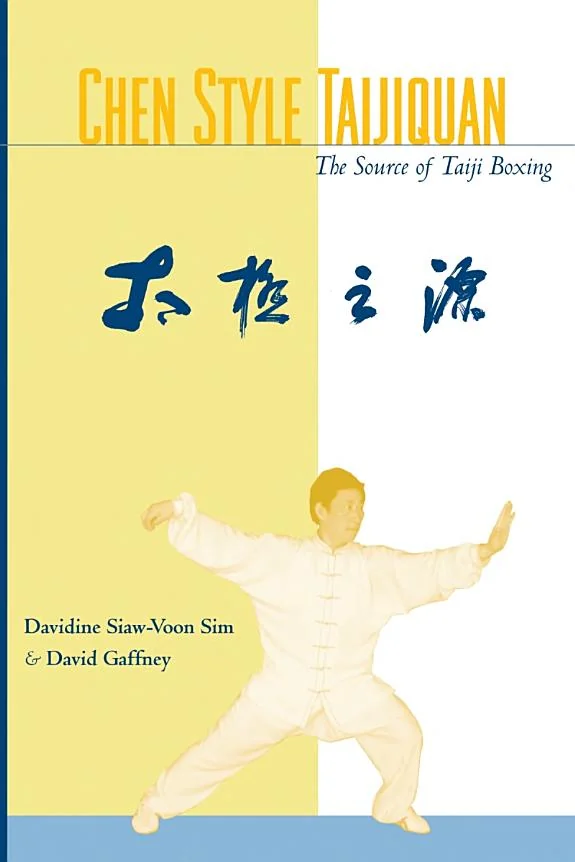
Chen Style Taijiquan
 79
79

Chen Style Taijiquan
David Gaffney and Davidine Siaw-Voon Sim's "Chen Style Taijiquan" offers a much-needed scholarly examination of the art's origins. The book commendably anchors the practice in its specific geographic and historical context, moving away from generalized claims. A particular strength lies in its detailed explanation of the silk-reeling (Chan Si) exercises, illustrating the fundamental principles of energy channeling. While the inclusion of legendary exploits adds color, these sections occasionally feel less grounded than the technical and historical analyses. The work effectively bridges the gap between martial practice and philosophical inquiry, though a deeper engagement with comparative martial philosophies would have further enriched its scholarly contribution. It stands as a solid reference for those seeking the foundational elements of Taijiquan.
📝 Description
79
### The Chen Style's Roots This volume traces the lineage of Taijiquan back to its foundational form, the Chen style, originating from Chen Village in Henan Province, China. It meticulously details the historical trajectory of this martial art, examining its evolution from ancient Chinese boxing traditions to its codified practice.
### Philosophical Underpinnings The work explores the philosophical currents that shaped Chen Style Taijiquan, linking its movements and principles to Taoist concepts of Yin and Yang, and the cultivation of internal energy (Qi). It moves beyond mere physical technique to address the deeper metaphysical framework.
### Training Methodologies Readers are guided through the specific training methods inherent in the Chen style. This includes an examination of the characteristic silk-reeling (Chan Si) exercises and the distinctive explosive power (Fajin) that sets this form apart from later developments.
### Legendary Accounts Included within the text are accounts of the Chen family's martial prowess and legendary exploits. These narratives serve not only to inspire but also to illustrate the practical application and efficacy of the techniques as passed down through generations.
💡 Why Read This Book?
• Gain a concrete understanding of the Chen style's martial applications, moving beyond generic interpretations of Taijiquan through specific discussion of techniques like Fajin. • Explore the philosophical bedrock of the art by examining its Taoist roots, including the interplay of Yin and Yang as presented in the text. • Trace the historical development from its inception in Chen Village, Henan Province, appreciating the specific lineage and evolution of this martial form.
⭐ Reader Reviews
Honest opinions from readers who have explored this book.
❓ Frequently Asked Questions
What is the primary difference between Chen Style Taijiquan and other Taijiquan forms?
Chen Style Taijiquan is distinguished by its inclusion of both slow, yielding movements and rapid, explosive power (Fajin). It also features characteristic silk-reeling (Chan Si) exercises, emphasizing spiral energy generation.
When was Chen Style Taijiquan first developed?
The Chen style originated in Chen Village, Henan Province, China, with its development spanning several centuries, though its codified forms solidified over time.
What philosophical traditions influenced Chen Style Taijiquan?
The practice is deeply influenced by Taoist philosophy, particularly concepts like Yin and Yang, the flow of Qi (internal energy), and principles of harmony and balance.
Are there specific exercises unique to the Chen style?
Yes, the Chen style is known for its silk-reeling (Chan Si) exercises, which train the body to generate power through spiraling movements, a foundational practice.
Who are the authors of 'Chen Style Taijiquan'?
The book was written by David Gaffney and Davidine Siaw-Voon Sim, first published in 2002.
Does the book discuss the legendary figures of the Chen family?
Yes, the text includes legendary exploits of the Chen family, offering historical context and inspiring accounts of their martial skills.
🔮 Key Themes & Symbolism
Lineage and Origins
This work meticulously reconstructs the historical trajectory of Taijiquan, anchoring it firmly in Chen Village, Henan Province. It moves beyond generalized narratives to detail the specific evolution of the Chen family's martial system, differentiating it from later adaptations. The book emphasizes the importance of understanding this foundational lineage to grasp the art's true nature and its development from earlier Chinese boxing forms.
Taoist Philosophical Integration
The text elucidates how Taoist principles are interwoven into the fabric of Chen Style Taijiquan. Concepts such as the dynamic interplay of Yin and Yang, the cultivation and circulation of Qi, and the pursuit of natural harmony are presented not as abstract notions but as integral to the practice and efficacy of the martial art. This connection reveals Taijiquan as a holistic system.
Internal Energy Cultivation (Qi)
Central to the Chen style is the concept of cultivating and directing internal energy, or Qi. The book details specific training methods, like silk-reeling (Chan Si), designed to develop this internal force. It explains how the unique movements of the Chen form are intended to harmonize the body's energetic pathways, leading to enhanced vitality and martial power.
Distinctive Martial Techniques
Beyond its philosophical and historical aspects, the book provides insight into the characteristic techniques of Chen Style Taijiquan. It highlights features such as the explosive power generation (Fajin) and the coiling, spiraling movements that distinguish it from other styles. These elements are presented as essential components of the Chen system's martial effectiveness.
💬 Memorable Quotes
“The Chen style is the original method from Chen Village, Henan Province.”
— This foundational statement underscores the book's central thesis: that understanding the Chen form is key to understanding the origins and true nature of Taijiquan as a whole.
“Silk-reeling exercises train the body to generate power through spiraling movements.”
— This highlights a core training principle unique to the Chen style, emphasizing the importance of coordinated, continuous, and spiraling motion for developing internal power.
“The system is rooted in Taoist concepts of Yin and Yang.”
— This points to the philosophical underpinnings of the martial art, suggesting that its movements and principles are designed to embody and harmonize fundamental natural forces.
“Fajin represents the explosive power characteristic of this form.”
— This identifies a key martial application and characteristic technique within the Chen style, differentiating it through its capacity for sudden, powerful force projection.
“Legendary exploits of the Chen family inspire practitioners.”
— This indicates the book's inclusion of historical anecdotes and heroic narratives, aiming to provide motivational context and illustrate the practical legacy of the Chen martial tradition.
🌙 Esoteric Significance
Tradition
While not strictly aligned with Western Hermeticism or Gnosticism, "Chen Style Taijiquan" engages with principles resonant within esoteric traditions, particularly Taoism. It explores the cultivation of internal energy (Qi) and the balance of opposing forces (Yin/Yang), concepts central to many mystical paths. The book treats the martial art as a vehicle for internal development and harmonizing with natural laws, aligning it with practices that seek union with the 'Tao' or fundamental reality.
Symbolism
The core symbolism revolves around the concept of 'silk-reeling' (Chan Si), representing the spiraling, continuous flow of energy essential to the style. This spiral motion symbolizes cosmic dynamism and the interconnectedness of forces. The interplay of Yin (yielding, receptive) and Yang (active, forceful) in movement mirrors fundamental dualistic principles found across various esoteric cosmologies, illustrating balance and transformation.
Modern Relevance
Contemporary practitioners of internal martial arts, somatic therapies, and Qigong draw heavily on the foundational principles detailed in works like this. Thinkers exploring embodied cognition and the integration of mind-body practices find the Chen style's emphasis on energetic mechanics and philosophical grounding highly relevant. Its detailed historical and technical exposition informs modern interpretations seeking to preserve the art's martial efficacy and internal cultivation aspects.
👥 Who Should Read This Book
['• Practitioners seeking to understand the historical and martial origins of Taijiquan, moving beyond simplified modern interpretations.', '• Students of Taoist philosophy interested in practical applications of Yin/Yang and Qi cultivation within a structured system.', '• Martial artists researching the development of internal styles and their unique energetic principles like Fajin and Chan Si.']
📜 Historical Context
Published in 2002, David Gaffney and Davidine Siaw-Voon Sim's "Chen Style Taijiquan" emerged during a period of burgeoning global interest in Chinese martial arts and internal cultivation practices. While Taijiquan had gained widespread recognition, much of the discourse focused on Yang-style or generalized forms. This work sought to rectify that by focusing on the historically prior Chen style, originating from Chen Village. It engaged with the existing scholarship on Chinese martial history, situating the Chen family's development within the broader context of Henan martial traditions. Unlike some popular interpretations that detached the art from its martial roots, this book emphasized its origins as a practical fighting system, influenced by classical Chinese philosophy. The work's detailed historical reconstruction provided a counterpoint to more anecdotally driven accounts, offering a scholarly grounding that resonated with practitioners seeking deeper understanding.
📔 Journal Prompts
The concept of silk-reeling (Chan Si) in Chen Style Taijiquan.
The integration of Yin and Yang principles within martial movements.
Historical accounts of the Chen family's martial legacy.
The role of Qi cultivation in developing explosive power (Fajin).
Connecting the philosophical roots of Taoism to the practice of the Chen form.
🗂️ Glossary
Chen Style Taijiquan
The oldest recognized form of Taijiquan, originating from the Chen family in Chen Village, Henan Province, China, characterized by slow and fast movements, and explosive power.
Qi (Chi)
In traditional Chinese culture, the vital life force or energy believed to flow through all living things and the universe, central to internal martial arts and health practices.
Yin and Yang
A fundamental concept in Chinese philosophy representing complementary, interconnected, and interdependent forces (e.g., passive/active, dark/light) whose dynamic balance governs the natural world.
Chan Si Gong
Literally 'silk-reeling exercises,' these are fundamental training methods in Chen Style Taijiquan that develop whole-body coordination and spiraling energy through continuous, coiling movements.
Fajin
A key principle in Chen Style Taijiquan, referring to the emission of explosive power, often characterized by a sudden burst of force generated through the entire body.
Chen Village
The ancestral home of the Chen family and the birthplace of Chen Style Taijiquan, located in Wen County, Jiaozuo City, Henan Province, China.
Henan Province
A province in central China, historically significant and recognized as the origin of the Chen family and their unique style of Taijiquan.