Bunnicula
 81
81

Bunnicula
The central conceit of a vampire rabbit is undeniably charming, a hook that grabs young readers from the outset. Howe and Howe craft a narrative where the pets' perspectives—Chester's dramatic pronouncements and Harold's steady observations—provide much of the comedic and narrative drive. The gradual unveiling of Bunnicula's peculiar habits, like draining tomatoes of their juice, is handled with a light touch that avoids genuine fright. However, the book's greatest strength, its whimsical premise, also serves as a minor limitation; the stakes never feel particularly high, and the mystery's resolution, while satisfying for the age group, lacks deep ambiguity. The recurring motif of Chester’s increasingly frantic attempts to expose Bunnicula, often misinterpreted by the humans, highlights the communication gap between species effectively. Ultimately, Bunnicula offers a delightful, if uncomplicated, foray into the playfully paranormal for young minds.
📝 Description
81
### What Bunnicula Is
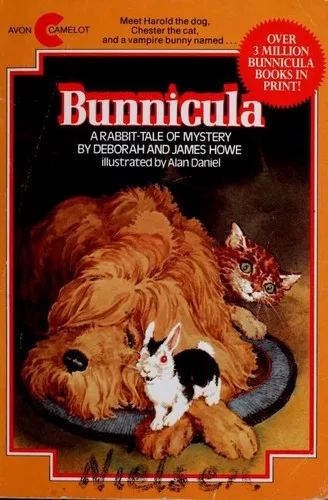
This children's novel, penned by Deborah Howe and James Howe, introduces readers to the peculiar case of Bunnicula, a vampire rabbit discovered by the Monroe family. Adopted after being found in a dark movie theater, the rabbit exhibits strange habits and an aversion to sunlight. The narrative unfolds as the Monroe children, Harold the dog and Chester the cat, attempt to unravel the mystery of their new, oddly pale pet.
### Who Bunnicula Is For
Bunnicula is primarily geared towards young readers aged 8-12, offering a blend of humor and mild suspense. It appeals to those who enjoy lighthearted mysteries with animal characters and a touch of the supernatural. Parents and educators looking for engaging chapter books that can spark discussions about empathy, observation, and understanding differences will find it a suitable choice for read-alouds or independent reading.
### Historical Context
Published in 1979, Bunnicula emerged during a period when children's literature was exploring more complex themes and introducing characters with unusual traits. While not overtly occult, its premise touches on the supernatural, a genre that saw renewed interest in various forms of media throughout the late 20th century. The book's success positioned it as a notable entry in the animal fiction genre, inspiring a series and numerous sequels.
### Key Concepts
The central concept revolves around the unexpected presence of the 'vampire rabbit,' Bunnicula, and the reactions of the family pets to this anomaly. It explores themes of perception versus reality, as Chester the cat insists Bunnicula is a creature of the night, while Harold the dog remains more pragmatic. The narrative also touches on the idea of the 'other' and how new, unusual beings are integrated into a family dynamic.
💡 Why Read This Book?
• Gain insight into the power of perspective by contrasting Chester the cat's dramatic, supernatural interpretations with Harold the dog's grounded, logical observations. • Understand how the mundane can become extraordinary through the lens of the unusual, exemplified by Bunnicula's peculiar dietary habits like draining tomatoes. • Explore the theme of integrating the 'other' into a familiar world, observing how the Monroe family and their pets adapt to the enigmatic Bunnicula's presence.
⭐ Reader Reviews
Honest opinions from readers who have explored this book.
❓ Frequently Asked Questions
What is the main premise of Bunnicula?
The book centers on a vampire rabbit named Bunnicula, adopted by the Monroe family. The story is told from the perspective of the family pets, Harold the dog and Chester the cat, who try to understand the rabbit's strange, nocturnal habits.
Who are the main characters in Bunnicula?
The main characters include Bunnicula the rabbit, Harold the dog, and Chester the cat. The Monroe family, Mina, Toby, and Pete, are also central to the story, though the narrative primarily focuses on the pets' interactions with Bunnicula.
When was Bunnicula first published?
Bunnicula was first published in 1979 by Atheneum Books.
What are some of Bunnicula's peculiar habits?
Bunnicula exhibits several peculiar habits, most notably an aversion to sunlight and a tendency to drain vegetables, particularly tomatoes, of their juice, leaving them pale and dry.
Is Bunnicula scary for young readers?
While the premise involves a vampire, Bunnicula is not intended to be frightening. It is a humorous and lighthearted story with mild suspense, suitable for children aged 8 and up.
What is the significance of the title character, Bunnicula?
The title character, Bunnicula, is a mysterious rabbit with vampiric characteristics. His presence disrupts the household and sparks the investigative efforts of the family pets, Harold and Chester.
🔮 Key Themes & Symbolism
Animal Perspectives
The novel brilliantly employs the distinct viewpoints of Harold the dog and Chester the cat to narrate the unfolding mystery of Bunnicula. Harold, pragmatic and loyal, offers a grounded perspective, while Chester, dramatic and superstitious, immediately suspects the rabbit of vampirism. This duality allows the authors to explore how different beings interpret the same events, creating humor and suspense as Chester's increasingly elaborate theories clash with Harold's simpler observations and the humans' obliviousness.
The 'Other' in the Household
Bunnicula represents the 'other' – an unusual, potentially unsettling presence introduced into the familiar domestic sphere. Chester's immediate fear and condemnation highlight societal tendencies to react with suspicion to the unknown. Conversely, Harold's gradual acceptance and the Monroe family's general affection for Bunnicula showcase the potential for integration and understanding, even when faced with peculiar traits like the rabbit's aversion to sunlight and unusual diet.
Supernatural vs. Mundane
The core tension lies in the conflict between Chester's belief in the supernatural and the more mundane explanations favored by Harold and the human family. Chester interprets Bunnicula's pale complexion and nocturnal habits as evidence of vampirism, while the humans attribute them to the rabbit's unusual origins or breed. This theme invites young readers to consider how appearances and behaviors can be interpreted in vastly different ways, blurring the lines between the ordinary and the extraordinary.
Mystery and Deduction
At its heart, Bunnicula is a mystery story told from an unconventional viewpoint. The 'crime' is Bunnicula's peculiar dietary habits – draining vegetables. The detectives are the pets, each employing their unique methods of investigation. Chester's dramatic accusations and Harold's careful observation drive the plot forward, encouraging readers to piece together clues alongside the animal protagonists and question the true nature of their peculiar housemate.
💬 Memorable Quotes
“Chester saw the rabbit for what he was: a creature of the night, a vampire.”
— This line encapsulates Chester the cat's immediate and dramatic interpretation of Bunnicula's arrival. It establishes the central conflict and the supernatural premise that Chester believes is unfolding, setting the stage for his increasingly frantic efforts to expose the rabbit.
“Bunnicula was a pale, thin rabbit with two tiny fangs.”
— This direct description provides the visual evidence that fuels Chester's 'vampire' theory. It grounds the fantastical element in a concrete, observable detail, making Chester's suspicions seem plausible within the narrative's logic, even if the humans dismiss it.
“Harold thought the rabbit was just peculiar.”
— This quote highlights Harold the dog's contrasting, more rational perspective. It establishes the dichotomy between the two pets' interpretations and shows how the same phenomena can be viewed through different lenses – one of fear and superstition, the other of simple observation.
“The Monroe children named the rabbit Bunnicula.”
— This simple factual statement marks the official christening of the titular character. The name itself, a portmanteau of 'bunny' and 'Dracula,' immediately signals the book's playful engagement with classic horror tropes for a young audience.
“Bunnicula had a way of making vegetables look as if they had been drained of all their juice.”
— This describes one of Bunnicula's most peculiar and incriminating habits. It's the central piece of 'evidence' that Chester uses to build his case, presenting a strange, almost magical, transformation of everyday food items.
🌙 Esoteric Significance
Tradition
While not directly affiliated with a specific esoteric tradition like Hermeticism or Kabbalah, *Bunnicula* draws upon the archetype of the vampire, a figure that has permeated Western folklore and occult studies for centuries. The vampire, often seen as a creature that subsists on life force, can be interpreted through various esoteric lenses, including themes of undeath, parasitic existence, and the shadow self. The book playfully recontextualizes this archetype within a domestic, child-friendly setting, offering a gentle introduction to the concept of beings that operate outside conventional natural laws.
Symbolism
The primary symbol is Bunnicula himself, representing the 'other' or the hidden, darker aspect that disrupts the mundane. His aversion to sunlight symbolizes the rejection of the conscious, diurnal world in favor of a nocturnal, perhaps subconscious, existence. The drained vegetables are symbolic of a life-force being siphoned, echoing vampiric lore. Chester the cat embodies the fearful, superstitious reaction to the unknown, while Harold the dog represents a more grounded, accepting approach to perceived anomalies.
Modern Relevance
In contemporary discussions around the uncanny and the fantastical in literature, *Bunnicula* remains a touchstone for how to introduce complex archetypes like the vampire to younger audiences. Its playful subversion of horror tropes anticipates later works that explore the monstrous in domestic settings or through the eyes of children. The book's enduring appeal lies in its demonstration that seemingly frightening concepts can be explored with humor and empathy, relevant to modern storytelling that often seeks to normalize or humanize the 'monstrous.'
👥 Who Should Read This Book
• Young readers aged 8-12 exploring chapter books, who will gain an introduction to mystery, humor, and light supernatural themes through relatable animal characters. • Parents and educators seeking engaging read-alouds that can spark conversations about perception, fear of the unknown, and the integration of different personalities. • Fans of animal-centric stories who will appreciate the unique narrative voices of Harold the dog and Chester the cat as they try to solve the mystery of Bunnicula.
📜 Historical Context
Published in 1979, *Bunnicula* emerged in a children's literature landscape that was increasingly open to genre-blending and characters with unconventional traits. While not a direct engagement with occultism, its playful use of vampire lore tapped into a broader cultural fascination with the supernatural that permeated popular culture in the late 20th century. The book arrived at a time when authors like Roald Dahl were also pushing boundaries with dark humor and eccentric characters in children's stories. *Bunnicula*'s success, leading to a series, demonstrated a market for humorous, slightly spooky tales. It avoided the overt allegorical or educational tones of some earlier children's literature, focusing instead on character-driven humor and a light mystery. Its reception was largely positive, cementing its place as a beloved classic in the animal fiction genre.
📔 Journal Prompts
Chester the cat's immediate conviction of Bunnicula's vampirism versus Harold's skepticism.
The symbolic draining of vegetables by Bunnicula.
The Monroe family's acceptance of Bunnicula despite his oddities.
Harold's role as the voice of reason among the pets.
The contrast between Bunnicula's appearance and his alleged nature.
🗂️ Glossary
Vampire Rabbit
A fictional rabbit possessing characteristics of a vampire, notably an aversion to sunlight and the ability to drain the life-force from vegetables.
Chester
The Monroe family's cat, who serves as the primary narrator suspecting Bunnicula of being a vampire and attempting to expose him.
Harold
The Monroe family's dog, who offers a more pragmatic and less fearful perspective on Bunnicula's unusual behavior.
Draining Juice
The peculiar habit attributed to Bunnicula, where he consumes the liquid from vegetables, leaving them pale and dry, which Chester interprets as vampiric feeding.
Aversion to Sunlight
Bunnicula's avoidance of daylight, a classic trait of vampires, which Chester uses as key evidence for his supernatural hypothesis.
Monroe Family
The human family who adopts Bunnicula, providing the domestic setting for the story and largely remaining unaware of the 'supernatural' events observed by the pets.
Movie Theater Discovery
The circumstance under which the Monroe family finds Bunnicula, adding an element of mystery to the rabbit's origins.