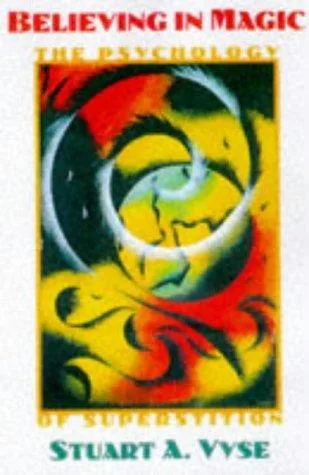
Believing in Magic
 80
80

Believing in Magic
Stuart A. Vyse’s "Believing in Magic" offers a rigorous, almost anthropological, examination of why humans cling to superstition even as science illuminates the world. Vyse, a leading expert, avoids condescension, instead approaching the subject with intellectual curiosity. He compellingly argues that superstitions are not mere quirks but emergent properties of psychological tendencies, particularly our drive to find order and control. The chapter detailing the 'illusion of control' is particularly sharp, illustrating how athletes, for instance, develop elaborate pre-game rituals to manage the inherent unpredictability of their sport. While the work is academically sound, its dense prose might deter casual readers seeking quick answers. The strength lies in its detailed psychological scaffolding, but a more anecdotal approach in places could have enhanced its accessibility. Ultimately, "Believing in Magic" is an essential, if demanding, exploration of a fundamental aspect of human cognition.
📝 Description
80
Stuart A. Vyse's 1997 book, Believing in Magic, explains why superstitions endure.
Despite living in an age of science, superstitious beliefs remain common. Stuart A. Vyse's "Believing in Magic" examines this enduring human tendency. The work argues that these inclinations are not oddities but predictable results of inherent psychological processes. These processes affect people regardless of their social standing, profession, or education.
Vyse, an authority on superstition, analyzes the cognitive structures behind these seemingly irrational convictions. The book shows how our minds seek patterns, create causal links where none exist, and form comforting stories when facing uncertainty. This updated edition reconsiders these core psychological mechanisms, providing a modern view on why such beliefs continue in the 21st century. The book also looks at the societal effects of widespread superstition, questioning its influence on choices, culture, and personal welfare.
While often studied through a psychological or sociological lens, "Believing in Magic" touches upon traditions that explore the human inclination towards the supernatural and the ritualistic. It examines the underlying mental frameworks that lead individuals to assign meaning and causality to events beyond empirical verification. This connects to broader discussions within esoteric studies concerning belief systems, ritual efficacy, and the human need for order and explanation in a complex world, even when those explanations lack scientific grounding.
💡 Why Read This Book?
• Understand the psychological mechanisms, such as confirmation bias, that drive superstitious behavior, providing a framework for analyzing your own beliefs. • Explore the historical evolution of superstitions, drawing connections to rituals and belief systems documented as far back as ancient Greece. • Gain practical insights into how the 'illusion of control' shapes decision-making in diverse fields, from sports to finance.
⭐ Reader Reviews
Honest opinions from readers who have explored this book.
❓ Frequently Asked Questions
What is the primary psychological explanation for superstitions offered in "Believing in Magic"?
Stuart A. Vyse explains superstitions as natural outcomes of psychological processes like patternicity and the illusion of control. Our minds seek order and causality, leading us to associate actions with outcomes even when no real link exists, especially in uncertain situations.
Who is Stuart A. Vyse and what is his expertise?
Stuart A. Vyse is a renowned expert on superstition and the psychology of belief. His work in "Believing in Magic" stems from extensive research into cognitive biases and the historical persistence of irrational convictions across cultures and time periods.
When was "Believing in Magic" first published?
The first edition of "Believing in Magic" by Stuart A. Vyse was published on September 1, 2013. This edition has since been updated to reflect contemporary research and societal observations.
Does the book claim superstitions are entirely irrational?
While the book investigates the irrational nature of superstitious beliefs from a scientific perspective, it argues they are psychologically rational in the sense that they emerge from predictable cognitive processes designed to cope with uncertainty and seek control.
What kind of examples does "Believing in Magic" use to illustrate its points?
The book draws on a wide array of examples, including those from athletes' pre-game rituals, gamblers' lucky charms, and common everyday superstitions, connecting them to psychological principles and historical precedents.
Is "Believing in Magic" a scientific text or a collection of anecdotes?
It is primarily a scientific text grounded in psychology and cognitive science, using anecdotes and historical examples to illustrate complex concepts rather than relying on them as primary evidence.
🔮 Key Themes & Symbolism
Cognitive Architecture of Belief
This theme examines the innate psychological structures that predispose humans to superstition. Vyse details concepts like confirmation bias and the tendency to perceive patterns where none exist (patternicity). The work suggests these are not flaws but adaptive mechanisms for navigating an unpredictable world. The book explores how these cognitive shortcuts, while often leading to irrational beliefs, serve a purpose in creating a sense of order and predictability, crucial for mental well-being.
The Illusion of Control
Central to Vyse's thesis is the 'illusion of control' – the pervasive human belief that we can influence events that are actually random. This theme examines how individuals, from athletes to investors, develop rituals and superstitions to feel a sense of agency. The book provides examples showing how this psychological phenomenon helps individuals cope with anxiety and uncertainty, even if the perceived control is illusory. It highlights the adaptive function of these beliefs in managing existential dread.
Superstition as Cultural Evolution
Vyse frames superstition not just as individual psychology but as a culturally transmitted phenomenon. This theme traces the historical lineage of superstitions, demonstrating how they evolve and adapt within societies. The work examines how certain beliefs gain traction and persist across generations, often becoming embedded in cultural practices and traditions. It underscores how shared irrational beliefs can foster social cohesion while also influencing collective behavior and decision-making.
The Persistence of Irrationality
This theme addresses the paradox of widespread superstition in a scientifically advanced age. Vyse explores why, despite access to rational explanations, individuals continue to adhere to magical thinking. The book argues that the psychological needs met by superstition – such as comfort, certainty, and a sense of agency – are so fundamental that they often override purely rational considerations. It posits that understanding the deep-seated nature of these beliefs is key to comprehending human behavior.
💬 Memorable Quotes
Direct passages from the work, attributed to the author.
“Superstition is not a sign of intellectual deficiency, but rather an index of the human mind's inherent tendency to impose order on chaos.”
— This interpretation highlights Vyse's core argument that superstitions arise from natural cognitive processes aimed at making sense of an unpredictable world, rather than from a lack of intelligence. It reframes superstition as a byproduct of adaptive psychological mechanisms.
“We are creatures wired for narrative, and superstition offers a compelling, albeit often false, causal story for the events that shape our lives.”
— This interpretation points to the role of storytelling in superstition. Vyse suggests that humans are predisposed to construct coherent narratives to explain phenomena, and superstitions provide simple, often anthropocentric, explanations for complex or random occurrences.
“Understanding why we believe in magic requires understanding the fundamental architecture of the believing mind itself.”
— This interpretation frames the study of superstition as a gateway to understanding human cognition more broadly. It suggests that exploring magical thinking reveals essential truths about how the human mind processes information, seeks meaning, and forms beliefs.
💡 Key Ideas
Editorial paraphrase of the work's core concepts — not direct quotes.
The athlete's ritual, the gambler's charm – these are not aberrations but expressions of a deep-seated need to feel in command of uncertain outcomes.
This paraphrased concept emphasizes the psychological function of superstitions in providing a sense of agency. It suggests that these practices, often seen as irrational, fulfill a fundamental human desire to influence and control events, particularly those perceived as random.
The persistence of superstition in the face of scientific knowledge demonstrates the powerful grip of psychological comfort over empirical reality.
This paraphrase underscores the tension between scientific understanding and emotional needs. It suggests that the comfort and sense of control offered by superstitious beliefs can be more influential in maintaining those beliefs than rational, evidence-based explanations.
🌙 Esoteric Significance
Tradition
While not strictly within a single esoteric lineage, "Believing in Magic" engages with the psychological underpinnings of phenomena often explored in esoteric traditions, such as sympathetic magic, divination, and ritualistic practices. It provides a rational, psychological framework for understanding the persistent human attraction to these concepts, which are central to Hermeticism, Gnosticism, and various forms of folk magic. Vyse's work offers a secular, scientific lens that can inform, and sometimes challenge, traditional esoteric interpretations of belief.
Symbolism
The book implicitly addresses symbols by analyzing the psychological functions they serve. For instance, a lucky charm (a symbol of luck) functions by reinforcing the illusion of control and providing a tangible focus for belief. Similarly, rituals (symbolic actions) become potent because they represent attempts to influence unseen forces or establish causal links. Vyse explains how these symbolic objects and actions gain power not through inherent magical properties, but through the psychological associations and perceived efficacy they foster in the believer's mind.
Modern Relevance
Contemporary thinkers in fields ranging from behavioral psychology to marketing and even digital culture studies draw upon Vyse's insights. His work is relevant to understanding the appeal of conspiracy theories, the spread of misinformation online, and the enduring popularity of pseudoscientific claims. Practices like mindfulness and cognitive behavioral therapy (CBT), while secular, indirectly address the same human need for control and order that superstitions historically fulfilled, offering more evidence-based methods for managing anxiety and uncertainty.
👥 Who Should Read This Book
• Psychology students and researchers interested in cognitive biases, belief formation, and the science of irrationality. • Anthropologists and sociologists examining cultural practices and the evolution of belief systems across societies. • Skeptics and critical thinkers seeking a scientific understanding of why superstitions persist despite evidence to the contrary.
📜 Historical Context
Published in 2013, "Believing in Magic" emerged during a period where cognitive psychology was increasingly dissecting the mechanisms of belief and irrationality. The work built upon decades of research in behavioral economics and social psychology, fields that had begun to quantify and explain cognitive biases. Vyse's approach can be seen as a contemporary extension of earlier work by figures like B.F. Skinner, who explored conditioned behavior, and more directly, by psychologists like Leon Festinger with his theory of cognitive dissonance. Unlike purely anthropological studies of magic or folk beliefs, Vyse's text centers on the psychological underpinnings, offering a distinct contribution. The book's reception highlighted its alignment with a growing academic interest in the 'science of superstition,' engaging with researchers like Gerd Gigerenzer who advocate for understanding heuristics rather than solely pathologizing irrationality.
📔 Journal Prompts
The confirmation bias and its role in maintaining superstitious beliefs.
Personal rituals and their connection to the illusion of control.
The psychological comfort derived from superstitious explanations.
Superstition as a narrative tool for understanding life events.
The adaptive function of patternicity in human cognition.
🗂️ Glossary
Patternicity
The tendency to detect meaningful patterns in random noise or unrelated stimuli. This cognitive process is fundamental to how humans identify correlations, which can lead to superstitious beliefs when patterns are perceived where none truly exist.
Illusion of Control
A cognitive bias where people overestimate their ability to influence events that are actually determined by chance. This bias drives many superstitious behaviors, as individuals believe their actions or rituals can affect random outcomes.
Confirmation Bias
The tendency to search for, interpret, favor, and recall information in a way that confirms one's pre-existing beliefs or hypotheses, while giving disproportionately less consideration to alternative possibilities.
Cognitive Dissonance
The mental discomfort experienced by a person who holds two or more contradictory beliefs, ideas, or values, or is confronted by new information that conflicts with existing beliefs, ideas, or values.
Post hoc ergo propter hoc
A logical fallacy that assumes that because event B followed event A, event A must have caused event B. This is a common reasoning error underlying many superstitious associations.
Magical Thinking
The belief that one's thoughts, words, or actions can influence the outcome of events in the physical world, often without any logical or scientifically plausible mechanism connecting them.
Heuristic
A mental shortcut that allows people to make decisions and solve problems quickly and efficiently. While often useful, heuristics can also lead to cognitive biases and superstitious reasoning.