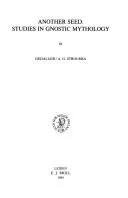
Another seed
 72
72

Another seed
Guy G. Stroumsa’s ‘Another Seed’ avoids the sensationalism that often plagues discussions of esoteric lore. Its strength lies in its meticulous academic approach, dissecting complex ideas with a clarity that belies their antiquity. The 1984 publication date positions it as a product of serious scholarly engagement with Gnosticism and related traditions, rather than a fleeting New Age trend. However, its rigorous academic tone, while admirable, might alienate readers seeking a more devotional or practical engagement with these subjects. The section discussing the concept of the 'aeons' in Gnostic cosmologies, for instance, is intellectually precise but offers little in the way of immediate spiritual insight for the uninitiated. Stroumsa offers a valuable historical and conceptual mapping of esoteric thought, serving as an excellent primer for further study.
📝 Description
72
### What It Is 'Another Seed' by Guy G. Stroumsa, first published in 1984, offers a scholarly examination of esoteric traditions. It does not present a singular doctrine but rather traces the development and interrelation of various mystical and philosophical currents that have influenced Western thought. The book analyzes the conceptual frameworks and historical trajectories of these movements, focusing on their internal logic and external interactions.
### Who It's For This work is suited for individuals with a serious interest in the history of ideas, particularly those concerned with the esoteric and religious dimensions of Western civilization. It appeals to academics, graduate students, and dedicated independent researchers who seek a nuanced understanding beyond popular interpretations. Readers should possess a foundational knowledge of philosophical and religious history to fully appreciate its depth.
### Historical Context Published in 1984, 'Another Seed' emerged during a period of renewed academic interest in Gnosticism and early Christian heresies, building on the work of scholars like Hans Jonas. Stroumsa's research engages with the intellectual milieu that re-examined the boundaries between orthodox and heterodox thought, challenging earlier categorizations. The era saw a surge in comparative religion studies and a critical reassessment of marginal spiritual movements.
### Key Concepts The book explores concepts such as dualism, redemption, and the nature of divine knowledge as understood across diverse esoteric systems. It examines the transmission of ideas through different cultures and epochs, highlighting how seemingly disparate traditions often share underlying concerns or employ similar symbolic language. The interplay between revelation and interpretation is a recurring theme, as is the construction of spiritual authority.
💡 Why Read This Book?
• Understand the historical evolution of Gnostic concepts, examining specific cosmological ideas presented in the text, such as the role of intermediary divine beings, which were influential in early centuries CE. • Gain insight into the academic discourse surrounding esoteric traditions as it existed around 1984, recognizing the scholarly context that shaped Stroumsa’s analysis of early Christian heterodoxies. • Learn about the complex relationship between seemingly disparate spiritual movements, exploring how Stroumsa connects ideas from various early Christian and Hellenistic philosophical schools.
⭐ Reader Reviews
Honest opinions from readers who have explored this book.
❓ Frequently Asked Questions
What specific Gnostic concepts does Guy G. Stroumsa's 'Another Seed' explore?
The book delves into core Gnostic ideas such as dualism, the nature of the Demiurge, the concept of aeons, and the path to salvation through gnosis, as understood within various early Christian and Hellenistic philosophical frameworks.
When was 'Another Seed' first published and what was the academic climate then?
'Another Seed' was first published in 1984. This period saw significant scholarly engagement with Gnosticism and early Christian heterodoxies, influenced by figures like Hans Jonas, and a re-evaluation of marginalized spiritual traditions.
Is 'Another Seed' a practical guide to esoteric practices?
No, 'Another Seed' is a scholarly work focused on the historical and philosophical analysis of esoteric traditions. It explores the conceptual underpinnings rather than providing instructions for practice.
Who are the key figures or traditions Stroumsa discusses in relation to Gnosticism?
Stroumsa's work engages with a range of early Christian authors and philosophical schools, examining their ideas in relation to Gnostic thought. He also situates his research within the broader context of Hellenistic philosophy.
What makes 'Another Seed' relevant for understanding Western esoteric thought?
The book maps the intellectual lineage and conceptual development of key esoteric ideas, demonstrating how they have shaped various strands of Western philosophy and religion over centuries.
Does the book discuss any specific symbolic systems?
While primarily conceptual, the work touches upon the symbolic language inherent in Gnostic cosmology and dualistic thought, explaining how these symbols function within their respective belief systems.
🔮 Key Themes & Symbolism
The Gnostic Cosmological Framework
Stroumsa meticulously unpacks the intricate cosmological architectures found in Gnostic traditions. This includes detailed explanations of the Pleroma, the aeons, the role of Sophia, and the flawed creation of the material world by a lesser deity, the Demiurge. The work emphasizes the dualistic worldview inherent in these systems, contrasting the spiritual, incorruptible realm with the material, flawed existence. Understanding this framework is crucial for grasping the Gnostic concept of salvation as a return to the divine source.
Salvation Through Gnosis
A central theme is the Gnostic understanding of salvation, which is achieved not through faith or works, but through direct, experiential knowledge – 'gnosis'. Stroumsa explores how this knowledge is often seen as a divine spark within the human soul, needing to be awakened. The book examines the various paths and revelations proposed within Gnostic texts for attaining this liberating awareness, distinguishing it from conventional soteriological models.
Dualism and the Material World
The concept of radical dualism, separating spirit from matter, is a cornerstone of the traditions analyzed. Stroumsa addresses the Gnostic view of the material world as fundamentally evil or illusory, a prison for the divine essence. This perspective informs the Gnostic critique of conventional religious and social structures, highlighting their perceived entanglement with the flawed material realm.
Hellenistic Philosophical Influences
The work situates Gnostic ideas within the broader intellectual landscape of Hellenistic philosophy, particularly Neoplatonism and Middle Platonism. Stroumsa identifies conceptual parallels and potential influences, showing how Gnostic thinkers engaged with, adapted, and sometimes radically reinterpreted existing philosophical concepts to articulate their unique spiritual vision.
💬 Memorable Quotes
“The material world is understood as a flawed creation.”
— This encapsulates the Gnostic rejection of the physical universe as inherently evil or a prison, contrasting it with a perfect spiritual realm.
“Gnosis represents a direct apprehension of the divine.”
— This highlights the salvific nature of knowledge in Gnosticism, emphasizing personal insight over dogma or ritual for spiritual liberation.
“Aeons populate the divine Pleroma.”
— This refers to the emanations or divine beings that constitute the fullness of God's presence in Gnostic cosmology, preceding the creation of the material world.
“The Demiurge is responsible for the material cosmos.”
— This identifies the lesser, often ignorant or malevolent, creator figure responsible for the flawed physical universe in Gnostic theology.
“Dualism sharply divides spirit and matter.”
— This points to the fundamental philosophical and theological separation between the incorporeal, divine realm and the corporeal, material existence.
🌙 Esoteric Significance
Tradition
This work primarily engages with the Gnostic and Manichaean traditions, situating them within the broader context of Hellenistic philosophy and early Christian thought. Stroumsa's approach departs from purely theological interpretations by focusing on the philosophical underpinnings and conceptual evolution of these systems. It fits within the lineage of scholars who analyze esoteric thought not as a monolithic entity, but as a dynamic set of ideas interacting with dominant cultural and intellectual currents.
Symbolism
The book implicitly addresses key Gnostic symbols such as the Pleroma (the divine fullness), the Aeons (emanations of the divine), and the figure of the Demiurge (the flawed creator of the material world). It interprets these not merely as mythological figures but as conceptual tools representing complex ideas about divine transcendence, the origin of evil, and the structure of reality as understood by these traditions.
Modern Relevance
Contemporary scholars of religion and philosophy continue to draw on Stroumsa's meticulous analysis when exploring the origins of Western dualism, concepts of liberation, and the enduring influence of Gnostic ideas on later esoteric movements. His work provides a solid academic foundation for understanding the philosophical roots of ideas that resurface in various forms within modern spiritual and philosophical discourse.
👥 Who Should Read This Book
• Academic researchers and graduate students focusing on comparative religion, Gnosticism, or the history of Western esotericism, seeking foundational scholarly analysis. • Students of philosophy interested in dualistic thought, cosmology, and the development of spiritual ideas in the Hellenistic and early Christian periods. • Individuals seeking a deeper, historically grounded understanding of Gnostic traditions beyond popular or superficial interpretations, who appreciate rigorous intellectual inquiry.
📜 Historical Context
Published in 1984, Guy G. Stroumsa’s 'Another Seed' emerged from a vibrant academic period focused on early Christianity and Hellenistic philosophy. Scholars like Hans Jonas had already revolutionized the study of Gnosticism with works like 'The Gnostic Religion' (1958), providing a foundation that Stroumsa built upon. The intellectual climate was characterized by a deep engagement with newly discovered Gnostic texts, such as those found at Nag Hammadi, prompting a re-evaluation of heterodox movements previously known primarily through the refutations of orthodox Church Fathers. Stroumsa’s work participated in this critical reassessment, offering nuanced analyses that navigated the complex relationship between Gnosticism, Platonism, and early Christian theology. It stood as a counterpoint to more speculative or popular interpretations, grounding the study of these traditions in rigorous historical and philological analysis, contributing to a more sophisticated understanding of religious diversity in antiquity.
📔 Journal Prompts
The concept of the Demiurge and its implications for understanding creation.
Reflect on the Gnostic emphasis on gnosis as a path to salvation.
How does the dualism discussed in the text structure the Gnostic worldview?
Consider the role of Sophia in the unfolding of Gnostic cosmology.
Analyze the relationship between Hellenistic philosophy and Gnostic thought as presented.
🗂️ Glossary
Gnosis
A Greek term meaning 'knowledge,' specifically referring to intuitive, experiential, or revealed knowledge of divine mysteries central to Gnostic salvation.
Pleroma
In Gnostic cosmology, the divine totality or fullness of God, comprising the divine realm and its emanations (Aeons).
Aeons
Divine beings or emanations that populate the Pleroma in Gnostic theology, often existing in pairs and involved in the divine unfolding.
Demiurge
A figure in Gnostic and Platonic thought, often identified with the God of the Old Testament, who is seen as the creator of the material universe, typically depicted as ignorant or malevolent.
Dualism
A philosophical or theological system positing two fundamental, often opposing, principles (e.g., spirit vs. matter, good vs. evil) as the basis of reality.
Hellenistic Philosophy
The philosophical traditions that flourished in the Hellenistic period (roughly 323 BCE to 31 BCE), including Stoicism, Epicureanism, and Skepticism, as well as Neoplatonism and Middle Platonism.
Sophia
Greek for 'wisdom,' often depicted in Gnosticism as a divine female emanation whose fall or error leads to the creation of the material world.