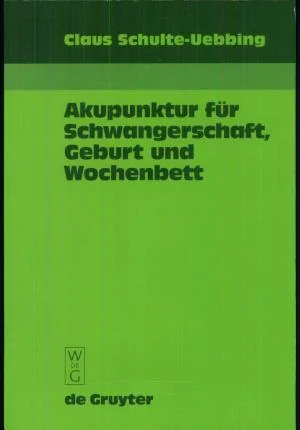
Akupunktur für Schwangerschaft, Geburt und Wochenbett
 80
80

Akupunktur für Schwangerschaft, Geburt und Wochenbett
Claus Schulte-Uebbing's "Akupunktur für Schwangerschaft, Geburt und Wochenbett" presents a focused, clinical approach to acupuncture in perinatal care. Its strength lies in the detailed, protocol-driven methodology for addressing common pregnancy and postpartum challenges. The book is particularly effective in outlining specific acupoint combinations for issues like morning sickness and for facilitating labor, drawing directly from established TCM diagnostic frameworks. However, a limitation is the relative scarcity of detailed case studies or broader discussions on the philosophical underpinnings of applying these techniques, which might leave some readers desiring more context beyond the purely technical. A passage detailing the use of specific points like SP6 (Sanyinjiao) for labor induction, explaining its energetic function in relation to the uterus, exemplifies the book's clinical precision.
This work offers a competent, practitioner-oriented guide to acupuncture in obstetrics.
📝 Description
80
### What It Is
This volume, originally published in 2000 by Claus Schulte-Uebbing, offers a specialized exploration of acupuncture's application during the crucial phases of pregnancy, childbirth, and the postpartum period. It moves beyond general wellness, focusing on specific energetic pathways and acupoint selections tailored to the physiological and emotional shifts experienced by expectant and new mothers. The work provides a framework for understanding how traditional Chinese medicine principles can support these significant life events.
### Who It's For
"Akupunktur für Schwangerschaft, Geburt und Wochenbett" is intended for practitioners of acupuncture and Traditional Chinese Medicine (TCM) seeking to deepen their knowledge in obstetrics and gynecology. It also serves midwives, doulas, and birth educators interested in complementary therapies that can be integrated into perinatal care. Individuals studying TCM with a focus on women's health will find this text a valuable resource for understanding specific protocols and their theoretical underpinnings.
### Historical Context
The early 21st century saw a growing interest in integrating traditional medicine with Western obstetrical practices. Schulte-Uebbing's work emerged within this context, contributing to a broader discourse on the efficacy and safety of acupuncture in prenatal and postnatal care. While acupuncture's roots stretch back millennia, its systematic application to these specific stages of the female reproductive cycle gained academic and clinical attention during this period, moving from anecdotal evidence to more structured study.
### Key Concepts
The book details specific acupuncture protocols designed to address common issues such as nausea, labor induction, pain management during labor, and postpartum recovery. It emphasizes the importance of timing, point selection, and needle manipulation to harmonize the body's Qi (vital energy) and Blood. Concepts like the Eight Extraordinary Vessels and their role in pregnancy, along with meridian theory as it applies to fetal positioning and uterine function, are central to its approach.
💡 Why Read This Book?
• Learn specific acupuncture point combinations and energetic rationale for managing pregnancy discomforts, as detailed in the section on "Schwangerschaftsbeschwerden" (Pregnancy Discomforts). • Gain practical techniques for supporting natural labor induction and pain relief during childbirth, referencing protocols discussed for "Geburt" (Childbirth). • Understand the application of acupuncture for postpartum recovery and addressing common issues like lactation support, as outlined in the "Wochenbett" (Postpartum) section.
⭐ Reader Reviews
Honest opinions from readers who have explored this book.
❓ Frequently Asked Questions
When was the first edition of "Akupunktur für Schwangerschaft, Geburt und Wochenbett" published?
The first edition of "Akupunktur für Schwangerschaft, Geburt und Wochenbett" by Claus Schulte-Uebbing was published in the year 2000.
What specific phases of a woman's reproductive cycle does this book cover?
The book specifically covers acupuncture applications during pregnancy, the process of childbirth, and the postpartum recovery period, known as "Wochenbett".
Is this book suitable for individuals new to acupuncture?
While it provides detailed protocols, the book is primarily aimed at practitioners and students of acupuncture and TCM. A foundational understanding of meridian theory is beneficial.
What are some common issues addressed by the acupuncture protocols in the book?
The book addresses common pregnancy ailments like nausea, labor induction, pain management during labor, and postpartum recovery issues, offering specific acupoint prescriptions.
Does the book discuss the historical development of acupuncture in obstetrics?
The book focuses more on contemporary clinical applications and protocols rather than a deep historical survey, though it operates within the long tradition of TCM.
Who is the author, Claus Schulte-Uebbing?
Claus Schulte-Uebbing is the author of "Akupunktur für Schwangerschaft, Geburt und Wochenbett", a work that brings his expertise in acupuncture to the field of perinatal care.
🔮 Key Themes & Symbolism
Perinatal Qi Regulation
This work emphasizes the critical importance of balancing Qi (vital energy) and Blood throughout the reproductive cycle. It details how specific acupuncture points and techniques can harmonize the mother's energetic system during pregnancy, labor, and postpartum. The focus is on preventing stagnation, supporting deficient conditions, and promoting smooth transitions between these significant life stages, aligning with Traditional Chinese Medicine's holistic view of health.
Labor Support Protocols
A significant portion of the book is dedicated to acupuncture's role in supporting labor. This includes methods for encouraging labor to begin when overdue (induction) and managing pain during contractions. Schulte-Uebbing outlines precise acupoint selections and stimulation techniques believed to influence uterine activity and pain perception, drawing on centuries of TCM practice adapted for modern obstetrical contexts.
Postpartum Recovery Energetics
The "Wochenbett" (postpartum) section explores how acupuncture can aid the mother's recovery after childbirth. This involves addressing common postpartum complaints such as fatigue, lochia regulation, and insufficient lactation. The principles focus on replenishing Qi and Blood, clearing residual stagnation from labor, and restoring the mother's vital energy to facilitate bonding and care for the newborn.
Meridian Pathways in Reproduction
The book navigates the intricate relationships between specific meridian pathways and the reproductive organs and processes. It explains how stimulating points on channels like the Spleen, Liver, and Kidney meridians, as well as the Extraordinary Vessels, can influence conception, fetal development, labor progression, and postpartum healing, providing a theoretical framework for the clinical protocols offered.
💬 Memorable Quotes
“Specific acupoint selections for labor induction and pain management.”
— This highlights the book's practical, clinical focus on actionable techniques for practitioners aiming to support women through the birthing process using Traditional Chinese Medicine principles.
“The energetic impact of Qi and Blood balance on maternal health.”
— This concept underscores the holistic approach of TCM, suggesting that the physical and emotional well-being of the mother is intrinsically linked to the smooth flow and sufficiency of her vital energy during pregnancy and postpartum.
“Addressing postpartum recovery through meridian therapy.”
— This points to the book's utility beyond labor, offering guidance on how acupuncture can facilitate the mother's physical and energetic restoration in the crucial weeks following childbirth.
“Tailoring acupuncture protocols to each stage of the perinatal cycle.”
— This emphasizes that the book provides distinct strategies for pregnancy, labor, and the postpartum period, recognizing the unique physiological and energetic needs of each phase.
“The application of Traditional Chinese Medicine in modern obstetrics.”
— This signifies the book's role in bridging ancient healing arts with contemporary healthcare, demonstrating the relevance and potential integration of acupuncture into standard perinatal care.
🌙 Esoteric Significance
Tradition
This work aligns with the practical application of Traditional Chinese Medicine (TCM), a system deeply rooted in Taoist philosophy and observable energetic principles. While not strictly 'esoteric' in the Western sense of secret societies or Hermetic traditions, TCM itself operates on principles of Qi, Yin/Yang, and Five Elements, which represent a profound, non-material understanding of health and the cosmos. Schulte-Uebbing's application to pregnancy situates this ancient medical system within the profound energetic shifts of human reproduction.
Symbolism
Key symbolic concepts revolve around the flow of Qi and Blood, representing the vital life force and its nourishing medium. The meridians themselves can be seen as symbolic pathways connecting the microcosm of the body to the macrocosm. Specific acupoints often carry symbolic resonance related to their names or locations, such as SP6 (Sanyinjiao), the 'Intersection of Three Yin,' signifying its crucial role in female reproductive health and its connection to fundamental Yin energies.
Modern Relevance
Contemporary practitioners of TCM, particularly those specializing in women's health and obstetrics, continue to draw upon the clinical protocols and theoretical frameworks presented in works like Schulte-Uebbing's. Its relevance is seen in modern acupuncture clinics, birth centers, and academic programs worldwide that integrate TCM into prenatal, labor, and postpartum care, reflecting a growing acceptance and demand for holistic and natural approaches to reproductive health.
👥 Who Should Read This Book
• Licensed acupuncturists and TCM practitioners seeking to expand their expertise in perinatal care and learn specific protocols for pregnancy, labor, and postpartum. • Midwives and doulas interested in understanding and potentially integrating acupuncture-based supportive therapies into their birth work practice. • Students of Traditional Chinese Medicine focusing on gynecology and obstetrics who require a structured, clinical text for their studies.
📜 Historical Context
Published in 2000, Claus Schulte-Uebbing's "Akupunktur für Schwangerschaft, Geburt und Wochenbett" emerged during a period of increasing global interest in complementary and alternative medicine (CAM) within mainstream healthcare. This era saw a significant push for evidence-based practices, leading to more rigorous study of traditional modalities like acupuncture, particularly in areas like pain management and women's health. The work contributed to the growing body of literature that sought to systematize and validate TCM approaches for obstetric and gynecological conditions. While acupuncture's use in China dates back millennia, its integration into Western obstetrics faced challenges, often contrasted with established pharmacological and surgical interventions. Schulte-Uebbing's publication arrived as practitioners and researchers were actively seeking to demonstrate acupuncture's safety and efficacy, building upon foundational texts and clinical observations from earlier decades, such as those influenced by figures like Dr. Shi-Zhen Chen who popularized acupuncture for gynecological issues.
📔 Journal Prompts
The energetic shifts during pregnancy and their corresponding acupuncture points.
Labor induction techniques and their theoretical basis.
Postpartum recovery strategies and Qi replenishment.
The role of specific meridians in supporting childbirth.
Integrating TCM principles into modern perinatal care.
🗂️ Glossary
Qi
Often translated as vital energy or life force, Qi is the fundamental concept in TCM representing the animating power within all living things. Its smooth flow and sufficiency are crucial for health.
Blut (Blood)
In TCM, 'Blut' refers not only to the physical blood but also to a broader concept of nourishing essence. It is closely related to Qi and essential for sustaining life and function.
Meridian
These are pathways or channels through which Qi and Blood circulate in the body, connecting acupuncture points and forming an intricate network that links internal organs to the surface.
Schwangerschaftsbeschwerden
German term for pregnancy discomforts, referring to common ailments experienced during pregnancy, such as nausea, fatigue, and back pain, which can be addressed with acupuncture.
Geburt
German term for childbirth or birth. This section of the book likely covers acupuncture applications related to facilitating labor and managing pain during delivery.
Wochenbett
German term for the postpartum period, typically the six weeks following childbirth. The book discusses how acupuncture can aid recovery and address common postpartum issues.
Akkupunkturpunkte
Specific locations on the body, typically along meridians, where acupuncture needles are inserted or pressure is applied to influence the flow of Qi and Blood.