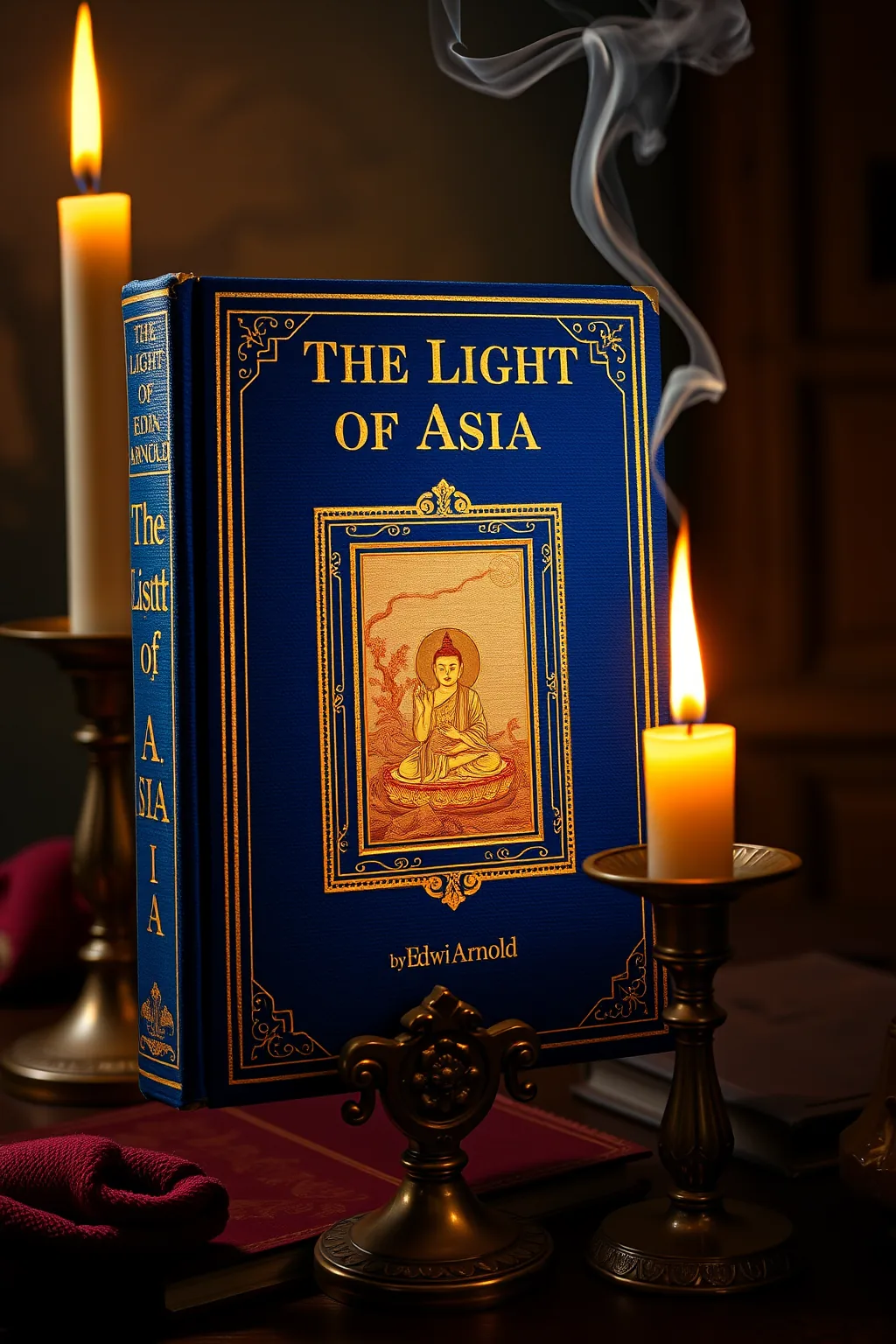
The Light of Asia
 73
73

The Light of Asia



Evander Ashcroft, Alchemy & Hermeticism Editor: Edwin Arnold's 'The Light of Asia' is a sublime poetic rendering of the Buddha's life, offering profound esoteric insights cloaked in exquisite verse. It transcends mere biography, delving into the alchemical transformation of Siddhartha from prince to the Awakened One. The work illuminates core Buddhist tenets – impermanence, compassion, the cessation of suffering – with a clarity that resonates deeply with hermetic principles of duality and transcendence. Its strength lies in its ability to distill complex philosophical ideas into accessible, beautiful language, making it an ideal companion for seekers and scholars of Eastern mysticism and comparative religion.
📝 Description
73
Edwin Arnold's 1879 poem retells the life of the Buddha from the Lalitavistara Sūtra.
Edwin Arnold's "The Light of Asia" recounts the life of Siddhartha, the prince who became the Buddha. Published in 1879, the poetic narrative draws from the Lalitavistara Sūtra, a text detailing the Buddha's life and teachings. Arnold's verses describe the prince's realization of suffering, his decision to leave his privileged life, and his subsequent spiritual practices. The poem follows his path toward enlightenment and the development of his philosophy.
It invites reflection on existence, the nature of attachment, and the power of inner understanding. The work aims to convey the core tenets of Buddhist thought in an accessible poetic form. For readers interested in contemplative traditions and Eastern philosophies, this volume offers an introduction to concepts of liberation and self-awareness. Its verses present universal ideas that resonate across different cultures.
Published in the late 19th century, "The Light of Asia" entered a Western intellectual climate increasingly interested in Eastern religions and philosophies. It was part of a broader engagement with Buddhist texts and concepts, which were being translated and studied by scholars. Arnold's poem, while poetic and accessible, introduced a wider audience to the story of the Buddha and core Buddhist ideas, contributing to the growing awareness of these traditions in the West. It presented Buddhist narratives and philosophical ideas through a familiar Western literary form, making them approachable for many.
✍️ Author
Edwin Arnold
Sir Edwin Arnold was an English poet and journalist, best known for "The Light of Asia".
Buddhist Teacher
💡 Why Read This Book?
Embark on a profound spiritual odyssey and uncover the timeless wisdom of the Buddha's life. 'The Light of Asia' offers a poetic gateway to understanding suffering, compassion, and the path to liberation. Ideal for spiritual seekers, philosophers, and anyone yearning for deeper contemplation and a connection to ancient esoteric traditions.
⭐ Reader Reviews
Honest opinions from readers who have explored this book.
❓ Frequently Asked Questions
What is the primary focus of 'The Light of Asia'?
The book is a poetic narrative of the life of Siddhartha Gautama, the Buddha, detailing his journey from prince to enlightenment and the core philosophies he taught.
Who is the intended audience for this book?
It is intended for readers interested in mysticism, Eastern philosophy, contemplative practices, spiritual seekers, scholars of religion, and those drawn to profound poetic narratives.
Is 'The Light of Asia' a religious text or a literary work?
While based on Buddhist scriptures, it is presented as a literary work—a narrative poem. It translates spiritual teachings into accessible and beautiful verse.
What spiritual traditions does this book draw from?
It primarily draws from the Buddhist tradition, specifically the Lalitavistara Sūtra, offering insights into its core doctrines and the life of its founder.
Can this book be read by someone unfamiliar with Buddhism?
Yes, the poetic and narrative style makes it accessible to those new to Buddhism, serving as an excellent introduction to its foundational principles and the Buddha's story.
🔮 Key Themes & Symbolism
The Awakening to Suffering
This central theme explores Siddhartha's profound realization of the pervasive nature of suffering in the human experience. Through his encounters with aging, sickness, and death, the prince is compelled to question the ephemeral nature of worldly pleasures and the illusion of permanence. This awakening is the catalyst for his spiritual quest, marking the transition from a life of privilege to one of profound introspection and the earnest search for a path to alleviate universal pain. It is the initial spark that ignites the flame of spiritual inquiry.
The Path of Renunciation and Discipline
Arnold beautifully depicts Siddhartha's radical decision to renounce his princely life, his family, and all worldly attachments. This act of renunciation is not an escape but a deliberate turning towards rigorous spiritual discipline. The narrative illustrates the arduous journey of meditation, asceticism, and self-mastery, highlighting the immense willpower and dedication required to transcend the ego and the sensory world. This theme underscores the transformative power of letting go of the material to embrace the spiritual.
The Dawn of Enlightenment
The culmination of Siddhartha's journey is his attainment of enlightenment under the Bodhi tree. 'The Light of Asia' poetically captures this central moment, symbolizing the dispelling of ignorance and the dawning of supreme wisdom. This theme explores the core tenets of the Buddha's teachings, such as the Four Noble Truths and the Eightfold Path, presented not as dogma but as useful insights into the nature of reality, karma, and the cessation of suffering. It represents the ultimate illumination of the mind.
💬 Memorable Quotes
Direct passages from the work, attributed to the author.
“He who is the Bodhisat, the Buddha-to-be.”
— This signifies the potential for enlightenment within all beings, a core tenet of Mahayana Buddhism and the concept of universal Buddhahood.
“The suffering of the world is the suffering of the soul.”
— This poetic line links individual pain to a universal existential condition, emphasizing the interconnectedness of all sentient beings.
“Seek not to be loved, but to love.”
— This is a powerful injunction towards selfless compassion and unconditional love, a core part of the Buddha's teachings on ethical conduct.
💡 Key Ideas
Editorial paraphrase of the work's core concepts — not direct quotes.
Ye suffer from your sensual desires.
This quote points to the root cause of suffering being attachment and craving, a fundamental principle in Buddhist philosophy.
Right is not right, and wrong is not wrong.
This quote alludes to the concept of emptiness (sunyata) and the illusory nature of dualistic thinking, where perceived opposites are ultimately inseparable.
🌙 Esoteric Significance
Tradition
This work is deeply rooted in the Buddhist tradition, specifically drawing from the Mahayana school's narrative accounts of the Buddha's life and teachings. Esoterically, it offers a profound allegory for the spiritual journey of the individual soul. The transformation of Siddhartha mirrors the alchemical process of purifying the self, shedding worldly attachments (base metals) to reveal the golden essence of awakened consciousness (the Philosopher's Stone). It speaks to the hidden potential for Buddhahood within every sentient being.
Symbolism
The narrative is rich with potent symbolism. Siddhartha's birth signifies a divine descent. The 'Four Sights' (aging, sickness, death, ascetic) are archetypal encounters with the limitations of worldly existence. The Bodhi tree represents the ultimate seat of wisdom and the interconnectedness of all things. The lotus flower, often associated with purity and enlightenment, symbolizes the emergence of the spiritual from the mud of material existence. The path itself is a symbolic representation of the arduous but ultimately rewarding journey of self-discovery and liberation.
Modern Relevance
In an age often characterized by materialism, existential anxiety, and spiritual seeking, 'The Light of Asia' remains profoundly relevant. Its exploration of suffering, impermanence, and the quest for inner peace offers timeless wisdom applicable to modern life. The emphasis on mindfulness, compassion, and detachment appeals to contemporary psychological and contemplative practices. For those grappling with the complexities of existence, the book provides a strong example of hope and a practical framework for cultivating inner resilience and a deeper understanding of the human condition.
👥 Who Should Read This Book
This luminous work is a treasure for a diverse audience. **Beginners** seeking an accessible and beautiful introduction to Buddhist philosophy and the life of the Buddha will find it captivating. **Spiritual seekers** yearning for profound wisdom and contemplative inspiration will be deeply moved. **Scholars of religion and comparative mysticism** will appreciate its historical significance and poetic depth. **Practitioners** of meditation and mindfulness will find resonance with its core teachings on overcoming suffering and cultivating inner peace. It is a book for anyone who seeks to understand the human condition and the path towards awakening.
📜 Historical Context
Published in 1879, 'The Light of Asia' emerged during a period of heightened Western interest in Eastern philosophies and religions, often termed the 'Occult Revival' or the 'New Age' movement's precursors. Victorian England was experiencing a thirst for spiritual exploration beyond the confines of traditional dogma, seeking wisdom in ancient texts and exotic cultures. Edwin Arnold, a scholar of Sanskrit and a journalist, bridged this gap with his accessible yet profound poetic adaptation of Buddhist lore. The book's immense popularity played an important role in popularizing Buddhism in the West, introducing concepts like karma, reincarnation, and Nirvana to a broad audience and influencing subsequent spiritual thinkers, writers, and artists.
📔 Journal Prompts
Reflect on a moment you first encountered suffering and how it shifted your perspective.
What worldly attachments do you find most difficult to relinquish, and why?
Meditate on the concept of impermanence and its impact on your daily life.
Consider the qualities of compassion and unconditional love; how can you cultivate them more fully?
Imagine your own 'Bodhi tree' – a place or state of profound inner peace and understanding. What does it look like and feel like?
🗂️ Glossary
Bodhisat
In Mahayana Buddhism, a being who is on the path to becoming a Buddha, possessing great compassion and wisdom, and delaying their own final enlightenment to help others.
Nirvana
The ultimate goal of Buddhism; a state of liberation from suffering, desire, and the cycle of rebirth (samsara), characterized by peace and enlightenment.
Karma
The principle of cause and effect; actions (physical, verbal, mental) that create consequences in this life and future lives, shaping one's destiny.
Samsara
The continuous cycle of birth, death, and rebirth, driven by ignorance, desire, and attachment, from which enlightenment (Nirvana) offers release.
Lalitavistara Sūtra
A significant Mahayana Buddhist text that elaborately narrates the life and teachings of the Buddha, emphasizing his divine nature and miraculous deeds.
This book appears in 2 collections
🔮 Readers Also Liked
Browse all →







More by Edwin Arnold
All books →





From the “Meditation” Collection
View all →![CIA Reading Room cia-rdp75-00149r000200590003-6: PROTECTING [PRIVACY AND FREEDOM]](/img/thumb/cia-reading-room-cia-rdp75-00149r000200590003-6-protecting-privacy-and-freedom-cia-reading-room.webp)







More Free Mysticism & Contemplation Books
View all →

![[Bat i le-gani] =](/img/thumb/bat-i-le-gani-joseph-isaac-schneersohn-604811.webp)