A serious call to a devout and holy life

 83
83

A serious call to a devout and holy life
William Law's "A Serious Call to a Devout and Holy Life" is less a gentle invitation and more a spiritual gauntlet thrown down. Its enduring power lies in its unflinching demand for authenticity in religious practice. Law's dissection of self-deception, particularly in the chapter concerning prayer, is particularly incisive, exposing the ways in which we can perform piety without genuine devotion. The limitation, however, is its sheer intensity; the relentless focus on renunciation and rigorous self-discipline can feel overwhelming to a modern reader accustomed to more psychologically nuanced approaches to spirituality. Nevertheless, the work's core message – that true faith must permeate every facet of existence – remains a potent challenge. It is a necessary, albeit demanding, examination of the soul's true north.
📝 Description
83
### What It Is William Law's "A Serious Call to a Devout and Holy Life," first published in 1740, is a foundational text in Christian asceticism and spiritual discipline. It is not a devotional manual in the modern sense, but rather a rigorous examination of the true nature of Christian living. Law challenges readers to move beyond superficial piety and embrace a life of deep, intentional holiness. The work presents a stark contrast between nominal Christianity and the demanding, all-encompassing commitment required by the Gospel.
### Who It's For This book is for serious seekers of spiritual truth, particularly those disillusioned with shallow religious practice. It speaks to individuals wrestling with the practical application of their faith in daily life, those who feel a persistent call to a deeper, more authentic spiritual existence. Readers who appreciate theological depth and are prepared for a challenging, unvarnished critique of spiritual complacency will find this work compelling. It is not for the faint of heart but for those committed to rigorous self-examination and spiritual growth.
### Historical Context Published in 1740, "A Serious Call" emerged during a period of religious revivalism and intellectual ferment in England. It predates the full flowering of Methodism, though its influence on John Wesley and George Whitefield is undeniable. Law's work stood in contrast to the more deistic or latitudinarian tendencies gaining traction in some circles. It also appeared at a time when the Anglican Church, while established, faced internal calls for greater spiritual fervor. Law's uncompromising stance on piety would later influence figures outside of mainstream Christianity, finding echoes in later esoteric movements.
### Key Concepts The central tenet of the book is the absolute necessity of living a life entirely devoted to God, permeating every action, thought, and intention. Law argues that true religion is not an occasional observance but a constant state of being. He critiques the common practice of dividing life into secular and sacred spheres, asserting that all of life should be lived in obedience to divine will. The concept of self-denial is explored not as mere abstinence, but as a positive redirection of will towards divine purpose. He emphasizes that spiritual progress requires constant vigilance against worldly distractions and the cultivation of virtues through deliberate practice.
✍️ Author
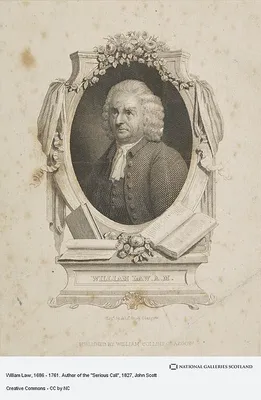
William Law
William Law (1686 – 9 April 1761) was a Church of England priest who lost his position at Emmanuel College, Cambridge, when his conscience would not allow him to take the required oath of allegiance to the first Hanoverian monarch, King George I. Previously…
💡 Why Read This Book?
• Understand the profound disconnect between outward religious observance and inner spiritual reality, as detailed in Law's critique of nominal Christianity. • Grasp the concept of "devout and holy life" not as a set of rules, but as a complete orientation of one's will, a core teaching from Law's 1740 treatise. • Confront the necessity of constant self-examination and the redirection of desire, principles powerfully articulated in Law's exploration of self-denial.
⭐ Reader Reviews
Honest opinions from readers who have explored this book.
❓ Frequently Asked Questions
When was William Law's "A Serious Call to a Devout and Holy Life" first published?
William Law's "A Serious Call to a Devout and Holy Life" was first published in 1740, a significant year for religious and philosophical discourse in England.
What is the main argument of "A Serious Call to a Devout and Holy Life"?
The book argues that true Christian life requires total devotion to God, permeating all actions and thoughts, and challenges superficial piety with a call for rigorous, authentic spiritual practice.
Did "A Serious Call" influence any notable figures?
Yes, "A Serious Call" significantly influenced John Wesley and George Whitefield, key figures in the early Methodist movement, who were deeply impacted by Law's emphasis on practical holiness.
Is "A Serious Call" a book about monasticism or asceticism?
While it calls for rigorous discipline and self-denial, it is not exclusively about monasticism. Law intended it for all Christians, advocating for the application of these principles within everyday life.
What does William Law mean by 'a devout and holy life'?
For Law, a 'devout and holy life' means a complete dedication of one's being to God's will, where every activity, from mundane tasks to prayer, is performed with divine purpose and consciousness.
How does "A Serious Call" differ from typical modern devotional books?
Unlike many modern devotional books that offer gentle encouragement, Law's work presents a stark, demanding critique of spiritual complacency, pushing readers toward radical self-examination and commitment.
🔮 Key Themes & Symbolism
The Uncompromising Nature of True Piety
Law argues vehemently against a compartmentalized faith, where religious duties are confined to specific times or places. He asserts that genuine devotion, as espoused in his 1740 work, must inform every aspect of existence. This means that secular activities, social interactions, and even rest are to be undertaken with a conscious orientation towards God's will. This absolute demand for a unified spiritual life contrasts sharply with the era's tendency towards a more relaxed or compartmentalized approach to religion, challenging readers to live out their faith consistently and without compromise.
Critique of Spiritual Complacency
A central theme is Law's sharp rebuke of those who profess faith but fail to live it authentically. He identifies numerous ways individuals deceive themselves into believing they are devout while remaining enslaved to worldly desires or pride. This critique is particularly evident in his discussions on prayer and charity, where he exposes the superficiality that can masquerade as genuine spirituality. The work serves as a mirror, forcing readers to confront their own potential for spiritual laziness and self-deception, urging a return to the rigorous demands of the Gospel.
The Practice of Self-Denial
Law redefines self-denial not merely as abstinence from pleasure, but as the positive and active redirection of one's will and desires towards God. This involves a conscious effort to overcome ego, pride, and attachment to worldly things. He presents it as an essential discipline for spiritual growth, necessary for purifying the heart and aligning oneself with divine purpose. The book details how this practice should manifest in daily life, making it an integral part of a 'devout and holy life' rather than an optional add-on.
The Necessity of Divine Union
Ultimately, Law's call is for a profound union with God. He posits that all spiritual disciplines – prayer, self-denial, scripture study – are means to this end. The goal is not personal perfection in isolation, but a state of constant communion with the Divine. This union transforms ordinary life into a sacred act. The work emphasizes that this is not an unattainable ideal but a practical, albeit challenging, possibility for any sincere believer willing to commit fully to the spiritual path laid out in his text.
💬 Memorable Quotes
“If you are in a state of sin, you are not at liberty to live as you please.”
— This statement encapsulates Law's foundational principle: true freedom in a spiritual sense is found only in obedience to God. Any deviation from divine will, according to Law, results in a form of bondage, not liberty.
“Every Christian is obliged to live a life of piety.”
— Law stresses that piety is not an optional extra for Christians but a fundamental obligation. This implies that the spiritual life must be actively pursued and integrated into all aspects of one's existence, not merely observed passively.
“The greatest hindrance to the spiritual life is self-deceit.”
— This highlights Law's focus on internal spiritual honesty. He believed that people often create illusions about their spiritual state, preventing genuine progress by failing to confront their true condition and motivations.
“There is no such thing as a Christian without the practice of devotion.”
— This quote underscores Law's rejection of nominal Christianity. He argues that outward profession is insufficient; consistent, active devotion is the hallmark of a true follower of Christ.
“The world is full of people who are very religious, but not at all holy.”
— Law draws a critical distinction between religious activity and actual holiness. He suggests that one can be outwardly observant of religious forms without possessing the inner transformation and character that define true sanctity.
🌙 Esoteric Significance
Tradition
While primarily a work of Christian asceticism, "A Serious Call" resonates with broader esoteric traditions through its emphasis on inner transformation and the purification of the will. Its rigorous focus on self-discipline and the redirection of consciousness towards the Divine aligns with practices found in Hermeticism and certain mystical branches of Sufism and Kabbalah, albeit framed within a distinct Christian theological context. Law's demand for a life lived entirely in divine service offers a blueprint for achieving spiritual unity that transcends conventional religious boundaries.
Symbolism
The 'holy life' itself serves as a central symbol, representing not merely a set of practices but a state of being—a life fully aligned with the Divine. The concept of 'self-denial' functions symbolically, representing the shedding of the ego's limitations to allow for the influx of divine grace. Law's critique of 'worldly distractions' symbolizes the ever-present forces that obscure spiritual reality, highlighting the need for constant vigilance and discernment in the pursuit of inner truth.
Modern Relevance
Contemporary spiritual seekers, particularly those interested in disciplined contemplative practices and the integration of faith into daily life, draw inspiration from Law's work. Thinkers and practitioners within the modern contemplative movement, as well as those exploring Christian mindfulness or radical discipleship, often cite Law's uncompromising call to authenticity. His emphasis on the pervasive nature of spirituality continues to inform discussions on holistic living and the pursuit of inner transformation beyond purely ritualistic or doctrinal adherence.
👥 Who Should Read This Book
• Serious Christian seekers wrestling with the practical application of their faith, who desire a deeper, more authentic spiritual life beyond superficial observance. • Students of religious history and movements, particularly those interested in the precursors to Methodism and the broader context of 18th-century English spirituality. • Ascetically inclined individuals seeking a challenging and unvarnished examination of spiritual discipline, self-denial, and the pursuit of unwavering devotion to the Divine.
📜 Historical Context
William Law's "A Serious Call to a Devout and Holy Life," published in 1740, emerged during a period of significant religious and intellectual flux in England. The early 18th century saw the rise of Methodism, spearheaded by figures like John Wesley and George Whitefield, who were deeply influenced by Law's rigorous approach to piety and spiritual discipline. Law's work presented a stark counterpoint to more latitudinarian or deistic trends prevalent in some intellectual circles, which favored reason over revelation or emphasized a less demanding form of faith. The book challenged the prevailing notion of a comfortable, nominal Christianity within the established Anglican Church, advocating instead for a life wholly dedicated to God. While not directly engaging with, for instance, the burgeoning Enlightenment focus on empirical reason, Law's intense focus on inner spiritual experience and divine will positioned his work as a powerful call to a more fervent, ascetical Christianity that would resonate with revivalist movements.
📔 Journal Prompts
The persistent call to a devout and holy life: how does it manifest in your daily routine?
Law's critique of self-deception: identify one instance where you might be deceiving yourself about your spiritual state.
The practice of self-denial: in what specific, non-obvious ways can you redirect your will towards divine purpose today?
Analyze your own 'spiritual disciplines'—are they mere performances or genuine expressions of devotion?
Reflect on the balance between divine union and worldly engagement as described by Law.
🗂️ Glossary
Piety
In Law's context, piety refers to a deep, sincere reverence for God and a commitment to living in accordance with divine will, extending beyond mere outward religious observance.
Devout and Holy Life
This signifies a life wholly dedicated to God, where every action, thought, and intention is oriented towards divine purpose, characterized by consistent spiritual discipline and inner transformation.
Self-Denial
The practice of foregoing personal desires, comforts, or willfulness for the sake of spiritual growth and alignment with God's purpose, viewed not as deprivation but as redirection.
Spiritual Complacency
A state of spiritual laziness or self-satisfaction where one believes they are devout without the necessary inner transformation or consistent practice, often stemming from self-deception.
Worldly Distractions
Elements of secular life—such as excessive attachment to possessions, status, or fleeting pleasures—that divert attention and energy away from spiritual pursuits and divine connection.
Divine Will
The perfect plan and desire of God for creation and humanity, which Law urges believers to constantly seek, understand, and obey as the ultimate guide for a holy life.
Nominal Christianity
A form of faith characterized by outward profession and adherence to religious customs without genuine inner conviction, transformation, or consistent practice of its core tenets.




![The Conference Of The Birds Penguin Classics [download]](/img/thumb/the-conference-of-the-birds-penguin-classics-download.webp)