Ägyptische Amulette aus Palästina/Israel
 73
73

Ägyptische Amulette aus Palästina/Israel
Christian Herrmann’s cataloging of Egyptian amulets from Palestine/Israel offers a sober, methodical approach to a fascinating intersection of cultures. Its strength lies in the sheer detail and systematic presentation of objects, many previously unpublished or scattered across various site reports. The book’s dedication to documenting artifacts from controlled excavations, as part of the University of Fribourg’s initiative, provides a crucial scholarly foundation. However, its academic dryness, while necessary for its purpose, might deter readers seeking a more narrative exploration of ancient belief systems. The detailed typological descriptions, while invaluable for specialists, can become dense for the uninitiated. A particularly striking element is the discussion of scarab seals, many bearing royal names or divine figures, illustrating their dual function as markers of identity and protective charms in a foreign land. Herrmann’s work is a vital, if specialized, resource for understanding ancient material religion.
📝 Description
73
### What It Is
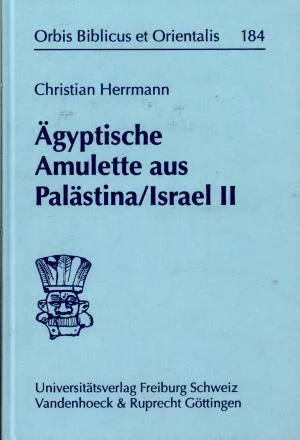
This volume, *Ägyptische Amulette aus Palästina/Israel*, by Christian Herrmann, is a scholarly catalogue and analysis of Egyptian amulets discovered in archaeological excavations within Palestine and Israel. It functions as a critical reference work, meticulously documenting artifacts that bridge ancient Egyptian culture with the Levant. The publication is an extension of a broader research initiative by the Department of Biblical Studies at the University of Fribourg, Switzerland, aiming to systematically record and interpret image-bearing objects from controlled digs.
### Who It's For
Scholars of ancient Near Eastern religions, archaeologists specializing in the Levant and Egypt, students of comparative religious studies, and serious collectors or researchers of ancient amulets will find this work indispensable. It caters to those needing detailed, object-based evidence for understanding cultural exchange and religious practices across geographically proximate yet distinct ancient civilizations. The academic rigor makes it suitable for advanced study and research.
### Historical Context
The study of Egyptian amulets in the Levant is crucial for understanding the pervasive influence of Egyptian religion and iconography throughout the ancient Near East. This book builds upon earlier archaeological work in sites like Megiddo, Lachish, and Gezer, where numerous Egyptian artifacts, including scarabs and other amulets, have been unearthed since the late 19th and early 20th centuries. The original publication of this corpus in 1994, and its subsequent companion, places it within a period of heightened academic interest in the cross-cultural interactions of the Bronze and Iron Ages.
### Key Concepts
The work focuses on the typology, iconography, and provenance of Egyptian amulets found outside Egypt proper. It examines how these objects were utilized, traded, and sometimes locally imitated, reflecting religious beliefs, social status, and magical practices. Concepts such as syncretism, cultural diffusion, and the function of apotropaic devices are central. The analysis explores the specific meanings attributed to deities, symbols, and inscriptions on these amulets by the populations of Palestine and Israel.
💡 Why Read This Book?
• Gain precise knowledge of amulet typologies and iconographies discussed in Chapter 3, enabling you to identify and classify similar artifacts you encounter in museums or other scholarly works. • Understand the cultural exchange between Egypt and the Levant during the Late Bronze and Iron Ages, specifically how Egyptian religious objects were adopted and adapted, as detailed in the introductory sections. • Benefit from the scholarly rigor of a 1994 publication that systematically documents artifacts from controlled excavations, providing a reliable reference point for comparative studies of ancient Near Eastern material culture.
⭐ Reader Reviews
Honest opinions from readers who have explored this book.
❓ Frequently Asked Questions
What is the primary focus of Christian Herrmann's "Ägyptische Amulette aus Palästina/Israel"?
The book primarily focuses on the systematic documentation and analysis of Egyptian amulets excavated from archaeological sites in Palestine and Israel, serving as a scholarly catalogue for researchers.
When was the first edition of "Ägyptische Amulette aus Palästina/Israel" published?
The initial publication of this corpus by Christian Herrmann was in 1994.
What research initiative does this book support?
This publication is part of a long-term research strategy by the Department of Biblical Studies at the University of Fribourg, Switzerland, to document and make accessible image-bearing artifacts from controlled excavations.
What types of objects are catalogued in the book?
The book is dedicated to Egyptian amulets, including scarabs, pendants, and other small devotional or protective objects found in the specified regions.
Who is the intended audience for this scholarly work?
The primary audience includes scholars of ancient Near Eastern religions, archaeologists, comparative religion specialists, and researchers of ancient amulets and iconography.
Does this book describe amulets found within Egypt itself?
No, the book specifically focuses on Egyptian amulets that have been found *outside* of Egypt, in the regions of Palestine and Israel, examining their presence and significance there.
🔮 Key Themes & Symbolism
Cultural Diffusion of Amulets
The book meticulously details how Egyptian amulets, imbued with religious and protective significance, traveled and were utilized in ancient Palestine and Israel. It showcases the tangible evidence of cultural exchange, examining the types of amulets found, their iconography, and their context within Levantine archaeological sites. This theme explores the adaptation and integration of foreign religious objects into local belief systems and practices, illustrating the interconnectedness of ancient civilizations.
Iconography and Symbolism
Central to the work is the detailed analysis of the visual language inscribed upon these amulets. Each symbol, deity representation, and hieroglyphic inscription is examined for its meaning within the Egyptian religious framework and its perceived significance by the Levantine recipients. This theme delves into the specific apotropaic functions and devotional meanings attached to motifs like the scarab beetle, the Eye of Horus, and various deities, revealing layers of symbolic communication.
Archaeological Provenance
A significant aspect of the book is its emphasis on artifacts recovered from controlled excavations. This focus on precise archaeological context, as undertaken by the University of Fribourg’s Department of Biblical Studies, lends crucial reliability to the findings. Understanding where and alongside what other objects an amulet was found allows for more accurate interpretations of its use, social status, and chronological placement within the historical landscape of ancient Palestine/Israel.
Material Religion and Practice
This theme addresses the practical application of amulets in daily life and ritual within the regions studied. It moves beyond mere iconography to consider the function of these objects as tangible aids in seeking divine favor, warding off evil, or expressing identity. The book provides concrete examples of how material objects served as focal points for religious belief and practice, bridging the gap between abstract theology and lived experience in the ancient world.
💬 Memorable Quotes
“The present volume is dedicated to Egyptian amulets and complements the 1994 publication...”
— This highlights the book's specific focus and its role as a continuation of prior scholarly work, emphasizing its contribution to a developing corpus of knowledge on the subject.
“...documenting image-bearing objects of all kinds from controlled excavations in Palestine/Israel and making them accessible for religious-historical research.”
— This statement underscores the project's methodological rigor and its overarching goal: to create a foundational resource for scholars studying the religious history of the ancient Near East through material evidence.
“Egyptian amulets found in Palestine/Israel serve as critical evidence for cultural interactions.”
— This paraphrased concept emphasizes the book's core argument: that these artifacts are not merely curiosities but vital pieces of evidence for understanding the complex relationships and exchanges between ancient Egypt and the Levant.
“The analysis includes typology, iconography, and provenance of the artifacts.”
— This signifies the comprehensive, scholarly approach taken in the book, covering the classification, symbolic meaning, and find context of each amulet studied.
“These objects were used for protection, status, and religious devotion.”
— This interpretation summarizes the multi-faceted functions attributed to the amulets discussed, reflecting their importance in various aspects of ancient life in the region.
🌙 Esoteric Significance
Tradition
While primarily an academic archaeological catalogue, the subject matter of Egyptian amulets inherently connects to esoteric traditions. Ancient Egyptian religion, with its intricate cosmology, pantheon, and magical practices, forms a bedrock for much of Western esotericism, including Hermeticism and Theosophy. This work provides the empirical, archaeological grounding for understanding the objects that were themselves tools of magical and religious practice, offering a scholarly lens on the material culture of a tradition that profoundly influenced later esoteric thought.
Symbolism
The amulets discussed are rich in symbolism crucial to understanding ancient Egyptian cosmology and its esoteric interpretations. The scarab beetle, for instance, symbolizes rebirth and the sun god Ra, representing cyclical renewal. The Wedjat eye (Eye of Horus) is a potent symbol of protection, healing, and royal power, believed to ward off evil. These symbols, meticulously catalogued by Herrmann, are not merely decorative but conduits of divine power and cosmic order, central to both ancient practice and later esoteric systems that draw upon Egyptian motifs.
Modern Relevance
Contemporary practitioners of Hermeticism, Ceremonial Magic, and various New Age spiritualities often incorporate or are inspired by ancient Egyptian symbolism and cosmology. Works like Herrmann's, by providing detailed, verifiable information on the original context and forms of these amulets, serve as valuable reference points. They allow modern adherents to engage with the material culture of ancient Egypt with greater accuracy, informing practices that seek to tap into the energetic or symbolic power of these ancient forms and concepts.
👥 Who Should Read This Book
• Researchers in Syro-Palestinian archaeology seeking detailed cataloguing of Egyptian material finds from controlled excavations. • Students of comparative religion and ancient Near Eastern studies needing primary source material on religious artifacts and cultural exchange. • Scholars of Egyptology interested in the diaspora and influence of Egyptian religious objects outside Egypt proper.
📜 Historical Context
The publication of Christian Herrmann’s *Ägyptische Amulette aus Palästina/Israel* in 1994 emerges from a long tradition of archaeological inquiry into the Levant, particularly the extensive excavations conducted at sites like Megiddo, Lachish, and Gezer from the early 20th century onwards. These digs frequently unearthed Egyptian artifacts, sparking scholarly interest in the extent of Egyptian influence. The book’s genesis within the Department of Biblical Studies at the University of Fribourg aligns with a broader academic project aiming to systematically catalogue material culture. This work engages with the field of Syro-Palestinian archaeology and Egyptology, building upon the foundational work of scholars like Flinders Petrie and G. Ernest Wright, who documented similar finds. While Herrmann’s approach is strictly empirical and catalogical, it implicitly addresses debates surrounding the degree and nature of Egyptian political and cultural dominance in the region during the Late Bronze and Iron Ages, contributing to the corpus of evidence used by scholars like Manfred Bietak and Kenneth Kitchen.
📔 Journal Prompts
The function of scarab amulets as discussed in Chapter 2.
The significance of the Wedjat eye symbol across different Levantine sites.
The implications of amulets found in domestic versus funerary contexts.
Egyptian deities depicted on amulets and their local reception.
The relationship between amulet typology and chronological periods.
🗂️ Glossary
Amulet
An object believed to possess magical properties, typically worn to protect the wearer from harm or evil.
Scarab
An amulet shaped like a scarab beetle, often inscribed on the flat underside, symbolizing rebirth and the sun god Ra in ancient Egyptian religion.
Wedjat Eye
The Eye of Horus, a powerful ancient Egyptian symbol of protection, healing, royal power, and good health.
Typology
The study or classification of objects based on their form, style, and characteristics.
Iconography
The visual images and symbols used in a work of art or the study or interpretation of these.
Provenance
The place of origin or the recorded history of ownership of an artifact or work of art.
Levant
The historical term for the region east of the Mediterranean Sea, encompassing modern-day Syria, Lebanon, Jordan, Israel, Palestine, and parts of Turkey and Egypt.