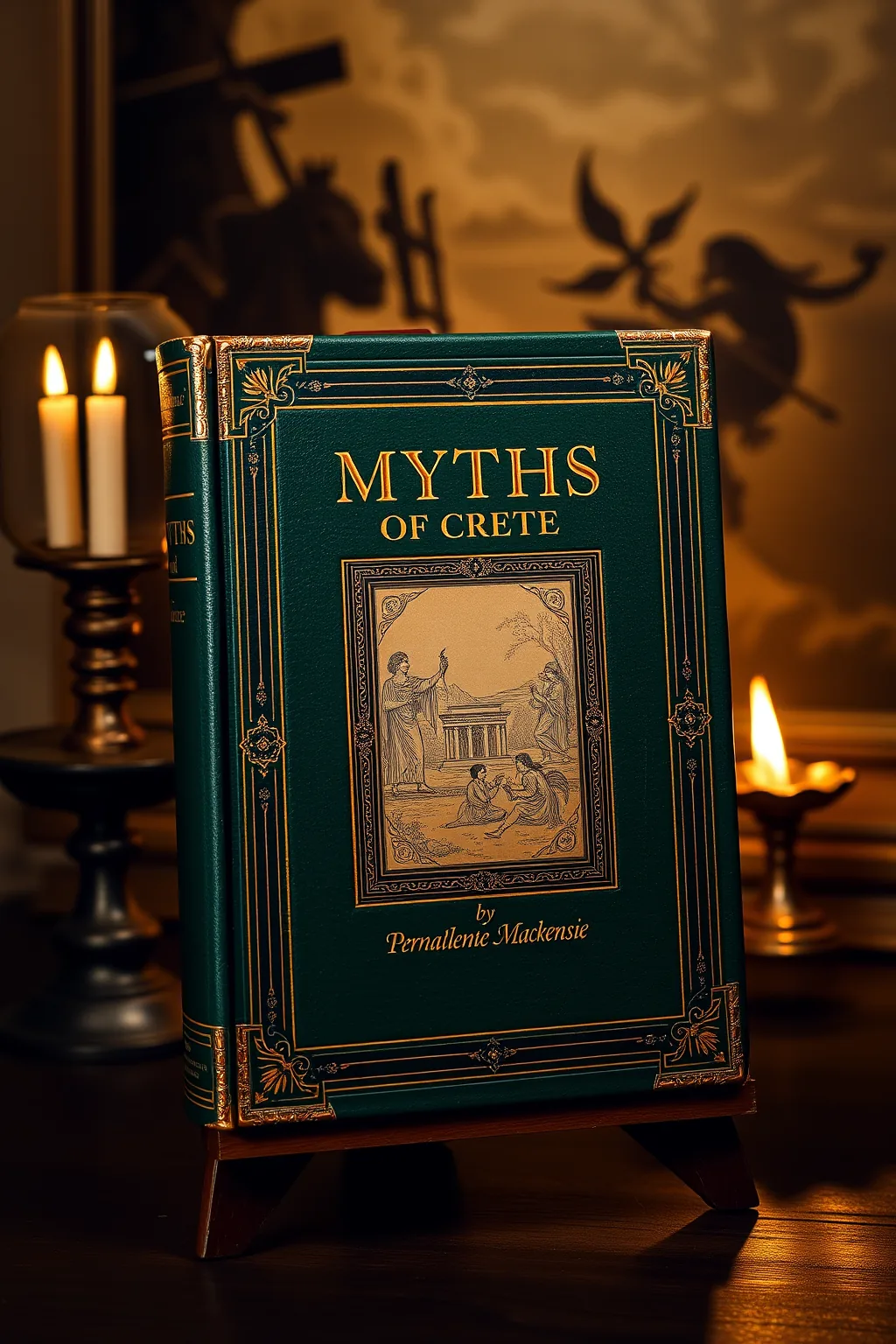
Myths of Crete and Pre-Hellenic Europe
 72
72

Myths of Crete and Pre-Hellenic Europe


Donald Alexander Mackenzie’s 'Myths of Crete and Pre-Hellenic Europe' is a foundational text for any serious student of esoteric history. Mackenzie masterfully excavates the symbolic landscape of a civilization whose influence predates Western civilization as we know it. He uncovers not just historical facts, but the very spiritual architecture of the Minoans, revealing a worldview deeply attuned to chthonic forces and matriarchal energies. His exploration of their myths offers profound insights into early European shamanism and earth-centered spirituality. This work is invaluable for its clarity in presenting complex mythological systems and its enduring relevance to understanding the roots of Western esoteric traditions. A treasure for scholars and mystics alike, it illuminates the sacred geometry of ancient belief.
📝 Description
72
Donald Alexander Mackenzie's 1917 book examines the myths of Crete and pre-Hellenic Europe.
Donald Alexander Mackenzie's 'Myths of Crete and Pre-Hellenic Europe' looks past later Greek epics to the earlier stories of the Minoan civilization. The book investigates the island of Crete before classical Greek culture took hold, suggesting its myths hold esoteric significance. Mackenzie presents this ancient society through its nature gods, powerful female figures, and ritual practices. He analyzes the symbolism in Minoan art and buildings to understand their worldview, focusing on concepts of creation and destruction. The work aims to reveal underlying spiritual patterns and the influence of lost traditions. It encourages reflection on how civilizations repeat and how myths explain fundamental aspects of life.
Published in 1917, Mackenzie's work sits within the early 20th-century interest in ancient mythologies and their supposed connections to deeper spiritual realities. It engages with a scholarly tradition that sought esoteric meanings in pre-Classical cultures, often linking them to universal archetypes and forgotten wisdom. The book taps into a vein of thought that saw these ancient societies as repositories of primal truths about human consciousness and the cosmos, predating and influencing later religious and philosophical systems. This perspective often overlapped with burgeoning fields like comparative mythology and early psychology.
✍️ Author
Donald Alexander Mackenzie
Donald Alexander Mackenzie was a Scottish folklorist and writer, known for his works on mythology and ancient cultures.
Esoteric Writer
💡 Why Read This Book?
Uncover the hidden origins of Western spirituality and matriarchal wisdom. This book is essential for seekers of forgotten lore, scholars of ancient civilizations, and practitioners interested in the roots of earth-based and chthonic magic. If you're drawn to the mysteries of Minoan Crete and the pre-Hellenic world, this is your definitive guide to their profound symbolic language and enduring spiritual legacy.
⭐ Reader Reviews
Honest opinions from readers who have explored this book.
❓ Frequently Asked Questions
What is the primary focus of 'Myths of Crete and Pre-Hellenic Europe'?
The book primarily focuses on the rich mythology, symbolism, and spiritual practices of the Minoan civilization of Crete and other pre-Hellenic European cultures, offering insights into their esoteric worldview and their influence on later traditions.
Who was Donald Alexander Mackenzie?
Donald Alexander Mackenzie was a Scottish journalist and folklorist known for his extensive research into comparative mythology, ancient religions, and esoteric traditions, particularly those of early Europe and the Near East.
What makes the Minoan civilization so significant in this book?
The Minoan civilization is highlighted for its advanced culture, unique matriarchal undertones, and complex religious symbolism that predates Greek mythology, offering a glimpse into a foundational European spiritual paradigm.
Is this book suitable for beginners in esoteric studies?
Yes, while rich in detail, Mackenzie's accessible writing style makes it suitable for beginners eager to explore the foundational myths and esoteric underpinnings of ancient European cultures.
What kind of esoteric themes are explored?
The book explores themes of earth worship, matriarchal deities, fertility cults, initiation rites, the symbolism of labyrinths and bulls, and the ancient connection between humanity and the natural world.
🔮 Key Themes & Symbolism
The Matriarchal Roots of European Spirituality
Mackenzie meticulously reconstructs the profound influence of matriarchal deities and feminine principles in pre-Hellenic European spiritual systems, particularly on Crete. He posits that these earth-centered cults, focused on fertility, regeneration, and the cyclical nature of life, formed the bedrock upon which later patriarchal mythologies were built. This theme looks at the symbolic representation of the Great Mother, her sacred animals, and the rituals that connected communities to the generative powers of the cosmos, offering a vital counterpoint to traditional Hellenic narratives and highlighting a forgotten lineage of feminine divine power.
The Labyrinthine Path to Inner Knowledge
The labyrinth, a potent symbol intrinsically linked to Minoan Crete, serves as a central motif for exploring the journey of initiation and self-discovery. Mackenzie interprets the labyrinth not merely as an architectural feature but as a profound metaphor for the spiritual quest, representing the complex pathways of the psyche and the challenges encountered on the road to enlightenment. This theme examines the symbolism of the Minotaur, the descent into the underworld, and the eventual emergence into a state of higher consciousness, drawing parallels to shamanic journeys and esoteric initiations across various ancient cultures.
Elements of the Primordial and the Subterranean
This theme looks at the chthonic aspects of pre-Hellenic belief systems, exploring the profound veneration of subterranean forces, earth deities, and the mysteries associated with caves, springs, and the underworld. Mackenzie illuminates how these cultures perceived the earth as a living entity, a source of both life and death, and the nexus of potent, often untamed, spiritual energies. The book examines the myths of descent, the power of ancestral spirits, and the symbolic significance of elements connected to the deep earth, revealing a worldview deeply rooted in the primal forces of creation and transformation.
💬 Memorable Quotes
Direct passages from the work, attributed to the author.
“Crete was the cradle of European culture.”
— Mackenzie suggests that the advanced Minoan civilization on Crete served as a foundational influence for subsequent European cultures, planting seeds of myth, art, and spirituality that would blossom in later eras.
“The Great Mother never truly dies.”
— This highlights the enduring theme of the matriarchal deity and the cyclical nature of life and rebirth, asserting the persistent power of feminine divinity and earth-centered spirituality across ancient epochs.
“The bull is the symbol of primal power.”
— This emphasizes the potent symbolism of the bull in Minoan culture, representing raw fertility, strength, and the untamed forces of nature that were central to their religious and mythological understanding.
💡 Key Ideas
Editorial paraphrase of the work's core concepts — not direct quotes.
The labyrinth is the path of the soul.
This quote captures the book's interpretation of the labyrinth as more than just a physical structure, but a sacred metaphor for the spiritual journey and the intricate pathways of self-discovery within the human psyche.
In the depths, truth is found.
This quote points to the book's exploration of chthonic myths and subterranean symbolism, suggesting that profound wisdom and hidden knowledge are often accessed through journeys into the subconscious or the symbolic underworld.
🌙 Esoteric Significance
Tradition
This work is deeply rooted in the comparative mythology and folklore traditions, often drawing connections to broader Indo-European, Near Eastern, and even shamanistic spiritual practices. It aligns with the esoteric pursuit of uncovering universal archetypes and primordial wisdom, suggesting that the myths of Crete hold keys to understanding ancient earth-based religions, matriarchal cults, and the symbolic language of initiation that transcends specific cultures and historical periods.
Symbolism
Mackenzie meticulously deciphers potent symbols such as the labyrinth, the bull, the snake, the double axe (labrys), and the goddess figures. These symbols are presented not as mere decorative elements but as carriers of profound esoteric meaning related to creation, destruction, rebirth, initiation, divine feminine power, and the interconnectedness of the cosmos. The book invites readers to look beyond the surface narrative to grasp the deeper, often mystical, significance embedded within Minoan art and myth.
Modern Relevance
In contemporary times, 'Myths of Crete and Pre-Hellenic Europe' remains highly relevant for those interested in goddess spirituality, earth-centered paganism, and the recovery of ancient wisdom. Its exploration of matriarchal societies and nature-based rituals offers valuable perspectives for modern spiritual practitioners seeking to reconnect with primal forces and alternative paradigms of power and divinity. The book's insights into archetypal patterns continue to resonate, providing a framework for understanding enduring human concerns about life, death, and transformation.
👥 Who Should Read This Book
This book is a valuable collection for a diverse range of readers. **Seekers of Hidden Knowledge** will find it an informative guide to the esoteric underpinnings of European civilization. **Scholars of Ancient History and Mythology** will appreciate its detailed research and comparative approach, offering a vital counterpoint to classical Greek narratives. **Practitioners of Esoteric Arts** will discover detailed symbolism and archetypal patterns that can inform their spiritual work, particularly in relation to earth-based traditions and goddess worship. **Beginners** curious about the deeper roots of Western spirituality will find Mackenzie's accessible prose a welcoming gateway into a fascinating and often overlooked area of ancient wisdom.
📜 Historical Context
Published in 1917, Donald Alexander Mackenzie's 'Myths of Crete and Pre-Hellenic Europe' emerged during a period of intense archaeological discovery and burgeoning anthropological interest in ancient civilizations. The early 20th century saw groundbreaking excavations in Crete, particularly Sir Arthur Evans' work at Knossos, which unearthed the astonishing Minoan civilization. This era was characterized by a desire to understand the origins of Western culture, moving beyond the well-trodden path of classical Greece to explore its deeper, often mysterious, antecedents. Mackenzie’s work reflects the academic and public fascination with these 'lost' worlds, seeking to decipher their spiritual and societal structures through the lens of mythology and folklore, positioning pre-Hellenic Europe as a vital, albeit enigmatic, precursor to the Hellenic and Roman eras.
📔 Journal Prompts
Reflect on the concept of the labyrinth as a metaphor for your personal spiritual journey. What are the 'turns' and 'dead ends' you've encountered?
Consider the 'Great Mother' archetype. How does this concept resonate with or differ from dominant patriarchal narratives you've encountered?
Explore the symbolism of the bull in Minoan myth. What primal energies or forces does it represent to you, and how do they manifest in your life?
Imagine you are an initiate undergoing a Minoan-style ritual. Describe the sensory details and the inner transformation you might experience.
How do the myths of Crete and pre-Hellenic Europe offer a different perspective on the relationship between humanity and the natural world compared to modern views?
🗂️ Glossary
Minoan Civilization
An advanced Bronze Age civilization that flourished on Crete from approximately 2700 to 1450 BCE, known for its complex palace systems, vibrant art, and unique script, predating the Mycenaean and Classical Greek eras.
Chthonic
Relating to the underworld or the earth; referring to deities or spirits associated with the subterranean realms, fertility, and the cycles of death and rebirth.
Matriarchal
A social system in which women hold primary power and predominate in roles of political leadership, moral authority, social privilege, and control of property; often associated with earth-centered spiritualities.
Labrys
A double-headed axe, a significant symbol found extensively in Minoan and Mycenaean art and archaeology, often associated with goddesses, priestesses, and ritualistic practices.
Archetype
A primordial, universal pattern or model of behavior, thought, or symbolism that recurs across cultures and time, often representing fundamental human experiences or concepts.
This book appears in 1 collection
🔮 Readers Also Liked
Browse all →







More by Donald Alexander Mackenzie
All books →



From the “Transcendental Meditation” Collection
View all →







More Free Esoteric History & Biography Books
View all →