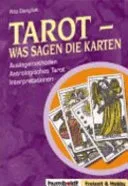
Tarot - was sagen die Karten?
 78
78

Tarot - was sagen die Karten?
Rita Danyliuk’s "Tarot - was sagen die Karten?" offers a refreshing, grounded perspective on a subject often shrouded in esotericism. The author rightly stresses that mastering Tarot requires more than just memorizing keywords; it demands a deep dive into the symbolism and the dynamic interplay between cards. A particular strength lies in its systematic approach to the 78 cards, moving beyond generic interpretations. However, the initial emphasis on 'intensive study' might feel slightly daunting for absolute beginners seeking immediate, simple readings. The section discussing the relationship between the cards, while crucial, could benefit from more varied illustrative examples. Overall, Danyliuk provides a solid foundation for serious students of the Tarot.
📝 Description
78
Rita Danyliuk's 2003 book offers a structured path to understanding the 78 Tarot cards.
Tarot - was sagen die Karten? presents a systematic method for interpreting the Major and Minor Arcana. Danyliuk stresses that effective Tarot reading requires both careful study of card meanings and the cultivation of intuition. The book guides readers through the individual symbolism of each of the 78 cards and explains how they function together in a reading.
This guide is for students of Tarot who seek a thorough grounding. It appeals to those who value a clear, analytical approach to the cards, combined with an understanding of their symbolic language. The aim is to move beyond superficial predictions towards a more insightful use of the Tarot.
Tarot reading builds on a long history of symbolic systems used for divination. Danyliuk's work connects this practice to a disciplined approach, merging intellectual understanding of symbols with practical, intuitive application. The book situates Tarot not merely as a tool for fortune-telling, but as a method for deeper self-reflection and understanding.
💡 Why Read This Book?
• Gain a structured understanding of Tarot interpretation, moving beyond rote memorization by studying the specific relationships between the Major and Minor Arcana as detailed in the book. • Develop your intuitive abilities alongside analytical skills, a balance the book argues is essential for reading the cards effectively, as opposed to relying solely on intuition. • Appreciate the historical continuity of divination practices, recognizing Tarot as a continuation of ancient traditions, a perspective introduced early in the text.
⭐ Reader Reviews
Honest opinions from readers who have explored this book.
❓ Frequently Asked Questions
What is the origin of the Tarot deck discussed in Rita Danyliuk's book?
While the book acknowledges the ancient roots of divination, it focuses on the modern interpretation and use of the 78-card Tarot deck as a continuation of this tradition, first published in 2003.
Does 'Tarot - was sagen die Karten?' explain different Tarot spreads?
Yes, the book presents a range of interpretation methods, covering how to lay out and understand the messages conveyed by both the Major and Minor Arcana within a spread.
Is this book suitable for someone completely new to Tarot?
The book is designed for those willing to engage in intensive study of symbolism and card relationships, making it suitable for dedicated beginners who want a thorough grounding.
What kind of study does Danyliuk recommend for learning Tarot?
Danyliuk emphasizes the need for intense study of the symbolism of each of the 78 cards, as well as their interrelationships, alongside developing intuition and concentration.
Does the book focus on specific divination techniques?
Yes, the book outlines various methods for interpreting the cards, focusing on both the individual meanings of the Major and Minor Arcana and their combined significance.
What distinguishes Danyliuk's approach to Tarot?
The approach emphasizes a balance between deep symbolic study and intuitive understanding, positioning Tarot as a continuation of ancient oracle traditions.
🔮 Key Themes & Symbolism
Symbolic Interpretation
The work studies the symbolic language inherent in the 78 cards of the Tarot. It argues that understanding the deep meanings behind symbols, such as the archetypal figures in the Major Arcana or the elemental associations in the Minor Arcana, is crucial for accurate divination. This approach moves beyond superficial interpretations, encouraging readers to engage intellectually with the visual and conceptual richness of each card.
Intuition and Study
Danyliuk posits that effective Tarot reading requires a dual approach: intensive study of the cards' meanings and symbolism, coupled with the cultivation of intuition and concentration. This book guides readers on how to develop both facets, presenting Tarot as a discipline that integrates intellectual knowledge with inner knowing to unlock the cards' messages.
Divination as Tradition
The book frames Tarot reading as a modern manifestation of ancient divinatory practices. It connects the act of consulting the cards to historical traditions of seeking guidance from oracles. By understanding Tarot within this lineage, readers are encouraged to see it not merely as a game or fortune-telling tool, but as a method for self-reflection and understanding life's patterns.
Card Relationships
A significant focus is placed on understanding how cards interact with each other within a spread. The book explores the dynamic interplay between the Major and Minor Arcana, suggesting that the true meaning emerges from the combination and context of multiple cards, rather than isolated interpretations. This systemic view is key to unlocking nuanced readings.
💬 Memorable Quotes
Direct passages from the work, attributed to the author.
“Tarot is a continuation of the ancient tradition of consulting oracles.”
— This statement positions Tarot not as a novel invention, but as an evolved form of a practice that has existed for millennia, seeking answers about the present and future.
“Card reading requires intuition and concentration.”
— This highlights the active mental and perceptive states necessary for effective Tarot interpretation, suggesting it is not a passive activity.
“Intensive study of symbolism is needed.”
— This emphasizes the intellectual component of Tarot mastery, pointing to the importance of understanding the deeper meanings embedded within the cards' imagery.
“The meanings of each of the 78 cards must be grasped.”
— This underscores the foundational requirement for learning Tarot: a comprehensive understanding of every single card in the deck, both Major and Minor Arcana.
“The relationships between cards are as important as individual meanings.”
— This points to the complex, systemic nature of Tarot interpretation, where the context and interaction of cards significantly shape the overall message.
🌙 Esoteric Significance
Tradition
The work positions Tarot as a continuation of ancient divinatory traditions, a practice found across various esoteric lineages. While not explicitly aligning with a single school like Hermeticism or Kabbalah, it draws on the universal esoteric principle of symbolic language as a means of accessing deeper truths about existence and fate.
Symbolism
Key symbols explored include the archetypal figures of the Major Arcana, representing fundamental human experiences and spiritual stages, and the elemental associations within the Minor Arcana, which connect the cards to the manifest world. The interaction between these symbolic realms is presented as central to unlocking the Tarot's wisdom.
Modern Relevance
Danyliuk's emphasis on combining rigorous study of symbolism with intuitive development speaks to contemporary practitioners of Tarot and other forms of divination. It informs modern approaches that seek a balanced, intellectual yet intuitive engagement with symbolic systems, finding application in personal growth and psychological exploration.
👥 Who Should Read This Book
• Aspiring Tarot readers seeking a structured method for learning the 78 cards, moving beyond basic keyword memorization. • Students of esoteric symbolism interested in understanding how ancient archetypes and elemental forces are represented in a Western system. • Individuals who prefer a systematic approach to divination, valuing both intellectual study and intuitive development for accurate readings.
📜 Historical Context
Published in 2003, Rita Danyliuk’s "Tarot - was sagen die Karten?" emerged during a period of continued popular interest in esoteric subjects, following the New Age movements of the late 20th century. While the Rider-Waite-Smith deck, popularized in the early 20th century, dominated much of the Western Tarot scene, Danyliuk's work contributes to a broader, ongoing discourse on Tarot interpretation. The book implicitly engages with the historical lineage of divination practices stretching back to antiquity, a tradition that saw diverse expressions across cultures. Unlike purely academic or historical analyses of Tarot, Danyliuk’s text focuses on practical application and symbolic study, aligning with practitioners seeking deeper understanding beyond simplistic fortune-telling. Its approach emphasizes systematic learning, a counterpoint to more intuitive-only methods that gained traction in some circles.
📔 Journal Prompts
The symbolic significance of the Major Arcana figures.
How the relationships between cards alter interpretation.
Developing concentration for focused card readings.
The connection between Tarot and ancient oracle traditions.
Personal intuitive responses to specific card imagery.
🗂️ Glossary
Major Arcana
The set of 22 trump cards in a Tarot deck, representing significant life events, spiritual lessons, and archetypal themes.
Minor Arcana
The 56 cards of a Tarot deck, divided into four suits (typically Wands, Cups, Swords, Pentacles), representing everyday situations, challenges, and influences.
Arcana
Plural of 'arcanum,' referring to the 'mysteries' or secret knowledge contained within the Tarot deck, divided into Major and Minor categories.
Divination
The practice of seeking knowledge of the future or the unknown by supernatural means, often through symbolic systems like Tarot.
Symbolism
The use of symbols to represent ideas and qualities, a fundamental aspect of Tarot interpretation where images carry deeper meanings.
Card Reading
The process of interpreting the meanings of Tarot cards laid out in a specific spread to gain insight into questions or situations.
Interpretation Methods
Various techniques and systems used to analyze and understand the messages conveyed by Tarot cards when drawn in a spread.