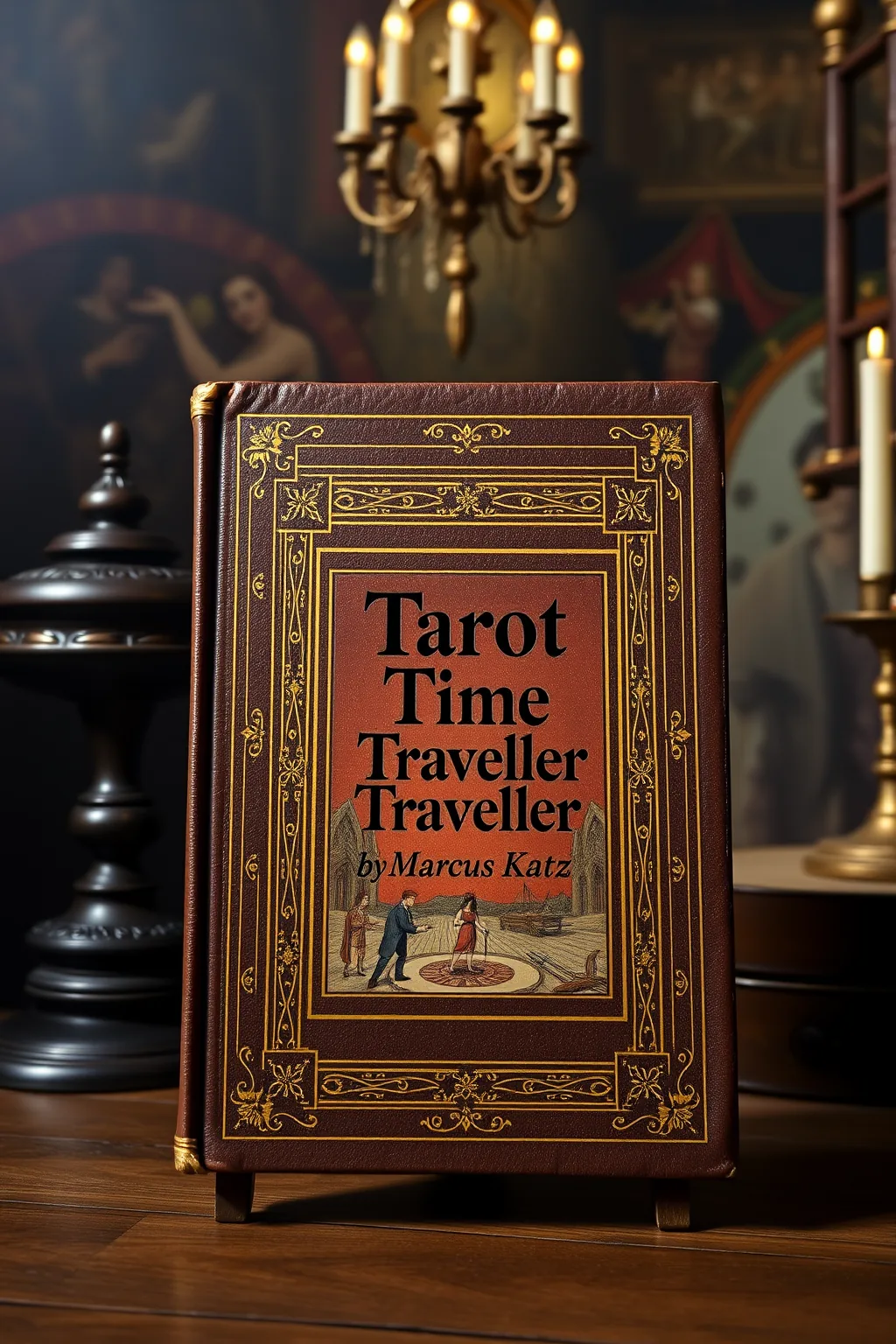
Tarot time traveller
 72
72

Tarot time traveller
Marcus Katz’s 'Tarot Time Traveller' approaches the ubiquitous tarot deck with a historian’s precision and an occultist’s informed curiosity. Unlike many contemporary tarot books that focus on divinatory applications, Katz prioritizes tracing the cards' evolutionary path and their entanglement with esoteric thought. He compellingly argues for the tarot as a repository of Western mystical symbolism, a concept he illustrates through examining specific card attributions and their historical antecedents. A particular strength lies in his methodical deconstruction of overly romanticized origin myths. However, the book occasionally becomes so enmeshed in tracing historical threads that the practical implications for a modern reader can feel distant. The discussion around the Knights of the Golden Dawn’s influence, while informative, could have been more tightly integrated with the core 'time traveller' thesis. Ultimately, 'Tarot Time Traveller' is a valuable scholarly intervention for those seeking depth beyond the surface-level use of tarot.
📝 Description
72
### What It Is
'Tarot Time Traveller' by Marcus Katz, first published in 2017, is not a typical tarot guide. It functions more as a historical and philosophical exploration of the tarot's lineage and its place within esoteric thought. The work examines the cards not just as divinatory tools but as symbolic systems with deep roots in Western occult traditions. Katz approaches the tarot with a critical, academic lens, seeking to understand its evolution and its connection to various mystical philosophies. The book traces potential influences and historical moments that shaped the modern tarot deck.
### Who It's For
This book is primarily for serious students of the tarot who have moved beyond basic interpretation and are interested in its historical and philosophical underpinnings. It will appeal to readers who enjoy intellectual engagement with esoteric subjects, particularly those with an interest in occult history, Western esotericism, and the development of symbolic languages. Individuals seeking a rigorous examination of the tarot's origins and its relationship to broader philosophical movements will find value here. It is less suited for those seeking a quick guide to daily card readings or a purely practical divinatory manual.
### Historical Context
Published in 2017, 'Tarot Time Traveller' emerges from a contemporary academic and esoteric landscape where the tarot is widely recognized but often studied superficially. Katz’s work situates itself within a lineage of scholarship that began to seriously consider the tarot’s esoteric connections in the late 19th and early 20th centuries, notably through figures like Eliphas Lévi and later A.E. Waite. The book engages with the ongoing scholarly debate about the tarot’s precise origins, acknowledging its complex evolution from playing cards to a sophisticated symbolic system. It implicitly contrasts with simpler, more populist approaches to tarot that gained traction throughout the 20th century, offering a more nuanced historical perspective.
### Key Concepts
The book centers on the concept of the tarot as a 'time traveller' – a symbolic system that has traversed centuries, absorbing and reflecting different cultural and philosophical currents. It explores the intricate relationship between the tarot and various esoteric traditions, including Hermeticism and Kabbalah, examining how these systems may have influenced or been influenced by the cards. Katz also investigates the historical development of specific card imagery and symbolism, looking for connections to medieval iconography, Renaissance symbolism, and the occult revival of the 19th century. The work scrutinizes claims about the tarot’s ancient Egyptian or Hebrew origins, offering a more grounded historical analysis.
💡 Why Read This Book?
• Gain a nuanced understanding of the tarot’s historical journey from 15th-century playing cards to a complex esoteric symbol system, moving beyond simplistic origin stories. • Explore the specific ways Western esoteric traditions, such as Hermeticism and Kabbalah, are reflected in tarot imagery and symbolism, as detailed in the book's analysis. • Appreciate the tarot as a 'time traveller' artifact, capable of carrying diverse philosophical and mystical ideas across centuries, offering a new perspective on card interpretation.
⭐ Reader Reviews
Honest opinions from readers who have explored this book.
❓ Frequently Asked Questions
What is the primary argument of Marcus Katz's 'Tarot Time Traveller' regarding the tarot's origins?
The book argues that the tarot functions as a 'time traveller,' a symbolic system that has absorbed and reflected various esoteric and philosophical currents throughout history, rather than possessing a single, ancient origin.
Does 'Tarot Time Traveller' offer practical card reading techniques?
No, the book's focus is primarily on the historical and philosophical exploration of the tarot's development and its connections to esoteric traditions, not on practical divinatory applications.
Which esoteric traditions are discussed in relation to the tarot in this book?
The work explores connections between the tarot and traditions such as Hermeticism and Kabbalah, examining how these systems may have influenced the cards' symbolism and meaning.
Who is the intended audience for 'Tarot Time Traveller'?
It is intended for serious students of the tarot, historians of esotericism, and those interested in the philosophical and symbolic evolution of the cards beyond basic divination.
When was 'Tarot Time Traveller' first published?
'Tarot Time Traveller' by Marcus Katz was first published in 2017.
Does the book examine the influence of specific historical groups on the tarot?
Yes, the work investigates the historical development of card imagery and symbolism, looking for connections to various periods and movements, including the occult revival.
🔮 Key Themes & Symbolism
Symbolic Evolution
The book posits the tarot as a dynamic symbolic language that has evolved over centuries. Katz traces how the imagery and potential meanings of the cards have been shaped by different historical periods and philosophical outlooks. This includes examining how Renaissance symbolism or 19th-century occult revival ideas became embedded within the deck. The 'time traveller' metaphor highlights the cards' capacity to carry layers of meaning accumulated through history, rather than being static objects of interpretation.
Esoteric Lineage
A central theme is the tarot's deep entanglement with Western esoteric traditions. Katz explores how concepts from Hermeticism, Kabbalah, and other mystical philosophies may have informed the structure and symbolism of the tarot. The work scrutinizes claims of direct ancient lineage, favouring a more nuanced view of how esoteric ideas were gradually integrated into the tarot's development, particularly during the occult revival era.
Historical Scrutiny
Katz employs a critical, historical approach to debunk myths and romanticized origin stories surrounding the tarot. He emphasizes the importance of understanding the cards within their specific historical contexts, from their origins as playing cards to their transformation into divinatory and spiritual tools. This involves analyzing primary sources and acknowledging the complex, often debated, path of the tarot's historical journey.
The Tarot as a Philosophical Mirror
The book presents the tarot not just as a tool for prediction but as a mirror reflecting the philosophical and spiritual concerns of different eras. As a 'time traveller,' the deck encapsulates shifts in Western thought, from medieval mysticism to the intellectual currents of the occult revival. Its enduring appeal lies in its ability to adapt and continue to speak to contemporary seekers through the lens of accumulated historical symbolism.
💬 Memorable Quotes
“The tarot has travelled through time, absorbing the intellectual and spiritual currents of each age.”
— This encapsulates the book's core metaphor, suggesting the tarot is not a static oracle but a dynamic system shaped by historical context and philosophical evolution.
“Examining the tarot requires understanding its roots in playing cards as much as its later esoteric associations.”
— This highlights Katz's method of grounding esoteric interpretations in historical fact, acknowledging the mundane origins before exploring deeper symbolic layers.
“Allegations of ancient Egyptian or Hebrew origins often obscure the more verifiable historical development.”
— This points to the author's critical stance on popular tarot myths, advocating for evidence-based historical analysis over speculative claims about extreme antiquity.
“The symbols on the cards are not fixed but have been reinterpreted across centuries of esoteric thought.”
— This emphasizes the fluid nature of symbolic meaning within esoteric traditions and how the tarot has been a vehicle for diverse interpretations over time.
“Understanding the tarot's historical journey enriches its contemporary use.”
— This suggests that a deeper knowledge of the tarot's past provides a more robust foundation for its practice and understanding in the present day.
🌙 Esoteric Significance
Tradition
The work fits within the Western Esoteric Tradition, specifically engaging with Hermeticism and Kabbalah. It acknowledges the tarot’s complex lineage, moving beyond simplistic attributions to explore how these traditions likely influenced the cards' development, particularly during the occult revival. Katz’s approach emphasizes a critical historical perspective, situating the tarot not as an ancient, unbroken tradition, but as a symbolic system that has absorbed and reflected evolving esoteric thought.
Symbolism
Key symbols explored include the Fool's Journey, representing a path of initiation and spiritual evolution, and the integration of Hebrew letters from the Kabbalah, which A.E. Waite notably assigned to specific Major Arcana cards. The book also examines the potent symbolism within the court cards and the numbered pip cards, tracing their potential roots in medieval iconography and their subsequent reinterpretation within esoteric frameworks.
Modern Relevance
Contemporary tarot practitioners and scholars interested in historical depth often draw upon Katz’s meticulous research. His work informs modern approaches that seek to understand the tarot’s symbolism beyond mere divination, connecting it to broader currents in Western mysticism. Thinkers and practitioners focusing on comparative esotericism or the history of magical orders find his analysis of the tarot’s evolution particularly relevant to understanding its place in the modern occult landscape.
👥 Who Should Read This Book
• Serious tarot students seeking historical context: Those who have moved beyond basic card meanings and wish to understand the tarot's evolution and its place within esoteric history. • Historians of Western Esotericism: Researchers interested in how symbolic systems develop and are integrated into mystical traditions, particularly from the Renaissance through the occult revival. • Philosophically-minded occultists: Individuals who appreciate a critical and intellectual approach to esoteric subjects and are looking to deepen their understanding of the tarot's symbolic underpinnings.
📜 Historical Context
Published in 2017, 'Tarot Time Traveller' emerged during a period of intense popular engagement with the tarot, often divorced from rigorous historical study. Marcus Katz’s work positions itself against this trend, aligning with a tradition of scholarship that sought to understand the tarot’s esoteric connections, a pursuit intensified during the late 19th-century occult revival. Key figures like Eliphas Lévi and A.E. Waite had already begun to link the tarot to Kabbalah and Hermeticism, shaping the discourse Katz engages with. The book implicitly contrasts with the more simplified, populist tarot guides that proliferated throughout the 20th century. While not directly engaging in public controversy, Katz’s approach offers a scholarly counterpoint to less historically-grounded interpretations prevalent in contemporary occult circles, emphasizing the tarot’s evolution from 15th-century Italian playing cards.
📔 Journal Prompts
The tarot as a 'time traveller': Reflect on which historical era's philosophical currents feel most present in the cards you use.
The integration of Hermetic and Kabbalistic concepts: How do these ideas manifest in the symbolism of the Major Arcana?
The evolution of the Fool's Journey: Trace a personal symbolic journey that mirrors the tarot's historical development.
Critiquing origin myths: Identify a popular tarot belief and examine its historical evidence, as discussed in the book.
Symbolism across centuries: Consider how a single card's imagery might have been interpreted differently in the 15th century versus the 19th century.
🗂️ Glossary
Hermeticism
A religious, philosophical, and esoteric tradition based on writings attributed to Hermes Trismegistus. It emphasizes spiritual ascent, the interconnectedness of all things, and the pursuit of divine knowledge.
Kabbalah
A system of Jewish mysticism that explores the divine nature and the creation of the universe through a complex symbolic language, often represented by the Tree of Life.
Occult Revival
A period, primarily in the late 19th and early 20th centuries, marked by renewed interest in esoteric, mystical, and magical traditions across Europe and North America.
Major Arcana
The trump cards of a tarot deck, typically numbering 22, which represent significant life lessons, spiritual archetypes, and major events.
Pip Cards
The numbered cards (Ace through 10) within each suit of a tarot deck, often seen as representing more mundane or everyday circumstances and challenges.
Symbolic System
A set of symbols and the rules governing their use and interpretation, employed to represent ideas, concepts, or phenomena.
Divination
The practice of seeking knowledge of the future or the unknown by supernatural means, often through tools like the tarot.