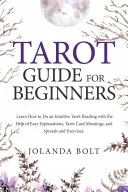
Tarot Guide For Beginners
 83
83

Tarot Guide For Beginners
Jolanda Bolt’s 'Tarot Guide For Beginners' tackles a common hurdle for novices: the sheer volume of information and perceived complexity surrounding tarot. Bolt’s strength lies in her direct, no-nonsense approach, stripping away the mystique to reveal a more accessible path to intuitive reading. The emphasis on internal wisdom over external memorization is a crucial distinction that many beginners will appreciate. However, the book occasionally feels a little too brief in its explanations. For instance, while the concept of ‘working with your intuition’ is central, the specific exercises or techniques for developing this intuition could have been more fleshed out. One particularly useful idea is the suggestion to approach each card not just for its traditional meaning, but for what it communicates *to you* in a specific spread. Ultimately, Bolt offers a valuable starting point for those intimidated by traditional tarot study, prioritizing personal connection over academic rigor.
📝 Description
83
### What It Is Tarot Guide For Beginners, penned by Jolanda Bolt and first published on August 5, 2022, offers a practical approach to understanding and using tarot cards. It moves beyond rote memorization, aiming to connect readers with their innate intuition. The guide focuses on developing a personal relationship with the cards, enabling readings without constant reliance on external references. It presents tarot not as a cryptic system, but as an accessible tool for self-discovery and guidance.
### Who It's For This book is designed for individuals new to the world of tarot. It caters to those who have perhaps felt intimidated by the perceived complexity of tarot decks or who are seeking a straightforward method to interpret card meanings intuitively. Readers looking for a non-dogmatic, personal approach to divination and self-exploration will find this guide particularly relevant. It’s for anyone who has a deck of tarot cards and feels ready to unlock their potential for personal wisdom.
### Historical Context While Jolanda Bolt's work is a contemporary publication from 2022, it engages with a long-standing tradition of tarot interpretation that gained significant traction in the late 19th and early 20th centuries. Movements like the Hermetic Order of the Golden Dawn, and later Theosophy, popularized complex symbolic systems for tarot, often requiring extensive study. Bolt's approach, emphasizing intuition over dense historical symbolism, can be seen as a reaction or alternative to these more academic, historically-focused methods that dominated earlier esoteric discourse, such as the interpretations offered by Arthur Edward Waite in his 1910 work 'The Pictorial Key to the Tarot'.
### Key Concepts The central concept is the cultivation of personal intuition as the primary tool for tarot reading. Bolt emphasizes that the 'wisdom beyond yourself' is actually within you, accessible through focused practice. The guide likely explores methods for attuning to the cards, moving past the need for a physical book to interpret their meanings. Another key idea is demystifying the tarot, presenting it as a language of symbols that can be learned and personalized, rather than a fixed, external code. The objective is to empower the reader to trust their inner knowing when engaging with the deck.
💡 Why Read This Book?
• You will learn to bypass the need for a physical tarot guide by developing your intuitive connection to the cards, a skill honed through Bolt's practical, non-dogmatic approach. • You will gain confidence in interpreting card meanings based on your personal resonance, moving beyond memorized definitions as demonstrated in the book's focus on inner wisdom. • You will discover a simplified method for engaging with tarot, making the practice accessible and less intimidating, as evidenced by the guide’s publication date of 2022, reflecting modern approaches.
⭐ Reader Reviews
Honest opinions from readers who have explored this book.
❓ Frequently Asked Questions
What is the main goal of Jolanda Bolt's Tarot Guide For Beginners?
The main goal is to teach beginners how to perform tarot readings using their intuition, rather than relying solely on memorized meanings or reference books. It aims to demystify tarot and make it an accessible tool for self-discovery.
Is this book suitable for someone who has never seen a tarot deck before?
Yes, the book is specifically designed for beginners. It starts with foundational concepts and aims to build confidence, assuming no prior knowledge of tarot symbolism or practice.
Does the book cover the historical origins of tarot cards?
While the book focuses on practical application, it acknowledges the context of tarot. It emphasizes that contemporary practice, like Bolt's 2022 publication, often diverges from older, more complex historical interpretations.
What does the author mean by 'wisdom beyond yourself'?
Bolt uses this phrase to refer to the deep inner knowing and intuition that resides within each person. The guide's purpose is to help readers access and trust this internal wisdom through their interaction with tarot cards.
How does this book differ from other tarot guides for beginners?
This guide distinguishes itself by prioritizing the development of personal intuition over the memorization of extensive card meanings or complex historical systems. It offers a direct, no-nonsense path to intuitive reading.
When was Tarot Guide For Beginners first published?
Tarot Guide For Beginners was first published on August 5, 2022, making it a recent addition to the field of tarot literature.
🔮 Key Themes & Symbolism
Intuitive Connection
The core of Bolt's philosophy centers on developing a direct, intuitive link with the tarot deck. This approach posits that true understanding comes not from external dogma or memorized meanings, but from the reader's inner wisdom. The book guides users to trust their gut feelings and personal associations with the cards, transforming the tarot from a complex puzzle into a mirror of the subconscious. This theme is crucial for beginners who may feel overwhelmed by the traditional academic study of tarot symbolism.
Demystifying Tarot
Bolt aims to peel back the layers of perceived complexity that often surround tarot. The guide presents tarot as an accessible language of symbols rather than an arcane secret society's code. By offering a straightforward, 'no-nonsense' method, the book empowers readers to see the cards as tools for everyday insight and self-reflection, rather than instruments of prophecy requiring specialized knowledge or initiation.
Personalized Interpretation
A significant theme is the encouragement of personalized meaning-making. While acknowledging traditional symbolism, the guide stresses that the most potent interpretations arise from the individual's unique perspective and current life circumstances. This fosters a dynamic relationship between the reader and their deck, where meanings evolve and deepen with practice, moving away from rigid, one-size-fits-all definitions.
Inner Wisdom as Source
Bolt frames the tarot as a conduit to accessing one's own inherent wisdom. The 'wisdom beyond yourself' is presented as residing within the reader, waiting to be unlocked. The book serves as a key, not by providing answers, but by teaching the reader how to ask the right questions and listen to the subtle guidance that emerges through the intuitive engagement with the cards.
💬 Memorable Quotes
“Know it seems more complicated than it is.”
— This statement directly addresses the common beginner's anxiety about tarot. It reassures the reader that the perceived difficulty is often an illusion, setting a tone of accessibility and encouragement for the learning process.
“A tremendous source of wisdom is hidden in you, waiting for you to access it.”
— This highlights the book's central thesis: that true insight comes from within. The tarot deck acts as a tool or catalyst to unlock this pre-existing internal knowledge, shifting the focus from external authority to personal empowerment.
“All you need is some no-nonsense explanation to understand how to work with your intuition.”
— This points to the practical, unfussy methodology of the guide. It promises clarity and actionable steps, emphasizing that the key to tarot lies in developing one's innate intuitive abilities through straightforward guidance.
“Have you been looking at your deck of tarot cards and hoped to find the key to its secret?”
— This question taps into the reader's potential desire and curiosity. It acknowledges the allure of tarot and positions the book as the solution to uncovering that 'secret' by revealing a personal, intuitive method.
“Do you want to know how to do tarot readings without a book?”
— This frames the ultimate goal for many aspiring tarot readers. The book promises to equip individuals with the skills and confidence to interpret cards independently, fostering self-reliance in their practice.
🌙 Esoteric Significance
Tradition
While not explicitly tied to a single esoteric lineage, Bolt's work aligns with modern, psychologically-oriented approaches to divination that emerged from broader esoteric movements. It draws from the universalist currents within Theosophy and later New Age thought, which sought to synthesize various spiritual traditions and emphasize inner experience. Unlike the more structured, Kabbalistically-informed interpretations found in Hermeticism, Bolt prioritizes a direct, intuitive engagement that is accessible to anyone, regardless of their background in specific esoteric systems.
Symbolism
The primary 'symbol' Bolt engages with is the tarot deck itself, viewed not as a fixed system of arcane symbols, but as a flexible mirror for personal intuition. While traditional decks feature rich symbolism like the Major Arcana's archetypes (e.g., The Fool, The Magician) and the Minor Arcana's suits, Bolt encourages readers to look beyond established meanings. The 'secret' she aims to unlock is less about deciphering specific symbols and more about understanding how these visual cues prompt individual inner knowing and personal narratives.
Modern Relevance
Bolt's approach resonates with contemporary trends in mindfulness, self-care, and intuitive development. Thinkers and practitioners in fields like Jungian psychology (which explored archetypes in dreams and myths) and modern intuitive coaching often echo her emphasis on inner wisdom. Her work is relevant to the current surge in accessible digital tools and online communities focused on personal growth, offering a grounded, practical method for those exploring spirituality outside traditional religious or rigid occult frameworks.
👥 Who Should Read This Book
• Absolute beginners to tarot who feel intimidated by complex historical symbolism or the sheer number of cards. • Individuals interested in developing their intuition and self-awareness as tools for guidance, seeking practical exercises beyond theoretical study. • Those who have previously encountered tarot but found traditional methods too rigid or disconnected from personal experience, looking for a more intuitive and contemporary approach.
📜 Historical Context
Jolanda Bolt's 'Tarot Guide For Beginners' emerges in 2022, a period where esoteric practices are increasingly integrated into mainstream wellness and self-help culture. This contemporary context contrasts sharply with the early 20th century, when tarot was often discussed within exclusive occult societies. For instance, Arthur Edward Waite's influential 'The Pictorial Key to the Tarot' (1910) was deeply embedded in the symbolism and esoteric philosophies of groups like the Hermetic Order of the Golden Dawn. Waite, along with Pamela Colman Smith, designed the Rider-Waite-Smith deck, which became a standard for complex symbolic interpretation. Bolt's 2022 publication, however, reflects a modern trend toward accessibility, emphasizing personal intuition over the dense, historically-rooted symbolic systems championed by figures like Waite. This shift can be seen as a democratization of tarot, moving it from specialized occult circles to a broader audience seeking practical self-guidance.
📔 Journal Prompts
Reflect on the concept of 'wisdom beyond yourself' and where you typically seek answers.
Consider the idea of a tarot deck feeling 'complicated' and identify one specific card that feels particularly mysterious.
Explore the potential for your intuition to guide you, separate from any external book or source.
Think about how a 'no-nonsense explanation' might differ from a highly symbolic one in learning a new skill.
Examine your relationship with your own tarot deck, focusing on initial impressions rather than learned meanings.
🗂️ Glossary
Intuition
The ability to understand something immediately, without the need for conscious reasoning. In tarot, it's the inner knowing or gut feeling that guides interpretation beyond learned meanings.
Tarot Reading
The practice of using a deck of tarot cards to gain insight into a situation, explore potential outcomes, or facilitate self-understanding. This guide focuses on intuitive rather than purely book-based methods.
Esoteric
Relating to or accessible only by a relatively small number of people with a specialized knowledge or interest. In this context, it refers to the hidden or inner meanings associated with tarot.
Deck
A set of tarot cards, typically consisting of 78 cards divided into the Major Arcana and Minor Arcana. This is the physical tool used for readings.
Interpretation
The act or explanation of the meaning of something. In tarot, it's how a reader understands and applies the message of a card or combination of cards.
No-nonsense explanation
A straightforward, practical, and direct approach to explaining something, avoiding unnecessary jargon, complexity, or abstract theory. This is Bolt's promised method for teaching tarot.
Personalized Method
An approach to tarot reading that emphasizes the individual reader's unique insights, feelings, and associations, rather than relying solely on universally accepted meanings.