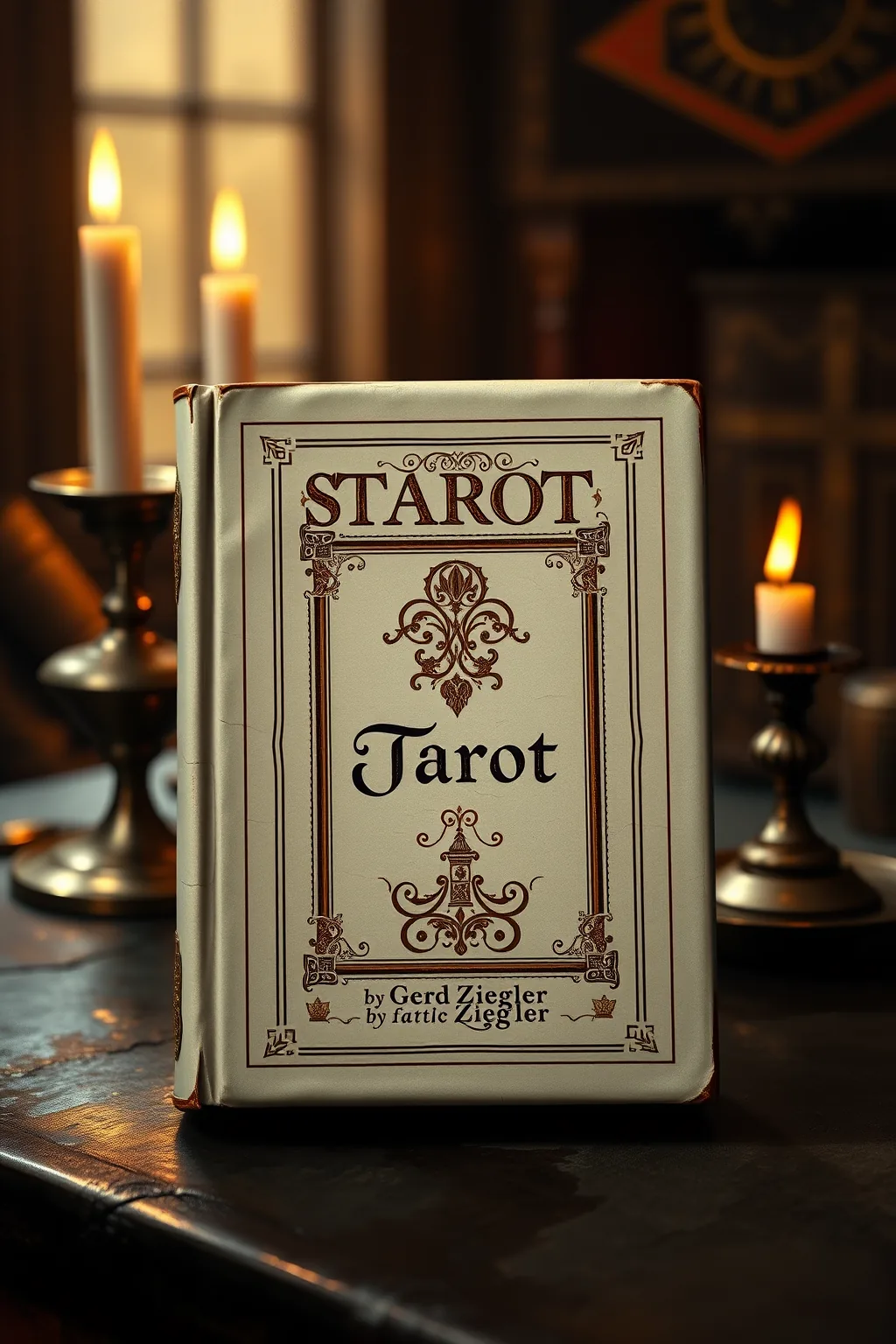
Tarot
 84
84

Tarot
Gerd Ziegler's "Tarot" offers a dense, scholarly approach to the cards, prioritizing symbolic depth over readily digestible divinatory recipes. The author's strength lies in his meticulous dissection of individual cards, particularly the Major Arcana, linking their imagery to profound psychological and spiritual concepts. For instance, his analysis of The Fool transcends simple notions of beginnings, presenting it as a complex archetype of potentiality and cosmic innocence. However, the book's academic rigor can also be its limitation. The prose, while precise, can become somewhat dense, demanding sustained attention from the reader. It lacks the accessible narrative flow found in some contemporary Tarot guides. Ziegler's detailed examination of The Hierophant, for example, while insightful, requires significant prior knowledge of esoteric traditions to fully appreciate. Ultimately, "Tarot" serves as a valuable reference for dedicated practitioners and scholars seeking to understand the cards' deeper symbolic architecture.
📝 Description
84
### What It Is Gerd Ziegler's "Tarot" is a significant exploration of the esoteric tradition surrounding the Tarot deck. First published in 1988, this work offers a detailed examination of the imagery, symbolism, and potential applications of the cards. It moves beyond simple divinatory meanings to investigate the deeper archetypal patterns and psychological resonances embedded within the Tarot's structure. The book aims to provide a comprehensive understanding for those seeking to engage with the Tarot as a system of self-knowledge and spiritual development.
### Who It's For This book is intended for serious students of esoteric philosophy and divination. It appeals to individuals who are not satisfied with superficial interpretations of Tarot cards and who wish to understand their historical and symbolic underpinnings. Readers interested in comparative mythology, Jungian psychology, or the history of Western esotericism will find substantial material here. It is particularly suited for those who approach the Tarot as a tool for introspection and personal growth, rather than solely as a predictive instrument.
### Historical Context The 1988 publication date places Ziegler's "Tarot" within a period of renewed interest in esoteric subjects, particularly following the counterculture movements of the 1960s and 70s. The work emerged during a time when scholars and practitioners were re-evaluating foundational texts and traditions. Authors like Joseph Campbell were popularizing archetypal psychology, and figures such as Dion Fortune and A.E. Waite had already established significant bodies of work on Tarot and occultism, setting a stage for more in-depth analyses like Ziegler's. The book contributes to the ongoing discourse on Tarot's place within Western esotericism.
### Key Concepts Ziegler's "Tarot" meticulously dissects the major and minor arcana, exploring their connections to various spiritual and philosophical systems. Central to the work is the concept of the Tarot as a symbolic language, a mirror reflecting the human psyche and the cosmic order. The book often references the archetypal figures and narratives that underpin the cards, drawing parallels with mythological figures and psychological states. It also examines the historical evolution of the Tarot, considering its journey from 18th-century origins to its modern esoteric interpretations, thereby situating the deck within a broader cultural and intellectual landscape.
💡 Why Read This Book?
• Gain a structured understanding of the Major Arcana's archetypal significance, as explored through Ziegler's detailed analysis of figures like The Magician and The Empress, providing insights into psychological dynamics. • Explore the Tarot's historical evolution and its place within Western esoteric traditions since its 18th-century origins, offering a context often missing in simpler guides. • Develop a more profound interpretive framework for the Minor Arcana by understanding their symbolic connections to the Major Arcana, moving beyond basic divinatory meanings.
⭐ Reader Reviews
Honest opinions from readers who have explored this book.
❓ Frequently Asked Questions
What is the primary focus of Gerd Ziegler's "Tarot"?
Ziegler's "Tarot" primarily focuses on the deep symbolic, psychological, and esoteric meanings of the Tarot cards. Published in 1988, it moves beyond simple fortune-telling to explore the archetypal patterns and spiritual significance embedded within the deck's imagery.
Is this book suitable for beginners in Tarot?
While comprehensive, the book's dense and scholarly approach might be challenging for absolute beginners. It is better suited for those with some existing knowledge or a serious interest in the esoteric and psychological dimensions of Tarot study.
What esoteric traditions does Ziegler draw upon?
The work draws on various Western esoteric traditions, including Hermeticism and Kabbalistic concepts, to interpret the Tarot's symbolism. It views the cards as a language of spiritual and psychological archetypes.
When was Gerd Ziegler's "Tarot" first published?
Gerd Ziegler's "Tarot" was first published in 1988, placing it within a resurgence of interest in esoteric studies and symbolic systems during the late 20th century.
Does the book cover divination techniques?
While it acknowledges the divinatory aspect, the book's core strength lies in its in-depth exploration of the Tarot's symbolic and psychological architecture, rather than providing a guide to practical divination methods.
How does Ziegler's work compare to other Tarot books?
Compared to more introductory or divinatory-focused books, Ziegler's "Tarot" offers a more academic and symbolic interpretation, emphasizing the cards' role as a system of archetypal knowledge and self-exploration.
🔮 Key Themes & Symbolism
Archetypal Psychology
Ziegler intricately connects Tarot imagery to archetypal psychology, drawing parallels to universal human patterns and mythic narratives. The book posits that each card represents a fundamental aspect of the human psyche, influenced by thinkers who explored the collective unconscious. This approach elevates the Tarot from a mere divinatory tool to a mirror reflecting profound psychological truths and developmental stages. The analysis of figures like The Emperor and The Empress, for example, explores their roles as representations of authority, structure, and nurturing principles within the psyche.
Symbolic Language of the Arcana
The work emphasizes the Tarot as a sophisticated symbolic language. Ziegler meticulously deciphers the visual lexicon of the Major and Minor Arcana, explaining how each symbol contributes to a larger, coherent system of meaning. He explores how the sequence of the Major Arcana, from The Fool to The World, can be seen as an initiatory journey. This perspective views the cards not in isolation, but as interconnected elements within a holistic system designed for spiritual and psychological exploration.
Esoteric Tradition and Interpretation
Ziegler situates the Tarot within the broader context of Western esoteric traditions. The book examines how various streams of thought, such as Hermeticism and Kabbalah, have influenced and are reflected in Tarot symbolism. It addresses the historical development of the Tarot, tracing its evolution from earlier forms to its established esoteric significance. This grounding in tradition provides a framework for understanding the depth and layered meanings attributed to the cards by practitioners over centuries.
The Tarot as a Mirror of Consciousness
A central theme is the Tarot's function as a mirror for consciousness. Ziegler suggests that engaging with the cards allows individuals to perceive and understand their own inner states, motivations, and potential pathways. The imagery serves as a catalyst for introspection, revealing hidden aspects of the self and the challenges or opportunities present in one's life. This perspective highlights the Tarot's utility as a tool for self-discovery and personal transformation.
💬 Memorable Quotes
“The Tarot is a symbolic language that reflects the order of the universe and the structure of the human soul.”
— This statement encapsulates Ziegler's core thesis: that the Tarot is not merely a tool for prediction, but a profound system for understanding both external cosmic principles and internal psychological landscapes.
“Each card in the Major Arcana represents an archetypal force or a significant stage in the journey of consciousness.”
— This highlights the book's focus on the deeper, psychological dimensions of the Tarot, viewing the cards as representations of fundamental human experiences and transformations.
“The Minor Arcana, when understood in relation to the Major Arcana, provide the practical details of life's experiences.”
— This suggests a hierarchical and interconnected view of the Tarot deck, where the seemingly mundane elements of the Minor Arcana gain deeper meaning through their relationship with the archetypal wisdom of the Major Arcana.
“Symbolism in the Tarot serves as a bridge between the conscious and the unconscious mind.”
— This interpretation underscores the Tarot's role as a psycho-spiritual tool, facilitating access to deeper levels of awareness and understanding through its rich visual language.
“Understanding the historical context of the Tarot is crucial for appreciating its esoteric significance.”
— This emphasizes the importance of historical scholarship in comprehending the Tarot's development and its integration into various esoteric traditions, moving beyond contemporary interpretations.
🌙 Esoteric Significance
Tradition
Ziegler's "Tarot" aligns with the Western esoteric tradition, particularly drawing from Hermetic philosophy and Kabbalistic concepts to interpret the symbolism of the cards. It views the Tarot as a microcosm of the universe and a map of the human psyche, echoing themes found in Gnostic and Neoplatonic thought. The work fits within the lineage of esotericists who saw the Tarot as a sacred text, a key to unlocking hidden knowledge, and a tool for spiritual initiation, building upon interpretations established by figures like Eliphas Lévi and A.E. Waite.
Symbolism
Central to Ziegler's interpretation are the archetypal figures and symbols of the Major Arcana. For instance, The Hierophant is explored not just as a religious figure, but as a symbol of tradition, established doctrine, and the transmission of sacred knowledge. The Wheel of Fortune is examined as a representation of cosmic cycles, fate, and the interplay of divine will and human destiny. These symbols are presented as potent keys to understanding the underlying spiritual laws and psychological forces that govern existence.
Modern Relevance
Contemporary practitioners and scholars of Western esotericism continue to reference Ziegler's meticulous analysis. His work is particularly relevant for those exploring the intersection of Tarot, Jungian psychology, and comparative mythology. Modern approaches to spiritual self-development and depth psychology often incorporate the archetypal interpretations found in "Tarot," demonstrating its enduring value as a resource for understanding the symbolic landscape of the human mind and spirit.
👥 Who Should Read This Book
• Serious students of Tarot seeking a deeper symbolic and psychological understanding beyond basic divination, particularly those interested in the Major Arcana's archetypal significance. • Scholars of Western esotericism and comparative mythology who wish to explore the historical and philosophical underpinnings of the Tarot as a symbolic system. • Individuals engaged in personal growth and self-reflection who are looking for a structured, introspective tool to explore the complexities of the human psyche.
📜 Historical Context
Published in 1988, Gerd Ziegler's "Tarot" emerged during a period of significant academic and popular engagement with esoteric subjects. The late 20th century saw a resurgence of interest in Western esotericism, partly fueled by the availability of previously obscure texts and the influence of figures like Carl Jung, whose work on archetypes provided a framework for understanding symbolic systems. Ziegler's book contributed to a growing body of literature that sought to interpret the Tarot not just as a divinatory tool, but as a profound system of spiritual and psychological knowledge. This era also featured prominent Tarot scholars and practitioners like Rachel Pollack, whose extensive works offered different yet complementary perspectives on the cards' meanings and history. Ziegler’s approach, emphasizing deep symbolic analysis, positioned his work within a scholarly tradition that moved beyond simpler, more occult-focused interpretations prevalent in earlier decades, engaging with the Tarot as a complex philosophical and psychological text.
📔 Journal Prompts
The symbolic representation of The Fool and its connection to potentiality.
The archetype of The Hierophant as a conduit for traditional knowledge.
How the sequence of the Major Arcana mirrors a journey of consciousness.
The interplay of fate and free will as depicted in The Wheel of Fortune.
Interpreting the Minor Arcana symbols in relation to the Major Arcana's themes.
🗂️ Glossary
Major Arcana
The set of 22 trump cards in a Tarot deck, each featuring allegorical or archetypal imagery, considered to represent significant spiritual lessons or life events.
Minor Arcana
The 56 cards of a Tarot deck, divided into four suits (Wands, Cups, Swords, Pentacles), which typically represent the more mundane, everyday events and circumstances of life.
Archetype
In psychology and mythology, a universal, archaic pattern or image derived from the collective unconscious, often personified as a mythical being or character.
Hermeticism
A philosophical and religious tradition based on the purported teachings of Hermes Trismegistus, emphasizing divine wisdom, the interconnectedness of all things, and the pursuit of spiritual enlightenment.
Kabbalah
A system of Jewish mysticism that explores the divine nature and the creation of the universe, often represented through symbolic diagrams like the Tree of Life.
Esotericism
Belief systems and practices that focus on inner knowledge and spiritual transformation, often involving secret teachings, symbolism, and mystical experiences.
Divination
The practice of seeking knowledge of the future or the unknown by supernatural means, often through tools like Tarot cards, runes, or astrology.