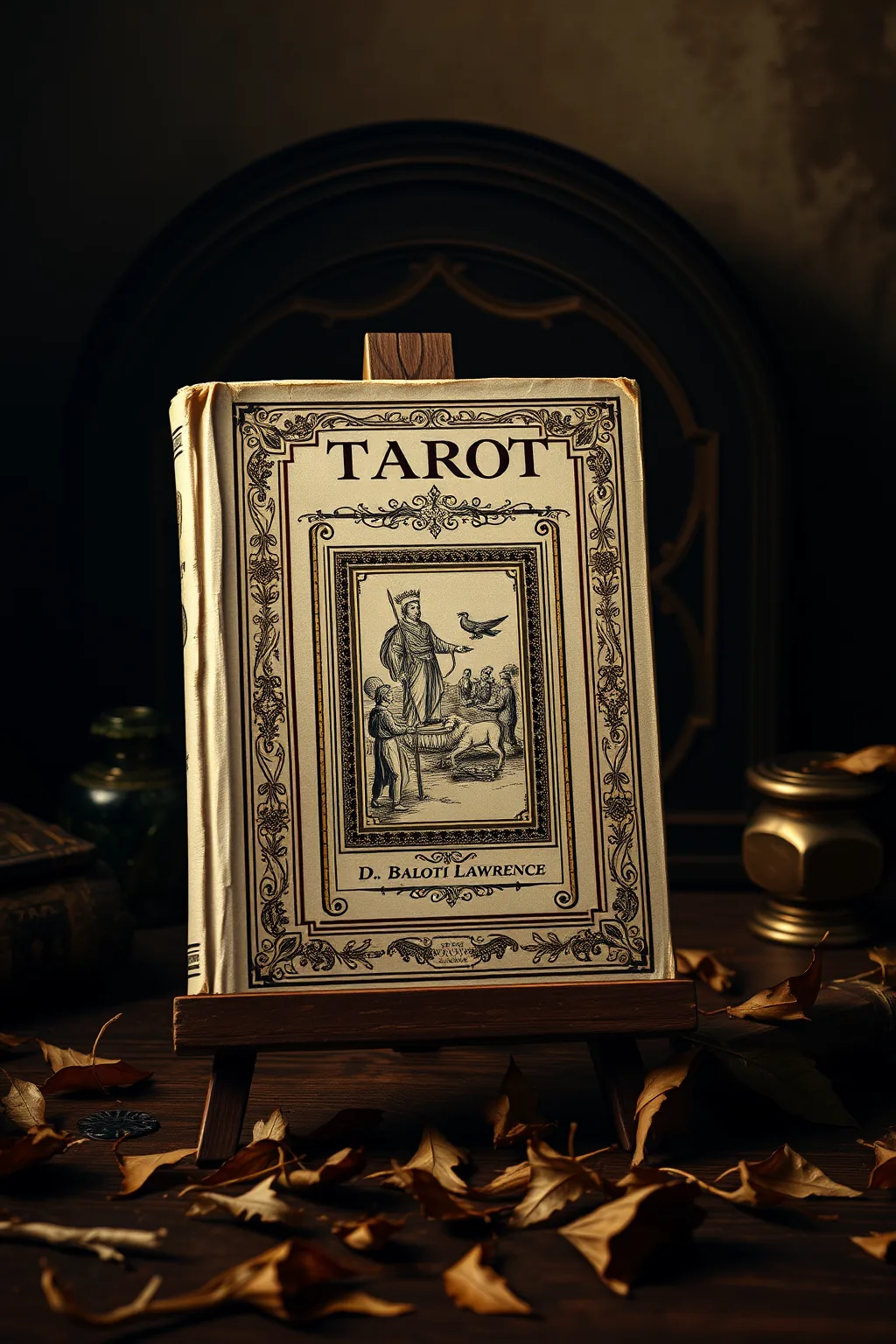
Tarot
 83
83

Tarot
D. Baloti Lawrence's "Tarot" approaches the cards with an academic rigor that distinguishes it from more popular, divination-focused texts. The author's strength lies in meticulously dissecting the symbolic architecture of both the Major and Minor Arcana, presenting them as a coherent system of esoteric knowledge rather than a collection of disconnected symbols. A particularly insightful passage discusses the progression of the Fool, illustrating how its seemingly paradoxical nature embodies fundamental principles of initiation and transformation within occult philosophy. However, the book's academic tone, while a strength for some, can also be a limitation; the prose is dense and may prove challenging for readers seeking a more intuitive or immediately practical guide to reading the cards. Lawrence prioritizes historical and symbolic analysis over predictive techniques, which might leave some practitioners wanting. Nevertheless, for those dedicated to understanding the Tarot's deep structure, "Tarot" offers a valuable, albeit demanding, scholarly resource.
📝 Description
83
### What It Is Tarot, authored by D. Baloti Lawrence, offers a detailed examination of the traditional Tarot deck, approaching it not merely as a divination tool but as a complex symbolic language. First published in 1992, the work systematically breaks down the archetypes and correspondences embedded within the Major and Minor Arcana, providing a framework for understanding their individual meanings and collective narratives. It explores the Tarot's roots and its evolution as a system of esoteric knowledge.
### Who It's For This book is primarily for individuals seeking a rigorous, scholarly approach to Tarot study. It caters to those who have moved beyond introductory guides and desire a deeper comprehension of the underlying philosophical and symbolic structures. Students of Western Esotericism, comparative mythology, and Jungian psychology will find its analytical depth particularly beneficial. It is for the serious practitioner or academic curious about the Tarots' place in occult traditions.
### Historical Context Published in 1992, D. Baloti Lawrence's "Tarot" emerged during a period of renewed interest in esoteric studies and occult philosophy following the counter-cultural movements of the 1960s and 70s. The late 20th century saw a diversification of Tarot interpretations, moving beyond purely fortune-telling applications towards psychological and spiritual frameworks. Lawrence's work can be situated alongside contemporary explorations by figures like Rachel Pollack, who also expanded the discourse on Tarot's symbolic richness and psychological resonance, though Lawrence's approach appears more grounded in textual analysis and historical lineage.
### Key Concepts The book introduces and elaborates on core concepts essential to understanding the Tarot system. It details the archetypal figures represented by the Major Arcana, explaining their significance as stages of the soul's journey or universal human experiences. The structure and symbolism of the Minor Arcana, including the suits (Wands, Cups, Swords, Pentacles) and the court cards, are meticulously analyzed. Lawrence also addresses the historical development of Tarot imagery and its integration into various esoteric traditions, highlighting the interplay between visual representation and symbolic meaning.
💡 Why Read This Book?
• Gain a structured understanding of the Tarot's symbolic language, as detailed in Lawrence's analysis of the 78 cards, moving beyond simple divinatory meanings. • Explore the historical evolution of Tarot imagery and its integration into esoteric traditions, providing context for its development since its origins around the 15th century. • Grasp the archetypal significance of figures like The Magician and The High Priestess, understanding their roles as fundamental patterns within Western occult thought.
⭐ Reader Reviews
Honest opinions from readers who have explored this book.
❓ Frequently Asked Questions
What is the historical origin of the Tarot deck discussed by D. Baloti Lawrence?
Lawrence's "Tarot" acknowledges the Tarot deck's origins in 15th-century Northern Italy, where playing cards with allegorical figures first appeared, later evolving into the divinatory and esoteric tool known today.
Does D. Baloti Lawrence's "Tarot" focus on practical card reading techniques?
While providing a deep symbolic understanding, the book prioritizes historical context and esoteric philosophy over step-by-step practical reading techniques for divination.
What is the significance of the Major Arcana in Lawrence's "Tarot"?
Lawrence presents the Major Arcana as a symbolic narrative, often interpreted as a spiritual journey or a series of archetypal encounters central to esoteric understanding and personal development.
How does "Tarot" by D. Baloti Lawrence relate to Jungian psychology?
The book's exploration of archetypes within the Tarot deck aligns with principles of Jungian psychology, particularly the concept of universal patterns influencing the human psyche and collective unconscious.
Is D. Baloti Lawrence's "Tarot" suitable for beginners?
It offers a scholarly and in-depth perspective, making it more suitable for intermediate to advanced students of Tarot and esoteric studies rather than absolute beginners seeking a quick start.
When was D. Baloti Lawrence's "Tarot" first published?
The original publication date for D. Baloti Lawrence's "Tarot" was 1992, placing it within a significant period of renewed interest in occult and esoteric literature.
🔮 Key Themes & Symbolism
Archetypal Narratives
The work meticulously unpacks the Major Arcana as a sequence of archetypal figures and transformative stages, akin to a spiritual odyssey. Lawrence examines how these archetypes, such as The Hermit or The Hanged Man, represent universal human experiences and stages of consciousness development. This approach treats the Tarot not just as a predictive tool but as a mirror reflecting the deeper patterns of the psyche and the cosmos, rooted in ancient wisdom traditions.
Symbolic Language of the Minor Arcana
Lawrence dedicates significant attention to the Minor Arcana, detailing the correspondences of the four suits (Wands, Cups, Swords, Pentacles) with elemental forces and aspects of human life. The book explores the numerical progression within each suit and the roles of the Court Cards (Page, Knight, Queen, King) as personifications of these energies. This systematic breakdown reveals the intricate structure that underpins the Tarot's narrative potential and its connection to everyday experience.
Historical and Esoteric Lineage
The book situates the Tarot within its historical development, tracing its roots from 15th-century playing cards to its later adoption by occultists. Lawrence discusses how figures and symbols within the deck were imbued with meaning by various esoteric traditions, including Hermeticism and Kabbalah. This contextualization highlights the Tarot's function as a repository of esoteric knowledge passed down through centuries.
The Tarot as a Philosophical System
Beyond divination, "Tarot" presents the deck as a sophisticated philosophical and psychological system. Lawrence explores how the interplay of cards can illuminate complex ideas, ethical dilemmas, and the nature of reality. The work encourages readers to engage with the Tarot's imagery as a means of self-inquiry and a tool for understanding the interconnectedness of various spiritual and mundane realms.
💬 Memorable Quotes
“The Fool's journey represents a primal leap into the unknown.”
— This interpretation highlights the archetype of The Fool not as ignorance, but as a courageous embrace of new beginnings and the inherent risks and potentials that accompany them.
“Each suit of the Minor Arcana carries specific elemental and life-domain associations.”
— This points to the structured nature of the Minor Arcana, suggesting that Wands, Cups, Swords, and Pentacles correspond to distinct energetic principles and areas of human experience.
“The Court Cards embody distinct personality types and stages of mastery within their respective suits.”
— This signifies that the King, Queen, Knight, and Page are not just figures but represent different levels of expression and engagement with the energies of their associated element.
“Tarot imagery evolved significantly from its origins as a card game.”
— This suggests a historical trajectory where the visual and symbolic content of the Tarot cards were reinterpreted and expanded upon by subsequent generations and esoteric practitioners.
“Understanding the Tarot requires appreciating its layered symbolic and philosophical dimensions.”
— This emphasizes that a comprehensive grasp of the Tarot necessitates looking beyond superficial interpretations to its deeper meanings, historical context, and philosophical underpinnings.
🌙 Esoteric Significance
Tradition
Lawrence's "Tarot" aligns with the Western Esoteric tradition, particularly its Hermetic and Kabbalistic branches, which have historically utilized symbolic systems for spiritual development. The book approaches the Tarot as a codified language of archetypes and cosmic principles, a common feature in these lineages. It departs from purely divinatory or fortune-telling interpretations by emphasizing the Tarot's role as a map of consciousness and a tool for philosophical inquiry, reflecting a trend in late 20th-century esoteric thought to integrate psychological and mystical frameworks.
Symbolism
The work extensively explores the symbolism of the Major Arcana, treating figures like The Hierophant and The Devil not just as images but as representations of spiritual laws and psychological states. Specific attention is given to the elemental correspondences of the four suits in the Minor Arcana (Wands for Fire, Cups for Water, Swords for Air, Pentacles for Earth), linking them to the Kabbalistic Tree of Life and broader Hermetic principles. The arrangement and imagery of the cards are presented as a coherent symbolic language designed to transmit esoteric wisdom.
Modern Relevance
Contemporary practitioners of Western Esotericism, particularly those involved in Hermetic orders or Kabbalistic studies, continue to draw upon the analytical depth provided by works like Lawrence's "Tarot." Its structured approach to symbolism and archetypes remains relevant for modern occultists seeking to understand the foundational grammar of the Tarot. Furthermore, scholars of religion and mythology find value in its detailed examination of the deck as a cultural artifact and a repository of symbolic meaning that continues to influence spiritual and psychological discourse today.
👥 Who Should Read This Book
• Students of Western Esotericism seeking to understand the Tarot's place within historical occult traditions and symbolic systems. • Advanced Tarot practitioners looking to deepen their knowledge beyond basic interpretation, focusing on archetypal psychology and philosophical underpinnings. • Comparative mythology scholars interested in analyzing archetypal imagery and its potential connections to universal narratives and spiritual frameworks.
📜 Historical Context
D. Baloti Lawrence's "Tarot", published in 1992, emerged during a fertile period for esoteric studies in the late 20th century. The preceding decades had seen a significant resurgence of interest in occultism, spirituality, and comparative mythology, partly fueled by the counter-culture movements and a growing dissatisfaction with purely materialistic worldviews. By 1992, the landscape of esoteric literature was diverse, with authors like Rachel Pollack and Mary K. Greer already expanding the discourse on Tarot beyond traditional divination, often integrating psychological and mythological perspectives. Lawrence's work can be seen as contributing to this scholarly turn, offering a structured, analytical approach that grounds the Tarot in its historical development and symbolic systems. While not directly engaging in public debates or facing specific censorship, books like Lawrence's were part of a broader intellectual current that sought to legitimize esoteric traditions through rigorous study and textual analysis, differentiating them from more pop-psychology or purely fortune-telling oriented publications.
📔 Journal Prompts
Reflect on the archetypal journey of The Fool as presented in the text.
Analyze the elemental and life-domain associations of the suit of Cups as described.
Consider the role of The Magician as a conduit of universal forces.
Examine the progression of numbers within one suit of the Minor Arcana.
Contemplate the symbolic representation of The High Priestess and her esoteric mysteries.
🗂️ Glossary
Major Arcana
The set of 22 trump cards in a Tarot deck, traditionally representing significant life events, spiritual lessons, and archetypal figures in a divinatory or allegorical sequence.
Minor Arcana
The 56 cards of a Tarot deck, divided into four suits (Wands, Cups, Swords, Pentacles), which typically represent everyday events, challenges, and circumstances.
Archetype
A universal, inherited pattern of thought or imagery derived from the experience of the race, present in the collective unconscious, often personified in mythology and symbolism.
Esotericism
A broad category of mystical and occult traditions that focus on hidden knowledge and spiritual transformation, often transmitted through symbolic systems and initiatory practices.
Hermeticism
A philosophical tradition based on the purported teachings of Hermes Trismegistus, emphasizing the unity of all things and the possibility of achieving spiritual enlightenment through knowledge and ritual.
Kabbalah
A system of Jewish mysticism that explores the divine nature and the creation of the universe through symbolic interpretation of scripture and esoteric doctrines, often represented by the Tree of Life.
Elemental Correspondences
The association of specific suits or cards within the Tarot with the four classical elements: Fire, Water, Air, and Earth, reflecting their respective qualities and domains.










![Cicero in twenty eight volumes. Vol.20: De senectute, De amicitia, De divinatione [Loeb 154]](/img/thumb/cicero-in-twenty-eight-volumes-vol-20-de-senectute-de-amicitia-de-divinatione-loeb-154-cicero-marcus-tulius-106-43-bce.webp)