New Thoughts on Tarot
 77
77

New Thoughts on Tarot
Mary K. Greer and Rachel Pollack's "New Thoughts on Tarot" offers a welcome departure from the often superficial treatment of the cards. The strength of this collection lies in its intellectual rigor, particularly in how it frames Tarot within broader psychological and esoteric frameworks. Pollack's exploration of the Hebrew alphabet's connection to the Major Arcana, for instance, provides a compelling historical and symbolic anchor. However, the book occasionally suffers from a density that might prove challenging for readers unfamiliar with esoteric jargon. A passage discussing the subtle interplay between the Fool's journey and Jungian individuation, while insightful, assumes a certain prior knowledge. Despite this, "New Thoughts on Tarot" remains a vital contribution for those seeking to understand the Tarot beyond its divinatory applications.
📝 Description
77
### What It Is
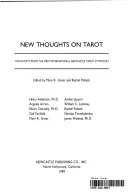
"New Thoughts on Tarot" is a collection of essays and explorations into the symbolic language and interpretive frameworks of Tarot cards. It moves beyond simple divinatory applications to consider the cards as a psychological and spiritual map. The work, first published in 1989, features contributions from Mary K. Greer and Rachel Pollack, two prominent figures in modern Tarot scholarship.
### Who It's For
This book is aimed at serious students of the Tarot, occultists, and anyone interested in the deeper psychological and esoteric meanings embedded within the 78-card deck. It appeals to those who have moved beyond beginner-level readings and seek to understand the archetypal patterns and philosophical underpinnings of Tarot imagery. It is also valuable for scholars of esoteric traditions and comparative mythology.
### Historical Context
Published in 1989, "New Thoughts on Tarot" emerged during a period of significant resurgence in esoteric studies and popular interest in Tarot. The late 20th century saw a move away from purely predictive interpretations towards more psychological and self-exploratory uses of the cards. This work stands as a key text from that era, reflecting a scholarly yet accessible approach that influenced subsequent generations of Tarot practitioners and writers.
### Key Concepts
The book engages with concepts such as the Tarot as a mirror for the psyche, the archetypal journey of the Fool, the relationship between Tarot and Kabbalah, and the historical evolution of card meanings. It explores the visual language of the cards, suggesting that their power lies not just in assigned meanings but in their ability to evoke personal associations and unconscious material. The focus is on understanding the cards as a system of esoteric knowledge.
💡 Why Read This Book?
• Gain a deeper understanding of the Tarot as a psychological map, informed by the work of Mary K. Greer and Rachel Pollack, moving beyond simple fortune-telling. • Explore the esoteric connections between Tarot and other mystical systems, such as the Kabbalah, as discussed in their 1989 publication. • Develop a more nuanced interpretive approach by examining the archetypal patterns within the cards, as detailed in their discussions of specific Major Arcana.
⭐ Reader Reviews
Honest opinions from readers who have explored this book.
❓ Frequently Asked Questions
When was "New Thoughts on Tarot" first published?
"New Thoughts on Tarot" was first published in 1989, marking a significant contribution to esoteric studies during that period.
Who are the primary authors of "New Thoughts on Tarot"?
The primary authors are Mary K. Greer and Rachel Pollack, both respected figures in the field of Tarot and esoteric scholarship.
What is the main focus of "New Thoughts on Tarot"?
The book focuses on the deeper psychological and esoteric meanings of the Tarot, exploring it as a symbolic system and spiritual map rather than solely a divinatory tool.
Does this book offer practical readings or theoretical insights?
It leans heavily towards theoretical insights and the philosophical underpinnings of the Tarot, offering a framework for deeper personal understanding rather than step-by-step reading instructions.
Is "New Thoughts on Tarot" suitable for beginners?
While accessible, it is best suited for those who have some foundational knowledge of Tarot and are interested in exploring its complex symbolic and psychological dimensions.
What esoteric traditions does the book connect Tarot to?
The book explores connections to various esoteric traditions, notably the Kabbalah, and discusses Tarot within the context of Jungian psychology and archetypal symbolism.
🔮 Key Themes & Symbolism
Tarot as Psychological Mirror
This work posits the Tarot deck as a profound tool for self-reflection, acting as a mirror to the user's inner landscape. It moves beyond simple fortune-telling to explore how the archetypal imagery of the cards can illuminate unconscious patterns, desires, and challenges. The book suggests that engaging with figures like The Fool or The High Priestess can facilitate an understanding of personal growth and the journey of individuation, drawing parallels with psychological theories.
Archetypal Journey and the Fool
Central to the book's thesis is the concept of the Fool's journey as a metaphor for the soul's progression through life and spiritual development. The authors analyze the sequence of Major Arcana cards as stages in this unfolding path, highlighting how each card represents a distinct archetype or lesson. This perspective frames the Tarot not as a static collection of symbols but as a dynamic narrative of transformation and self-discovery.
Esoteric Correspondences
The book delves into the intricate web of esoteric correspondences associated with the Tarot. It explores links to the Kabbalah, particularly the Hebrew alphabet's relationship with the Major Arcana, offering a framework for understanding the cards' deeper mystical significance. By examining these connections, "New Thoughts on Tarot" reveals the system's roots in Western esotericism and its potential for advanced spiritual study.
Symbolic Language of the Cards
Greer and Pollack emphasize that the true power of the Tarot lies in its rich, multi-layered symbolic language. They encourage readers to look beyond rote meanings and to engage with the visual details, color symbolism, and compositional elements of each card. This approach fosters a more intuitive and personal connection with the Tarot, allowing the imagery to speak directly to the subconscious mind.
💬 Memorable Quotes
“The cards are a map of the soul.”
— This interpretation suggests that the Tarot's primary function is not to predict external events but to chart the internal landscape of the psyche and spiritual development.
“Each card is a doorway to a different state of consciousness.”
— This highlights the transformative potential of the Tarot, viewing each card not as a fixed symbol but as an entry point into varied modes of perception and awareness.
“The Fool's journey is our own journey.”
— This conceptualizes the Fool's path through the Major Arcana as a direct allegory for the human experience of growth, learning, and spiritual evolution.
“Tarot speaks in the language of symbols and archetypes.”
— This emphasizes the symbolic and archetypal nature of Tarot, suggesting that its meaning is conveyed through universal patterns and imagery that resonate on a deep, often unconscious level.
“Understanding the Hebrew letters unlocks deeper meanings.”
— This refers to the practice of correlating the Major Arcana with the Hebrew alphabet, a key esoteric tradition that reveals layered symbolic connections within the Tarot system.
🌙 Esoteric Significance
Tradition
This work fits within the modern Western Esoteric tradition, particularly drawing from Jungian psychology and Hermeticism. It moves beyond the divinatory focus prevalent in earlier eras, reframing Tarot as a tool for psychological integration and spiritual development. The emphasis on archetypes and the unconscious connects it to psychoanalytic thought, while its exploration of correspondences links it to older Kabbalistic and alchemical traditions, reinterpreting them for a contemporary audience.
Symbolism
Key symbols explored include The Fool, representing the uninitiated soul embarking on a spiritual quest, and the archetypal figures of the Major Arcana, which are analyzed as stages of psychological and spiritual growth. The book also delves into the symbolism of numbers and colors within the cards, and their potential connections to the Hebrew alphabet, highlighting the intricate, multi-layered meanings embedded in the Tarot's visual language.
Modern Relevance
Contemporary practitioners of Tarot, particularly those focused on psychological and archetypal approaches, continue to draw heavily on the insights presented in "New Thoughts on Tarot." The book's influence can be seen in modern Tarot courses and literature that emphasize self-exploration and the integration of unconscious material. Its nuanced perspective has helped solidify Tarot's place as a legitimate tool for personal growth and spiritual inquiry within esoteric communities.
👥 Who Should Read This Book
["• Advanced Tarot students seeking to deepen their theoretical understanding beyond basic readings and explore the cards' psychological and esoteric dimensions.", '• Practitioners of Jungian psychology and archetypal studies interested in applying symbolic systems to explore the unconscious mind.', '• Scholars of Western Esotericism interested in the evolution of Tarot interpretation and its connections to traditions like the Kabbalah.']
📜 Historical Context
The publication of "New Thoughts on Tarot" in 1989 placed it squarely within a late 20th-century renaissance of esoteric studies. The era saw a growing academic and popular interest in occult traditions, moving beyond the more sensationalist perceptions of earlier decades. Figures like Joseph Campbell had popularized the study of mythology and archetypes, creating fertile ground for works that explored symbolic systems like Tarot through a psychological lens. This period also saw the rise of feminist scholarship, which influenced many esoteric writers to re-examine traditional symbolism. While the mainstream academic world was often skeptical, the work contributed to a burgeoning field of comparative mysticism and the psychology of religion. It offered an alternative to more dogmatic spiritual paths, aligning with a general cultural shift towards personal exploration and self-discovery, influenced by thinkers like Carl Jung.
📔 Journal Prompts
The Fool's journey as a personal narrative.
Archetypal figures encountered in the Major Arcana.
The symbolic resonance of specific card imagery.
Tarot as a map for internal states.
Exploring esoteric correspondences in a personal spread.
🗂️ Glossary
Archetype
Universal, archaic patterns and images that derive from the collective unconscious and are the psychic counterpart of the instincts. In Tarot, these are represented by the figures and scenes on the cards.
Individuation
A central concept in Jungian psychology referring to the process of psychological integration, in which the individual becomes whole and distinct. The Tarot's journey is often seen as mirroring this process.
Kabbalah
A system of Jewish mysticism that deals with the nature of God and creation. The book explores its connections to the Tarot, particularly through the Hebrew alphabet.
Major Arcana
The 22 trump cards of the Tarot deck, representing significant life lessons, archetypal figures, and spiritual milestones in the Fool's journey.
Minor Arcana
The 56 cards of the Tarot deck divided into four suits (Wands, Cups, Swords, Pentacles), representing everyday events, situations, and challenges.
Esotericism
A category of religious or spiritual thought characterized by esoteric, or inner, teachings and practices. It often involves symbolic interpretation and hidden meanings.
Divination
The practice of seeking knowledge of the future or the unknown by supernatural means. The book discusses this aspect of Tarot but emphasizes deeper interpretations.