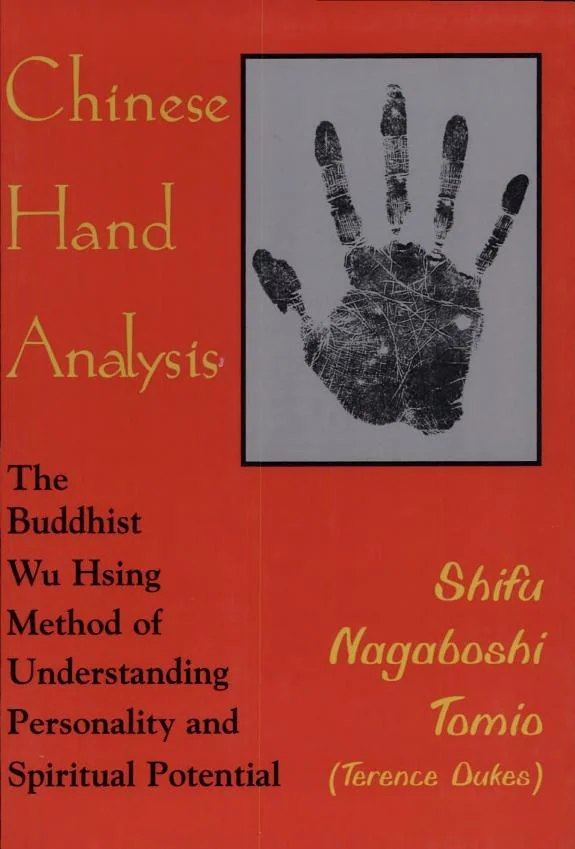
Chinese hand analysis
 80
80

Chinese hand analysis
Terence Dukes and Shifu Nagaboshi Tomio's "Chinese Hand Analysis" offers a structured, if somewhat dense, exploration of palmistry rooted in Eastern traditions. Its strength lies in its systematic approach, attempting to codify a practice often perceived as nebulous. The detailed descriptions of hand shapes, line meanings, and the integration of the Five Elements provide a solid foundation for serious study, moving beyond superficial parlor tricks. However, the work occasionally suffers from a dry, academic tone that can obscure the intuitive nature of the practice. A particularly illustrative section details the subtle differences in interpreting the Head Line based on its starting point and trajectory, highlighting the nuanced approach required. While valuable for its thoroughness, it might benefit from more case studies or practical exercises to bridge the gap between theory and application for the novice reader. It serves as a competent manual for the dedicated student of palmistry.
📝 Description
80
### What It Is Chinese hand analysis, also known as palmistry or physiognomy, is an ancient practice examining the lines, shapes, and mounts of the hands to discern character traits, predict future events, and understand life paths. This particular work, first published in 1988, presents a systematic approach to the subject, drawing from established traditions. It goes beyond simple fortune-telling, aiming to offer a framework for self-understanding and personal development.
### Who It's For This book is intended for individuals interested in esoteric disciplines, particularly those exploring non-Western divination systems. It will appeal to students of traditional Chinese metaphysics, comparative religion scholars, and anyone curious about the human hand as a map of personal potential. It is also suitable for practitioners seeking to expand their repertoire of divinatory tools or those interested in the intersection of psychology and spiritual insight.
### Historical Context The practice of palmistry has roots stretching back millennia in various cultures, but its systematic study in the West gained momentum in the 19th century. This 1988 publication emerges in an era of renewed interest in occult and esoteric studies, often termed the 'New Age' movement, which saw a surge in translations and original works on global spiritual traditions. Authors like Shifu Nagaboshi Tomio, collaborating with Terence Dukes, contributed to this burgeoning field by making complex systems accessible.
### Key Concepts Central to Chinese hand analysis are the interpretations of the 'Five Elements' (Wu Xing) as they relate to different hand features and the mapping of planetary influences onto the palm. The text likely details the significance of specific lines such as the Life Line, Head Line, and Heart Line, but also explores less commonly discussed features like the mounts (e.g., Mount of Venus, Mount of Jupiter) and the texture and color of the skin. Understanding the interplay between these elements is presented as crucial for a comprehensive reading.
💡 Why Read This Book?
• Learn to interpret the specific meaning of the Mount of Jupiter on the palm, a concept central to understanding ambition and leadership as presented in this text. • Gain practical skills in distinguishing between different hand shapes, such as the 'Air' or 'Water' hand, as categorized and analyzed within the framework established by Shifu Nagaboshi Tomio. • Understand the foundational principles of the Five Elements (Wu Xing) and their application to hand analysis, a core concept unique to this tradition that influences character and destiny.
⭐ Reader Reviews
Honest opinions from readers who have explored this book.
❓ Frequently Asked Questions
What is the original publication year of Chinese Hand Analysis?
The original publication year for "Chinese Hand Analysis" by Terence Dukes and Shifu Nagaboshi Tomio is 1988.
Are there multiple authors for Chinese Hand Analysis?
Yes, the work is attributed to Terence Dukes and Shifu Nagaboshi Tomio, with Shifu Nagaboshi Tomio often cited as the primary contributor from the original 1988 publication.
What is the primary focus of Chinese Hand Analysis?
The primary focus is on examining the lines, shapes, and mounts of the hand to understand character, potential, and life paths, drawing from ancient Chinese traditions.
Is Chinese Hand Analysis the same as Western palmistry?
While both examine the hand, Chinese hand analysis incorporates specific concepts from Chinese metaphysics, such as the Five Elements, which distinguish it from purely Western approaches.
Who is Shifu Nagaboshi Tomio?
Shifu Nagaboshi Tomio is a significant figure associated with the original 1988 publication of "Chinese Hand Analysis," contributing expertise from Eastern esoteric traditions.
What are the 'mounts' in Chinese hand analysis?
The 'mounts' are the fleshy pads at the base of each finger and on the palm, named after planets (e.g., Mount of Venus, Mount of Jupiter), believed to indicate specific personality traits and potentials.
🔮 Key Themes & Symbolism
The Five Elements (Wu Xing)
The integration of the ancient Chinese philosophy of the Five Elements—Wood, Fire, Earth, Metal, and Water—forms a cornerstone of this analysis. It posits that these elemental forces influence not only the physical characteristics of the hand but also the temperament, health, and destiny of the individual. The text likely maps these elements to specific hand features, colors, and textures, offering a holistic view of the person's energetic makeup and how they interact with the world, moving beyond simple line readings to a more comprehensive understanding of cosmic influence.
Hand Shapes and Finger Lengths
Beyond the lines etched into the palm, the fundamental shape of the hand and the relative lengths of the fingers are crucial indicators in Chinese hand analysis. The work likely categorizes hands into types associated with classical elements (e.g., Earth hands, Air hands) and explores how these broad classifications interact with finer details. Finger lengths, particularly the thumb, are analyzed for their contribution to willpower, logic, and sensuality. This section provides a foundational understanding of the physical structure as a primary key to unlocking personality archetypes.
The Mounts as Planetary Indicators
In conjunction with the major palm lines, the text elucidates the significance of the 'mounts'—the fleshy prominences found at the base of the fingers and the fleshy mound below the thumb. Each mount is associated with a classical planet (e.g., Jupiter, Saturn, Apollo) and represents a specific area of life or personality trait, such as ambition, wisdom, or creativity. The development and markings on these mounts offer crucial insights into the strengths and challenges related to these planetary influences, adding a layer of astrological correlation to the palmistic reading.
Line Interpretation Nuances
While common lines like the Heart, Head, and Life lines are discussed, Chinese hand analysis offers unique interpretations and emphasizes subtle variations. The text likely details how the starting point, ending point, clarity, and any breaks or islands on these lines contribute to a more precise understanding of their meaning. Furthermore, it may introduce less common lines or minor markings, providing a comprehensive lexicon for deciphering the palm's intricate script and revealing the flow of vital energy (Qi) throughout a person's life.
💬 Memorable Quotes
“The hand is a map of the soul's journey.”
— This conceptual interpretation suggests that the physical features of the hand are not arbitrary but rather a symbolic representation of an individual's inherent nature, past experiences, and future potentials. It frames palmistry as a tool for self-discovery and understanding one's unique path.
“Each line, mount, and finger contributes a verse to the poem of life.”
— This paraphrase highlights the intricate and interconnected nature of palmistry. It suggests that every detail on the hand plays a role in the overall narrative of a person's existence, emphasizing a holistic approach to interpretation rather than focusing on isolated features.
“Understanding the Five Elements reveals the energetic blueprint of the individual.”
— This interpretation emphasizes the foundational role of the Wu Xing system in the book. It implies that by analyzing how the Five Elements manifest in the hand, one can gain insight into a person's core energetic constitution and their innate tendencies.
“The thumb's flexibility speaks to the adaptability of the will.”
— This interpretation focuses on a specific physical attribute – the thumb's range of motion. It connects this physical characteristic directly to a psychological trait, suggesting that a more flexible thumb indicates a more adaptable and less rigid willpower.
“The clarity of the Head Line indicates the directness of thought.”
— This conceptual statement links the visual appearance of a specific palm line to a cognitive function. A clear, unbroken Head Line, according to this interpretation, suggests a straightforward and focused mental process.
🌙 Esoteric Significance
Tradition
This work fits within the broader lineage of esoteric physiognomy, specifically drawing from ancient Chinese metaphysical principles. It aligns with Taoist and traditional Chinese medicine concepts that view the body as a microcosm reflecting universal energies and patterns. Unlike purely Western palmistry, which often incorporates Hellenistic astrological correspondences, this text emphasizes the Chinese framework of the Five Elements (Wu Xing) and the flow of Qi, situating it within a distinct cosmological understanding.
Symbolism
Key symbols include the Five Elements (Wood, Fire, Earth, Metal, Water), each representing distinct qualities and influencing different aspects of the hand's appearance and the individual's character. Another significant motif is the mapping of planetary influences onto the 'mounts' of the hand, such as the Mount of Jupiter (ambition) or the Mount of Apollo (creativity), linking the physical form to celestial archetypes. The various lines—Life, Head, Heart—are also symbolic, representing the flow of vital energy, consciousness, and emotional currents.
Modern Relevance
Contemporary practitioners of holistic wellness, energy healing, and psychological astrology often draw upon the principles presented in works like this. Modern life coaches and therapists might integrate the self-understanding aspects of physiognomy, while alternative spiritual educators continue to explore the intricate symbolism of the hand. The emphasis on energetic balance through the Five Elements resonates with current interest in Eastern philosophies and mind-body connection practices.
👥 Who Should Read This Book
['• Students of traditional Chinese metaphysics seeking to understand the application of the Five Elements (Wu Xing) to a divinatory art.', '• Aspiring palmists interested in a comprehensive system that moves beyond superficial readings and incorporates detailed analysis of hand shapes and mounts.', '• Individuals exploring comparative systems of divination and physiognomy who wish to contrast Eastern and Western approaches to reading the human hand.']
📜 Historical Context
The 1988 publication of "Chinese Hand Analysis" arrived during a period of significant global interest in esoteric knowledge, often associated with the burgeoning 'New Age' movement. This era saw a resurgence of translated spiritual texts and original works exploring diverse mystical traditions, making systems like palmistry, particularly those with ancient roots, increasingly accessible to a Western audience. The work by Terence Dukes and Shifu Nagaboshi Tomio contributed to this trend by presenting a systematic, Eastern-influenced approach to palmistry, differentiating itself from the more common Western palmistry schools prevalent at the time. While figures like Cheiro had popularized palmistry earlier in the 20th century, this book offered a distinct perspective, likely drawing from specific Chinese metaphysical frameworks. The reception was part of a broader cultural embrace of alternative belief systems, though academic engagement remained limited.
📔 Journal Prompts
The Mount of Venus and its perceived prominence.
Interpreting the clarity and breaks in the Head Line.
Reflecting on the symbolism of your dominant hand's shape.
The interplay between finger length and thumb flexibility.
How the Five Elements manifest in your personal characteristics.
🗂️ Glossary
Wu Xing
The Chinese philosophical concept of the Five Elements: Wood, Fire, Earth, Metal, and Water. In hand analysis, these elements are believed to correspond to different characteristics, health patterns, and energetic predispositions.
Mounts
The fleshy, raised areas on the palm, typically located at the base of the fingers and below the thumb. Each mount is associated with a classical planet and represents specific personality traits or life potentials.
Life Line
A major line on the palm that curves around the base of the thumb. It is traditionally associated with physical vitality, health, and significant life events, rather than the literal length of one's life.
Head Line
A prominent line extending across the palm, often from the area between the thumb and index finger. It is interpreted as representing mental faculties, intellectual approach, communication style, and cognitive processes.
Heart Line
The uppermost horizontal line on the palm, typically starting below the little finger. It is associated with emotional expression, romantic relationships, and the state of one's emotional well-being.
Qi (Chi)
A fundamental concept in traditional Chinese culture, referring to vital energy or life force. In hand analysis, the flow and balance of Qi are believed to be reflected in the clarity and markings of the palm's lines.
Physiognomy
A branch of knowledge that claims to assess character and disposition through outward appearance, particularly the features of the face and body. Hand analysis is considered a specific form of physiognomy.