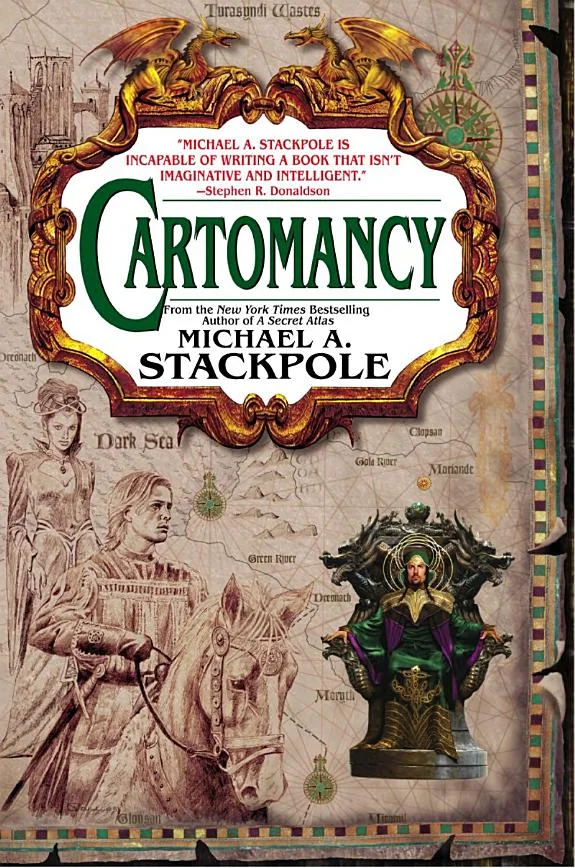
Cartomancy
 78
78

Cartomancy



Michael A. Stackpole's *Cartomancy* presents a fascinating premise: mapmakers who don't just depict worlds but can actively shape them. The novel excels in its detailed exploration of this cartographic magic, grounding its fantastical elements in a system that feels both intricate and logical. The early scenes, establishing the abilities of the mapmakers and the looming threat of the 'Nameless Enemy,' are particularly effective in drawing the reader into Nalenyr's plight. However, the narrative occasionally falters in its pacing, particularly in the middle sections where the grand scope of the world-saving mission can feel a bit diffuse. The characterization, while functional, sometimes leans towards archetypes, making certain heroic sacrifices feel less emotionally impactful than they could have been. Despite these points, the sheer ingenuity of the core concept—magic as applied geography—makes *Cartomancy* a noteworthy entry in speculative fiction. It offers a unique take on world-building that rewards readers patient enough to follow its intricate design.
📝 Description
78
### The Mapmakers' Art Cartomancy, penned by Michael A. Stackpole and first published in 2006, introduces a fantasy world where cartography transcends mere representation to become a tool of creation and alteration. The narrative centers on a cadre of mapmakers possessing the extraordinary ability to chart not only known territories but also to discover and even shape entirely new realities. This power places them at the forefront of a struggle for survival against an undefined, encroaching threat.
### For the Discerning Reader This work is intended for readers who appreciate intricate world-building and speculative fiction that pushes the boundaries of its genre. It appeals to those who enjoy narratives where magic or extraordinary abilities are tied to specific, well-defined systems, rather than arbitrary powers. Fans of authors like Brandon Sanderson or N.K. Jemisin, who craft detailed magical frameworks and complex societal structures, will find themselves engaged by Stackpole’s approach to the mapmakers' craft.
### Echoes of Early Fantasy Published in 2006, Cartomancy emerged during a period when epic fantasy was solidifying its mainstream appeal, building on foundations laid by authors like J.R.R. Tolkien and later popularized by writers such as Robert Jordan. Stackpole’s contribution to this landscape in 2006 involved exploring the concept of reality-shaping through a unique cartographic lens, distinguishing it from more traditional magic systems prevalent at the time. The narrative's emphasis on strategic defense against an alien force also echoes classic conflict archetypes within the genre.
### Core Concepts Explored The book centers on the principle of cartomancy, the art and science of creating maps that possess tangible power over the depicted reality. This involves understanding the fundamental energies and structures of existence, which the mapmakers learn to manipulate. Another key concept is the nature of the 'Nameless Enemy,' a force of destruction whose lack of definition makes it a potent existential threat. The narrative also explores the rediscovery and reawakening of ancient powers and heroes necessary to combat this overwhelming adversary, suggesting a cyclical or dormant aspect to the world’s defense mechanisms.
💡 Why Read This Book?
• Understand the concept of cartomancy as a reality-shaping force, learning how Stackpole intertwines geography with fundamental magical principles. • Experience the strategic implications of defending Nalenyr against the 'Nameless Enemy,' offering a unique perspective on conflict resolution beyond standard combat. • Witness the revival of ancient heroes, exploring how dormant powers and forgotten lore are essential for confronting existential threats in fantasy.
why_read
⭐ Reader Reviews
Honest opinions from readers who have explored this book.
❓ Frequently Asked Questions
What is the core magical system in Michael A. Stackpole's Cartomancy?
The central magical system is cartomancy, the art of creating maps that can influence or alter the reality they represent. This involves a deep understanding of the world's underlying structure and energies.
Who are the main protagonists in Cartomancy?
The protagonists are a group of mapmakers who possess the unique ability to discover and shape new worlds through their craft. They are tasked with defending their land, Nalenyr.
What is the primary conflict driving the plot of Cartomancy?
The primary conflict is the invasion by a mysterious and unnamed enemy, referred to as the 'Nameless Enemy,' which threatens Nalenyr with oblivion.
When was Cartomancy first published?
Cartomancy was first published on February 28, 2006.
What genre does Cartomancy belong to?
Cartomancy belongs to the fantasy fiction genre, specifically focusing on speculative elements with intricate world-building and unique magic systems.
What makes the mapmakers in this book special?
The mapmakers in Cartomancy are special because their maps are not just representations but tools that can discover and actively shape reality, a power central to the plot.
🔮 Key Themes & Symbolism
Cartomancy as Creation
The book posits cartomancy not as a passive art but an active force capable of generating and altering existence. This approach suggests that understanding and mapping reality are foundational to its control, a concept that resonates with hermetic principles of 'as above, so below.' The mapmakers' abilities highlight how detailed knowledge and precise representation can translate into tangible power, allowing them to discover new worlds and defend their own.
The Nature of the Nameless Enemy
The antagonist, the 'Nameless Enemy,' represents an existential threat whose undefined nature amplifies its terror. This abstract foe challenges the protagonists not through identifiable motives or forms, but as a force of pure negation or entropy. Its presence forces a re-evaluation of defense strategies, moving beyond conventional warfare to confront an encroaching oblivion that threatens to erase existence itself.
Reawakening Ancient Powers
A crucial element of the plot involves the necessity of awakening old heroes and dormant powers to counter the overwhelming threat. This theme suggests that solutions to contemporary crises may lie in forgotten lore or latent potentials within the world's history. It implies a cyclical view of conflict, where past guardians and their abilities must be resurrected to face escalating dangers, linking the present struggle to ancestral strengths.
The Interplay of Map and Territory
Stackpole's work delves into the profound connection between a map and the territory it represents, elevating it to a metaphysical level. The mapmakers' skill lies in manipulating this connection, implying that the symbolic representation holds dominion over the physical. This concept challenges the reader to consider how our own perceptions and representations of reality might influence its substance.
💬 Memorable Quotes
“The old heroes must be awakened.”
— This line encapsulates the narrative's reliance on past strength to confront present danger. It suggests that current resources are insufficient, and a resurgence of ancient protectors or powers is essential for survival.
“Discover new worlds—and shape reality itself.”
— This phrase highlights the dual power of the mapmakers: exploration and active creation. It underscores that their cartographic skills are not merely observational but foundational to the very existence and nature of the worlds they chart.
“Under the shadow of invasion by a nameless enemy.”
— This sets the stage for an existential threat. The 'nameless' aspect emphasizes the enemy's unknown nature, making it a more terrifying and abstract force of destruction that defies conventional understanding or opposition.
“Only one way to save Nalenyr from oblivion.”
— This statement emphasizes the dire stakes of the conflict. It implies that conventional or obvious solutions have failed, necessitating extraordinary measures and a singular, focused path toward salvation.
“Journey across...”
— This phrase, though incomplete in the blurb, points to a quest narrative. It suggests that overcoming the threat requires movement, exploration, and likely significant challenges faced during the journey itself.
🌙 Esoteric Significance
Tradition
While not explicitly tied to a single esoteric lineage, *Cartomancy*'s concept of shaping reality through symbolic representation echoes Hermetic principles, particularly the axiom 'As Above, So Below.' The idea that meticulous mapping—a form of symbolic ordering—can influence the physical world aligns with magical traditions that posit a correspondence between mental constructs and material manifestation. It departs from purely spiritual or devotional paths, grounding its metaphysics in a more practical, almost alchemical, manipulation of existence.
Symbolism
The primary symbol is the map itself, representing not just geography but the underlying structure of reality. The act of charting becomes a ritual, with lines and symbols holding inherent power. The 'Nameless Enemy' can be interpreted as a symbol of chaos or entropy, the antithesis of the ordered, mapped reality the protagonists strive to maintain. The 'old heroes' symbolize latent potential and ancestral wisdom, representing the idea that forgotten knowledge holds the key to overcoming present crises.
Modern Relevance
Contemporary thinkers and practitioners in areas like consciousness studies and speculative fiction continue to explore the power of representation and narrative in shaping perception and reality. The idea that our mental maps and conceptual frameworks profoundly influence our experience of the world, a concept central to *Cartomancy*, finds echoes in modern psychology and philosophy of mind. The book's exploration of creation through symbolic action remains relevant to anyone interested in the generative power of imagination and intent.
👥 Who Should Read This Book
• Fans of intricate fantasy world-building who appreciate magic systems with clear, logical rules. • Readers interested in philosophical explorations of reality, perception, and the power of symbols. • Individuals seeking speculative fiction narratives that explore themes of creation, destruction, and the reawakening of dormant potential.
📜 Historical Context
Michael A. Stackpole's *Cartomancy*, published in 2006, arrived in a landscape of fantasy literature still heavily influenced by the epic traditions of authors like Robert Jordan, whose *Wheel of Time* series was nearing completion. The early 2000s saw a surge in popular fantasy, with works exploring intricate magic systems and expansive world-building gaining significant traction. Stackpole’s contribution in 2006 was to introduce a novel concept: cartomancy, where mapmaking transcends representation to become a literal force of creation and alteration. This differentiated it from contemporary works that often relied on more traditional elemental or psionic magic. While not a direct engagement with, say, the burgeoning urban fantasy scene led by authors like Jim Butcher, *Cartomancy* tapped into a reader appetite for high fantasy with unique, system-based magical frameworks. Its reception was generally positive within the genre, appreciated for its inventive premise and strategic narrative, though it did not spark a specific critical debate or a measurable counter-movement in the way some more genre-defining works might have.
📔 Journal Prompts
The mapmakers' ability to shape reality through cartography.
The implications of an undefined 'Nameless Enemy' as a narrative antagonist.
The necessity of awakening dormant powers to face existential threats.
The relationship between Nalenyr's defense and the reawakening of old heroes.
The concept of cartomancy as a tool for discovering new worlds.
🗂️ Glossary
Cartomancy
The art and practice of creating maps that possess the power to discover, influence, or actively shape the reality they depict. It is the central magical system in the book.
Nalenyr
The name of the land or world that the protagonists are trying to save from invasion and oblivion.
Nameless Enemy
An unspecified, existential threat that invades Nalenyr. Its lack of definition makes it a terrifying and potent force of destruction.
Old Heroes
Refers to ancient protectors or figures of power within Nalenyr who must be reawakened or revived to combat the current threat.
Mapmakers
Individuals possessing the unique ability of cartomancy, allowing them to create maps that directly affect reality.
Oblivion
The state of utter destruction or non-existence that the Nameless Enemy threatens to bring upon Nalenyr.
Shaping Reality
The act by which mapmakers, through their cartomancy, can alter or create aspects of the world they are mapping.