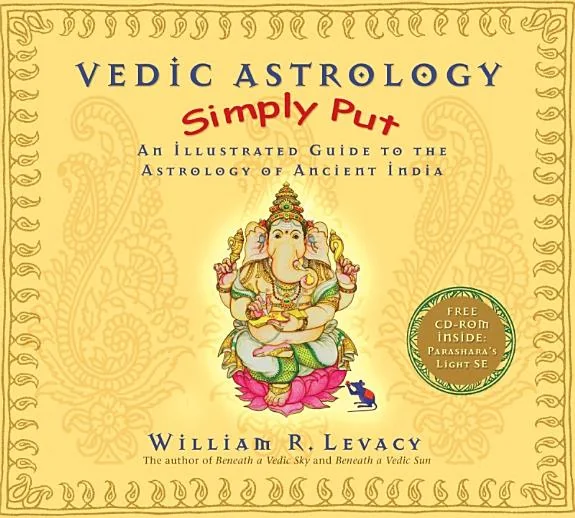
Vedic Astrology Simply Put
 76
76

Vedic Astrology Simply Put
William R. Levacy’s *Vedic Astrology Simply Put* arrives with a commendable aim: to render the intricate system of Jyotish approachable. Its strength lies in the author’s evident desire to connect with the novice, employing clear language and illustrative aids that sidestep the esoteric jargon that often fences off such disciplines. The section on the nine planets (Grahas) and their basic significations, for example, offers a solid, digestible foundation for understanding their energetic roles. However, in its pursuit of simplicity, the book occasionally glosses over the deeper philosophical currents that animate Vedic astrology, particularly its profound connection to karmic principles and dharma. While the intention is to ease the reader in, some may find the explanations of the twelve houses (Bhavas) a touch too superficial, lacking the gravitas that a more seasoned practitioner might expect. Levacy succeeds in making the initial steps into Jyotish less daunting, but the true depth of the tradition remains largely untouched. It is a competent primer, though not a complete exposition.
📝 Description
76
William R. Levacy's 2007 book presents Vedic astrology for a modern audience.
Vedic Astrology Simply Put aims to make Jyotish, the Indian system of celestial interpretation, understandable for newcomers. Published in 2007, the book focuses on clear explanations rather than complex calculations. It breaks down core astrological principles, how planets affect human behavior, and life patterns. The author focuses on the basic elements that structure this ancient system. This approach is intended for people new to Vedic astrology who want an accessible introduction. It is also for those who find more advanced texts or studies overwhelming. Readers interested in comparative spirituality or Eastern philosophies will find practical insights into understanding personal destiny and psychological traits.
Jyotish, or Vedic astrology, developed in India thousands of years ago as part of Vedic civilization. Meaning 'light,' it was linked to rituals and philosophy, with systematic development noted in texts like the *Vedanga Jyotisha* around 1450 BCE. This tradition predates many Western astrological systems. Levacy's 2007 book appeared during a time of growing global interest in Eastern spiritual practices, a trend amplified by earlier figures who introduced Indian philosophies to Western audiences.
💡 Why Read This Book?
• Learn the fundamental differences between Vedic astrology and Western systems, understanding the unique structure of Jyotish as presented in Levacy's accessible framework. • Grasp the basic significations of the nine planets (Grahas) and their influence on personality and life events, as detailed in the book’s illustrative explanations. • Gain a foundational understanding of astrological houses (Bhavas) and their application in analyzing a birth chart, drawing from the book's simplified approach to chart interpretation.
⭐ Reader Reviews
Honest opinions from readers who have explored this book.
❓ Frequently Asked Questions
How does Vedic Astrology Simply Put explain the origins of Jyotish?
The book traces the origins of Vedic astrology, known as Jyotish, to ancient India, presenting it as an age-old system of behavior and trend analysis derived from Vedic civilization.
What are the main differences between Vedic astrology and Western astrology according to the book?
Vedic Astrology Simply Put highlights that Vedic astrology, or Jyotish, uses a sidereal zodiac (which accounts for the precession of the equinoxes), unlike the tropical zodiac commonly used in Western astrology.
Does the book cover the planetary influences in Vedic astrology?
Yes, the book provides straightforward guidance on deciphering the influence of the nine planets (Grahas) in Vedic astrology, explaining their basic characteristics and roles.
Is Vedic Astrology Simply Put suitable for complete beginners?
Absolutely. The book is designed as a simplified entry into Vedic astrology, using colorful, fun, and beautifully rendered illustrations to ease understanding for those new to the subject.
What is the significance of the term 'Jyotish' as explained in the book?
Jyotish, the Indian name for Vedic astrology, is explained as meaning 'light' or 'celestial body,' emphasizing its role in illuminating one's life path and understanding cosmic influences.
Does the book discuss the concept of Karma in relation to astrology?
While not explicitly detailed in the provided blurb, books on Vedic astrology typically explore the concept of Karma as it relates to astrological configurations and the karmic blueprint present in a birth chart.
🔮 Key Themes & Symbolism
Jyotish Fundamentals
This book serves as an introductory guide to Jyotish, the ancient Indian system of astrology. It breaks down complex concepts such as the sidereal zodiac, the nine planets (Grahas), and the twelve houses (Bhavas) into digestible pieces. Levacy's approach prioritizes clarity and visual appeal, making the foundational elements of this millennia-old practice understandable for newcomers. The emphasis is on providing a solid, uncomplicated base for those wishing to explore astrological interpretations from an Indian perspective.
Behavioral Trend Analysis
Fundamentally, Vedic astrology, as presented here, is framed as a sophisticated method for analyzing human behavior and life trends. The book illustrates how celestial configurations at the time of birth can correlate with an individual's predispositions, potential challenges, and life path. Levacy simplifies the interpretation of these correlations, offering readers tools to understand personal tendencies and the cyclical nature of events, thereby providing a unique lens through which to view one's own life journey.
Simplified Esoteric Entry
Vedic Astrology Simply Put functions as a gateway into a profound esoteric tradition, stripping away much of the intimidating complexity often associated with astrological studies. By focusing on clear explanations and accessible language, the book democratizes access to Jyotish. It aims to clarify concepts that have historically been part of specialized spiritual and philosophical lineages, offering a 'colorful, fun' introduction to a system deeply embedded in Indian cosmology and philosophy.
Karmic Blueprint
Although the book's blurb does not explicitly detail this, Vedic astrology is intrinsically linked to the concept of Karma. The birth chart, or horoscope, is often seen as a map of an individual's karmic inheritance and potential destiny. Levacy’s simplified approach likely introduces readers to how planetary positions and house placements can be interpreted as indicators of past actions (karma) and their unfolding consequences in the current life, offering a framework for understanding life's patterns.
💬 Memorable Quotes
Direct passages from the work, attributed to the author.
“A simplified entry into the mysterious and captivating world of Vedic Astrology, called Jyotish in India.”
— This statement captures the book's primary objective: to make the complex and often intimidating subject of Jyotish accessible to a broad audience, promising an engaging and less daunting learning experience.
“William R. Levacy, an astrologer with more than two decades of experience, offers beautifully rendered illustrations and text to ease your understanding.”
— This highlights the author's expertise and the book's pedagogical approach, emphasizing that the content is presented with both seasoned knowledge and visually supportive elements designed to aid comprehension.
“This book gives you straightforward guidance on how to decipher the myths and origins of Vedic astrology.”
— This indicates the book's commitment to providing foundational knowledge, including the historical and mythological context, which is crucial for a holistic understanding of any ancient system like Jyotish.
“How Vedic astrology differs...”
— This suggests the book addresses common points of confusion for those familiar with other astrological systems, likely by contrasting the sidereal zodiac and unique interpretive techniques of Jyotish with Western astrology.
“An ancient system of behavior and trend analysis.”
— This frames Vedic astrology not merely as fortune-telling, but as a sophisticated tool for understanding psychological patterns and the predictable cycles of human experience and societal shifts.
🌙 Esoteric Significance
Tradition
Vedic astrology, or Jyotish, is an integral part of the Vedic tradition, one of the oldest continuously practiced spiritual and philosophical systems originating in India. It is considered one of the six *Vedangas* (auxiliary limbs of the Vedas), specifically the limb dealing with celestial observation. While not strictly Hermetic or Kabbalistic, Jyotish shares with these traditions a belief in cosmic correspondence and the influence of celestial bodies on terrestrial affairs, viewing the horoscope as a map of karmic patterns and dharma.
Symbolism
Key symbols in Vedic astrology include the Grahas (planets), often depicted with distinct characteristics and associations (e.g., Mars as a warrior, Jupiter as a guru). The zodiac signs, derived from constellations, carry archetypal meanings. The Nakshatras, or lunar mansions, represent finer divisions of the zodiac, each with its own presiding deity and symbolism, adding layers of interpretation beyond the 12 solar signs. The Bhavas (houses) symbolize different areas of life, from self and wealth to relationships and spirituality.
Modern Relevance
Contemporary Western practitioners of Vedic astrology, alongside comparative religion scholars and those interested in transpersonal psychology, often reference foundational texts and systems like those Levacy simplifies. The work taps into a modern desire for self-understanding and predictive tools that integrate spiritual and psychological insights. Thinkers exploring conscious evolution and cyclical patterns in history or personal development may find Jyotish a valuable framework, continuing the ancient practice's relevance in contemporary esoteric discourse.
👥 Who Should Read This Book
• Beginners curious about Eastern astrology: Those new to Jyotish who find Western astrology overwhelming or wish to explore a different astrological paradigm will benefit from the book’s simplified explanations. • Students of comparative spirituality: Individuals studying diverse religious and philosophical systems will find this book a clear introduction to a significant aspect of Indian cosmology and its practical application. • Self-improvement enthusiasts seeking deeper self-awareness: Readers looking for structured methods to understand their personality, life patterns, and potential challenges can use this guide to interpret their astrological blueprint.
📜 Historical Context
Published in 2007, *Vedic Astrology Simply Put* emerged during a period of significant global interest in Eastern spiritual and philosophical traditions, a trend amplified by the internet and increased cultural exchange. While Vedic astrology, or Jyotish, has a lineage stretching back millennia in India, its introduction to the West gained momentum in the late 19th and 20th centuries, influenced by figures associated with Theosophy and later, gurus like Paramahansa Yogananda. Levacy’s work arrives in a landscape already populated by more academic or complex presentations of Jyotish, such as those by K.S. Krishnamurti (creator of the KP system) or Hart de Fouw. The book's explicit goal of simplification positions it as a response to the perceived barrier of entry for many Westerners, contrasting with the more traditional, often Sanskrit-based, educational paths for Jyotish practitioners. Its publication date predates the recent surge in AI-driven astrological interpretations, offering a human-centric and visually-oriented approach.
📔 Journal Prompts
The role of the Grahas in shaping personal tendencies.
Interpreting the significance of the twelve Bhavas in your own life narrative.
Reflecting on the myths and origins of Vedic astrology presented.
Comparing the Jyotish approach to behavior analysis with other systems you know.
The concept of Karma as mapped by celestial configurations.
🗂️ Glossary
Jyotish
The traditional Indian name for Vedic astrology, meaning 'light' or 'celestial body.' It is an ancient system used for analyzing celestial influences on human life and behavior.
Graha
In Vedic astrology, 'Graha' refers to the nine celestial bodies that influence human life: the Sun, Moon, Mars, Mercury, Jupiter, Venus, Saturn, Rahu, and Ketu. They are considered the primary agents of astrological effects.
Bhava
The twelve 'Bhavas' or houses in Vedic astrology represent different areas or departments of life, such as self, wealth, siblings, home, children, health, relationships, and spirituality. They are crucial for chart interpretation.
Sidereal Zodiac
The zodiac system used in Vedic astrology, which is based on the actual positions of constellations in the sky. It differs from the tropical zodiac used in Western astrology by accounting for the precession of the equinoxes.
Nakshatra
Lunar mansions; the division of the ecliptic into 27 segments, each with unique characteristics, deities, and symbolism. They provide a more detailed layer of interpretation in Vedic astrology.
Karma
A core concept in Vedic philosophy, referring to the law of cause and effect. In astrology, the birth chart is often seen as a reflection of an individual's accumulated karma from past lives.
Vedanga
Literally 'limbs of the Veda,' these are six auxiliary disciplines considered essential for understanding Vedic texts. Jyotish (astrology) is one of these six Vedangas.
This book appears in 1 collection
🔮 Readers Also Liked
Browse all →
![[Elements. English. Selections] Elements of geometry; containing the first six books of Euclid, with two books on the geometry of solids. To which are added, elements of plane and sperical trigonometry. By John Playfair. 1795](/img/thumb/elements-english-selections-elements-of-geometry-containing-the-first-six-books-of-euclid-with-two-books-on-the-geometry-of-solids-to-which-are-added-elements-of-plane-and-sperical-trigonometry-by-joh.webp)






From the “Vedic Astrology” Collection
View all →








More Free Astrology & Cosmology Books
View all →