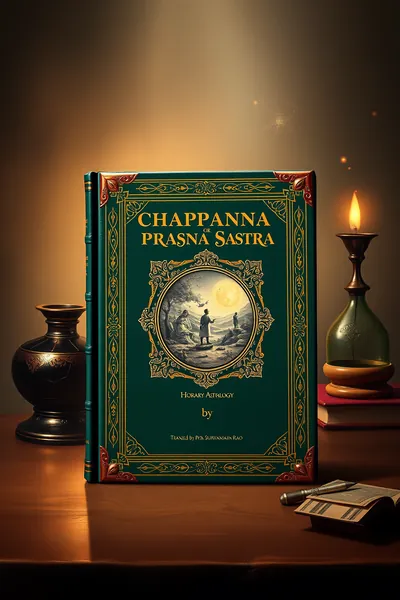
Prashna
 83
83

Prashna
Raj Kumar's "Prashna" offers a focused examination of horary astrology within the Vedic framework, moving beyond the typical natal chart analysis. The strength of the text lies in its systematic approach to interpreting the Prashna chart, particularly its detailed breakdown of planetary significations relative to the question asked. Kumar clearly delineates how the ascendant, Moon, and planetary lords function as direct indicators of the querent's situation and potential resolution. However, the book could benefit from more contemporary case studies. While the theoretical underpinnings are robust, illustrating these principles with a wider array of modern examples, perhaps referencing events post-2008, would enhance its practical applicability for today's practitioners. A particularly insightful section details the application of divisional charts (Vargas) within the Prashna context, adding a layer of complexity often overlooked. Ultimately, "Prashna" serves as a dedicated manual for those committed to mastering this specialized astrological art.
📝 Description
83
Raj Kumar's 2008 book Prashna details the Vedic astrological system of Horary astrology.
Prashna, authored by Raj Kumar and published in 2008, details a specific branch of Vedic astrology known as Horary astrology. This system uses the exact moment a question is posed to an astrologer to create a predictive chart, offering direct answers and predictions for immediate queries. Unlike natal astrology, which relies on birth charts, Prashna focuses on the inception of a question.
The book aims to teach readers how to cast and interpret these specialized charts. It covers the principles and techniques required for this practice. The core of Prashna involves creating a chart based on the precise time and location the question was asked. Key concepts include identifying significators for the questioner, the query itself, and its potential outcome. The analysis centers on the placement and aspects of planets, houses, and nakshatras within this specific chart.
Horary astrology, known in the Vedic tradition as Prashna Jothidam or Prashna Shastra, has ancient roots. Its practice is documented across various cultures and developed alongside Indian astronomy and astrology, particularly during the Gupta Empire. This system stands apart from natal astrology by focusing on immediate divination through charts cast at the time of a question, rather than birth data.
💡 Why Read This Book?
• Gain practical skills in casting and interpreting horary charts, specifically drawing on Vedic principles for immediate answers to pressing questions, a technique detailed throughout the book's chapters. • Understand the unique role of the ascendant, Moon, and planetary lords in Prashna, moving beyond natal chart interpretation as described in the "Key Concepts" section. • Explore the historical lineage of horary astrology within the Indian subcontinent, appreciating its distinct methodology compared to other divination systems, as contextualized in the "Historical Context" section.
⭐ Reader Reviews
Honest opinions from readers who have explored this book.
❓ Frequently Asked Questions
What is the core difference between Prashna and Natal Astrology?
Prashna, or horary astrology, uses the moment a question is asked to cast a chart for immediate answers. Natal astrology, conversely, uses the moment of birth to create a chart that outlines a person's life potential and characteristics.
Who is Raj Kumar and what is his background in astrology?
Raj Kumar is the author of "Prashna," first published in 2008. While specific biographical details beyond his authorship are not provided, the book itself demonstrates a deep engagement with Vedic astrological traditions.
When was the first edition of "Prashna" published?
The first edition of Raj Kumar's "Prashna" was published in 2008, making it a relatively modern text on this ancient system of astrology.
Does "Prashna" require prior knowledge of Vedic astrology?
While a basic understanding of Vedic astrological principles is beneficial, "Prashna" aims to systematically explain its specific techniques. However, prior familiarity will undoubtedly enhance the reader's comprehension and application of the material.
What kind of questions can be answered using the Prashna system?
The Prashna system is designed to answer specific, immediate questions across a wide range of topics, including lost items, financial prospects, relationship outcomes, career decisions, and health concerns.
Are there any specific planetary combinations to look for in a Prashna chart?
Yes, the book details various planetary combinations and their interpretations within a Prashna chart. Key indicators include the strength and placement of the ascendant lord, the Moon's condition, and the influence of benefic and malefic planets on relevant houses.
🔮 Key Themes & Symbolism
Horary Chart Interpretation
The central theme is the meticulous interpretation of the Prashna chart, cast at the moment a question is posed. This involves analyzing the ascendant, its lord, the Moon, and other planetary placements relative to the houses representing the query. The book emphasizes how these elements act as direct indicators of the situation's dynamics and potential resolution, offering a unique predictive methodology distinct from natal analysis. Kumar guides readers through identifying key significators and understanding their interplay to derive clear answers. The work stresses the importance of the question's exact timing and wording in shaping the chart's meaning and subsequent predictions.
Planetary Significators
Central to Prashna is the concept of planetary significators. The book elaborates on how specific planets are assigned to represent different people, objects, or circumstances relevant to the querent's question. For instance, the ascendant lord often signifies the querent, while other planets may represent a spouse, wealth, or obstacles. Understanding which planet signifies what is crucial for accurate interpretation. The strength, dignity, and aspects received by these significators provide vital clues about the unfolding of events and the likely outcome, forming the bedrock of the Prashna technique as presented by Kumar.
Vedic Astrological Framework
Prashna is firmly rooted within the Vedic astrological tradition, often referred to as Jyotish. This framework distinguishes it from Western horary systems. The book integrates concepts such as the nakshatras (lunar mansions), planetary periods (dashas), and the use of specific yogas (planetary combinations) that are characteristic of Vedic astrology. Kumar's work demonstrates how these traditional elements are adapted and applied to the unique context of horary questions, providing a culturally specific and astrologically rich approach to divination. The adherence to Vedic principles ensures a consistent and time-tested methodology.
Predictive Accuracy
The ultimate aim of the Prashna system, as detailed in the book, is to achieve predictive accuracy for specific queries. Kumar focuses on the practical application of horary principles to deliver reliable forecasts. This involves understanding the nuances of planetary influences, house significations, and inter-planetary relationships as they manifest in the Prashna chart. The text provides guidelines for assessing the probability of success, the timing of events, and the nature of outcomes. The emphasis is on a direct, answers-oriented approach to astrological consultation, making it a potent tool for practical divination.
💬 Memorable Quotes
Direct passages from the work, attributed to the author.
“The ascendant and its lord are paramount in a Prashna chart.”
— This statement highlights the foundational importance of the ascendant (Lagna) and its ruling planet in horary astrology. They are seen as direct indicators of the querent and the core of the question being asked, setting the stage for all further interpretation.
“The Moon acts as a general significator for events and the querent's mind.”
— This emphasizes the Moon's many-sided role in horary charts. Beyond its general signification, its condition and placement reveal the emotional state of the querent and the flow of events related to the question.
“Malefic influences on key significators suggest obstacles or delays.”
— This interpretation points to the impact of challenging planetary aspects. When planets signifying crucial elements of the question are afflicted by malefics (like Saturn or Mars), it typically indicates difficulties that must be overcome.
“Divisional charts can offer deeper insights into specific aspects of the question.”
— This suggests that beyond the main Rashi chart, other harmonic charts (Vargas) in Vedic astrology can provide more granular details about specific areas, such as career, marriage, or finances, when applied to a Prashna reading.
“The timing of the question is as critical as the moment of birth in natal astrology.”
— This underscores the principle that the specific instant a question is articulated and understood by the astrologer forms the basis of the horary chart, holding as much predictive weight for that specific query as a birth chart does for a lifetime.
🌙 Esoteric Significance
Tradition
Prashna is a significant component of the Vedic astrological tradition, which itself is a vast system of celestial divination and cosmology deeply embedded in Indian philosophy and spirituality. It aligns with the broader aim of Jyotish to understand divine will and cosmic influences on earthly affairs. Within this tradition, Prashna functions as a direct oracle, providing timely guidance. It departs from natal astrology's focus on inherent potentials and long-term karmic patterns by offering immediate, actionable insights into specific situations, thus serving a more immediate, therapeutic, or decision-making role.
Symbolism
Key symbols in Prashna include the Ascendant (Lagna), representing the querent and the question's essence, and the Moon, symbolizing the mind, emotions, and the unfolding of events. Planets are not just celestial bodies but active significators; for instance, Jupiter often represents wisdom and fortune, while Mars can signify conflict or energy. The houses, each representing different life areas (wealth, siblings, career), are mapped onto the Prashna chart to delineate the specific domain of the question. The interplay of these symbols provides a symbolic language for interpreting the 'cosmic answer'.
Modern Relevance
In contemporary practice, Prashna remains a vital tool for astrologers seeking to provide clients with direct answers. Thinkers and practitioners in modern Vedic astrology, as well as those exploring comparative divination systems, draw heavily on classical Prashna texts and techniques. Its emphasis on immediate problem-solving appeals to the fast-paced nature of modern life. Schools and online courses dedicated to Jyotish often feature Prashna as an advanced module, ensuring its transmission to new generations of practitioners interested in practical, results-oriented astrological consultation.
👥 Who Should Read This Book
• Aspiring Vedic astrologers seeking to expand their predictive toolkit beyond natal charts, offering them a method for providing clients with immediate, specific answers. • Experienced astrologers interested in comparative divination systems, providing a deep dive into the unique principles and applications of Indian horary astrology. • Individuals fascinated by practical divination methods, who wish to learn a structured system for gaining clarity on pressing questions through celestial interpretation.
📜 Historical Context
The practice of horary astrology, or Prashna, has ancient roots within the vast tradition of Indian astrology (Jyotish). While its exact origins are debated, horary techniques were certainly known and utilized during periods of significant astrological development, such as the post-Gupta era and the medieval centuries. This system flourished alongside natal astrology, offering a complementary method for divination. Unlike natal astrology, which requires precise birth data, Prashna provides answers based on the moment a question is posed. Its continued relevance is evidenced by its practice throughout centuries and its inclusion in classical texts. While specific reception events like major controversies or academic citations are less documented for this particular branch compared to broader astrological movements, its persistence indicates a steady, albeit often private, scholarly and practical engagement. Contemporary astrologers, both within India and globally, continue to study and apply Prashna, often alongside other Vedic techniques, demonstrating its enduring appeal.
📔 Journal Prompts
The Ascendant and its lord in a Prashna chart: explore their significance for your current query.
The Moon's condition and its relation to the question asked.
Identify the primary significator for the core element of your question and analyze its placement.
Reflect on how the timing of your question impacts the potential outcome indicated by the Prashna chart.
Analyze potential obstacles suggested by malefic influences on key significators in a hypothetical Prashna scenario.
🗂️ Glossary
Prashna
A Sanskrit term meaning 'question' or 'inquiry'. In astrology, it refers to the system of horary astrology that uses the moment a question is posed to cast a chart for an answer.
Horary Astrology
A branch of astrology concerned with answering specific questions posed by a querent, based on a chart cast for the precise moment the question is understood by the astrologer.
Jyotish
The traditional Hindu system of astrology, also known as Vedic astrology. It encompasses natal, horary, and other branches of celestial divination.
Ascendant (Lagna)
The zodiacal degree rising on the eastern horizon at a specific time and place. In Prashna, it represents the querent and the primary focus of the question.
Significator
A planet or house that represents a particular person, object, event, or area of life within an astrological chart. Identifying correct significators is key to interpretation.
Nakshatra
Lunar mansions; a division of the ecliptic into 27 segments, each with specific characteristics and deities, used extensively in Vedic astrology.
Malefic Planet
In traditional astrology, planets considered to bring about challenges, obstacles, or difficulties. Typically Saturn, Mars, and sometimes the Sun or Rahu/Ketu.