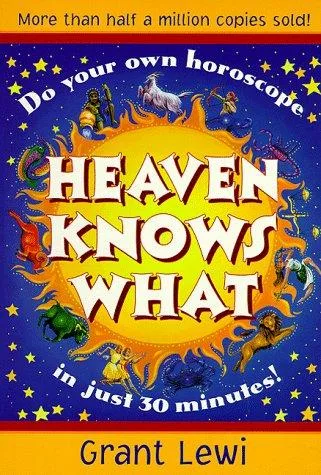
Heaven Knows What (Llewellyn's Popular Astrology Series)

 81
81

Heaven Knows What (Llewellyn's Popular Astrology Series)
Grant Lewi’s "Heaven Knows What" has a directness that cuts through astrological jargon. Published in 1984, it’s a no-nonsense guide that prioritizes clarity above all else. Lewi excels at breaking down the twelve zodiac signs and the planets into their core essences, making complex ideas feel manageable. A particular strength is his explanation of the houses, which he presents as distinct arenas of life where planetary energies manifest. However, the book’s focus on fundamentals means it offers little for those already familiar with basic chart interpretation; the discussions on aspects, while present, are not deeply explored. The prose, while functional, lacks a certain evocative quality found in other astrological works. Nevertheless, for its intended audience, "Heaven Knows What" serves as a solid, unpretentious introduction to astrological mechanics.
📝 Description
81
Grant Lewi's 1984 book, 'Heaven Knows What,' explains astrological basics beyond horoscopes.
First published in 1984, Grant Lewi's 'Heaven Knows What' offers a clear introduction to astrological principles, moving past simple horoscopes. The book's aim is to make core astrological concepts understandable for individuals new to the subject or those wanting a firmer grasp on its foundations. Lewi focuses on how celestial positions influence personality and life events, detailing the mechanics of natal chart interpretation.
This text is primarily for beginners and intermediate students of astrology. It suits readers interested in self-discovery through planetary archetypes and zodiacal energies. While not for advanced practitioners of complex synthesis, it provides a solid basis for understanding astrological fundamentals. The book emerged during a time of renewed public interest in astrology, often linked with the New Age movement, and sought to make esoteric knowledge more accessible for daily life.
Published in 1984, 'Heaven Knows What' arrived as astrology saw a significant rise in public engagement, often through the New Age movement. Grant Lewi's approach, part of Llewellyn's Popular Astrology Series, fit a trend making esoteric knowledge more digestible. The book provided a way into astrological study for a general audience, contrasting with more academic or strictly traditional methods that might have seemed daunting.
💡 Why Read This Book?
• Learn the foundational archetypes of the twelve zodiac signs, understanding their core symbolism as presented in Lewi's 1984 text, which moves beyond superficial daily horoscopes. • Grasp the distinct energetic roles of the planets (Sun, Moon, Mercury, etc.) as explained through Lewi's accessible framework, providing a clearer picture of personal psychological drivers. • Understand the twelve astrological houses as specific life domains, gaining insight into where planetary energies are likely to play out in one's experience, as detailed in the book's practical approach.
⭐ Reader Reviews
Honest opinions from readers who have explored this book.
❓ Frequently Asked Questions
When was "Heaven Knows What" by Grant Lewi originally published?
"Heaven Knows What" by Grant Lewi was first published in 1984 by Llewellyn Publications as part of their Popular Astrology Series.
What is the primary focus of Grant Lewi's "Heaven Knows What"?
The book focuses on demystifying fundamental astrological concepts like zodiac signs, planets, houses, and aspects for beginners, offering a practical guide to natal chart interpretation.
Is "Heaven Knows What" suitable for advanced astrologers?
No, the book is primarily designed for beginners and intermediate students seeking a clear understanding of astrological basics. Advanced techniques or complex synthesis are not covered.
What does the book explain about the astrological houses?
Lewi thoroughly examines the twelve houses, explaining each as a distinct area of life where the energies of planets and signs manifest, providing a framework for understanding personal circumstances.
What makes the 1984 publication date significant for this book?
The 1984 publication places "Heaven Knows What" within a period of heightened public interest in astrology and the New Age movement, where accessible explanations of esoteric subjects were in demand.
Does "Heaven Knows What" offer predictions or psychological insights?
While providing a foundation for understanding astrological influences, the book focuses more on explaining the mechanics and archetypes rather than offering direct predictions or deep psychological analysis.
🔮 Key Themes & Symbolism
Zodiac Sign Archetypes
The work meticulously unpacks the twelve zodiac signs, moving beyond simple sun-sign descriptions to detail the core archetypal energies associated with each. Lewi explains how Aries' pioneering spirit differs from Taurus's grounded nature, and how Gemini's communicative drive contrasts with Cancer's nurturing tendencies. This section grounds the reader in the fundamental symbolic language of astrology, crucial for understanding any birth chart interpretation from 1984 onwards.
Planetary Roles and Energies
Lewi dedicates significant attention to the planets, presenting them not merely as astronomical bodies but as potent forces influencing human psychology and life experience. The book differentiates the assertive energy of Mars from the introspective nature of Saturn, and the expansive influence of Jupiter from the transformative power of Pluto. This exploration provides a vital key to interpreting the dynamic interplay within an astrological chart.
The Twelve Houses of Life
A central theme is the explanation of the twelve astrological houses, which the book defines as specific sectors of life. From the self-oriented first house to the spiritual twelfth house, Lewi outlines the distinct arenas where planetary energies are expressed. This conceptualization allows readers to contextualize astrological influences within practical life circumstances, a core interpretive technique established in astrological practice.
Aspects as Interplanetary Dialogue
The book introduces the concept of aspects – the angular relationships between planets – as a means of understanding how different energies interact. Lewi explains how harmonious aspects (like trines and sextiles) facilitate flow, while challenging aspects (like squares and oppositions) indicate areas of tension and growth. This theme highlights the dynamic, relational nature of astrological interpretation.
💬 Memorable Quotes
Direct passages from the work, attributed to the author.
“Understanding the signs gives you the vocabulary of astrology.”
— This emphasizes the foundational importance of the zodiac signs, positioning them as the essential building blocks for any deeper comprehension of astrological principles and chart reading.
“Aspects show how the planets communicate with each other.”
— This interpretation underscores Lewi's view of astrological aspects as indicators of interaction and dialogue between planetary energies, revealing the dynamic interplay within an individual's birth chart.
“The Ascendant is the mask you wear, the Descendant is who you seek in others.”
— This concisely explains the symbolic meaning of the Ascendant and Descendant axes in a natal chart, relating them to self-perception and relationship dynamics as explored in astrological theory.
💡 Key Ideas
Editorial paraphrase of the work's core concepts — not direct quotes.
The planets are the actors, the signs are the costumes they wear, and the houses are the stages on which they play their parts.
This quote succinctly captures the core interpretive model Lewi presents: planets represent forces, signs describe their nature, and houses indicate the life areas where these dynamics unfold.
Each house represents a different area of life experience.
This paraphrased concept highlights Lewi's focus on the practical application of astrological houses, framing them as distinct domains where personal energies and potentials manifest throughout life.
🌙 Esoteric Significance
Tradition
This work fits within the Western Esoteric tradition, specifically drawing from Hellenistic and later Renaissance astrological frameworks. While not explicitly Kabbalistic or Gnostic, it utilizes the symbolic language and interpretive structures common to Hermetic astrology. Lewi's contribution lies in distilling these complex systems into a more digestible format, making the core principles of natal chart analysis available to a wider audience, departing from highly specialized, classical texts.
Symbolism
Key symbols include the twelve zodiac signs, each representing archetypal human drives and characteristics (e.g., Aries as the initiator, Libra as the harmonizer). Planets are central symbols, viewed as personified energies or deities (e.g., Mars as the warrior, Venus as the lover). The twelve houses function as symbolic arenas of life, from personal identity (1st House) to hidden matters (12th House), providing a map of human experience.
Modern Relevance
Contemporary astrologers, particularly those focused on psychological and archetypal approaches, continue to reference Lewi's foundational explanations. His clear delineation of planets, signs, and houses remains a standard starting point for many modern practitioners and students. The book's accessible style influences how introductory astrological concepts are taught in online courses and contemporary popular astrology resources.
👥 Who Should Read This Book
• Beginners in astrology seeking a clear, step-by-step introduction to reading a birth chart, who will gain a solid understanding of signs, planets, and houses. • Individuals interested in self-discovery through astrological symbolism, who will benefit from Lewi's straightforward explanations of planetary archetypes and their life applications. • Students of comparative esotericism looking to understand the accessible presentation of astrological concepts prevalent in the 1980s, gaining context for the popularization of the field.
📜 Historical Context
Published in 1984, "Heaven Knows What" emerged during a vibrant period for popular astrology, fueled by the New Age movement's growing influence. Grant Lewi's work offered a clear, accessible entry point into astrological interpretation, aligning with Llewellyn's mission to disseminate esoteric knowledge. This era saw a broad public engaging with astrology, often seeking personal growth and self-understanding. Lewi's practical approach contrasted with more esoteric or academic traditions, making astrological concepts relatable to everyday life. While authors like Liz Greene were exploring deeper psychological dimensions of astrology, Lewi focused on explaining the core mechanics. The book's reception reflected the widespread appetite for practical guidance in understanding celestial influences, cementing its place as a foundational text for a generation of aspiring astrologers.
📔 Journal Prompts
Your natal chart's Ascendant: how does its sign description align with your self-perception?
Reflect on the planet ruling your Ascendant sign: what is its core energy in your life?
Identify the house occupied by your Sun sign: how does this arena manifest your core identity?
Consider the aspects to your Moon: what dialogues are occurring between your emotions and other life energies?
Analyze the symbolism of the Midheaven: how does this point relate to your aspirations or public role?
🗂️ Glossary
Ascendant (Rising Sign)
The zodiac sign that was rising on the eastern horizon at the moment of birth. It represents outward personality, initial impressions, and the physical body.
Descendant
The zodiac sign directly opposite the Ascendant, located on the western horizon. It symbolizes relationships, partnerships, and what one seeks in others.
Midheaven (MC)
The highest point in the birth chart, representing career, public image, reputation, and ultimate life goals. It is the cusp of the 10th House.
Natal Chart
A snapshot of the celestial bodies' positions at the exact time and place of a person's birth, used for astrological interpretation.
Aspect
The angular relationship between two or more planets in a birth chart, indicating how their energies interact. Examples include conjunctions, squares, and trines.
House Cusp
The boundary line between two astrological houses. The sign on the cusp indicates the primary energies operating within that house.
Mutable Signs
A category of zodiac signs (Gemini, Virgo, Sagittarius, Pisces) known for their adaptability, flexibility, and ability to facilitate change and transition.
🔮 Readers Also Liked
Browse all →








More by Grant Lewi
All books →



More Free Astrology & Cosmology Books
View all →