Chinese Mathematical Astrology
 79
79

Chinese Mathematical Astrology
Ho Peng Yoke’s *Chinese Mathematical Astrology* offers a meticulous dissection of a subject often obscured by mystique. The author’s strength lies in her ability to render complex calendrical calculations and their astrological implications with academic clarity, moving beyond mere description to illuminate the underlying philosophical structures. A particularly illuminating passage details the cyclical progression of the 60-year Gan Zhi cycle, demonstrating its dual function as a calendrical marker and an astrological framework. However, the book’s density, while a virtue for specialists, may present a steep learning curve for those unfamiliar with Chinese cosmology or advanced mathematics. The lack of explicit visual aids for some of the more abstract mathematical relationships could also be a minor hurdle. Nonetheless, for its scholarly rigor and deep dive into the mechanics of a significant esoteric tradition, the work is invaluable. It serves as a vital resource for understanding the intellectual architecture of Chinese divination.
📝 Description
79
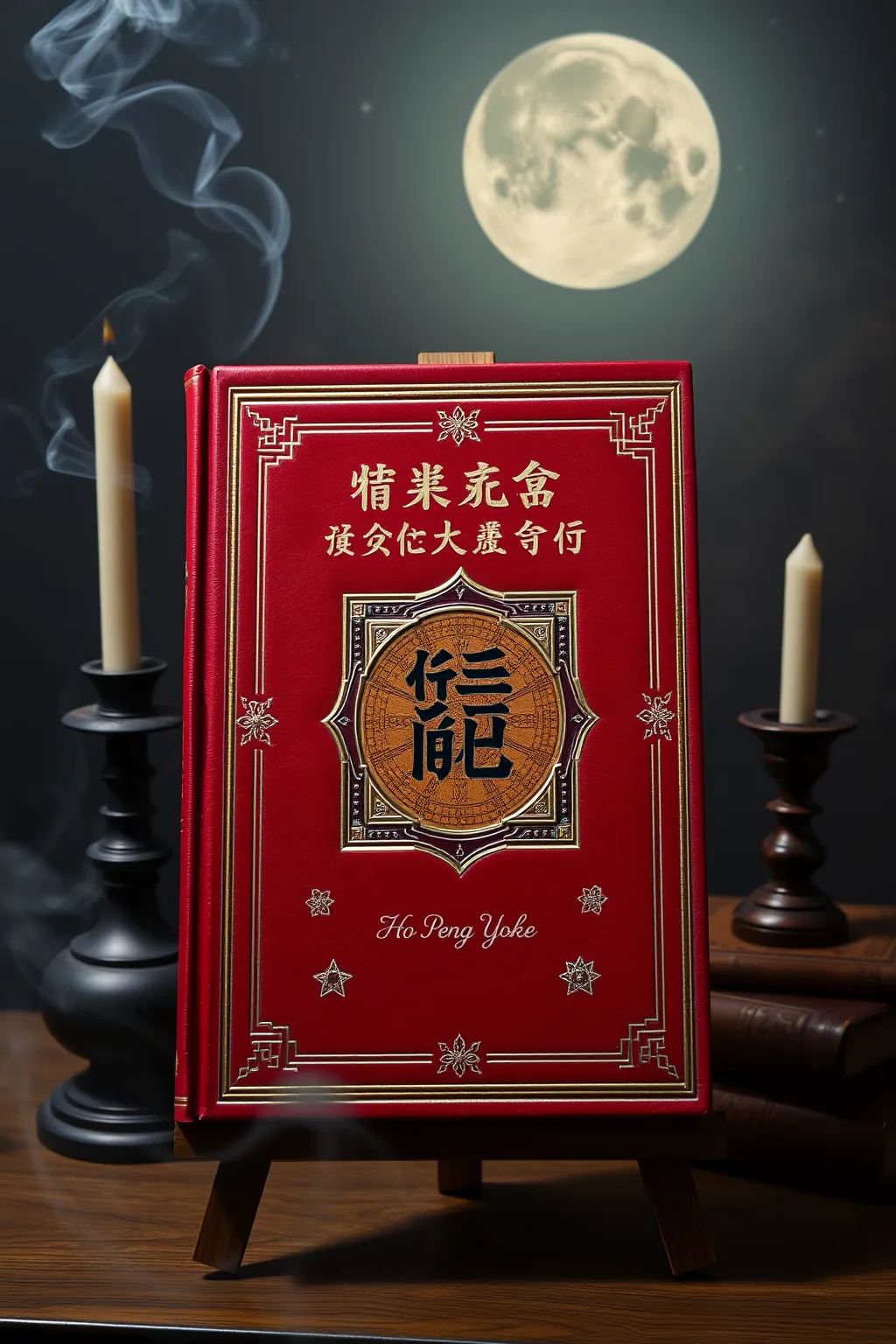
Ho Peng Yoke's 2003 book, Chinese Mathematical Astrology, details how Chinese cosmology integrated mathematics with celestial divination.
Published in 2003, Ho Peng Yoke's work examines the integration of calendrical systems, astronomical observation, and divinatory practices within traditional Chinese cosmology. The book argues that mathematical principles in China were more than calculation tools; they were integral to a worldview where celestial events possessed symbolic and predictive significance. It moves beyond a simple historical account to show the complex mix of numerology, astronomy, and philosophy that shaped Chinese astrological thought for centuries.
The volume illustrates how these elements combined to form a complex system for interpreting human destiny and the cosmos. This is a detailed academic study, not introductory material for casual readers. It is intended for scholars of East Asian history, comparative cosmology, and the history of science, as well as advanced astrology practitioners interested in the mathematical and philosophical basis of non-Western systems. Readers curious about the connections between mathematics, philosophy, and esoteric traditions will find substantial content.
This study situates Chinese astrology within a broader history of cosmological thought, highlighting its independent development of sophisticated mathematical and philosophical frameworks. Unlike Hellenistic traditions, Chinese astrology evolved with a unique emphasis on the symbolic and predictive power of numbers and celestial cycles. Ho Peng Yoke's work contributes to understanding this tradition as a system deeply intertwined with statecraft, philosophy, and personal destiny, distinct from but parallel to other global esoteric lineages.
💡 Why Read This Book?
• Learn the foundational mathematics behind Chinese calendrical systems, understanding how the calculation of celestial cycles, like the lunar calendar, directly informed astrological interpretations, as detailed in the book's exploration of the Gan Zhi cycle. • Grasp the philosophical underpinnings of Chinese cosmology, specifically the interplay of Yin-Yang and the Five Elements (Wu Xing) within astrological frameworks, enabling a deeper appreciation of their correlative logic. • Discover the historical development and distinctiveness of Chinese astrology, recognizing how its mathematical sophistication and philosophical integration, separate from Hellenistic influences, shaped its unique divinatory practices.
⭐ Reader Reviews
Honest opinions from readers who have explored this book.
❓ Frequently Asked Questions
What is the primary focus of Ho Peng Yoke's Chinese Mathematical Astrology?
The book's primary focus is on the intricate mathematical and astronomical foundations of traditional Chinese astrology, exploring how calendrical systems and cosmic observations were integrated into divinatory practices and philosophical thought.
When was Chinese Mathematical Astrology first published?
Ho Peng Yoke's *Chinese Mathematical Astrology* was first published in 2003, making it a relatively modern academic treatment of an ancient subject.
Does the book explain the Gan Zhi cycle?
Yes, the work explores the Gan Zhi (Heavenly Stems and Earthly Branches) cycle in detail, explaining its use as both a calendrical system and a fundamental component of Chinese astrological interpretation.
Is this book suitable for beginners interested in astrology?
While informative, the book is written at an academic level and delves into complex mathematical concepts, making it more suitable for scholars or advanced students rather than absolute beginners.
What are the Five Elements (Wu Xing) in the context of this book?
The book discusses the Five Elements (Wu Xing) as a core philosophical concept in Chinese cosmology, demonstrating how their cyclical interactions and correspondences were applied within astrological frameworks.
What historical period does the book primarily cover?
The book examines the historical development of Chinese mathematical astrology over centuries, focusing on the principles and practices that were established and evolved within traditional Chinese culture.
🔮 Key Themes & Symbolism
Calendrical Systems as Cosmic Maps
The book elucidates how Chinese calendrical systems, such as the lunisolar calendar, were far more than timekeeping devices. They were intricate mathematical constructs designed to reflect and predict celestial movements, embedding astronomical data into a framework for understanding cosmic influences. Ho Peng Yoke details the calculations that allowed ancient Chinese astronomers and diviners to map out cycles of time, aligning them with perceived astrological patterns. This approach highlights a worldview where the measurement of time was inseparable from the interpretation of destiny, with each calendrical period carrying specific energetic qualities derived from celestial phenomena.
The Gan Zhi Cycle's Dual Role
A central theme is the profound significance of the 60-year cycle formed by the Heavenly Stems and Earthly Branches (Gan Zhi). This system served a dual purpose: it provided a sophisticated method for dating events with precision and acted as a fundamental structure for astrological analysis. The book explains how each of the 60 combinations within the Gan Zhi cycle possesses unique characteristics, derived from the interplay of Yin-Yang and the Five Elements, which were used to interpret personal destinies, predict worldly affairs, and understand the energetic qualities of any given year, month, day, or hour.
Mathematical Precision in Divination
Ho Peng Yoke's work emphasizes the rigorous mathematical foundation underlying Chinese astrological practices. It moves beyond anecdotal interpretations to showcase the complex calculations, astronomical observations, and systematic logic employed. The book demonstrates that Chinese divination was not arbitrary but relied on precise mathematical models derived from deep observation of celestial mechanics. This analytical approach reveals how numbers and formulas were integral to translating cosmic patterns into meaningful predictions about human life and events, underscoring a scientific yet mystical approach to understanding the universe.
Cosmology and Human Destiny
The book illustrates the integral connection between the Chinese cosmological model and the concept of human destiny. It explores how the cyclical nature of the universe, as represented by astronomical patterns and calendrical systems, was believed to mirror and influence human lives. Concepts like Yin-Yang and the Five Elements are presented not just as abstract philosophical ideas but as active forces within the cosmos that shape individual fortunes and collective destinies. This perspective reveals a holistic worldview where humanity and the heavens are inextricably linked, with astrological interpretation serving as a bridge between the two.
💬 Memorable Quotes
Direct passages from the work, attributed to the author.
“The calculations for the calendar were intrinsically tied to the principles of astrology.”
— This highlights the core argument that timekeeping in ancient China was not a secular, scientific endeavor separate from esoteric beliefs, but rather a unified system where astronomical precision directly served divinatory and cosmological purposes.
“The Gan Zhi cycle provided a framework for understanding the energetic quality of time.”
— This emphasizes the symbolic and qualitative aspect of the Chinese calendar, suggesting that each unit of time, as defined by the Heavenly Stems and Earthly Branches, carried specific influences and characteristics beyond mere temporal sequencing.
“Mathematical astronomy was the engine of Chinese astrological interpretation.”
— This points to the active and crucial role of calculation and observation, positioning mathematical astronomy not as a passive backdrop but as the dynamic force that enabled and shaped the practice of astrology.
“Correlative cosmology formed the philosophical bedrock of astrological practice.”
— This interpretation underscores that the deep connections perceived between different elements of the cosmos (like stars, seasons, and human affairs) and the underlying philosophical systems (such as Yin-Yang and Five Elements) were essential for any astrological understanding.
“The interpretation of celestial events was a precise, systematic art.”
— This suggests that Chinese astrological practice was not based on guesswork but on a structured methodology, employing specific rules and calculations derived from observation and philosophical principles to arrive at interpretations.
🌙 Esoteric Significance
Tradition
This work examines the East Asian esoteric tradition, specifically Chinese cosmology and divination. It aligns with philosophical Taoism and Confucianism in its emphasis on natural order, cycles, and the interconnectedness of the macrocosm and microcosm. Unlike Hermetic or Kabbalistic traditions that heavily feature numerology and planetary correspondences in a Western context, Chinese mathematical astrology utilizes its own unique symbolic language of Heavenly Stems, Earthly Branches, and the Five Elements to map cosmic influences and human destiny.
Symbolism
Central symbols include the Yin-Yang duality, representing complementary opposites that drive cosmic change, and the Five Elements (Wu Xing: Wood, Fire, Earth, Metal, Water). The book explains how these elements, in their generative and destructive cycles, are applied to interpret astrological configurations. The 60-year Gan Zhi cycle, a complex interplay of these symbols, is another key motif, serving as both a calendrical tool and a predictive matrix for understanding the energetic qualities of time and human fate.
Modern Relevance
Contemporary practitioners of Traditional Chinese Medicine (TCM) often implicitly draw upon the same cosmological and elemental theories explored in the book. Astrologers studying global traditions find value in understanding the mathematical rigor and philosophical depth of Chinese systems. Furthermore, scholars of comparative religion and the history of science continue to reference Ho Peng Yoke's work for its detailed exposition of a sophisticated, mathematically grounded divinatory system that offers a distinct perspective on humanity's relationship with the cosmos.
👥 Who Should Read This Book
• Scholars of East Asian history and philosophy seeking a rigorous examination of the mathematical and cosmological underpinnings of Chinese divination. • Advanced astrology students interested in comparative systems and the historical development of astrological thought beyond Western traditions. • Researchers in the history of science interested in pre-modern calendrical calculations and their integration with philosophical worldviews.
📜 Historical Context
Ho Peng Yoke's *Chinese Mathematical Astrology* emerged in 2003, building upon a long tradition of scholarship on Chinese science and cosmology. Key figures like Joseph Needham, whose monumental *Science and Civilisation in China* series began publication in the 1950s, had already established a framework for understanding ancient Chinese scientific achievements. Ho Peng Yoke’s work contributes by specifically focusing on the intricate mathematical underpinnings of astrological practices, situating them within a rich philosophical landscape. This study gained prominence during a period of increasing global interest in comparative esoteric studies and the history of science. Unlike the diffusion of Hellenistic astrology into Europe and the Middle East, Chinese astrology developed largely independently, incorporating indigenous philosophical concepts like Yin-Yang and the Five Elements (Wu Xing). The reception of such detailed academic analyses within sinology and the history of science has generally been positive, recognizing their contribution to a nuanced understanding of pre-modern intellectual systems.
📔 Journal Prompts
The application of the Gan Zhi cycle in interpreting temporal energies.
The mathematical principles underpinning Chinese calendrical calculations.
The philosophical relationship between Yin-Yang, the Five Elements, and human destiny.
Celestial observation as a precursor to divinatory practice.
The divergence of Chinese mathematical astrology from Western traditions.
🗂️ Glossary
Gan Zhi
The Sexagenary Cycle, composed of ten Heavenly Stems (Tian Gan) and twelve Earthly Branches (Di Zhi). It forms a 60-unit cycle used for dating and astrological interpretation in Chinese culture.
Wu Xing
The Five Elements or Phases: Wood (Mu), Fire (Huo), Earth (Tu), Metal (Jin), and Water (Shui). These are fundamental concepts in Chinese philosophy, representing dynamic forces and their cyclical interactions.
Yin-Yang
The Taoist concept of complementary, interconnected opposites (e.g., dark/light, passive/active) that are fundamental to the Chinese understanding of the natural world and cosmic balance.
Lunisolar Calendar
A calendar that is based on both the phases of the Moon and the apparent position of the Sun. Traditional Chinese calendars are lunisolar.
Divination
The practice of seeking knowledge of the future or the unknown by supernatural means. In this context, it refers to the systematic interpretation of celestial phenomena.
Cosmology
The study of the origin, evolution, and eventual fate of the universe. In Chinese thought, cosmology is deeply intertwined with philosophy and the natural sciences.
Heavenly Stems
The ten cyclical signs (Jia, Yi, Bing, Ding, Wu, Ji, Geng, Xin, Ren, Gui) that are combined with the Earthly Branches to form the Gan Zhi cycle.
🔮 Readers Also Liked
Browse all →








More by Ho Peng Yoke
All books →

More Free Astrology & Cosmology Books
View all →