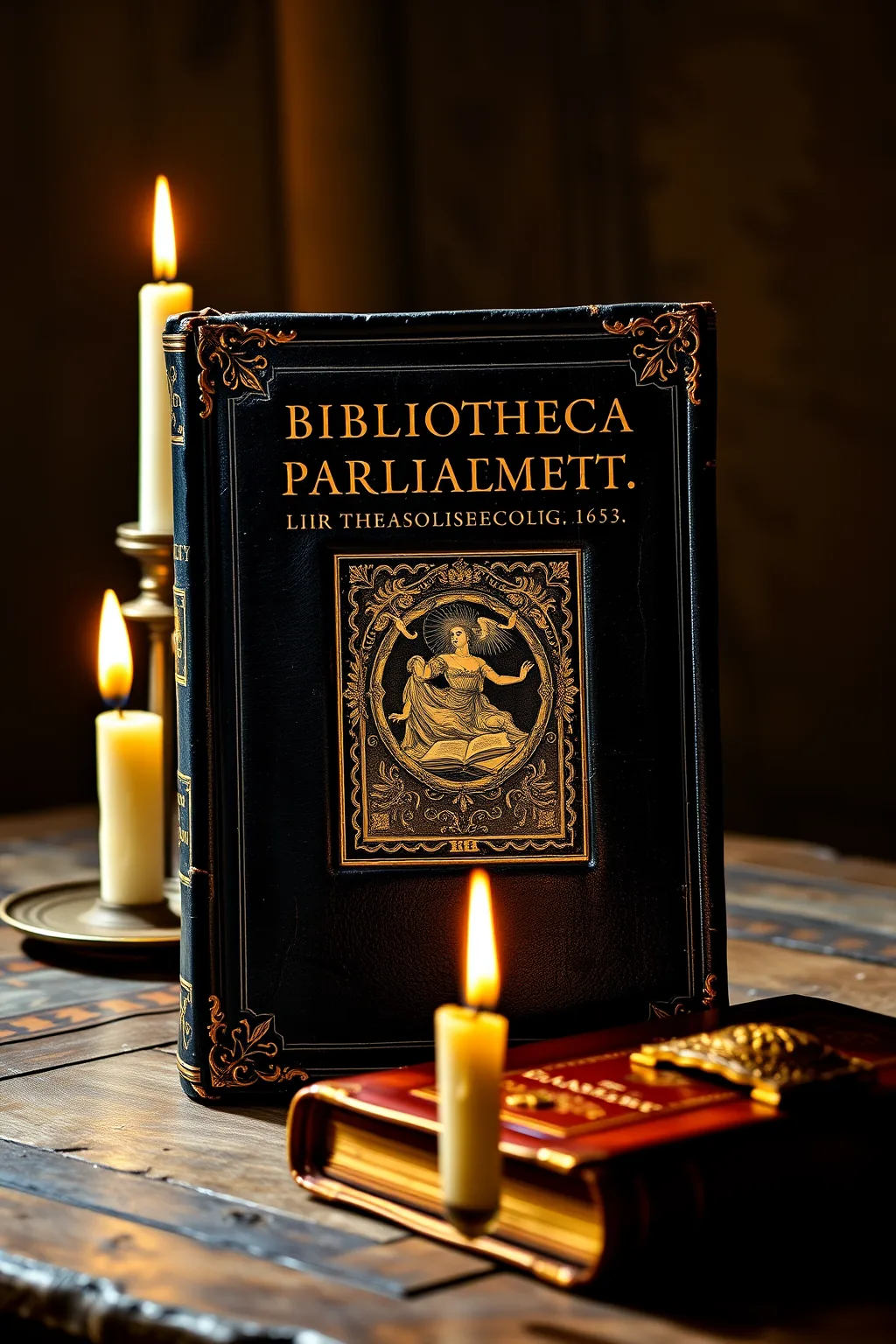
Bibliotheca Parliamenti, libri, theologici... Classis secunda. 1653
 76
76

Bibliotheca Parliamenti, libri, theologici... Classis secunda. 1653


Aurelia Blackwood (Occult Philosophy Critic) — Sir John Birkenhead's *Bibliotheca Parliamenti* is a seminal work, meticulously cataloging theological tracts with an unmistakable undercurrent of esoteric intent. This 'second class' reveals Birkenhead's discerning eye for texts that explore the divine architecture of the cosmos and the symbolic language of faith. The volume serves as an invaluable resource for understanding the intellectual landscape of 17th-century occult philosophy, particularly its engagement with theological frameworks. While dense, its carefully selected entries offer profound insights for scholars of hermeticism and practitioners seeking to connect with ancient wisdom. A must-have for any serious collection on the intersection of theology and the hidden arts.
📝 Description
76
Published in 1653, Sir John Birkenhead's *Bibliotheca Parliamenti* collects theological works from a period of intense intellectual and spiritual ferment.
Sir John Birkenhead assembled this collection, *Bibliotheca Parliamenti, libri, theologici... Classis secunda*, in 1653. It gathers theological texts from a time marked by both esoteric discussions and emerging scientific thought. Birkenhead, known for his sharp intellect and subtle expression, compiled these works not just as a list, but as tools for deeper comprehension. The book contains ideas related to contemplating the cosmos, the connections between divine principles and worldly events, and the symbolic systems used to understand the universe. It is a resource for those dedicated to finding forgotten knowledge, for students of hermetic practices, and for thinkers interested in the structure of reality.
The theological arguments presented are dense, but they also contain an underlying cosmology. This invites readers to consider the divine design of existence and the complex way creation is depicted. Engaging with this digitized volume offers a more informed view of the philosophical foundations of mystical thinking during that era.
This collection sits within the broader tradition of Renaissance and early modern esoteric thought, which sought to reconcile Christian theology with Neoplatonic, Hermetic, and alchemical philosophies. Such works often aimed to reveal hidden correspondences between the macrocosm (the universe) and the microcosm (humanity), and to understand divine will through symbolic language and numerology. Birkenhead's selection reflects an interest in the spiritual and intellectual currents that sought deeper meaning beyond surface appearances, connecting theological study with a contemplation of cosmic structure.
💡 Why Read This Book?
Delve into the intellectual crucible of 17th-century England, where theological discourse intertwined with nascent esoteric thought. *Bibliotheca Parliamenti* offers a curated selection of texts that reveal hidden connections between faith, cosmology, and the divine order. Ideal for scholars, seekers of lost wisdom, and practitioners interested in the philosophical underpinnings of mystical traditions. Explore the arcane underpinnings of a pivotal historical era.
⭐ Reader Reviews
Honest opinions from readers who have explored this book.
❓ Frequently Asked Questions
What is the primary focus of 'Bibliotheca Parliamenti, libri, theologici... Classis secunda'?
This volume is a catalog of theological books, curated by Sir John Birkenhead, with an implicit focus on texts that explore mystical, cosmological, and symbolic dimensions of theology prevalent in the mid-17th century.
Who was Sir John Birkenhead?
Sir John Birkenhead was a prominent Royalist writer and satirist during the English Civil War and the Interregnum, known for his sharp wit and his engagement with the intellectual currents of his time, including those with esoteric leanings.
What does 'Classis secunda' imply?
'Classis secunda' translates to 'second class' or 'second division', suggesting this is a further categorization or selection of theological works within a larger collection or library.
Is this book a primary source for occult practices?
While not a direct grimoire, it is a primary source for understanding the *intellectual context* and *types of texts* considered relevant to theological and potentially esoteric thought in the 17th century. It reflects the knowledge base of its time.
What makes this book relevant to modern esoteric studies?
It provides a historical lens into how theological concepts were interpreted through a symbolic and cosmological framework, offering insights into the evolution of esoteric thought and its relationship with established religious doctrines.
🔮 Key Themes & Symbolism
Theological Foundations of Esotericism
This volume studies the intricate relationship between theological doctrine and esoteric interpretations prevalent in the 17th century. It showcases how seemingly orthodox religious texts could be re-contextualized and understood through a lens of hidden symbolism, divine correspondences, and cosmic order. Birkenhead's curation suggests a discernment for works that not only discussed faith but also hinted at the underlying spiritual mechanics of the universe, bridging the gap between public theology and private mystical pursuit.
Symbolic Language of the Cosmos
The 'Bibliotheca Parliamenti' serves as a evidence of the era's fascination with the symbolic language that permeated the cosmos. Texts within this collection likely explore how celestial bodies, natural phenomena, and scriptural narratives were understood as encoded messages from the divine. This theme highlights the belief that the universe itself was a book, written in a symbolic cipher waiting to be deciphered by the illuminated mind, revealing divine truths and universal laws.
The Parliament of Books and Hidden Knowledge
The very title, 'Bibliotheca Parliamenti', evokes a curated assembly – a 'parliament' of books. This suggests an intentional selection process, aiming to present a coherent intellectual landscape. The inclusion of 'Classis secunda' indicates a hierarchy or specific categorization, hinting at a system of organizing knowledge, particularly knowledge deemed significant for understanding deeper spiritual or philosophical truths, often veiled from the uninitiated.
💬 Memorable Quotes
Direct passages from the work, attributed to the author.
“Within the sacred texts lie hidden architectures of creation.”
— This implies that religious scriptures contain not only moral and spiritual guidance but also underlying blueprints or structures that reveal the divine organization of the universe.
“Wisdom is a garden, its rarest blooms seldom seen.”
— This metaphor highlights the scarcity and value of true knowledge, suggesting that clear insights are often concealed and require dedicated effort to discover and appreciate.
“The microcosm mirrors the macrocosm, a divine echo.”
— This refers to the Hermetic principle of 'As above, so below', suggesting a fundamental interconnectedness and correspondence between the human being (microcosm) and the universe (macrocosm).
“Faith's illumination pierces the veil of material sight.”
— This emphasizes the power of spiritual belief and intuition to perceive realities beyond the physical senses, revealing a deeper, divine truth.
💡 Key Ideas
Editorial paraphrase of the work's core concepts — not direct quotes.
The celestial spheres whisper truths to the attentive soul.
This quote suggests that the movements and arrangements of the stars are not random but convey profound spiritual or philosophical insights accessible through deep contemplation and intuition.
🌙 Esoteric Significance
Tradition
This work is situated within the broader tradition of Hermeticism and Renaissance Neoplatonism, which sought to reconcile classical philosophies with Christian theology. It reflects an interest in divine cosmology, symbolic interpretation of scripture, and the belief in an ordered universe governed by hidden principles, all hallmarks of esoteric thought during this period.
Symbolism
Key symbols likely explored within the referenced theological texts would include celestial bodies as divine agents, scriptural narratives as allegories for spiritual journeys, and the inherent mathematical and geometric order of the universe as a manifestation of the divine mind. The arrangement and selection of these books themselves form a symbolic gesture, curating a specific intellectual and spiritual pathway.
Modern Relevance
In an age often characterized by secularism and empirical reductionism, *Bibliotheca Parliamenti* offers a valuable historical counterpoint. It demonstrates the profound integration of spiritual and cosmological thinking in earlier eras, reminding contemporary seekers and scholars of the deep human impulse to find meaning and order in the universe through symbolic and theological frameworks.
👥 Who Should Read This Book
This volume is an essential acquisition for scholars of early modern English literature, intellectual history, and the history of esotericism. For aspiring practitioners of occult philosophy, it provides crucial context regarding the intellectual lineage of their pursuits, revealing how theological frameworks were once intertwined with esoteric inquiry. Seekers of profound philosophical insights will find a collection of thought that bridges faith and cosmic understanding. Even those new to these subjects can gain an appreciation for the intellectual depth and symbolic richness of the 17th century.
📜 Historical Context
The year 1653 falls within England's Interregnum period, a time of significant political and social upheaval following the English Civil War. This era, marked by the abolition of the monarchy and the rise of Puritan influence, paradoxically fostered a rich intellectual environment. While public discourse was often dominated by religious and political debate, there was also a flourishing of clandestine intellectual pursuits, including alchemy, astrology, and hermetic philosophy. Sir John Birkenhead, a Royalist writer, navigated this complex landscape, often using satire to critique the prevailing powers while subtly engaging with deeper philosophical and mystical ideas. The *Bibliotheca Parliamenti* reflects this historical milieu, showcasing theological works that, for the discerning reader, offered pathways to understanding the cosmos and the divine beyond conventional religious dogma.
📔 Journal Prompts
How might the theological texts cataloged here be interpreted through a lens of symbolic cosmology?
What parallels can be drawn between Birkenhead's curated 'parliament' of books and modern methods of knowledge organization?
Reflect on the concept of 'hidden architectures of creation' and its personal significance.
Consider the influence of celestial movements on human affairs as perceived in the 17th century.
How does the idea of 'faith's illumination' challenge or complement your current understanding of knowledge acquisition?
🗂️ Glossary
Hermeticism
A religious, philosophical, and esoteric tradition based on writings attributed to Hermes Trismegistus, which claims to have been inspired by divine revelation and seeks to understand the universe through divine wisdom and symbolic interpretation.
Neoplatonism
A philosophical system originating in the Roman Empire that sought to synthesize the ideas of Plato with other philosophical and religious traditions, emphasizing the concept of 'The One' as the ultimate source of all existence.
Cosmology
The study of the origin, evolution, and eventual fate of the universe, often encompassing philosophical and theological perspectives on the nature and order of the cosmos.
Microcosm
In esoteric philosophy, the concept that the human being (or any smaller system) is a reflection or miniature representation of the larger universe (macrocosm).
Macrocosm
The universe considered as a complex and unified whole, often seen as having a direct correspondence with the human being (microcosm).
This book appears in 1 collection
🔮 Readers Also Liked
Browse all →







From the “Astrology” Collection
View all →





More Free Astrology & Cosmology Books
View all →