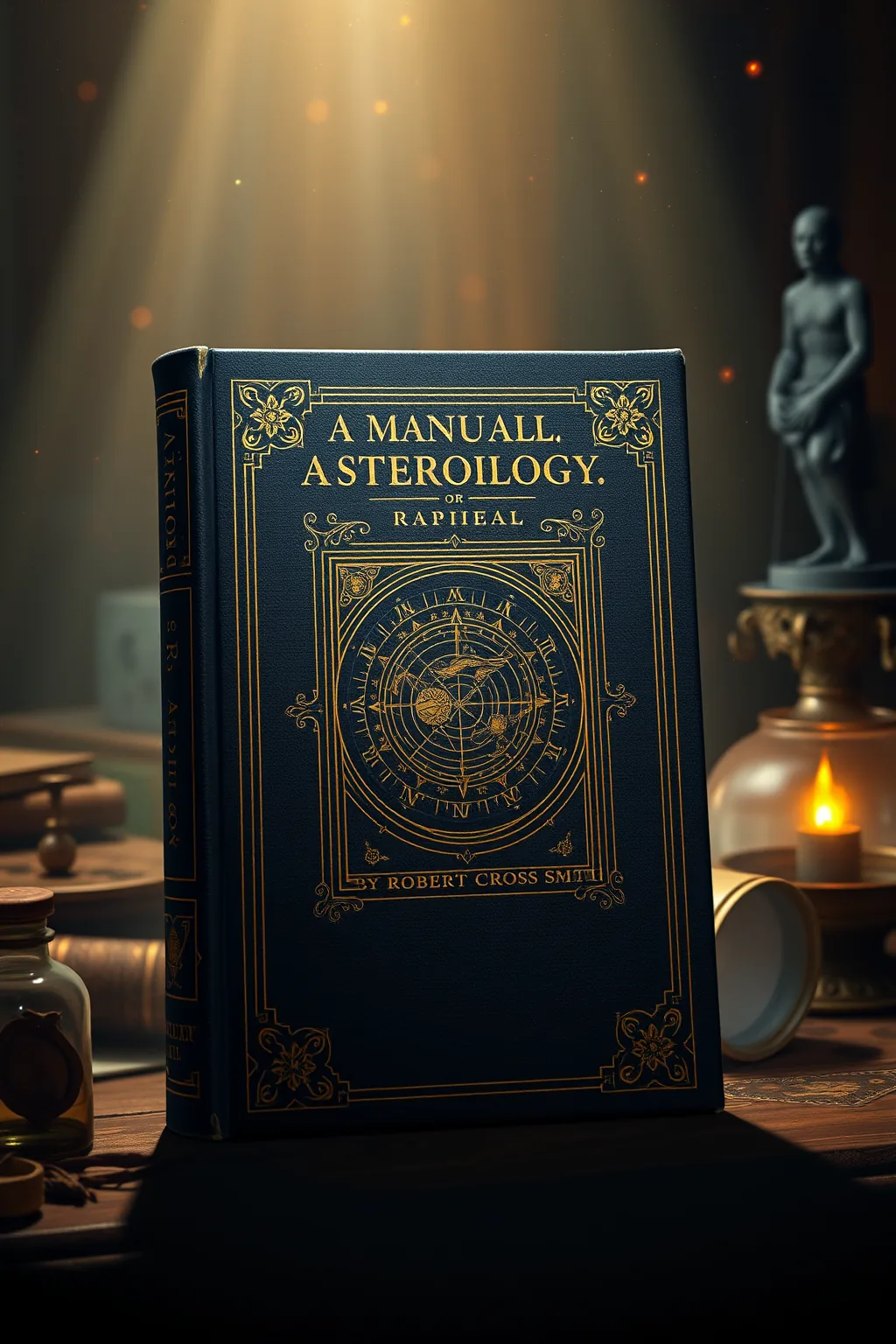
A Manual of Astrology, Or the Book of the Stars, by Raphael
 72
72

A Manual of Astrology, Or the Book of the Stars, by Raphael
Raphael's "A Manual of Astrology" offers a stark, unvarnished look at 19th-century astrological practice, a far cry from the popular psychological interpretations of today. Its strength lies in its meticulous, if dense, exposition of calculation techniques. The opening quote from Locke, "the mind must stop and buckle to it, and stick upon it with labor and thought and close consideration," perfectly encapsulates the book's ethos – astrology as a demanding intellectual discipline. However, the 1828 edition's notorious textual issues, as hinted at in its original blurb, can be a significant barrier. Navigating through potential typos and missing sections requires a degree of patience and perhaps access to supplementary materials. The directness with which it approaches the mechanics of chart erection, focusing on the nuts and bolts of planetary degrees and house cusps, is its singular value. This is not a book for the casual reader but for the determined student of astrological history.
Raphael's manual is a vital, albeit challenging, window into historical astrology.
📝 Description
72
Raphael's A Manual of Astrology, first published in 1828, details 19th-century astrological calculation and interpretation methods.
Written by Robert Cross Smith under the pseudonym Raphael, this volume presents a systematic approach to astrology as practiced in the early 19th century. It covers the construction of horoscopes and the analysis of planetary positions and aspects. The book's direct, instructional style aims to equip readers with the technical knowledge for astrological practice. It is intended for students of natal astrology interested in historical chart calculation and interpretation methods. Readers seeking to engage with computationally intensive techniques of the past will find value. The work is also relevant for researchers of Western esotericism and the history of science, particularly those interested in the evolution of astrological thought from the late Georgian era.
Published in 1828, Raphael's manual appeared during a time of revived interest in esoteric subjects after the Enlightenment. While empirical science grew, astrological traditions continued to be explored. This work predates later theosophical syntheses by figures like Eliphas Lévi and Helena Blavatsky. It fits into a tradition of practical astrological handbooks that codified complex techniques, distinguishing itself from earlier, more philosophical or purely predictive texts.
💡 Why Read This Book?
• Learn the precise mathematical methods for calculating a birth chart as practiced in the early 19th century, a skill distinct from modern software-generated charts. • Understand the foundational astrological concepts like planetary dignities and aspects as they were taught by Raphael, providing a historical baseline for astrological interpretation. • Gain insight into the intellectual rigor required for astrological study prior to digital computation, as exemplified by the book's emphasis on "labor and thought and close consideration."
⭐ Reader Reviews
Honest opinions from readers who have explored this book.
❓ Frequently Asked Questions
What is the original publication year of "A Manual of Astrology"?
The original publication year for "A Manual of Astrology, Or the Book of the Stars" by Raphael (Robert Cross Smith) is 1828.
Who was Raphael in the context of astrology?
Raphael was the pseudonym of Robert Cross Smith, a notable English astrologer and author who lived from approximately 1795 to 1832. He published several astrological works.
Are there known issues with the 1828 edition?
Yes, the original 1828 edition is known to have potential issues such as numerous typos and missing text, which purchasers are often advised about.
What is the primary focus of this astrological manual?
The manual primarily focuses on the technical aspects of natal astrology, including the calculation of horoscopes and the interpretation of planetary positions and aspects.
Where can I find a corrected version of the original text?
Publishers often provide a free scanned copy of the original, unedited book for download to purchasers of modern editions, which can help overcome textual issues.
Is this book illustrated?
No, the original 1828 edition of "A Manual of Astrology, Or the Book of the Stars" is not illustrated.
🔮 Key Themes & Symbolism
Natal Chart Calculation
The manual meticulously details the process of erecting a natal chart, emphasizing the mathematical precision required. It covers the calculation of planetary positions, house cusps, and ascendant based on time and location. This section highlights astrology as a computational art, requiring diligent application of astronomical data and specific formulas, setting a standard for astrological practice in the early 19th century.
Planetary Aspects and Dignities
Central to Raphael's method is the interpretation of how planets interact through aspects (angular relationships) and their inherent strengths or weaknesses (dignities and debilities). The book explains the significance of conjunctions, oppositions, trines, squares, and sextiles, alongside concepts like essential dignities (domicile, exaltation) and accidental dignities, forming the basis for understanding planetary influence.
The Houses System
The work elaborates on the twelve astrological houses, explaining their division of the celestial sphere and their correlation with different areas of human life. It details how the position of planets and the cusps of the houses at the moment of birth are interpreted to provide insights into an individual's personality, destiny, and specific life circumstances.
Astrology as Intellectual Labor
Quoting Locke, the manual frames astrological study not as passive reception but as active intellectual engagement. It underscores that mastering astrological techniques requires 'labor and thought and close consideration.' This perspective positions astrology as a rigorous discipline demanding mental effort and sustained focus, distinguishing it from more superficial or intuitive approaches.
💬 Memorable Quotes
Direct passages from the work, attributed to the author.
“The mind must stop and buckle to it, and stick upon it with labor and thought and close consideration.”
— This interpretation highlights the book's emphasis on astrology as an intellectual discipline requiring focused mental effort, rather than a simple or intuitive practice.
“Calculation of a nativity was esteemed a very difficult process.”
— This statement reflects the historical reality that astrological chart calculation was a complex, time-consuming task before the advent of modern computing.
“In former times the calculation of a nativity was obliged to ta...”
— This incomplete sentence points to the historical methods of astrological calculation, likely referring to the manual processes and tools astrologers relied upon before modern technology.
“The Astrologer was either obliged to ta...”
— This incomplete quote implies that early astrologers had specific, perhaps laborious, requirements or methods they had to follow when performing astrological calculations.
💡 Key Ideas
Editorial paraphrase of the work's core concepts — not direct quotes.
The sense lies deep, the mind must stop and buckle to it.
This paraphrased concept suggests that the deeper meanings within astrological texts and charts are not immediately obvious and require dedicated study and contemplation to uncover.
🌙 Esoteric Significance
Tradition
This work firmly belongs to the Western Hermetic and traditional astrological lineage. It represents a practical application of Hellenistic and medieval astrological principles, updated with the astronomical knowledge of its time. While not explicitly Kabbalistic or Gnostic, it operates within the broader esoteric framework that views the cosmos as imbued with meaning and influence, accessible through specific symbolic and mathematical languages.
Symbolism
Key symbols include the twelve zodiacal signs, each representing archetypal energies and influences, and the ten celestial bodies (planets plus Sun and Moon), understood as cosmic agents. The division of the sky into twelve houses symbolizes the different spheres of life experience, from selfhood to culmination, all interpreted through the lens of planetary placements and relationships.
Modern Relevance
Contemporary astrologers interested in historical techniques, particularly those focusing on precise calculation and traditional interpretation methods, draw heavily from manuals like Raphael's. It informs modern practice by offering a contrast to psychologically-oriented astrology and provides a foundation for understanding the evolution of astrological thought, influencing fields that study the history of science and esotericism.
👥 Who Should Read This Book
• Students of Western Esotericism seeking to understand the historical practice of astrology in the early 19th century, moving beyond modern interpretations. • Aspiring Natal Astrologers who wish to learn the foundational computational methods and interpretive frameworks before the widespread use of astrological software. • Researchers of the history of science and belief systems interested in the persistence and evolution of occult traditions during the post-Enlightenment era.
📜 Historical Context
Published in 1828, "A Manual of Astrology" by Raphael (Robert Cross Smith) emerged during a period of significant intellectual ferment in Europe. While the scientific revolution had firmly established empirical methods, a counter-current of interest in mesmerism, phrenology, and esoteric traditions persisted and even grew. This era predated the major occult revival spearheaded by figures like Helena Blavatsky and the Hermetic Order of the Golden Dawn, but it represented a crucial bridge. Raphael's work offered a practical, technical guide to natal astrology at a time when astrology was often viewed with skepticism by the scientific establishment, yet retained a dedicated following. It contrasted with the more philosophical or divinatory approaches and aimed to re-establish astrological calculation as a precise art. Contemporary authors like Sir Walter Scott incorporated occult themes into popular literature, reflecting a broader cultural engagement with the mysterious and arcane, even if not directly engaging with astrological texts.
📔 Journal Prompts
The astrological concept of 'labor and thought' required for calculation.
The distinction between 'former times' calculation methods and contemporary approaches.
The role of planetary dignities in interpreting a nativity.
How the twelve astrological houses structure life experience.
The perceived difficulty of calculating a nativity in the 19th century.
🗂️ Glossary
Nativity
In astrology, a 'nativity' refers to the birth chart or horoscope of an individual, calculated based on the precise date, time, and location of their birth.
Horoscope
A diagram representing the positions of the Sun, Moon, and planets at the time of a person's birth, used for astrological interpretation.
Aspects
The angular relationships between planets in a horoscope, such as conjunctions, oppositions, and trines, which are interpreted as indicators of interaction and influence.
Houses
The twelve divisions of the astrological chart, each representing a different area of life experience, from personal identity to public reputation.
Dignities
A system in astrology that assesses the strength or weakness of a planet based on its placement within zodiacal signs (e.g., domicile, exaltation, detriment, fall).
Cusps
The boundary lines of the astrological houses, particularly the Ascendant (the cusp of the 1st house) and the Midheaven (the cusp of the 10th house).
Ephemerides
Tables providing the calculated positions of celestial bodies (Sun, Moon, planets) for each day over a period of time, essential for astrological calculations.