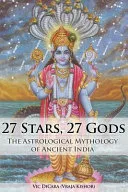
27 Stars, 27 Gods
 83
83

27 Stars, 27 Gods
Vic DiCara's "27 Stars, 27 Gods" offers a much-needed clarity on the Nakshatras, moving beyond mere astrological correspondences to explore their rich mythological narratives. The author’s methodical approach, evident from the book's decade-long gestation, results in explanations that are both academically sound and remarkably accessible. DiCara avoids the pitfalls of overly simplistic interpretations, instead grounding the celestial bodies in their original Vedic context. A particular strength lies in his ability to untangle Sanskrit terminology without alienating the reader, a feat few achieve. The section detailing the mythology of Rohini, for instance, vividly illustrates the interplay between the divine and the cosmic architecture. However, the sheer density of information, while a boon for serious students, might feel overwhelming for the absolute beginner. Despite this, the work is a significant contribution, offering a grounded, mythological perspective on a cornerstone of Vedic astrology.
📝 Description
83
Vic Dicara's 2012 book, 27 Stars, 27 Gods, details the 27 lunar mansions of Indian astrology.
This volume examines the 27 Nakshatras, the lunar mansions central to Vedic astrology. Vic DiCara details the mythological origins and symbolic meanings associated with each star. He clarifies complex Sanskrit terms and Vedic lore for a modern readership. The book serves as both a practical reference and an interpretive guide to these celestial divisions.
Astrologers working with Vedic or Jyotish systems will find this useful for a deeper grasp of the Nakshatras. Students of comparative mythology, religion, and ancient astronomy will benefit from the detailed narratives and historical background. Anyone interested in the connections between astronomy, mythology, and spiritual practices will find a wealth of information here. The work aims to bring clarity to the esoteric aspects of celestial mapping.
The book's core idea is the division of the ecliptic into 27 Nakshatras. Each Nakshatra has a specific deity, a related myth, and its own characteristics. DiCara systematically analyzes each one, discussing its associated deities, legends, and astrological properties.
Published in 2012, this work emerged during a renewed interest in Vedic traditions and esoteric studies. Indian astrology, or Jyotish, has ancient roots, but DiCara's book addresses a contemporary need for interpretations that are both accessible and informed. It engages with the long history of Nakshatra interpretation, which has been fundamental to Indian calendrical and astrological systems since at least the Vedic period. The book emphasizes the archetypal and mythological dimensions over purely predictive or ritualistic applications.
💡 Why Read This Book?
• Gain a unique understanding of the 27 Nakshatras by connecting them directly to their ruling deities and associated Vedic myths, a depth not typically found in Western astrological texts. • Decipher the Sanskrit names and concepts, such as 'Nakshatra' itself, through clear explanations that unlock the original meaning and esoteric significance intended by ancient Indian astrologers. • Appreciate the historical lineage of these celestial divisions, first codified in texts predating the common era, and understand their foundational role in Jyotish systems developed over centuries.
⭐ Reader Reviews
Honest opinions from readers who have explored this book.
❓ Frequently Asked Questions
When was "27 Stars, 27 Gods" first published?
The book "27 Stars, 27 Gods" by Vic Dicara and Vraja Kishor Das was first published on December 29, 2012, reflecting over a decade of dedicated research.
What is the primary focus of "27 Stars, 27 Gods"?
The book focuses on the 27 Nakshatras (lunar mansions) of ancient Indian astrology, providing detailed explanations of their mythology, symbolism, and astrological meaning.
Who are the authors of "27 Stars, 27 Gods"?
The authors are Vic Dicara and Vraja Kishor Das. Vic DiCara is credited with extensive research and writing, guided by spiritual and academic advisors.
What background knowledge is helpful for reading "27 Stars, 27 Gods"?
While the book aims for clarity, a basic familiarity with astrological concepts or an interest in comparative mythology and Vedic traditions would enhance the reader's experience.
What kind of research went into this book?
The book is the result of over a decade of dedicated research by Vic DiCara, including guidance from a swami, a babaji, and a Sanskrit scholar.
Does the book explain Sanskrit terms?
Yes, a key aspect of the book is its clear and straightforward explanations of Sanskrit terminology relevant to Vedic astrology and mythology.
🔮 Key Themes & Symbolism
Nakshatras as Cosmic Deities
The work posits that each of the 27 Nakshatras is not merely a segment of the sky but embodies a specific deity or divine principle. This perspective elevates the Nakshatras from astronomical markers to active participants in the cosmic drama. For instance, the text explores how the ruling deity of each Nakshatra imbues it with particular energies and mythological narratives, influencing human lives and destinies. This understanding connects the celestial map directly to the pantheon of Vedic gods, offering a richer, more personified interpretation of astrological influences beyond abstract symbolism.
Mythological Narratives of the Stars
Central to the book is the detailed exploration of the stories associated with each of the 27 stars. These narratives, drawn from Vedic scriptures and Puranic lore, are presented not just as ancient tales but as keys to understanding the character and function of each Nakshatra. The book elucidates how figures like the Ashvins (associated with Ashvini) or Brahma (associated with Krittika) offer archetypal patterns that resonate within the astrological interpretation of these lunar mansions. This approach provides a deep, symbolic framework for astrological analysis.
Sanskrit Linguistics in Astrology
DiCara emphasizes the importance of understanding Sanskrit to grasp the full meaning of the Nakshatras. The book provides direct explanations of key Sanskrit terms and grammatical structures, clarifying the language barrier often encountered by students of Vedic astrology. By dissecting terms and their etymologies, the author reveals layers of meaning embedded within the astrological nomenclature. This focus on linguistic precision allows for a more authentic and nuanced interpretation of the astrological principles derived from ancient Indian sources.
The Archetypal Significance
Beyond specific myths and deities, "27 Stars, 27 Gods" examines the archetypal significance of each Nakshatra. The book presents these lunar mansions as representing fundamental patterns of human experience and consciousness, mapped onto the celestial sphere. By understanding the archetypal role of each star, readers can gain insights into their own psychological makeup and life path. This interpretive layer connects the ancient astrological system to modern depth psychology and the study of universal human motifs.
💬 Memorable Quotes
Direct passages from the work, attributed to the author.
“The 27 stars of the zodiac are the foundation of Vedic astrology.”
— This statement highlights the centrality of the Nakshatras within the Jyotish system, positioning them as the primary framework upon which astrological interpretations are built, more so than perhaps the zodiacal signs in Western astrology.
“Understanding Sanskrit grammar unlocks deeper layers of astrological meaning.”
— This emphasizes the author's approach, suggesting that a direct engagement with the original language is crucial for a truly profound comprehension of Vedic astrological concepts and terminology.
“The myths associated with the stars provide keys to their symbolic interpretation.”
— This interpretation points to the book's methodology: using ancient narratives as a direct lens through which to understand the astrological qualities and effects of each Nakshatra.
💡 Key Ideas
Editorial paraphrase of the work's core concepts — not direct quotes.
Each Nakshatra has a ruling deity that influences its character.
This paraphrased concept underscores the animistic and personified nature of Vedic astrology, where celestial bodies are seen as imbued with the power and personality of specific gods from the Hindu pantheon.
Vedic astrology offers a unique perspective on destiny and cosmic influence.
This paraphrased concept frames the book's subject matter as a distinct system of understanding human fate and the forces that shape it, differentiating it from other astrological traditions.
🌙 Esoteric Significance
Tradition
This work is firmly rooted in the Vedic astrological tradition, known as Jyotish. It adheres to the foundational principles of this lineage, particularly the emphasis on the Nakshatras (lunar mansions) as primary interpretive units. DiCara departs from purely ritualistic or predictive Jyotish by foregrounding the mythological and symbolic dimensions, aligning with a more philosophical and esoteric interpretation of the tradition. It serves as a bridge, connecting ancient Vedic cosmology and theology to modern astrological practice.
Symbolism
The 27 Nakshatras themselves are the primary symbols, each representing a distinct cosmic archetype or divine energy. Key symbols explored include the ruling deities associated with each Nakshatra, such as the Ashvins for Ashvini, linking celestial positions to specific mythic figures. Another significant symbolic motif is the classification of Nakshatras by guna (Sattva, Rajas, Tamas) and element, providing layers of interpretive meaning. The imagery derived from the mythological stories associated with each star, like the creative act or the destructive force, further enriches their symbolic resonance.
Modern Relevance
Contemporary practitioners of Vedic astrology, comparative religion scholars, and students of mythology find immense value in DiCara's work. It provides a scholarly yet accessible entry point into the rich symbolic language of Jyotish, relevant for those seeking to understand the cross-cultural significance of celestial mapping. Thinkers exploring archetypal psychology through non-Western lenses also draw upon the mythological depth presented. The book's focus on integrating mythology with astrological interpretation appeals to modern esoteric movements seeking holistic understanding of cosmic and human interconnectedness.
👥 Who Should Read This Book
• Students of Vedic Astrology (Jyotish): Individuals seeking to deepen their understanding of the Nakshatras beyond basic correspondences will find detailed mythological context and linguistic keys. • Comparative Mythology Enthusiasts: Readers interested in how celestial bodies are personified and mythologized across different cultures will appreciate the detailed narratives and divine associations. • Esoteric Scholars: Those exploring the intersection of astronomy, spirituality, and ancient wisdom traditions will benefit from the work's focus on symbolic interpretation and archetypal meanings.
📜 Historical Context
Published in 2012, "27 Stars, 27 Gods" emerges from a period of renewed global interest in Eastern spiritual traditions and esoteric knowledge. Vic DiCara's work engages with the ancient Indian astrological system, Jyotish, which has roots stretching back thousands of years, with its foundational texts like the Vedas and early Puranas. While the Nakshatras themselves have been documented since at least the late Vedic period (c. 1500-500 BCE), DiCara's contribution lies in synthesizing complex mythological and linguistic analyses for a contemporary audience. This contrasts with purely academic, ahistorical approaches or simplified, popularized versions of astrology prevalent at the time. His work provides a mythological and symbolic depth that moved beyond the often numerically or predictively focused interpretations that some contemporaries might have favored, offering a richer interpretive framework grounded in Sanskrit scholarship and guided by traditional insights.
📔 Journal Prompts
Reflect on the specific deity governing your birth Nakshatra and its mythological narrative.
Consider the symbolism of Krittika and its association with Brahma.
Explore the concept of lunar mansions as energetic fields in your own life.
Analyze the linguistic roots of a chosen Nakshatra's name.
How does the myth of Rohini connect to its astrological interpretation?
🗂️ Glossary
Nakshatra
One of the 27 lunar mansions or star constellations that divide the ecliptic in Vedic astrology. Each Nakshatra has unique characteristics, ruling deities, and mythological associations.
Jyotish
The traditional Hindu system of astrology, also known as Vedic astrology. It is based on sidereal (fixed) star positions and incorporates Nakshatras as a primary interpretive tool.
Vedic
Relating to the Vedas, the ancient scriptures of Hinduism. In this context, it refers to the cultural and religious traditions originating from these texts, including astrology and mythology.
Sanskrit
An ancient Indo-Aryan language that is the liturgical language of Hinduism, Buddhism, and Jainism. It is crucial for understanding the original texts of Vedic astrology.
Deity
A god or goddess in a polytheistic religion. In Vedic astrology, specific deities are associated with each Nakshatra, influencing their qualities and symbolic meanings.
Ecliptic
The apparent path of the Sun across the celestial sphere over the course of a year. The Nakshatras are divisions along this path.
Ashvins
Twin celestial horsemen in Vedic mythology, known as divine physicians. They are associated with the Nakshatra named Ashvini.