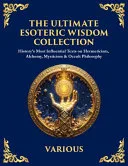
The Ultimate Esoteric Wisdom Collection
 71
71

The Ultimate Esoteric Wisdom Collection
The *Ultimate Esoteric Wisdom Collection* attempts a noble task: modernizing perennial philosophies for a new generation. Its strength lies in its ambitious scope, bringing together diverse threads of Hermetic and alchemical thought under one cover. The modernization of the language, while necessary for accessibility, occasionally strips away some of the original text's unique cadence. A particularly illuminating section is the exploration of the Kybalion's core tenets, which, despite its late 19th-century origins, effectively distills earlier Hermetic principles. However, the editorial decision to present these disparate texts as a singular, unified 'collection' might oversimplify their complex historical development and differing contexts. The work is a useful primer, though scholars may find the synthesis lacks the nuance of dedicated commentaries on individual texts. It serves as a commendable gateway, but not a definitive scholarly resource.
📝 Description
71
This collection gathers texts from Hermes Trismegistus, The Three Initiates, and Julian The Theurgist.
This volume brings together foundational writings on Hermeticism, alchemy, and occult sciences. It updates ancient wisdom for modern readers, drawing from traditions that shaped spiritual thought from ancient Egypt to Renaissance Europe. The compilation presents a unified view of universal principles.
The book is for anyone wanting a deeper grasp of esoteric traditions, especially Hermetic philosophy, alchemy's history, and the basis of occult practices. It suits both students of the occult and those interested in the philosophical ideas behind Western esotericism.
The included works come from thought streams active over many centuries. Hermeticism began in Hellenistic Egypt and saw a major revival during the Renaissance, influencing figures like Marsilio Ficino. Alchemy's lineage extends from ancient Alexandria through medieval Islamic scholars to European alchemists like Nicolas Flamel, all examining the transformation of matter and spirit.
This collection is situated within the Hermetic tradition, which traces its origins to Hellenistic Egypt and experienced a significant resurgence during the European Renaissance. The texts reflect a lineage of thought that connects ancient philosophical inquiries with later alchemical and occult practices. It engages with core concepts that have informed Western esotericism for centuries, providing a framework for understanding a worldview centered on universal laws and spiritual development. The compilation bridges historical periods, showing the enduring relevance of these ideas.
💡 Why Read This Book?
• Gain a foundational understanding of Hermetic principles, such as the Seven Principles outlined in *The Kybalion*, providing a framework for understanding cosmic laws. • Explore the historical development of alchemy, tracing its symbolic language and philosophical underpinnings from ancient roots to its influence on Renaissance thought. • Access modernized translations of key esoteric texts, making complex philosophical ideas and occult sciences more approachable for contemporary study and contemplation.
⭐ Reader Reviews
Honest opinions from readers who have explored this book.
❓ Frequently Asked Questions
What specific texts are included in The Ultimate Esoteric Wisdom Collection?
The collection prominently features foundational Hermetic texts, including a modernized version of *The Kybalion* by The Three Initiates. It also draws from earlier Hermetic traditions originating from Hellenistic Egypt and Renaissance European alchemical writings.
Is this book suitable for beginners in esoteric studies?
Yes, the collection is designed for accessibility. The modernization of language and curated selection of foundational texts make it suitable for individuals new to Hermeticism, alchemy, and occult sciences.
What is the historical significance of the Hermetic tradition mentioned in the book?
The Hermetic tradition, rooted in texts attributed to Hermes Trismegistus, significantly influenced Western esotericism from the Renaissance onwards. It posits universal laws governing the cosmos, impacting philosophy, science, and spiritual practices.
Does the book explain the concept of 'As Above, So Below'?
Indeed. The principle of correspondence, famously summarized as 'As Above, So Below,' is a central theme explored within the collection, illustrating the interconnectedness between the macrocosm and the microcosm.
Who are the primary authors or sources credited in this collection?
The collection credits Hermes Trismegistus as the foundational source, with key modern interpretations and compilations attributed to The Three Initiates (authors of *The Kybalion*) and Julian The Theurgist.
When was the first publication date for this specific collection?
The first publication date for *The Ultimate Esoteric Wisdom Collection* is listed as November 13, 2025, indicating it is a contemporary compilation of older wisdom traditions.
🔮 Key Themes & Symbolism
The Kybalion's Seven Principles
This collection examines the core teachings of *The Kybalion*, particularly its Seven Principles: Mentalism, Correspondence, Vibration, Polarity, Rhythm, Cause and Effect, and Gender. These principles are presented not as abstract theories but as fundamental laws governing all reality, from the physical plane to the mental and spiritual. The work explains how understanding these tenets offers a framework for comprehending the universe's mechanics and one's place within it, drawing parallels to ancient Hermetic axioms.
Alchemical Transformation
The book explores the symbolic and spiritual dimensions of alchemy, moving beyond the literal pursuit of turning lead into gold. It discusses the concept of spiritual transmutation – the purification and elevation of the human soul – as the true 'Great Work.' This includes examining alchemical symbolism, the stages of the process (often represented by colors like black, white, and red), and the role of the adept in achieving inner perfection, linking it to philosophical traditions originating in Hellenistic Egypt.
Hermetic Philosophy
Central to the collection is the philosophy attributed to Hermes Trismegistus. This encompasses a worldview that emphasizes the unity of all things, the divine nature of the cosmos, and the potential for human beings to attain gnosis or spiritual knowledge. The texts within the collection explore concepts like the Mind of God, the nature of the soul, and the importance of self-knowledge as a path to understanding universal truths that have guided thinkers since antiquity.
Occult Science and Universal Laws
The collection frames esoteric knowledge as a form of 'occult science,' suggesting a structured, albeit hidden, system underlying reality. It investigates universal laws that are believed to operate consistently across all planes of existence. This includes exploring correspondences between the physical, psychological, and spiritual realms, providing readers with tools to perceive and potentially influence these energetic interactions.
💬 Memorable Quotes
Direct passages from the work, attributed to the author.
“The lips of wisdom are closed, except to the ears of understanding.”
— This aphorism underscores the idea that esoteric knowledge is not readily available to everyone. It requires a receptive mind and a cultivated inner faculty to grasp the deeper meanings concealed within teachings attributed to figures like Hermes Trismegistus.
“As above, so below; as within, so without.”
— This iconic Hermetic principle highlights the concept of correspondence. It suggests that the patterns and laws governing the greater universe (macrocosm) are mirrored in the smaller individual (microcosm), implying a fundamental unity and interconnectedness.
“The All is Mind; the Universe is Mental.”
— This statement from *The Kybalion* articulates the principle of Mentalism, a core part of Hermetic philosophy. It posits that reality itself is fundamentally mental or consciousness-based, and that the physical world is a manifestation of this underlying divine mind.
“There is but one Universal Law, and it is the Law of Cause and Effect.”
— This principle emphasizes the deterministic nature of the cosmos according to Hermetic thought. Every action has a reaction, and understanding this chain of causality is crucial for spiritual progression and working through the complexities of existence.
“Man can know the laws of the Universe, and then become master of his own destiny.”
— This reflects the empowering aspect of esoteric study. By understanding the fundamental principles and laws that govern reality, individuals are believed to gain agency over their lives and spiritual development, moving from a state of being subject to fate to one of conscious creation.
🌙 Esoteric Significance
Tradition
This collection primarily draws from the Hermetic tradition, a philosophical and religious system largely based on writings attributed to Hermes Trismegistus. It also incorporates elements from the alchemical tradition, which shares many symbolic and conceptual overlaps with Hermeticism, particularly concerning transformation and the nature of reality. It fits within the broader Western Esoteric tradition, serving as a gateway to complex ideas that have informed Gnosticism, Kabbalah, and later Theosophical movements.
Symbolism
Key symbols include the Caduceus of Hermes, representing balance, duality, and the flow of energy. The Ouroboros, the serpent eating its tail, symbolizes cyclicality, eternity, and the unity of all things. Within alchemy, symbols like the alembic (distillation apparatus) represent purification and transformation, while the colors black (nigredo), white (albedo), and red (rubedo) signify distinct stages of the Great Work.
Modern Relevance
Contemporary thinkers and practitioners in fields like depth psychology (e.g., Jungian analysis's engagement with alchemy), New Age spirituality, and modern occultism frequently reference Hermetic principles and alchemical symbolism. The collection's focus on universal laws and consciousness appeals to modern explorations of quantum physics, mindfulness practices, and the search for meaning in a secularized world.
👥 Who Should Read This Book
• Aspiring students of Hermeticism seeking a consolidated introduction to its core principles and historical texts. • Practitioners of alchemy interested in exploring the philosophical and spiritual dimensions beyond the laboratory procedures. • Researchers in comparative religion and Western esotericism looking for accessible source material on foundational occult sciences.
📜 Historical Context
The intellectual milieu from which these collected works emerge spans centuries of Western esoteric thought. Hermeticism, largely revived in the European Renaissance through translations of the *Corpus Hermeticum*, deeply influenced Neoplatonism and figures like Giordano Bruno. Alchemy, meanwhile, was a vibrant, albeit often clandestine, practice from ancient Alexandria through medieval Islamic scholarship (e.g., Jabir ibn Hayyan) and into the European alchemical tradition, which included notable figures like Paracelsus. This collection's modernization efforts aim to bridge the gap between these historical currents and contemporary understanding. The very act of compiling and reinterpreting these texts engages with a long tradition of esoteric scholarship, often occurring in parallel to, and sometimes in tension with, the dominant empirical sciences that gained prominence from the 17th century onward.
📔 Journal Prompts
The principle of Correspondence: How does the concept 'As Above, so Below' manifest in your daily life?
The Seven Principles of The Kybalion: Which principle, Vibration or Polarity, do you find most challenging to accept and why?
Alchemical Symbolism: Reflect on the Ouroboros symbol and its representation of cyclical processes in your personal journey.
The nature of Mind: Consider the Hermetic axiom 'The All is Mind' and its implications for your perception of reality.
The path of the adept: What does 'mastery of one's destiny' mean to you in the context of learning these esoteric laws?
🗂️ Glossary
Hermeticism
A philosophical and spiritual tradition attributed to Hermes Trismegistus, emphasizing divine wisdom, the unity of the cosmos, and the potential for human spiritual attainment through understanding universal laws.
Alchemy
An ancient tradition focused on the transformation of matter, often interpreted symbolically as a process of spiritual purification and enlightenment for the practitioner, the 'Great Work'.
The Kybalion
A book published in 1908 by 'The Three Initiates,' purporting to be a summary of the Hermetic principles communicated through various ages. It outlines seven core principles governing the universe.
The Great Work (Major work)
In alchemy, this refers to the process of creating the Philosopher's Stone, but more importantly, it signifies the spiritual transformation and perfection of the alchemist's soul.
Gnosis
Direct spiritual knowledge or insight, often understood as a salvific experience in Gnostic and other mystical traditions, allowing for a deeper understanding of reality and the divine.
Mentalism
The first Hermetic principle as described in *The Kybalion*, stating that 'The All is Mind; The Universe is Mental.' It posits that reality is fundamentally consciousness or thought.
Correspondence
The second Hermetic principle, summarized as 'As above, so below; as within, so without.' It asserts a fundamental harmony and interconnectedness between different planes of existence.