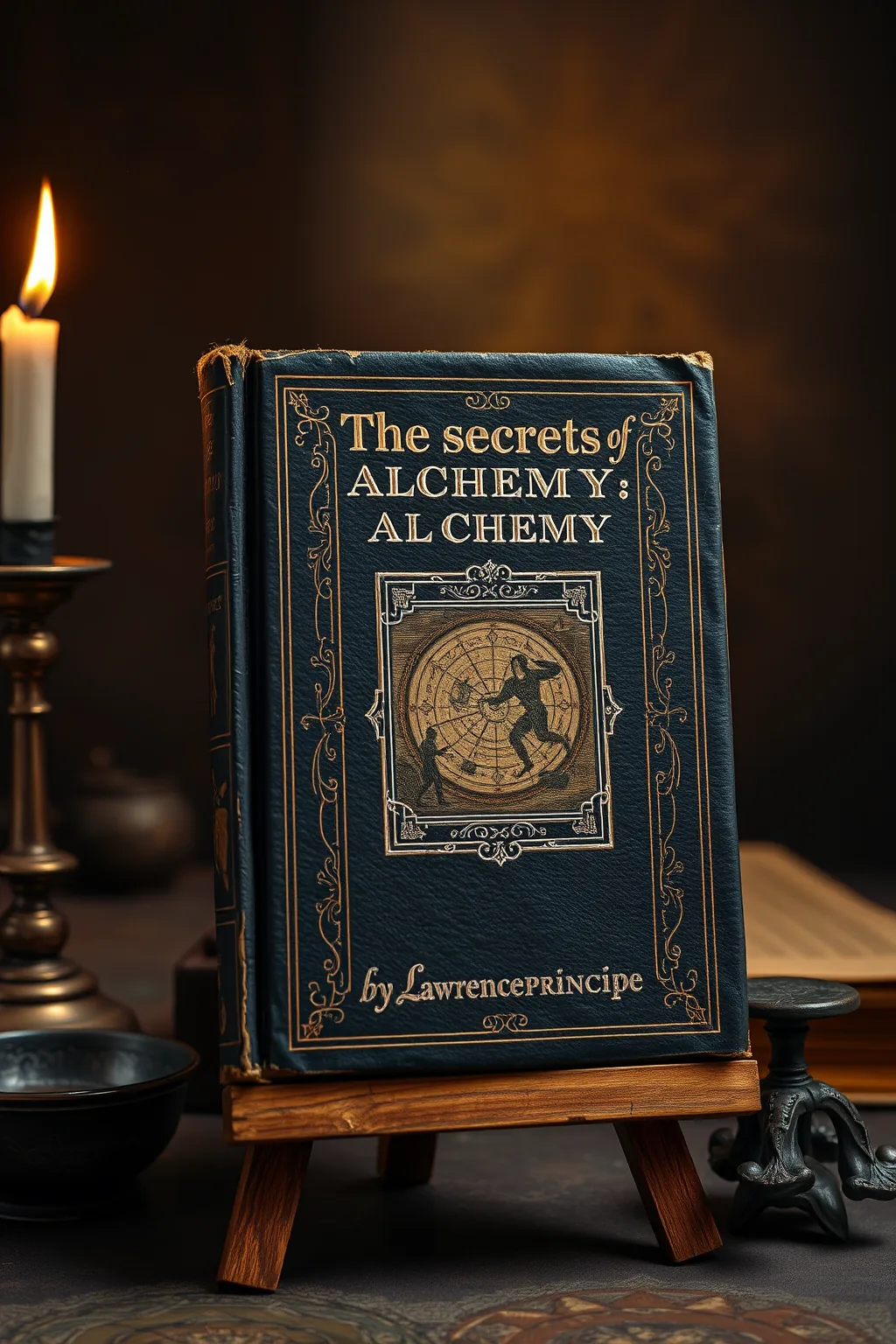
The secrets of alchemy
 72
72

The secrets of alchemy
Principe's "The Secrets of Alchemy" offers a welcome antidote to the more fanciful interpretations of the alchemical arts. It grounds the subject firmly in intellectual history, challenging the reader to consider alchemy not as a set of recipes, but as a philosophical and scientific pursuit. The strength of the book lies in its rigorous scholarship, meticulously detailing the evolution of alchemical thought from its ancient roots through to its influence on early modern science. A particularly insightful section discusses the theological implications that alchemists debated, demonstrating the profound spiritual dimensions often overlooked. However, its academic rigor can also be a limitation; readers seeking a more accessible or practical introduction might find the dense prose and focus on theoretical minutiae demanding. The detailed analysis of figures like George Ripley and their contributions to alchemical theory, while informative, requires a dedicated reader. Ultimately, Principe provides a crucial scholarly lens through which to understand alchemy's complex legacy.
📝 Description
72
Lawrence Principe's 2012 book, "The Secrets of Alchemy," examines alchemical practice from historical and philosophical angles.
Lawrence Principe's "The Secrets of Alchemy" is not a manual for transmutation. Instead, it offers a scholarly look at the historical and philosophical foundations of alchemical pursuits. The book carefully breaks down the alchemical tradition, following its development across different eras and cultures. It concentrates on the theoretical structures and intellectual environments where alchemical ideas were formed and discussed, rather than practical instructions.
This work is geared toward dedicated students of history, philosophy, and the history of science, especially those interested in pre-modern thinking and the evolution of Western esotericism. Readers looking for an academic viewpoint on alchemy, one that looks past sensationalized myths, will find it valuable. It also serves those researching the links between early chemistry, medicine, and spiritual or philosophical thought. A background in historical studies or a willingness to grapple with complex ideas is beneficial.
Published in 2012, Principe's study enters a period of revived scholarly attention to alchemy. This field, once often dismissed, is now increasingly seen as a complex intellectual system that influenced the scientific revolution. Principe places his analysis within this ongoing reassessment, considering arguments about alchemy's role as both a precursor to modern chemistry and a distinct philosophical system. The book engages with the intellectual milieu in which alchemical ideas were formulated, moving beyond the popular image of the craft.
💡 Why Read This Book?
• Understand the philosophical underpinnings of the Magnum Opus, moving beyond simplistic notions of gold-making. This offers insight into pre-modern conceptions of transformation and perfection. • Grasp the historical evolution of alchemical ideas, particularly their interaction with early scientific thought up to the 17th century. This provides context for the Scientific Revolution. • Explore the complex symbolic language of alchemy, such as the principles of Sulphur and Mercury, and their role in alchemical cosmology. This illuminates the metaphorical richness of esoteric traditions.
⭐ Reader Reviews
Honest opinions from readers who have explored this book.
❓ Frequently Asked Questions
Is "The Secrets of Alchemy" a practical guide to performing alchemical operations?
No, Lawrence Principe's work is a scholarly examination of alchemy's history and philosophy. It focuses on the intellectual context and theoretical frameworks rather than providing step-by-step instructions for laboratory work.
What historical periods does "The Secrets of Alchemy" cover?
The book traces alchemical thought from its ancient origins through its development in the medieval period and into the early modern era, particularly its influence leading up to and during the Scientific Revolution.
Who were some key figures discussed in the book?
While the focus is on ideas, Principe engages with the historical context of alchemists and thinkers who shaped the tradition. Key figures often discussed in such historical analyses include Zosimos of Panopolis and later figures like George Ripley, whose work contributed to alchemical theory.
Does the book explain the meaning of common alchemical symbols?
Yes, "The Secrets of Alchemy" delves into the symbolic language of alchemy, explaining concepts like the Prima Materia, Sulphur and Mercury, and the Great Work (Magnum Opus) within their historical and philosophical contexts.
What is the relationship between alchemy and early chemistry according to this book?
Principe's work explores alchemy's complex role as both a precursor to modern chemistry and a distinct philosophical system. It examines how alchemical practices and theories contributed to the empirical investigations that characterized the Scientific Revolution.
Is this book suitable for someone new to the study of alchemy?
While informative, the book is written for a scholarly audience. Beginners interested in a more accessible introduction might find it dense, but it offers a rigorous academic perspective for those dedicated to understanding alchemy's historical and philosophical dimensions.
🔮 Key Themes & Symbolism
The Great Work (Major work)
Principe examines the concept of the Major work not merely as a material process of transmutation, but as a profound spiritual and philosophical undertaking. This central theme involves the purification and perfection of both the practitioner and the material world, reflecting a holistic worldview where spiritual and physical realms are interconnected. The book details how this pursuit shaped alchemical theory and practice across centuries.
Symbolic Duality: Sulphur and Mercury
The book dissects the fundamental alchemical symbolism of Sulphur and Mercury, representing active (male, fiery) and passive (female, watery) principles, respectively. These are not literal elements but philosophical concepts crucial for understanding alchemical cosmology and the process of transformation. Principe illustrates how these dualities were interpreted and manipulated in alchemical operations and texts to achieve the desired 'conjunction'.
Prima Materia and Transformation
Central to alchemical theory is the concept of the Prima Materia, the fundamental, undifferentiated substance from which all things are believed to originate. Principe's work explores how alchemists theorized about this primordial matter and the various processes, often involving complex symbolic stages, required to extract, purify, and ultimately transform it into the Philosopher's Stone or Elixir.
Alchemy and Early Science
The book critically assesses the intricate relationship between alchemical pursuits and the nascent scientific methodologies of the early modern period. Principe investigates how alchemical experimentation, though often shrouded in mystical language, contributed empirical observations and practical skills that fed into the broader development of chemistry and the Scientific Revolution, particularly in the 17th century.
💬 Memorable Quotes
Direct passages from the work, attributed to the author.
“The alchemical goal often encompassed both material and spiritual perfection.”
— This highlights that alchemy was rarely just about physical gold; it was a path of self-transformation and understanding the divine order, integrating esoteric philosophy with material investigation.
“Sulphur and Mercury represented fundamental principles of operation and substance.”
— These core alchemical concepts are not mere chemicals but symbolic representations of active and passive forces, essential for conceptualizing the processes of creation and transformation.
“Alchemical texts required careful interpretation due to their symbolic and allegorical nature.”
— This points to the hermeneutic challenges in studying alchemy, where literal readings are insufficient, and understanding the layered meanings is key to grasping the alchemist's intent.
“The pursuit of the Great Work was deeply intertwined with theological and philosophical questions.”
— This emphasizes that alchemy was not divorced from broader intellectual currents of its time but engaged directly with debates about creation, divinity, and humanity's place in the cosmos.
“Early chemical practices were often embedded within alchemical traditions.”
— This acknowledges that the roots of modern chemistry are found within the experimental and theoretical frameworks of alchemy, challenging a strict dichotomy between the two.
🌙 Esoteric Significance
Tradition
Principe's work primarily engages with the Western Hermetic tradition, which views alchemy as a path to understanding the fundamental laws of the cosmos and achieving spiritual perfection. While not strictly a practitioner's manual, it situates alchemical philosophy within this lineage, exploring its connections to Neoplatonism and Gnosticism. The book illuminates how alchemists saw themselves as working in harmony with divine principles to reveal the hidden order of creation.
Symbolism
Key symbols explored include the Philosopher's Stone, representing ultimate perfection and the agent of transmutation, and the Ouroboros, the serpent eating its tail, symbolizing cyclicality, unity, and the eternal nature of the alchemical process. Principe also details the symbolic significance of the four elements (Earth, Air, Fire, Water) and their interplay, crucial for understanding alchemical cosmology and the stages of transformation.
Modern Relevance
Contemporary thinkers in fields like depth psychology (drawing from Jung's analysis of alchemical symbolism) and various modern esoteric orders (such as Rosicrucian and Hermetic groups) find value in Principe's scholarly framework. His work provides historical grounding for understanding how ancient alchemical concepts continue to inform modern explorations of consciousness, transformation, and the relationship between the material and spiritual realms.
👥 Who Should Read This Book
• Students of Western Esotericism: Those seeking a rigorous academic understanding of alchemy's philosophical and historical development will find this book essential for contextualizing their studies. • Historians of Science and Philosophy: Researchers interested in the transition from ancient and medieval thought to early modern science will gain insights into alchemy's complex role. • Metaphysical Practitioners: Individuals exploring symbolic systems and transformative philosophies will benefit from the detailed analysis of alchemical concepts and their esoteric meanings.
📜 Historical Context
Lawrence Principe's "The Secrets of Alchemy," published in 2012, emerges in a field significantly shaped by late 20th-century scholarship. Figures like Allen Debus had already begun repositioning alchemy from mere charlatanism to a vital component of early modern science. Principe engages with this legacy, exploring the intellectual currents of the Renaissance and early Scientific Revolution, a period marked by figures like Isaac Newton, who famously engaged in alchemical studies, and Robert Boyle, who sought to establish more empirical chemical practices. Alchemy at this time competed with emerging mechanical philosophies and Aristotelian naturalism, yet its adherents continued to develop complex symbolic systems and experimental techniques. The work addresses the reception of alchemical ideas, noting how they were both integrated into and rejected by the burgeoning scientific community, facing skepticism from rationalist thinkers while retaining a devoted following among mystics and natural philosophers.
📔 Journal Prompts
The philosophical implications of the Prima Materia.
How the duality of Sulphur and Mercury informs contemporary understanding of opposing forces.
The ethical considerations alchemists faced regarding the manipulation of creation.
Interpreting alchemical allegories in light of historical scientific beliefs.
The personal transformation envisioned within the alchemical 'Great Work'.
🗂️ Glossary
Major work
The 'Great Work' of alchemy, encompassing the entire process of creating the Philosopher's Stone, often understood as involving both material transmutation and spiritual perfection of the alchemist.
Prima Materia
The first matter or primordial substance from which all things are believed to originate in alchemical philosophy; the fundamental, undifferentiated substrate of the universe.
Sulphur and Mercury
Key alchemical principles representing active (Sulphur) and passive (Mercury) forces, or spirit and soul, essential components believed to be present in all metals and necessary for transmutation.
Philosopher's Stone
The legendary alchemical substance believed to be capable of transmuting base metals into gold or silver, and sometimes associated with an Elixir of Life granting longevity or immortality.
Transmutation
In alchemy, the process of changing one substance into another, most famously the conversion of base metals like lead into noble metals like gold.
Hermeticism
A philosophical and religious tradition based on writings attributed to Hermes Trismegistus, which profoundly influenced alchemy and other esoteric disciplines, emphasizing divine knowledge and cosmic principles.
Elixir
A potent medicinal potion, often associated with the Philosopher's Stone, believed to cure diseases, prolong life, or grant other beneficial properties.
🔮 Readers Also Liked
Browse all →








More by Lawrence Principe
All books →





More Free Alchemy & Hermeticism Books
View all →