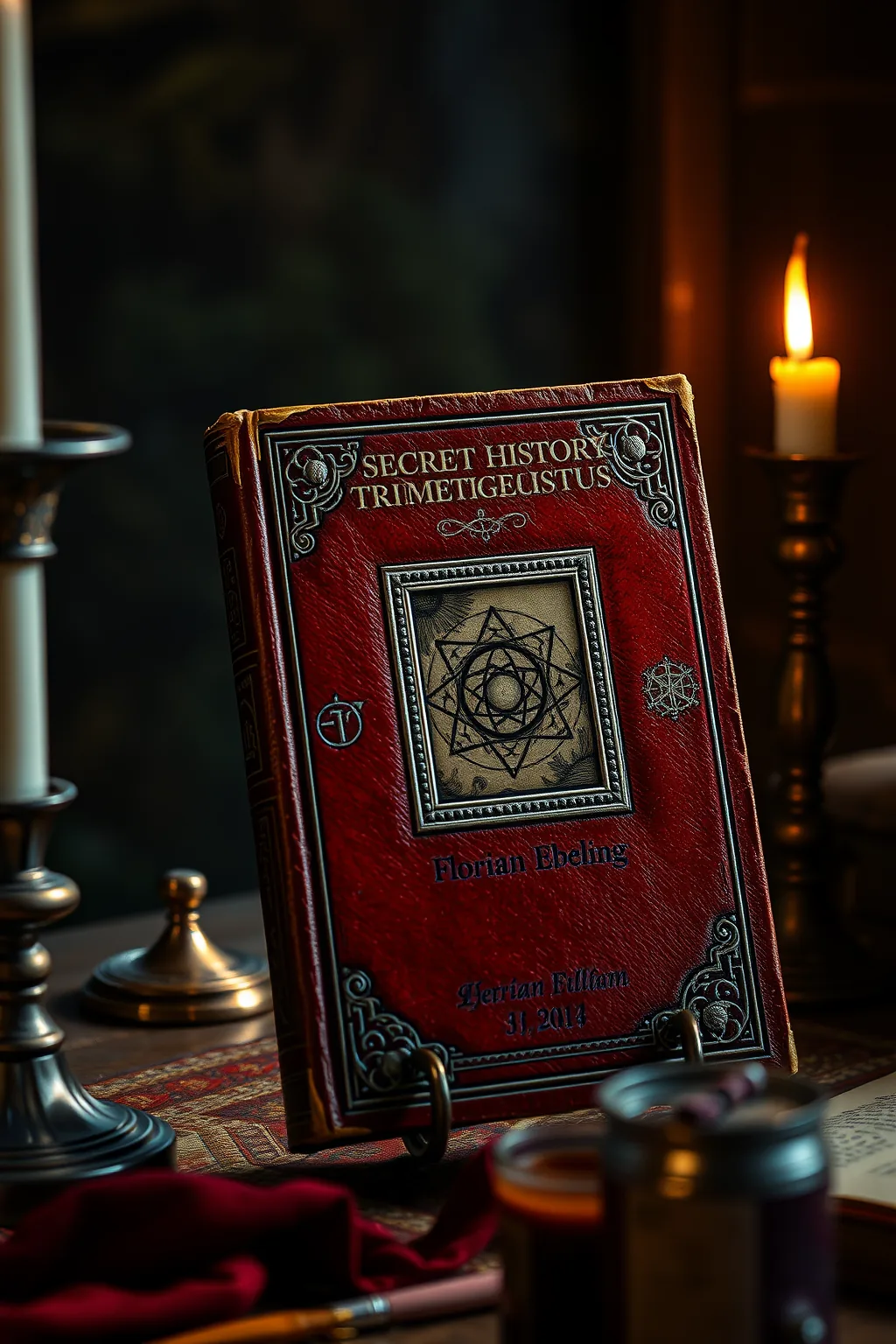
The Secret History of Hermes Trismegistus
 73
73

The Secret History of Hermes Trismegistus
Florian Ebeling’s *The Secret History of Hermes Trismegistus* offers a much-needed scholarly antidote to romanticized notions of ancient wisdom. Ebeling systematically debunks the idea of a singular, pristine Hermetic tradition, instead presenting it as a protean force that has been continuously reinterpreted. His strength lies in meticulous historical tracing; for instance, the discussion of Renaissance Neoplatonists like Marsilio Ficino, who saw Hermes as a precursor to Plato, clearly illustrates this adaptive nature. The limitation, however, is the dense academic prose, which, while accurate, can feel less accessible to the casual seeker of esoteric lore. The work excels when it dissects how figures like Ficino selectively adopted Hermetic ideas to bolster their own philosophical systems, demonstrating the text's fluidity. This is a critical, not devotional, history of a foundational esoteric corpus.
📝 Description
73
Florian Ebeling's 2007 book examines the Hermetic Corpus and its reception.
This scholarly work traces the history and influence of the Hermetic Corpus, a collection of ancient Greek and Roman texts attributed to Hermes Trismegistus. Ebeling analyzes how this tradition, which blended philosophical and religious ideas, was interpreted and adapted across different eras. The book details the ways these texts, often appearing in varied forms, shaped numerous esoteric and philosophical movements throughout history. The examination covers the texts' emergence in Hellenistic Egypt, a time of significant cultural blending, and their subsequent transformations and appropriations by various thinkers. Early Christians, medieval alchemists, Renaissance philosophers, and Enlightenment figures all engaged with Hermeticism, frequently imbuing its cryptic messages with their own intellectual agendas. Ebeling highlights the Corpus's role as a adaptable source for diverse theological and philosophical systems, demonstrating its persistent relevance.
The study focuses on Hermeticism as a fluid tradition rather than a fixed set of beliefs. It considers the concept of the *prisca theologia*, the idea that a singular, ancient divine wisdom underlies all religions. This notion made the Hermetic texts particularly appealing to later scholars and mystics seeking a unified source of spiritual knowledge. The book meticulously dissects these interpretations and their impact on Western thought and esoteric practices.
The Hermetic Corpus represents a significant strand within Western esotericism, originating in the Hellenistic period. These texts, attributed to the legendary figure Hermes Trismegistus, blend Egyptian, Greek, and Gnostic ideas into a unique philosophical and religious system. For centuries, they served as a touchstone for those seeking hidden knowledge, divine wisdom, and a connection to an ancient spiritual lineage. Movements like Renaissance Neoplatonism and various alchemical traditions drew heavily on Hermetic concepts, viewing them as keys to understanding the cosmos and humanity's place within it. Ebeling's work situates this tradition within its historical development and intellectual interactions.
💡 Why Read This Book?
• Gain a nuanced understanding of Hermeticism's evolution, moving beyond simplistic interpretations by examining its reception by Renaissance scholars like Marsilio Ficino. • Uncover how the *Corpus Hermeticum* served as a flexible philosophical and theological source across disparate historical periods, influencing thinkers from antiquity to the Enlightenment. • Appreciate the scholarly rigor behind tracing the textual history of Hermes Trismegistus, understanding that its influence is built on centuries of reinterpretation, not a single original doctrine.
⭐ Reader Reviews
Honest opinions from readers who have explored this book.
❓ Frequently Asked Questions
When was the original publication date of Florian Ebeling's work?
Florian Ebeling's *The Secret History of Hermes Trismegistus* was first published on September 1, 2011.
What is the primary focus of *The Secret History of Hermes Trismegistus*?
The book focuses on the historical development and varied reception of the Hermetic Corpus, exploring how these ancient texts have been interpreted and adapted across different philosophical and religious traditions.
Which ancient philosophical traditions are discussed in relation to Hermeticism?
The work explores connections between Hermeticism and traditions such as Platonism, Stoicism, Gnosticism, and certain Aristotelian doctrines, highlighting Hermeticism's syncretic nature.
Who was Hermes Trismegistus?
Hermes Trismegistus is a legendary syncretic figure, a fusion of the Greek god Hermes and the Egyptian god Thoth, to whom a body of esoteric philosophical and religious texts known as the Hermetic Corpus is attributed.
What does the book say about the 'prisca theologia' concept?
Ebeling discusses the *prisca theologia*, the idea of a single, ancient divine wisdom found in various religions, which made Hermetic texts appealing to later thinkers seeking a unified esoteric tradition.
Is this book suitable for beginners in esoteric studies?
While informative, the book is written with a scholarly tone and academic rigor, making it more suitable for students and researchers of esoteric history and philosophy than for absolute beginners seeking introductory material.
🔮 Key Themes & Symbolism
The Fluidity of Hermeticism
Ebeling emphasizes that Hermeticism is not a fixed doctrine but a dynamic tradition that has absorbed and adapted elements from numerous philosophical and religious systems throughout history. The *Corpus Hermeticum*, attributed to Hermes Trismegistus, served as a adaptable source, allowing thinkers from different eras—from Hellenistic Egypt to the Renaissance and beyond—to find resonance with their own ideas. This adaptability is key to its enduring appeal and its capacity to influence diverse schools of thought, from Neoplatonism to alchemy.
Hermes Trismegistus as a Syncretic Figure
The book looks at the composite nature of Hermes Trismegistus, a figure emerging from the Hellenistic period's syncretic milieu, blending Greek Hermes with Egyptian Thoth. This syncretism is mirrored in the Hermetic texts themselves, which synthesize Platonic, Stoic, and Gnostic ideas. Ebeling illustrates how this composite identity allowed Hermes Trismegistus to function as a universal sage, a transmitter of ancient, divine knowledge capable of bridging cultural and philosophical divides.
Reception and Reinterpretation
A central theme is the varied reception and constant reinterpretation of the Hermetic Corpus. Ebeling meticulously details how different historical periods and intellectual movements—such as Renaissance humanism and the Enlightenment—selected, modified, and utilized Hermetic texts to support their own agendas. The concept of the *prisca theologia*, which posited a single, ancient theological truth, played a significant role in this process, framing Hermes as a prophet of primordial wisdom.
The Hermetic Corpus as a Source Text
The work examines the *Corpus Hermeticum* not as a monolithic scripture but as a collection of diverse texts reflecting different philosophical and theological concerns. Ebeling traces its transmission and transformation, noting how its fragmented nature and allegorical language facilitated its appropriation by alchemists, mystics, and philosophers. The symbolic richness and philosophical depth of these texts made them a fertile ground for esoteric speculation across centuries.
💬 Memorable Quotes
Direct passages from the work, attributed to the author.
“Hermeticism has made it possible to produce many analogies and relationships to various traditions: to Platonism..., to Stoicism, to Gnostic ideas, and even to certain Aristotelian doctrines.”
— This highlights the syncretic nature of Hermeticism, showing how it served as a flexible framework that could be integrated with or seen as a precursor to established philosophical schools, contributing to its broad appeal.
“The Gnostic, the esoteric, the Platonist, or the deist has each been able to find something familiar in the writings.”
— This illustrates the adaptability of the Hermetic texts, demonstrating how individuals from diverse philosophical and spiritual backgrounds could interpret them through their own lenses, finding validation or inspiration within the corpus.
“One just had to have a penchant for remote antiquity, for the idea of a Golden Age, in order for Hermeticism, w[hich] one saw as a remnant of that epoch, to be perceived as a profound truth.”
— This points to the historical bias and romanticization of ancient origins that fueled the acceptance of Hermeticism, framing it as a pure, primordial wisdom that predated later philosophical developments.
“The Hermetic writings were not a fixed canon but a fluid body of literature that was constantly being reinterpreted and expanded.”
— This interpretation underscores the dynamic and evolving nature of the Hermetic tradition, emphasizing that its influence stems from its malleability and its capacity to be reshaped by successive generations of thinkers.
“The concept of the *prisca theologia* allowed later thinkers to view Hermetic texts as part of a single, ancient, divine revelation.”
— This explains a key mechanism by which Hermeticism was integrated into Western thought, allowing scholars to reconcile its pagan origins with Christian or philosophical frameworks by positing a unified ancient wisdom.
🌙 Esoteric Significance
Tradition
This work examines Hermeticism, a tradition deeply rooted in Hellenistic syncretism, blending Greek philosophy (especially Platonism and Stoicism) with Egyptian religious concepts and later influencing Gnosticism and alchemy. Ebeling positions Hermeticism not as a rigid dogma but as a fluid, adaptable corpus of texts that provided a framework for diverse esoteric interpretations. Its significance lies in its capacity to absorb and transmute ideas, serving as a bridge between philosophical inquiry and mystical experience across centuries.
Symbolism
Key symbols explored include the divine intermediary figure of Hermes Trismegistus himself, representing wisdom and revelation, and the concept of *gnosis* (spiritual knowledge) as the path to salvation or enlightenment. The texts also engage with alchemical symbolism, often in allegorical forms, representing processes of purification, transformation, and the unification of opposites, reflecting a desire for cosmic and personal renewal.
Modern Relevance
Contemporary esoteric practitioners and scholars continue to draw from the Hermetic tradition. Modern occult orders, New Age philosophies, and various schools of Western esotericism frequently reference the *Corpus Hermeticum* for its philosophical depth and symbolic language. Thinkers and authors in fields like depth psychology and comparative religion also engage with Hermetic ideas regarding the nature of consciousness, cosmology, and the human quest for meaning.
👥 Who Should Read This Book
• Students of ancient philosophy and religious history: Gain a scholarly perspective on the origins and evolution of the Hermetic Corpus, understanding its connections to Platonism, Stoicism, and Gnosticism. • Researchers of Western Esotericism: Explore the complex reception history of Hermetic texts, from antiquity through the Renaissance, and their foundational role in later esoteric movements. • Seekers interested in the history of ideas: Understand how a body of ancient texts could be continuously reinterpreted to address diverse philosophical and spiritual concerns across different eras.
📜 Historical Context
Florian Ebeling's work situates the Hermetic Corpus within the vibrant intellectual milieu of Hellenistic Egypt, specifically the period following the Roman conquest. This era was characterized by intense syncretism, where Greek philosophy, Egyptian religion, and various Eastern traditions mingled. The texts attributed to Hermes Trismegistus emerged from this fertile ground, often appearing in Greek and circulating widely by the 2nd and 3rd centuries CE. They were not a unified movement but a diverse collection of philosophical, theological, and magical writings. The work highlights how figures like Iamblichus, a prominent Neoplatonist in the 4th century, engaged with and integrated elements of Hermetic thought into their own systems, demonstrating its influence on contemporary schools of thought. Later, during the Renaissance, thinkers like Marsilio Ficino championed the idea of the *prisca theologia*, reinterpreting Hermes as a pagan prophet whose wisdom aligned with Christian doctrine, thus securing the Corpus's place in Western intellectual history.
📔 Journal Prompts
The concept of *prisca theologia* as a unifying idea across traditions.
Hermes Trismegistus as a syncretic figure embodying multiple cultural influences.
The adaptability of Hermetic writings to different philosophical frameworks.
The role of ancient texts in shaping later esoteric movements.
How the interpretation of ancient wisdom reflects the concerns of a particular era.
🗂️ Glossary
Hermetic Corpus
A collection of ancient Greek and Roman philosophical and religious texts attributed to the legendary figure Hermes Trismegistus, dealing with cosmology, astrology, alchemy, and theology.
Hermeticism
A philosophical and religious tradition based on the teachings attributed to Hermes Trismegistus, characterized by syncretism, a focus on divine knowledge (*gnosis*), and often associated with esoteric practices.
Hermes Trismegistus
A legendary syncretic figure combining the Greek god Hermes and the Egyptian god Thoth, considered the author of the Hermetic Corpus and a central figure in esoteric traditions.
Gnosticism
A diverse set of religious and philosophical systems in the ancient world emphasizing salvation through secret knowledge (*gnosis*), often featuring a dualistic worldview and complex cosmologies.
Platonism
A school of philosophy founded by Plato, characterized by the theory of Forms, the concept of an immortal soul, and the pursuit of knowledge through reason and dialectic.
Stoicism
A school of Hellenistic philosophy emphasizing virtue, reason, and living in accordance with nature, advocating for emotional resilience and self-control.
Prisca Theologia
The concept of a 'primordial theology' or ancient divine wisdom believed to be present in various religions and philosophical traditions, often attributed to figures like Hermes Trismegistus.









![An English translation of the Hermetic Arcanum of Penes Nos Unda Tagi [pseud.] 1623](/img/thumb/an-english-translation-of-the-hermetic-arcanum-of-penes-nos-unda-tagi-pseud-1623-jean-d-espagnet.webp)