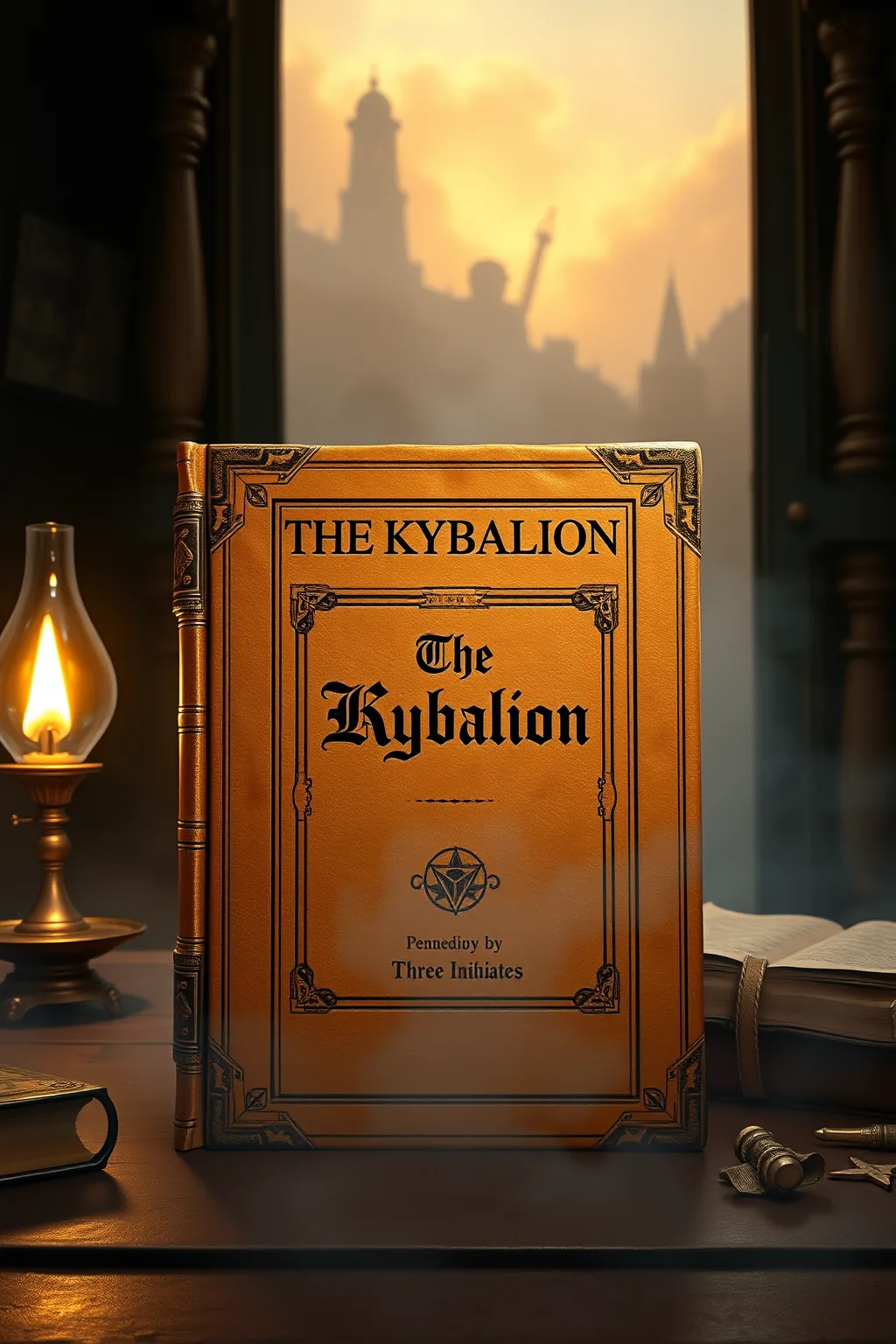
The Kybalion
 81
81

The Kybalion
The Kybalion’s strength lies in its concise articulation of the Seven Hermetic Principles, offering a structured entry point into a vast philosophical tradition. The clarity with which concepts like Vibration and Polarity are explained, even if abstract, provides a framework for contemplating existence. However, the text suffers from a lack of specific historical grounding; the "Three Initiates" remain an enigma, and the precise origins of these distilled principles are obscured by their purported ancient lineage. The concept of "Mentalism" is particularly compelling, suggesting the universe is a projection of a Great Mind, but the book offers little in the way of practical application or verifiable evidence beyond its own internal logic. It serves as a primer, not a complete system, leaving the reader to bridge the gap between theory and lived experience.
📝 Description
81
Published in 1908, The Kybalion distills Hermetic philosophy into seven principles.
The Kybalion, attributed to the "Three Initiates," presents seven core tenets of Hermetic philosophy. It focuses on a metaphysical worldview rather than historical accounts. The text aims to make complex esoteric doctrines accessible to a wider audience. It emerged in the early 20th century during a period of heightened interest in occultism.
This work is for those seeking metaphysical understanding and students of Western esotericism. It appeals to individuals who approach spiritual study analytically, looking for universal laws. Readers should expect abstract concepts and a presentation that does not rely on dogma. The book's anonymous authors drew from various Hermetic, Kabbalistic, and New Thought traditions.
The Kybalion appeared in 1908 amidst a surge of interest in occultism in Europe and America. This period saw the rise of groups like the Hermetic Order of the Golden Dawn and the influence of Theosophy. The "Three Initiates" synthesized existing Hermetic, Kabbalistic, and New Thought ideas into a unified format. While influential in occult circles, it received little attention from academic scholars.
💡 Why Read This Book?
• Understand the Hermetic Principle of Mentalism, which posits that the entire universe is a mental creation, offering a new perspective on reality beyond the purely material. • Grasp the Principle of Correspondence ("As Above, So Below"), a concept central to esoteric traditions since antiquity, providing a framework for inter-dimensional understanding. • Explore the Principle of Vibration, which explains that all matter and energy are in constant motion, offering insights into the dynamic nature of existence and personal transformation.
⭐ Reader Reviews
Honest opinions from readers who have explored this book.
❓ Frequently Asked Questions
When was The Kybalion first published?
The Kybalion was first published in 1908, during a period of burgeoning interest in esoteric and occult philosophies in the Western world.
Who are the "Three Initiates" mentioned as authors?
The "Three Initiates" is a pseudonym; the true identities of the authors have never been definitively confirmed, adding to the book's mystique.
What is the core philosophy presented in The Kybalion?
The book presents Hermetic philosophy, which centers on seven universal principles believed to govern all aspects of existence, from the physical to the mental and spiritual.
Are the Seven Principles of Hermeticism unique to The Kybalion?
While The Kybalion is the most famous source for the Seven Principles, the ideas themselves have roots in ancient Hermetic traditions, predating the book's 1908 publication.
Is The Kybalion considered a religious text?
It is not a religious text in the traditional sense but a philosophical and metaphysical work offering a system of understanding the universe and one's place within it.
Does The Kybalion offer practical exercises?
While it outlines principles for understanding, it does not provide step-by-step practical exercises. Application relies on the reader's interpretation and integration of the concepts.
🔮 Key Themes & Symbolism
The Seven Hermetic Principles
The central framework of The Kybalion, these seven principles—Mentalism, Correspondence, Vibration, Polarity, Rhythm, Cause and Effect, and Gender—are presented as immutable laws of the universe. They offer a metaphysical lens through which to understand phenomena, from the smallest particle to the grandest cosmic cycles. The book systematically breaks down each principle, illustrating its pervasive influence on all levels of existence and consciousness, suggesting that understanding these laws is key to mastering oneself and one's environment.
The Power of the Mind
Central to Hermetic thought, particularly through the Principle of Mentalism, is the idea that the universe is fundamentally mental. The Kybalion posits that "The All" is Mind, and that our own minds are manifestations of this Universal Mind. This concept elevates consciousness, suggesting that our thoughts, beliefs, and perceptions are not merely passive reflections of reality but active forces in shaping it. The text explores how understanding this mental nature of reality can lead to greater personal agency and control over one's experiences.
Universal Laws and Duality
The Kybalion emphasizes the interconnectedness of all things through universal laws. Principles like Correspondence and Polarity highlight the inherent dualities within existence—masculine/feminine, light/dark, good/evil—and how these apparent opposites are, in fact, different degrees of the same fundamental reality. This understanding is presented as crucial for transcending limitations and achieving a more balanced perspective, recognizing that apparent contradictions are merely facets of a greater whole.
The Art of Transmutation
While not explicitly a "how-to" manual, The Kybalion lays the groundwork for mental and spiritual transmutation. By understanding and applying the Seven Principles, particularly those of Vibration and Polarity, individuals are encouraged to shift their mental states, influence their environment, and transform their circumstances. The book suggests that mastery over one's own mind and the application of these laws allow for a conscious evolution and elevation of one's being.
💬 Memorable Quotes
Direct passages from the work, attributed to the author.
“The lips of wisdom are closed, except to the ears of Understanding.”
— This aphorism suggests that true wisdom is not freely accessible to all but requires a receptive and prepared mind. Understanding is presented as the prerequisite for grasping profound truths, implying a need for inner development before external knowledge can be effectively assimilated.
“The Principle of Mentalism states that The All is Mind; the Universe is Mental.”
— This core tenet posits that reality is not fundamentally material but rather a manifestation of a singular, infinite consciousness. It implies that our thoughts and perceptions are integral to the fabric of existence, not merely byproducts of a physical brain.
“As Above, So Below; As Below, So Above.”
— This famous Hermetic maxim, the Principle of Correspondence, illustrates the interconnectedness of all planes of existence. It suggests that understanding the laws governing one level (e.g., the physical) can provide insight into others (e.g., the mental or spiritual), and vice versa.
“Everything flows, out and in; everything has its tides; all things rise and fall.”
— This describes the Principle of Rhythm, highlighting the cyclical nature of existence. It suggests that change is constant, characterized by ebb and flow, expansion and contraction, and that recognizing these patterns can lead to greater adaptability and less resistance to life's inevitable fluctuations.
“Nothing rests; everything moves; everything vibrates.”
— This statement captures the Principle of Vibration, asserting that the universe is in a constant state of motion and energetic flux. It implies that even seemingly solid objects are composed of vibrating energy, and that differences in vibration account for the diversity of phenomena.
🌙 Esoteric Significance
Tradition
The Kybalion is firmly rooted in the Western Esoteric Tradition, specifically drawing from Hermeticism, a philosophical and religious tradition attributed to Hermes Trismegistus. It presents itself as a distillation of ancient Egyptian and Greek Hermetic teachings. While it shares thematic overlaps with Gnosticism and Kabbalah, its primary lineage is Hermetic, aiming to provide a unified and accessible interpretation of these foundational esoteric concepts for a modern audience.
Symbolism
Key symbols include the "All" or Universal Mind, representing the ultimate reality and source of all existence. The principle of Correspondence is often visualized through the "As Above, So Below" axiom, linking macrocosmic and microcosmic realms. The concept of Gender is symbolized by masculine and feminine principles inherent in all things, not necessarily biological but energetic forces of creation and reception, vital for understanding manifestation.
Modern Relevance
Contemporary thinkers and practitioners in fields such as New Age spirituality, modern Hermeticism, and certain branches of psychology and self-help continue to engage with The Kybalion. Its principles are often referenced in discussions of consciousness, manifestation, and universal laws. Modern authors and spiritual teachers frequently cite its concepts, demonstrating its enduring influence on popular understanding of esoteric philosophy and personal development.
👥 Who Should Read This Book
• Aspiring students of Hermetic philosophy seeking a clear, structured introduction to its core principles. • Individuals interested in comparative mysticism who wish to understand a key text influencing Western esoteric thought. • Seekers of metaphysical frameworks looking for conceptual tools to analyze personal experiences and the nature of reality.
📜 Historical Context
Published in 1908, The Kybalion emerged during a fertile period for esoteric and occult revival in the Western world. This era saw the flourishing of movements like Theosophy, founded by Helena Blavatsky, and the Hermetic Order of the Golden Dawn, which popularized Hermeticism, Kabbalah, and ceremonial magic. The book's anonymous "Three Initiates" likely synthesized elements from these streams, along with New Thought philosophies, presenting a streamlined version of Hermetic principles. Its accessibility contrasted with more complex grimoires or theosophical tracts, making Hermeticism palatable to a broader audience. While it gained significant traction within occult circles, mainstream academic study of esoteric traditions was minimal at the time, meaning its intellectual reception was largely confined to practitioners and enthusiasts rather than scholarly critique.
📔 Journal Prompts
The Principle of Mentalism: How does the idea that the universe is mental impact your perception of challenges?
Reflect on the Principle of Correspondence: Identify one "below" phenomenon that mirrors an "above" situation in your life.
The Principle of Vibration: How might understanding that everything vibrates alter your approach to emotional states?
Consider the Principle of Polarity: Explore a situation where apparent opposites are two sides of the same coin.
Analyze the Principle of Rhythm: How can acknowledging the "rise and fall" in your endeavors lead to greater acceptance?
🗂️ Glossary
The All
The ultimate reality, the Absolute, the Supreme Being. It is described as infinite, eternal, and unchanging, representing the entirety of existence from which all phenomena emanate.
Mentalism
The First Hermetic Principle, stating that the Universe is fundamentally mental. It posits that the All is Mind, and that the physical and mental worlds are manifestations of this Universal Mind.
Correspondence
The Second Hermetic Principle, summarized by the maxim "As Above, So Below." It explains the harmony and interconnectedness between different planes of existence, suggesting that understanding one plane can illuminate others.
Vibration
The Third Hermetic Principle, asserting that nothing rests; everything moves and vibrates. It explains that differences in vibration account for the diverse phenomena observed in the universe, from physical matter to mental states.
Polarity
The Fourth Hermetic Principle, stating that everything is dual, having poles. It explains that apparent opposites (like hot/cold, light/dark) are actually different degrees of the same fundamental force or substance.
Rhythm
The Fifth Hermetic Principle, describing the universal law of ebb and flow, rise and fall, action and reaction. It suggests that all things move in cycles, with predictable patterns of movement and change.
Cause and Effect
The Sixth Hermetic Principle, affirming that every cause has its effect and every effect has its cause. It implies a deterministic universe where actions have predictable consequences, and understanding these links allows for greater control.
![The ancient fragments; containing what remains of the writings of Sanchoniatho, Berossus, Abydenus, Megasthenes, and Manetho. Also the Hermetic Creed, the Old Chronicle, the Laterculus of Eratosthenes, the Tyrian Annals, the Oracles of Zoroaster […]](/img/thumb/the-ancient-fragments-containing-what-remains-of-the-writings-of-sanchoniatho-berossus-abydenus-megasthenes-and-manetho-also-the-hermetic-creed-the-old-chronicle-the-laterculus-of-eratosthenes-the-tyr.webp)