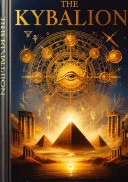
The Kybalion, A Study of The Hermetic Philosophy of Ancient Egypt and Greece
 77
77

The Kybalion, A Study of The Hermetic Philosophy of Ancient Egypt and Greece
The enduring appeal of "The Kybalion" lies not in its originality, but in its concise, almost axiomatic presentation of complex metaphysical ideas. Attributed to the elusive "Three Initiates," its 1908 publication tapped into a zeitgeist hungry for esoteric knowledge beyond conventional frameworks. The strength of the work is its systematic cataloging of seven principles, offering a seemingly complete blueprint for understanding existence. The Principle of Mentalism, stating "The All is Mind; The Universe is Mental," is perhaps its most cited axiom, providing a potent starting point for contemplation. However, the book's limitation is its lack of historical or textual substantiation for its claims to ancient Hermetic wisdom; it functions more as a modern codification than a direct transmission. The assertion that "The lips of wisdom are closed, except to the ear of Understanding" (as presented in the text's introduction) perfectly encapsulates its approach: demanding a receptive, rather than analytical, reader. "The Kybalion" serves as a potent, albeit unproven, metaphysical primer.
📝 Description
77
"The Kybalion" was published in 1908, outlining seven Hermetic principles.
This 1908 text presents itself as a summary of Hermetic philosophy, attributed to Hermes Trismegistus. Authored by the pseudonymous "Three Initiates," the book details seven core principles intended to explain universal laws. It serves as an introduction to metaphysical ideas, aiming to give readers a way to understand reality's underlying structures. The volume is suitable for anyone interested in the core ideas of Western esoteric thought. It speaks to readers curious about occult philosophy, spiritual alchemy, and the connections between ancient Egyptian and Greek thinking.
The book's appearance coincided with a surge of interest in spiritualism, theosophy, and occultism across Europe and America. It connected with the New Thought movement, which stressed the mind's role in shaping experience. The anonymous authors and the claim of ancient origins appealed to a public looking for alternatives to conventional religious and scientific views. Its publication by the Yogi Publication Society situated it alongside other works on Eastern philosophies and esoteric practices.
The Kybalion emerged from the Western esoteric tradition, drawing heavily on Hermeticism, a philosophical system attributed to Hermes Trismegistus. This tradition blends ancient Egyptian and Greek mystical ideas, emphasizing spiritual knowledge and the hidden laws of the cosmos. The book's publication in 1908 placed it within the broader context of the New Thought movement and early 20th-century occult revival, a period when interest in non-traditional spiritual and philosophical systems was high.
💡 Why Read This Book?
• Gain a structured overview of seven Hermetic Principles, like Mentalism and Correspondence, providing a foundational vocabulary for metaphysical inquiry. • Understand the historical positioning of the book within the early 20th-century occult revival, particularly its connection to the New Thought movement. • Explore the concept of "as above, so below" (the Principle of Correspondence), offering a lens to view the interconnectedness of macrocosm and microcosm.
⭐ Reader Reviews
Honest opinions from readers who have explored this book.
❓ Frequently Asked Questions
When was "The Kybalion" first published?
"The Kybalion" was first published in 1908 by the Yogi Publication Society. This marked its introduction to the public during a period of significant interest in esoteric and metaphysical philosophies.
Who are "The Three Initiates" mentioned as authors?
The identities of "The Three Initiates" remain officially unknown. This anonymity is a deliberate choice, intended to focus attention on the teachings rather than the personalities, aligning with the book's esoteric purpose.
What is the Principle of Mentalism?
The Principle of Mentalism, the first principle discussed, posits that "The All is Mind; The Universe is Mental." It suggests that reality itself is a mental construct, originating from a Universal Mind.
How does "The Kybalion" relate to Hermeticism?
The book claims to be a summary of the core teachings of Hermeticism, a tradition attributed to Hermes Trismegistus. It presents seven principles as the essence of this ancient wisdom.
Is "The Kybalion" considered an occult or a spiritual text?
It is widely considered an occult text due to its exploration of hidden laws and metaphysical principles. However, its focus on universal laws and mental causation also aligns it with spiritual and New Thought literature.
Where can I find "The Kybalion"?
"The Kybalion" is readily available through numerous booksellers and online platforms. As it was first published in 1908, it is in the public domain in many regions, making it accessible online for free.
🔮 Key Themes & Symbolism
The Seven Hermetic Principles
Central to the work are the seven principles presented as immutable laws of the universe: Mentalism, Correspondence, Vibration, Polarity, Rhythm, Cause and Effect, and Gender. Each principle is explained with illustrative examples, intended to provide a framework for understanding all phenomena. The text argues these are not mere theories but fundamental truths governing existence, from the smallest particle to the grandest cosmic cycles. Understanding these principles is framed as the key to mastery over one's reality and the unfolding of events.
The Nature of Reality
The book posits a fundamentally mental universe, a concept derived from the Principle of Mentalism. It suggests that consciousness is the primary substance and that the physical world is a manifestation of this underlying mental reality. This perspective challenges materialistic viewpoints, proposing that all events, thoughts, and matter originate from a Universal Mind. The implications are profound, suggesting that by understanding and aligning with these mental laws, individuals can influence their perceived reality.
Personal Transformation and Mastery
"The Kybalion" is not merely theoretical; it advocates for the practical application of its principles for personal growth and mastery. By understanding concepts like Cause and Effect and Rhythm, individuals are encouraged to work with, rather than against, the natural laws of the cosmos. The text suggests that true power lies in comprehending these forces and consciously directing one's mental energies, leading to a more harmonious and purposeful existence. This focus on practical application distinguishes it within philosophical literature.
The Hermetic Tradition
The work positions itself as a modern interpretation and summary of the ancient Hermetic tradition, attributed to Hermes Trismegistus. It claims to distill essential truths passed down through centuries, making them accessible to a contemporary audience. The book's publication in 1908 places it within the context of early 20th-century occult revival, attempting to bridge ancient esoteric knowledge with modern sensibilities and scientific understanding, albeit through a metaphysical lens.
💬 Memorable Quotes
Direct passages from the work, attributed to the author.
“The lips of wisdom are closed, except to the ear of Understanding.”
— This statement emphasizes that true knowledge is not passively received but requires a receptive and prepared mind. It suggests that wisdom is veiled and accessible only to those who cultivate the capacity to comprehend its deeper meanings.
“The All is Mind; The Universe is Mental.”
— This is the core tenet of the Principle of Mentalism. It asserts that the fundamental reality of existence is consciousness or Mind, and that the entire universe, including all its phenomena, is a manifestation of this Universal Mind.
“As above, so below; as below, so above.”
— This phrase, representing the Principle of Correspondence, highlights the idea that there is a perfect parallel between different planes of existence, from the highest spiritual realms to the lowest material levels. It suggests a unified, interconnected cosmos.
“Nothing rests; everything moves; everything vibrates; everything flies and returns.”
— This expresses the Principle of Vibration, stating that motion is inherent in all things. It suggests a dynamic universe where constant change and oscillation are fundamental properties of existence at all levels.
“Everything is dual; everything has poles; everything has its pair of opposites; the opposites are identical in nature, but different in degree.”
— This explains the Principle of Polarity, illustrating how apparent opposites are merely two extremes of the same underlying reality. It suggests that concepts like hot/cold or light/dark are relative and can be transcended by understanding their common essence.
🌙 Esoteric Significance
Tradition
The work is a cornerstone text within modern Western Hermeticism, attempting to synthesize and present the core tenets attributed to Hermes Trismegistus. It draws parallels with Gnosticism and Kabbalah through its emphasis on hidden knowledge and symbolic interpretation. However, its clear structure and accessible language, particularly its alignment with New Thought concepts, distinguish it from more complex or historically dense Hermetic grimoires, positioning it as a gateway text for contemporary seekers.
Symbolism
While "The Kybalion" primarily focuses on principles rather than overt symbolism, the number seven itself is highly symbolic, representing completion and perfection in many esoteric traditions. The concept of Hermes Trismegistus, a syncretic deity merging the Greek Hermes and Egyptian Thoth, symbolizes the union of wisdom and communication across cultures and eras. The book's structure, presenting seven distinct but interconnected principles, implies a cosmic order where each element plays a vital role in the totality.
Modern Relevance
Contemporary practitioners of Hermeticism, Western esotericism, and spiritual alchemy continue to reference "The Kybalion" for its foundational principles. Its ideas influence modern New Thought, law of attraction philosophies, and self-help methodologies that emphasize mental causation and personal empowerment. Thinkers and groups exploring consciousness studies and comparative mysticism often engage with its framework for understanding universal laws and their application in daily life.
👥 Who Should Read This Book
• Aspiring students of Hermeticism seeking a structured introduction to its core principles, moving beyond anecdotal accounts to a systematic framework. • Individuals interested in the historical development of occult and metaphysical thought in the early 20th century, particularly its intersection with New Thought. • Seekers of philosophical tools for understanding the nature of reality and personal causality, who appreciate concise explanations of complex metaphysical concepts.
📜 Historical Context
Published in 1908 by the Yogi Publication Society, "The Kybalion" emerged during a fertile period for esoteric thought in the West. It arrived amidst the rise of Theosophy, championed by figures like Helena Blavatsky, and the concurrent New Thought movement, which emphasized mental healing and the power of positive thinking. "The Kybalion" offered a more codified, seemingly ancient system, contrasting with some of the more eclectic or overtly spiritualist leanings of its contemporaries. Its anonymous authorship, attributed to "The Three Initiates," lent an air of mystery and authority, positioning it as a direct transmission of Hermetic wisdom. While not directly engaging with specific critics, its reception was part of a broader cultural fascination with ancient mysteries and alternative spiritual paths, drawing interest from those disillusioned with traditional religious dogma.
📔 Journal Prompts
The Principle of Mentalism and the concept of "The All is Mind": How does this perspective alter your perception of everyday events?
Reflect on the Principle of Correspondence: Identify a situation where observing a macrocosmic pattern might illuminate a personal challenge.
Consider the Principle of Vibration: How might the idea that 'nothing rests' influence your approach to stability and change?
The Principle of Polarity and its application: Explore an apparent duality in your life and seek its underlying unity.
Contemplate the Principle of Cause and Effect: How can a conscious understanding of causation transform your response to circumstances?
🗂️ Glossary
Hermes Trismegistus
A legendary, possibly mythical, figure revered as the founder of Hermeticism. He is a syncretic deity combining the Greek god Hermes with the Egyptian god Thoth, symbolizing wisdom, writing, and magic.
Hermetic Philosophy
A system of esoteric thought and practice based on the purported teachings of Hermes Trismegistus, emphasizing spiritual wisdom, alchemy, astrology, and the interconnectedness of the universe.
The All
In "The Kybalion," this refers to the Universal Mind or Absolute Reality, the ultimate source and substance of all existence, from which everything emanates.
Mentalism
The first Hermetic principle, stating that the fundamental nature of the universe is mental, meaning all reality is a manifestation of a Universal Mind.
Correspondence
The second Hermetic principle, expressed as 'As above, so below; as below, so above,' indicating a parallel relationship between different levels of reality.
Vibration
The third Hermetic principle, asserting that everything in the universe is in constant motion and oscillation, differing only in frequency.
Polarity
The fourth Hermetic principle, explaining that opposites are merely different degrees of the same underlying substance or force.