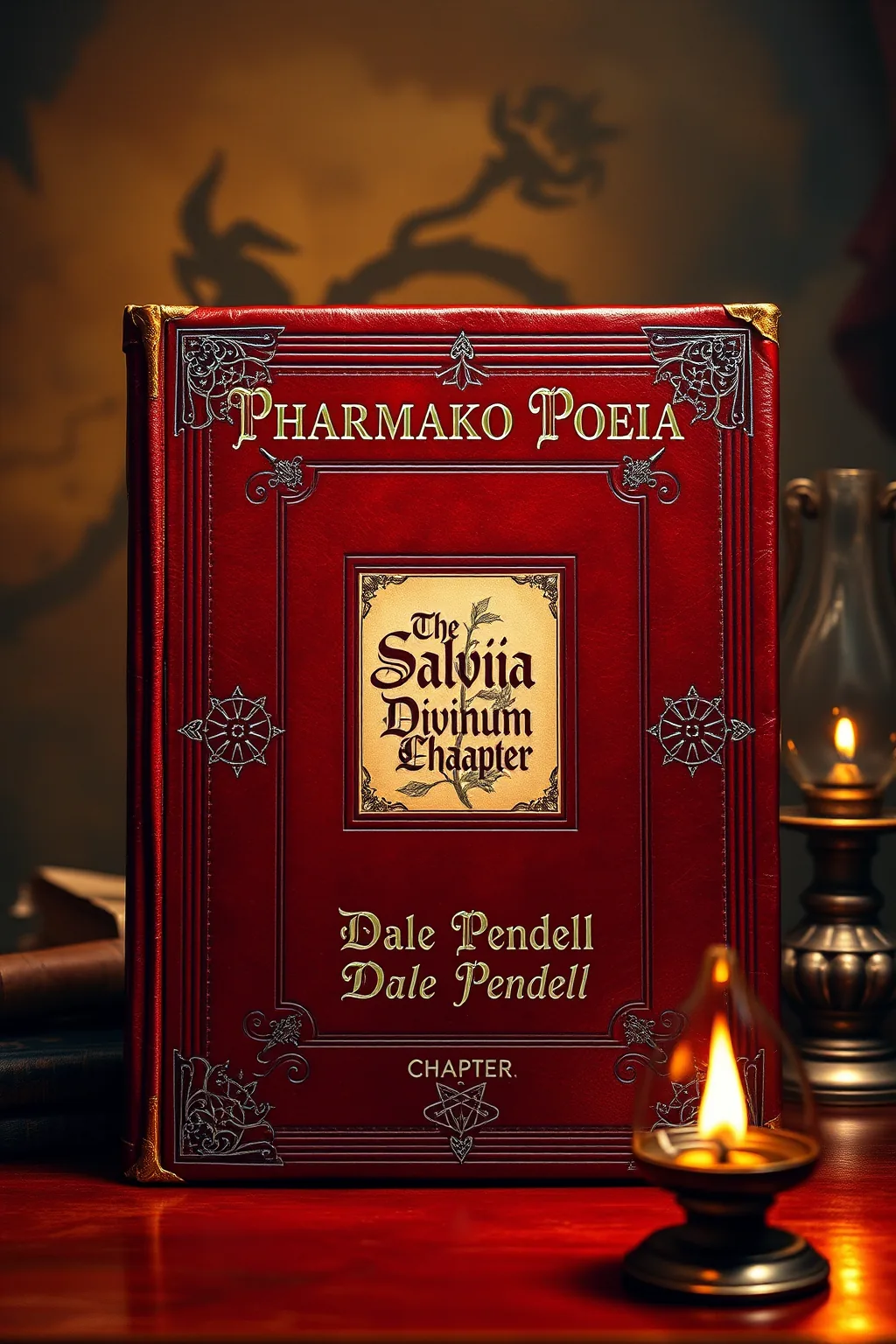
Pharmako Poeia – The Salvia Divinorum chapter
 81
81

Pharmako Poeia – The Salvia Divinorum chapter


Ophelia Vance, Mystical Literature Reviewer — Dale Pendell's exploration of Salvia Divinorum within 'Pharmako/Poeia' is nothing short of visionary. This chapter transcends conventional ethnobotany, offering a deeply Hermetic and alchemical lens through which to view the 'shepherdess of the ferns.' Pendell's erudition is astounding, seamlessly blending scientific understanding with ancient wisdom, revealing the profound symbolic resonance of this remarkable plant. It's a must-read for anyone interested in the esoteric applications of psychoactive flora, offering unparalleled insights into consciousness alteration and the archetypal forces at play. Highly recommended for serious practitioners and scholars of the occult.
📝 Description
81
Dale Pendell's Pharmako Poeia chapter examines Salvia Divinorum's role in alchemy and consciousness.
Dale Pendell's section on Salvia Divinorum from 'Pharmako/Poeia: Plant Powers, Poisons, and Herbcraft' moves beyond simple botany. Pendell connects the psychoactive properties of this plant with alchemical thought and historical usage. He discusses its symbolic meanings and its place in the broader relationship between humans and the plant world. The text encourages a view of Salvia as more than just a substance, suggesting it holds deeper energetic significance.
This writing is for those interested in the hidden aspects of plant use and consciousness alteration. It aims to provide a framework for understanding how such plants have been perceived and worked with across different traditions. Pendell's approach integrates empirical observation with esoteric interpretation, inviting readers to consider new perspectives on reality and awareness.
This chapter situates Salvia Divinorum within the historical and philosophical currents of alchemy and Hermeticism. It treats the plant not merely as a biological specimen but as a subject of alchemical operations and symbolic interpretation. Pendell draws parallels between the plant's effects and traditional alchemical processes, suggesting a correspondence between botanical phenomena and the Great Work. This approach aligns with a lineage of esoteric thought that views the natural world as a repository of hidden knowledge and spiritual potential.
✍️ Author
by Dale Pendell
Norman Oliver Brown (September 25, 1913 – October 2, 2002) was an American scholar, writer, and social philosopher. Beginning as a classical scholar, his later work branched into wide-ranging, erudite, and intellectually sophisticated considerations of his…
💡 Why Read This Book?
Delve into the esoteric secrets of Salvia Divinorum, as Pendell illuminates its mystical properties through an alchemical and Hermetic framework. This chapter is essential for seekers of hidden plant lore, scholars of consciousness, and practitioners looking to deepen their understanding of psychoactive allies and their symbolic significance. Discover a new paradigm for engaging with the vegetal realm.
⭐ Reader Reviews
Honest opinions from readers who have explored this book.
❓ Frequently Asked Questions
What is the core esoteric teaching regarding Salvia Divinorum presented in this chapter?
The chapter frames Salvia Divinorum not just as a psychoactive plant, but as a potent alchemical agent and a conduit to other realms of consciousness, rich in symbolic meaning and historical resonance.
Is this chapter suitable for beginners in esoteric studies?
While dense with information, the chapter's evocative language and rich symbolism can be profoundly engaging for curious beginners, though a deeper understanding may benefit from prior exposure to Hermeticism or alchemy.
What distinguishes Pendell's approach to Salvia Divinorum from a purely scientific one?
Pendell integrates scientific data with alchemical philosophy, historical context, and sociological observations, presenting a holistic, multidimensional understanding of the plant's power and significance.
Can this chapter be read independently of the full 'Pharmako/Poeia' book?
Yes, this chapter offers a substantial and self-contained exploration of Salvia Divinorum, providing significant esoteric insights even when read in isolation from the complete work.
What kind of 'herbcraft' is discussed in relation to Salvia Divinorum?
The 'herbcraft' refers to a deep, symbolic, and energetic engagement with the plant's essence, moving beyond mere consumption to a profound understanding of its role in consciousness exploration and spiritual development.
🔮 Key Themes & Symbolism
Alchemical Transmutation of Consciousness
Pendell frames the experience of Salvia Divinorum through the lens of alchemical processes, suggesting that the profound shifts in perception and reality induced by the plant can be understood as a form of inner transmutation. This involves the dissolution of egoic structures, the confrontation with archetypal forces, and the potential for a reintegration of consciousness at a higher vibratory state. The chapter explores how Salvia acts as a catalyst, mirroring the alchemist's quest for the Philosopher's Stone by facilitating radical transformations of the self, revealing hidden potentials and deeper truths about the nature of existence.
The Hermetic Sophia and Plant Intelligence
Central to Pendell's analysis is the concept of the plant as a vessel of Sophia, divine wisdom, particularly within a Hermetic framework. Salvia Divinorum is presented as a key that unlocks access to a vast, interconnected intelligence inherent in the natural world. This 'plant intelligence' is not merely biological but possesses a spiritual dimension, communicating through symbolic language and archetypal imagery. The chapter studies the plant's role as a 'shepherdess of the ferns,' guiding the user through labyrinthine landscapes of the mind, revealing cosmic patterns and the interconnectedness of all life.
The Sociocultural and Historical Resonance of Sacred Flora
Beyond its immediate psychoactive effects, Pendell situates Salvia Divinorum within a collection of human history, culture, and spiritual practice. He explores its traditional uses, the societal perceptions of potent plants, and the enduring human fascination with altered states of consciousness. The chapter highlights how Salvia, like other sacred flora, has served as a bridge between the mundane and the divine, influencing shamanic traditions, mythologies, and the very evolution of human consciousness. It underscores the importance of understanding these plants not just scientifically, but within their broader socio-historical and spiritual contexts.
💬 Memorable Quotes
Direct passages from the work, attributed to the author.
“The shepherdess of the ferns has come.”
— This evocative phrase introduces Salvia Divinorum, personifying the plant as a guiding entity that leads the user through the dense, often primal, landscapes of the subconscious mind.
“A key to unlock the hidden chambers of perception.”
— This metaphor emphasizes Salvia's power to break down ordinary perceptual barriers, granting access to novel ways of experiencing reality and consciousness.
“The plant speaks in symbols, a language older than words.”
— This highlights the non-linear, archetypal, and symbolic nature of the Salvia experience, suggesting a profound communication that transcends rational thought.
“To know the plant is to know a facet of the divine.”
— This speaks to the sacred nature of the plant, suggesting that understanding Salvia Divinorum offers a glimpse into the broader spiritual forces and intelligences that permeate the universe.
💡 Key Ideas
Editorial paraphrase of the work's core concepts — not direct quotes.
Alchemy is not just in the flask, but in the flesh.
This quote underscores the book's central thesis: that the alchemical process of transformation is not confined to material experiments but is an inherent potential within human consciousness itself, catalyzed by plants like Salvia.
🌙 Esoteric Significance
Tradition
This chapter is deeply rooted in the Hermetic tradition, drawing heavily on alchemical principles, symbolic language, and the concept of correspondences. It also touches upon Gnostic ideas of hidden knowledge and the Sophia, or divine wisdom, inherent in nature. The exploration of plant intelligence and consciousness alteration aligns with various shamanic and mystical paths that seek direct experience of the divine through altered states.
Symbolism
Salvia Divinorum is imbued with strong symbolism within the chapter. It's presented as a 'shepherdess of the ferns,' a guide through the subconscious. The plant's intense, often fragmented visions are interpreted as symbolic encounters with archetypal forces, the dissolution of the ego, and the unveiling of underlying cosmic structures. The alchemical symbolism of transmutation, dissolution, and reintegration is central to understanding the plant's wide impact on the user's psyche.
Modern Relevance
In an era increasingly seeking meaning beyond materialist explanations, Pendell's work offers a vital bridge. The chapter's exploration of plant intelligence and consciousness alteration speaks to contemporary discussions on psychedelics, mindfulness, and the interconnectedness of all life. It provides a sophisticated framework for understanding these phenomena through ancient esoteric lenses, urging a more reverent and integrated approach to our relationship with the plant kingdom and the depths of our own consciousness.
👥 Who Should Read This Book
This chapter is a treasure for the dedicated seeker of esoteric knowledge, particularly those drawn to the mysteries of plant consciousness and psychoactive flora. Scholars of comparative religion, anthropology, and consciousness studies will find Pendell's interdisciplinary approach invaluable. Practitioners of Hermeticism, alchemy, and shamanic traditions will discover clear insights into the symbolic and energetic properties of Salvia Divinorum. Even those new to these fields but possessed of a curious and open mind will find themselves captivated by the evocative prose and the profound questions it raises about reality and perception.
📜 Historical Context
The chapter on Salvia Divinorum emerges from a fertile period of renewed interest in altered states of consciousness, ethnobotany, and esoteric traditions, particularly in the late 20th and early 21st centuries. Dale Pendell's work reflects a broader cultural shift, moving away from purely reductionist scientific paradigms towards a more holistic and integrated understanding of consciousness and the natural world. This era saw the rise of psychedelic research, a resurgence of interest in Hermeticism, Gnosticism, and various forms of 'natural magic,' and a growing appreciation for indigenous wisdom. Pendell's "Pharmako" trilogy stands as a monumental synthesis of these currents, offering a sophisticated, alchemically informed perspective that bridges the gap between empirical observation and the ineffable mysteries of plant-human interaction, positioning Salvia Divinorum within a lineage of sacred plants that have shaped human spiritual evolution.
📔 Journal Prompts
Reflect on the 'shepherdess of the ferns' metaphor. What does it suggest about the guiding intelligence of Salvia Divinorum?
How does Pendell's alchemical interpretation of Salvia's effects differ from a purely pharmacological one? What is gained by this perspective?
Consider the idea of 'plant intelligence.' What forms might this intelligence take, and how might we perceive it?
If Salvia Divinorum is a 'key to unlock hidden chambers,' what 'chambers' within your own consciousness do you feel it might unlock?
How does understanding Salvia's historical and cultural context enhance its perceived power and significance for you?
🗂️ Glossary
Hermeticism
An ancient philosophical and religious tradition based on the writings attributed to Hermes Trismegistus, emphasizing esoteric knowledge, spiritual transformation, and the interconnectedness of the microcosm and macrocosm.
Alchemy
An ancient practice and philosophical tradition that sought to purify, mature, and perfect certain materials, often understood metaphorically as a spiritual process of transforming the soul.
Sophia
In Gnosticism and other traditions, Sophia represents divine wisdom, often depicted as a feminine principle that emanates from the divine and is intimately connected with creation and knowledge.
Archetype
In Jungian psychology and esoteric thought, an archetype is a primordial, universal pattern or image that derives from the collective unconscious and is believed to influence behavior and perception.
Psychoactive
Referring to substances that affect mental processes, such as perception, mood, consciousness, cognition, and behavior, often by interacting with neurotransmitters in the brain.
This book appears in 3 collections
🔮 Readers Also Liked
Browse all →






From the “Gnosticism” Collection
View all →




More Free Alchemy & Hermeticism Books
View all →



![An English translation of the Hermetic Arcanum of Penes Nos Unda Tagi [pseud.] 1623](/img/thumb/an-english-translation-of-the-hermetic-arcanum-of-penes-nos-unda-tagi-pseud-1623-jean-d-espagnet.webp)