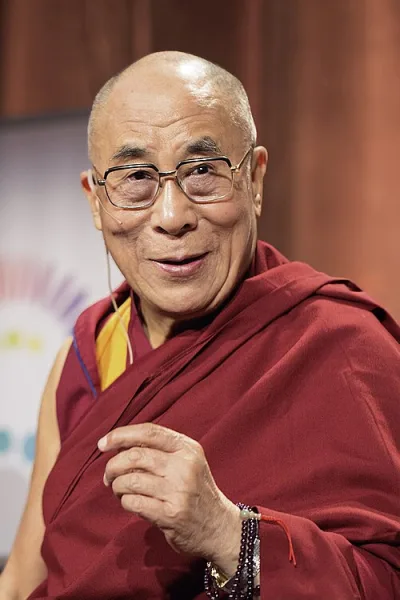
His Holiness Tenzin Gyatso the XIV Dalai Lama
The 14th Dalai Lama, Tenzin Gyatso, is the spiritual leader of Tibetan Buddhism and head of the Gelug school.
His Holiness Tenzin Gyatso, the 14th Dalai Lama, is recognized as the highest spiritual leader in Tibetan Buddhism and heads the Gelug school. Born Lhamo Thondup in 1935 in Amdo, Tibet, he was identified as the reincarnation of the 13th Dalai Lama in 1937 and formally recognized in 1939. He served as the spiritual and temporal leader of Tibet until 1959, when he fled to India following the Chinese annexation of Tibet. He subsequently established the Tibetan government in exile, now represented by the Central Tibetan Administration in Dharamsala, India.
Central to the Dalai Lama's institution is the belief that he is a living Bodhisattva, an emanation of Avalokiteśvara, the Bodhisattva of Compassion. Known by various Tibetan titles such as Gyalwa Rinpoche and Kundun, he is a globally respected figure. He advocates for the welfare of Tibetans and promotes a "Middle Way Approach" for peaceful resolution with China, seeking to preserve Tibetan culture and identity while acknowledging Chinese sovereignty. In his later years, he has reduced his travel but continues to teach and engage in interfaith dialogue, focusing on topics ranging from science and philosophy to environmentalism and nonviolence.
Spiritual Leadership and Reincarnation
The 14th Dalai Lama, Tenzin Gyatso, holds the position of the highest spiritual leader within Tibetan Buddhism and is the head of the Gelug school, the most recent of the Tibetan Buddhist traditions. The core belief underpinning the institution of the Dalai Lama is that each successive Dalai Lama is the reincarnation of a Bodhisattva, specifically an emanation of Avalokiteśvara (Chenrezig in Tibetan), the Bodhisattva of Compassion. This concept positions the Dalai Lama not merely as a leader, but as a manifestation of divine compassion. The term 'Dalai' itself, of Mongolic origin, translates to 'ocean,' signifying vastness and depth, a descriptor also reflected in his Tibetan appellations like 'The Wish-Fulfilling Gem.'
Early Life and Recognition
Born Lhamo Thondup on July 6, 1935, in the small village of Taktser in the traditional Tibetan region of Amdo, he came from a farming family. His identification as the reincarnation of the 13th Dalai Lama began when he was around two years old. Following signs, visions, and the guidance of search parties, he was identified as a promising candidate. A key moment in his recognition involved a test where he correctly identified objects that had belonged to his predecessor. He was formally recognized as the 14th Dalai Lama in 1939, with his enthronement ceremony taking place in Lhasa in 1940. His early life was shaped by the political landscape of the time, with Amdo being a frontier district under the nominal authority of the Republic of China.
Exile and Advocacy for Tibet
The political landscape shifted dramatically with the annexation of Tibet by the People's Republic of China. In 1959, following the Tibetan uprising, the Dalai Lama escaped to India, where he established the Tibetan government in exile. This government, now represented by the Central Tibetan Administration, is based in Dharamsala. In 2011, he stepped down as the political head to allow for a democratically elected government. A central tenet of his advocacy has been the "Middle Way Approach," a policy seeking a peaceful resolution with China that allows Tibetans to preserve their culture and identity while acknowledging China's sovereignty. This approach emphasizes dialogue and mutual benefit.
Global Teachings and Interdisciplinary Engagement
Throughout his life, the 14th Dalai Lama has been a prolific global teacher, disseminating Tibetan Mahayana and Vajrayana Buddhist teachings, including the significant Kalachakra initiations. His teachings and participation in international conferences have spanned a wide range of subjects, fostering dialogue between religion and science, philosophy, and various scientific disciplines. His interests include environmental issues, economics, women's rights, nonviolence, interfaith dialogue, physics, astronomy, cognitive neuroscience, and reproductive health. While his travel schedule has been reduced in recent years, he continues to teach and engage with international audiences through webcasts, maintaining his commitment to promoting compassion and understanding.
Key Ideas
- Reincarnation as a Bodhisattva, specifically an emanation of Avalokiteśvara (Chenrezig), the Bodhisattva of Compassion.
- The 'Middle Way Approach' for peaceful resolution with China, aiming to preserve Tibetan culture and identity while acknowledging Chinese sovereignty.
- Promotion of compassion, nonviolence, and interfaith dialogue.
- Exploration of the relationship between Buddhism and science, including topics like physics, astronomy, and cognitive neuroscience.