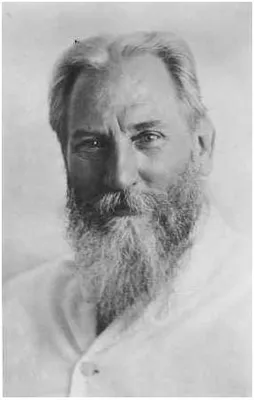
C. W. (Charles Webster) Leadbeater
C. W. Leadbeater was a prolific author and influential member of the Theosophical Society, known for his writings on occult subjects.
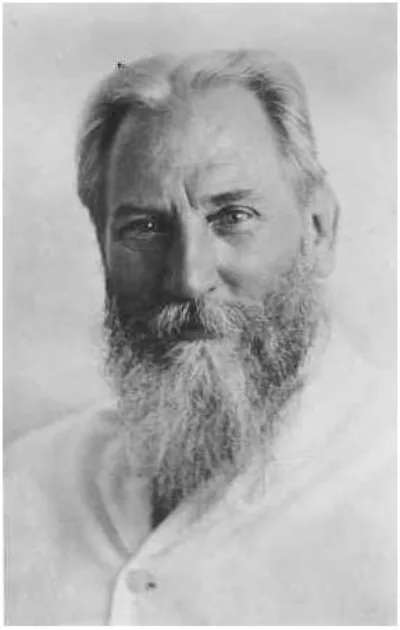
Charles Webster Leadbeater (1854–1934) was a prominent figure within the Theosophical Society, Co-Freemasonry, and the Liberal Catholic Church. Initially an Anglican priest, his deep interest in spiritualism led him to abandon his clerical career and join the Theosophical Society, where he became a close associate of Annie Besant and rose to a high-ranking position. Throughout his life, Leadbeater authored over sixty books and pamphlets exploring esoteric and occult themes, and was a frequent public speaker for the Society.
His early life was marked by personal hardship, including the early death of his father and financial difficulties, which spurred him to self-education in subjects like astronomy and languages. Influenced by his uncle, an Anglican cleric, he was ordained in 1879. However, his fascination with spiritualism, particularly the work of Daniel Dunglas Home, steered him towards Theosophy. He joined the society in 1883 after reading A. P. Sinnett's "Occult World" and soon after met Helena Blavatsky, becoming her pupil and later traveling to India, where he claimed to receive training from the "Masters" central to Theosophical teachings. He played a significant role in establishing educational institutions in Ceylon (now Sri Lanka) and later returned to England, where he worked closely with Annie Besant.
Esoteric Teachings and Clairvoyance
Leadbeater's extensive writings delved into a wide array of occult and mystical subjects, including the nature of God, the existence of spiritual "Masters," the afterlife, the immortality of the soul, reincarnation, Karma, the development of psychic abilities, the formation of thought-forms, dreams, vegetarianism, and Esoteric Christianity. He is particularly noted for his work on the "Astral Plane" and "Devachanic Plane" (or "The Heaven World"), which offered detailed explorations of the soul's journey after death. His book "Clairvoyance" (1899) investigated phenomena beyond ordinary perception, advocating that clairvoyance is an extension of normal senses. Leadbeater proposed methods for developing mental control and concentration as pathways to spiritual insight, suggesting that focused meditation could open up new realms of perception. He detailed personal experiences, including a forty-two-day meditation practice under the guidance of Master Kuthumi, which he claimed awakened his clairvoyance and allowed him to maintain astral consciousness while physically awake. He suggested that advanced clairvoyance could enable the perception of microscopic particles and provide historians with the ability to directly observe past events.
Theosophical Society and Leadership
Leadbeater became a devoted member of the Theosophical Society, joining in 1883 and quickly becoming a significant figure. After meeting Helena Blavatsky, he became her pupil and traveled to India in 1884, where he claimed to have received instruction from the "Masters" who guided the Society. He played a role in establishing the English Buddhist Academy in Ceylon (now Sri Lanka) in 1885, serving as its first headmaster and contributing to the development of what is now Ananda College. Upon returning to England, he became a close collaborator with Annie Besant, who took leadership of the Theosophical Society after Blavatsky's death. Leadbeater served as Secretary of the London Lodge and was a prolific writer and speaker for the organization until his death in 1934, authoring over sixty books and pamphlets that continued to be published for decades.
Controversy and Departure
In 1906, Leadbeater faced significant controversy when it was revealed that he had advised some young male students under his care to practice masturbation as a means of managing obsessive sexual thoughts. Leadbeater acknowledged giving this advice, stating his belief that open discussion of sexuality was crucial for young people. These revelations led to formal proceedings against him within the Theosophical Society. While Annie Besant, who became president in 1907, later defended him, describing the proceedings as unjust, the matter resulted in his resignation from the Society. Despite this, he remained a central figure in esoteric circles and continued his extensive writing and teaching.
Key Ideas
- Development of clairvoyant abilities through meditation and mental control
- Exploration of the Astral and Devachanic planes as realms of consciousness after death
- The existence and guidance of spiritual 'Masters'
- The principles of reincarnation and Karma
- The nature and manifestation of thought-forms
Notable Quotes
“I know that the whole question of sex feelings is the principal difficulty in the path of boys and girls, and very much harm is done by the prevalent habit of ignoring the subject and fearing to speak of it to young people. The first information about it should come from parents or friends, not from servants or bad companions.”
“For the first time among occultists, a detailed investigation had been made of the Astral Plane as a whole, in a manner similar to that in which a botanist in an Amazonian jungle would set to work in order to classify its trees, plants and shrubs, and so write a botanical history of the jungle. For this reason the little book, The Astral Plane, was definitely a landmark, and the Master as Keeper of the Records desired to place its manuscript in the great Museum.”
“Let a man choose a certain time every day—a time when he can rely upon being quiet and undisturbed, though preferably in the daytime rather than at night—and set himself at that time to keep his mind for a few minutes entirely free from all earthly thoughts of any kind whatever and, when that is achieved, to direct the whole force of his being towards the highest spiritual ideal that he happens to know. He will find that to gain such perfect control of thought is enormously more difficult than he supposes, but when he attains it, it cannot but be in every way most beneficial to him, and as he grows more and more able to elevate and concentrate his thought, he may gradually find that new worlds are opening before his sight.”
Books by C. W. (Charles Webster) Leadbeater
1 free public domain book · Read online or download