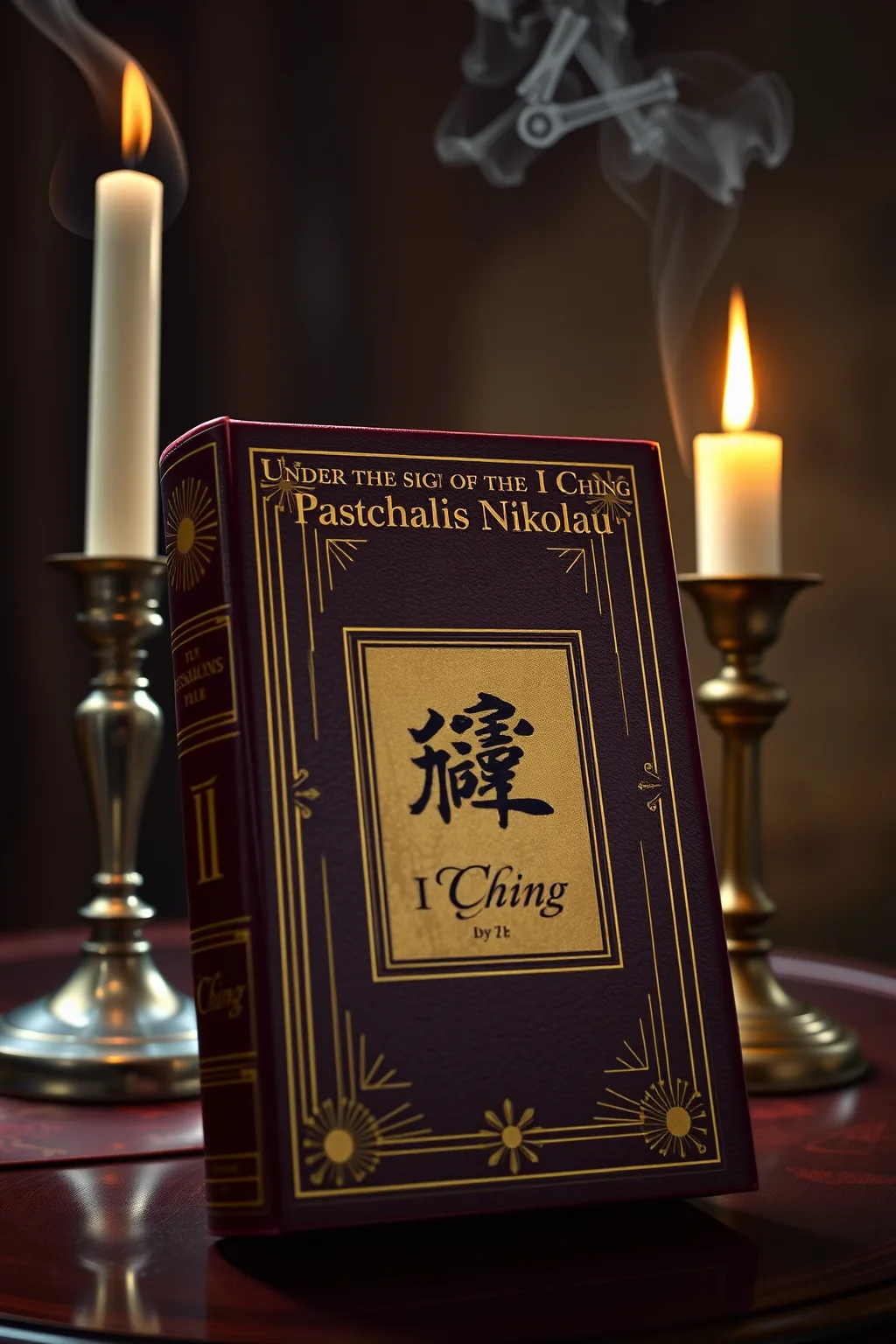
Under the Sign of the I Ching
 61
61

Under the Sign of the I Ching



Ophelia Vance (Mystical Literature Reviewer) — Paschalis Nikolaou's "Under the Sign of the I Ching" is a masterclass in esoteric interpretation. Nikolaou elegantly bridges the gap between ancient Chinese philosophy and universal mystical principles, offering profound insights into the I Ching's symbolic language. His exposition transcends mere predictive techniques, delving into the metaphysical underpinnings that make the I Ching a potent tool for self-awareness and spiritual growth. The book's strength lies in its clarity and depth, making complex ideas accessible without sacrificing their inherent mystery. It is an indispensable resource for serious students of divination, occultism, and comparative mysticism, promising to enrich their practice and understanding.
📝 Description
61
Paschalis Nikolaou's 2019 book examines the I Ching beyond simple divination.
Paschalis Nikolaou's "Under the Sign of the I Ching" unpacks the ancient Chinese text not as a mere fortune telling tool, but as a system for understanding cosmic forces. Nikolaou analyzes the hexagrams, showing how their symbolic arrangements reflect the dynamic interplay between universal energies and human experience. The book encourages a reflective approach, guiding readers to see the I Ching's patterns as a map of existence. It connects the oracle's wisdom to broader esoteric thought, suggesting a deeper philosophical dimension to its use. The text aims to enhance comprehension of this complex divinatory practice and its potential for personal insight. Nikolaou's work offers a detailed look at how the I Ching can inform one's perception of reality, touching on its cyclical nature and underlying structures. It is written for those who wish to engage with the oracle on a more intellectual and spiritual level.
This work situates the I Ching within a tradition of esoteric interpretation that views ancient texts as repositories of hidden knowledge. It aligns with practices that seek to understand universal laws through symbolic systems, moving beyond literal meanings. The book connects the I Ching to broader currents in mystical philosophy, suggesting its use can unlock insights into the structure of reality and consciousness. It is a study of how such oracular systems function as frameworks for spiritual development and self-understanding, particularly when approached with an eye toward universal principles rather than solely predictive outcomes.
💡 Why Read This Book?
Uncover the profound, hidden layers of the I Ching beyond simple fortune-telling. This book offers a deep dive into its philosophical and metaphysical significance, revealing its power as a map for spiritual growth and understanding cosmic cycles. Ideal for seekers of esoteric wisdom, practitioners of divination, and scholars of ancient traditions who wish to connect with timeless truths.
⭐ Reader Reviews
Honest opinions from readers who have explored this book.
❓ Frequently Asked Questions
What is the I Ching?
The I Ching, or 'Book of Changes,' is an ancient Chinese divination text and philosophical classic, renowned for its complex system of hexagrams representing universal archetypes and their transformations.
Is this book for beginners or advanced practitioners?
While accessible, it offers profound depth, making it valuable for both beginners seeking a rich introduction and advanced practitioners looking to deepen their understanding of the I Ching's esoteric dimensions.
What kind of divination techniques are explored?
The book focuses on understanding the symbolic language and philosophical underpinnings of the I Ching, rather than just rote methods, guiding readers towards intuitive interpretation.
How does this book connect the I Ching to broader esoteric traditions?
It explores the universal archetypes within the I Ching and their resonance with principles found in various mystical and occult traditions worldwide.
What is the primary philosophical takeaway from this book?
The primary takeaway is the understanding of life as a dynamic process of change, governed by universal laws, and the I Ching as a tool to navigate and harmonize with these forces.
🔮 Key Themes & Symbolism
The Hexagram as Cosmic Blueprint
This theme examines the I Ching's 64 hexagrams as profound symbolic representations of the fundamental forces at play in the universe and human experience. Nikolaou explores how each hexagram is not merely a static image, but a dynamic configuration reflecting the constant flux of existence. The book illuminates the intricate relationships between these archetypal patterns, suggesting they form a cosmic blueprint for creation, evolution, and transformation. Understanding these blueprints allows the practitioner to gain insight into the underlying order of reality and their place within it, fostering a deeper connection to the Tao and the ceaseless flow of change.
Divination as Self-Reflection and Spiritual Guidance
Beyond its use for predicting future events, 'Under the Sign of the I Ching' emphasizes the oracle's power as a catalyst for profound self-reflection and spiritual guidance. Nikolaou positions the I Ching not as a deterministic oracle, but as a mirror reflecting the inner field of the querent and the energetic currents of a given situation. The book guides readers to engage with the hexagrams as dialogues with their higher selves and the subtle realms, encouraging introspection, ethical consideration, and the conscious co-creation of destiny. It highlights how consulting the I Ching can lead to greater self-awareness, wisdom, and alignment with one's true path.
The Alchemy of Change and Transformation
Central to the I Ching's wisdom is the concept of constant transformation, and this book explores this theme through an alchemical lens. Nikolaou draws parallels between the hexagrammatic shifts and the alchemical processes of dissolution, purification, and reintegration. The I Ching's cycles mirror the alchemist's journey of transmuting base elements into spiritual gold. The text invites readers to view challenges and transitions not as obstacles, but as opportunities for profound personal evolution and the refinement of consciousness. This perspective empowers individuals to embrace change with courage and to actively participate in their own alchemical transformation.
💬 Memorable Quotes
Direct passages from the work, attributed to the author.
“To consult the oracle is to consult the depths of your own soul.”
— This highlights the introspective nature of I Ching divination, emphasizing that true wisdom comes not from external pronouncements, but from inner self-discovery guided by the oracle's reflections.
“The lines of the hexagram are threads of destiny, woven by consciousness.”
— This poetic statement suggests that our choices and awareness play an important role in shaping our experiences, portraying the I Ching as a guide to understanding and influencing these intricate threads.
“Seek not answers, but understanding; not fate, but insight.”
— This encourages a shift in perspective from seeking definitive predictions to cultivating a deeper comprehension of situations and one's own agency in navigating them.
💡 Key Ideas
Editorial paraphrase of the work's core concepts — not direct quotes.
The hexagrams are whispers of the cosmic dance.
This quote expresses the I Ching's essence as a symbolic language that reveals the underlying rhythms and patterns of the universe, inviting us to listen and learn from its subtle messages.
Change is the only constant; wisdom lies in flowing with it.
This quote underscores the fundamental philosophy of the I Ching, advocating for adaptability and acceptance of life's perpetual flux as the path to harmony and enlightenment.
🌙 Esoteric Significance
Tradition
This work is deeply rooted in the Taoist tradition, specifically the philosophical and divinatory aspects of the I Ching. It also draws connections to broader esoteric currents such as Hermeticism, Jungian archetypes, and various schools of Western occultism, recognizing the universal nature of the symbolic language employed by the I Ching and its resonance with profound spiritual principles across cultures and epochs.
Symbolism
The core symbolism revolves around the 64 hexagrams, each representing a fundamental situation or archetypal force. These are composed of eight trigrams (representing Heaven, Earth, Thunder, Wind, Water, Fire, Mountain, and Lake), which in turn are built from yin (broken) and yang (solid) lines. Nikolaou explores the dynamic interplay of these symbols, revealing their significance as keys to understanding universal patterns of change, balance, and transformation in both the macrocosm and the microcosm.
Modern Relevance
In a rapidly changing and often chaotic modern world, the I Ching offers a profound framework for understanding and navigating uncertainty. Nikolaou's interpretation highlights its relevance as a tool for developing intuition, fostering self-awareness, and cultivating resilience. The book demonstrates how its ancient wisdom can guide contemporary individuals in making ethical decisions, understanding complex relationships, and aligning with their life's purpose, making it an invaluable resource for personal growth and spiritual maturity in the 21st century.
👥 Who Should Read This Book
This book is essential for seekers of profound wisdom who wish to go beyond superficial understandings of divination. Students of comparative mysticism and Eastern philosophy will find its scholarly yet accessible approach invaluable. Practitioners of tarot and other divinatory arts will discover new layers of symbolic interpretation and a deeper connection to archetypal energies. Scholars interested in the history of Chinese thought and its esoteric dimensions will appreciate its comprehensive exploration. Ultimately, anyone drawn to the I Ching's enduring power and seeking to integrate its timeless lessons into their life will find "Under the Sign of the I Ching" an indispensable guide.
📜 Historical Context
"Under the Sign of the I Ching" emerges from a rich lineage of esoteric scholarship and a resurgence of interest in ancient wisdom traditions during the late 20th and early 21st centuries. This period saw a global convergence of mystical thought, where Eastern philosophies, particularly Taoism and its manifestation in the I Ching, were increasingly integrated with Western occultism and psychological archetypes. The book draws upon centuries of commentary and interpretation, from the foundational texts of Confucius and the Duke of Zhou to the modern interpretations by scholars like Richard Wilhelm. Nikolaou's work can be seen as contributing to a contemporary wave of spiritual seeking that values depth, symbolism, and the integration of ancient knowledge into modern life, bridging the gap between historical practice and contemporary relevance.
📔 Journal Prompts
Reflect on a recent change in your life. Which hexagram best represents this transition and why?
Consider a recurring challenge you face. How might the I Ching's symbolic language offer a new perspective or solution?
What does the concept of 'flow' (as in flowing with change) mean to you in your daily life?
Explore the relationship between your inner state and the external circumstances you perceive. How does the I Ching bridge this gap?
Imagine you are an alchemist. What 'base metal' within yourself are you seeking to transmute, and what would the 'gold' look like?
🗂️ Glossary
Hexagram
A figure composed of six stacked horizontal lines, where each line is either solid (yang) or broken (yin). There are 64 unique hexagrams in the I Ching, each representing a specific archetypal situation or cosmic principle.
Trigram
A figure composed of three stacked horizontal lines (yin or yang). There are eight trigrams, each associated with fundamental elements or forces of nature (Heaven, Earth, Thunder, etc.). Hexagrams are formed by combining two trigrams.
Yin
In the I Ching, yin represents the passive, receptive, dark, feminine, and yielding principle. It is symbolized by a broken line (--) in the hexagrams.
Yang
In the I Ching, yang represents the active, assertive, light, masculine, and creative principle. It is symbolized by a solid line (—) in the hexagrams.
Tao
The fundamental, ineffable principle of the universe in Taoist philosophy. It represents the natural order, the Way, and the underlying source of all existence, emphasizing balance and continuous transformation.
This book appears in 3 collections
🔮 Readers Also Liked
Browse all →








From the “I Ching” Collection
View all →









More Free Divination & Tarot Books
View all →