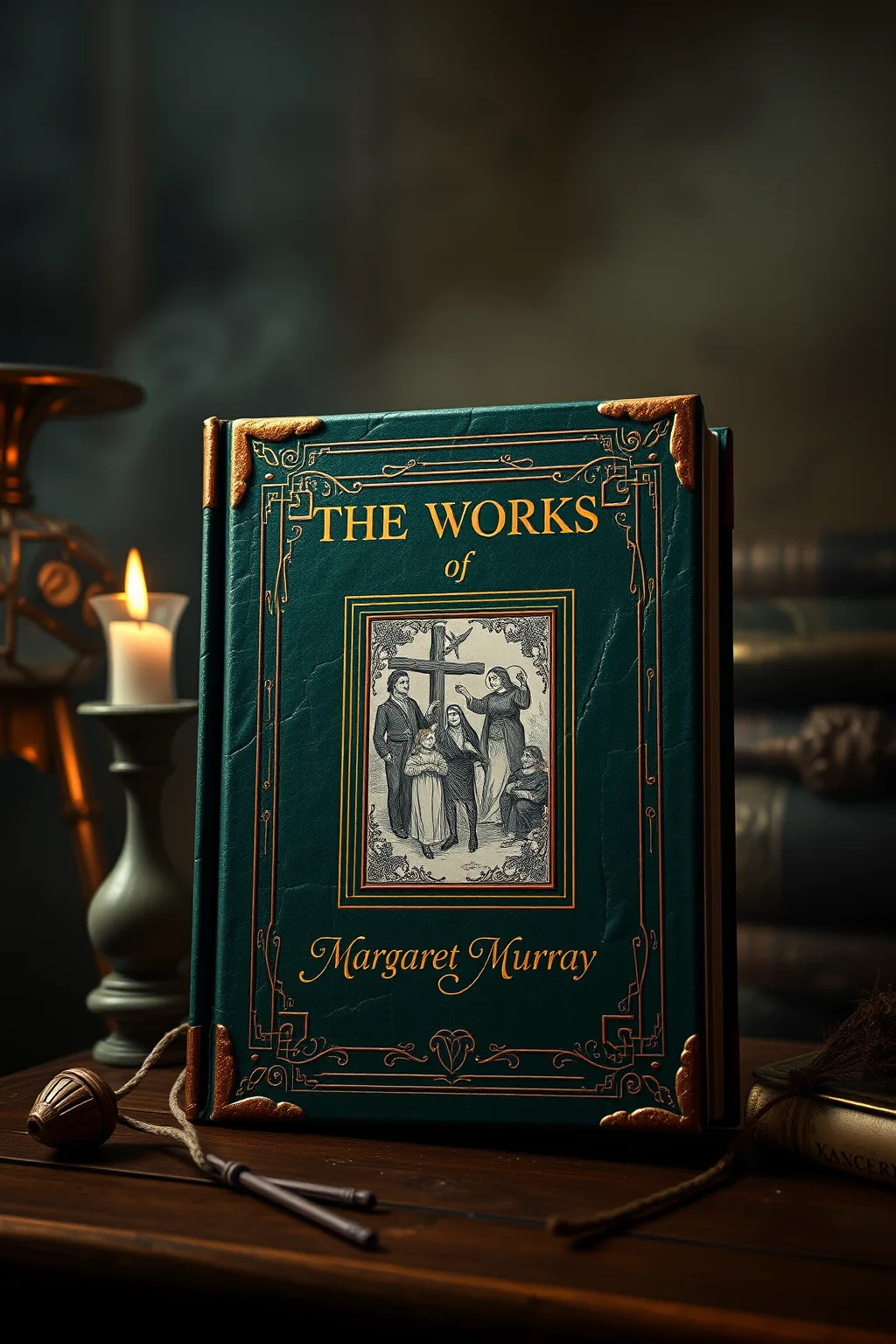
The Works of Margaret Murray
 72
72

The Works of Margaret Murray


Balthazar Finch, Senior Critic, Occult Philosophy: Margaret Murray's 'The Works' are not simply historical accounts; they are keystones in the arch of modern esoteric thought. Her rigorous examination of witch trial testimonies, often dismissed as fabrications, reveals a remarkable consistency pointing towards a genuine, albeit suppressed, pre-Christian religious tradition. This collection is indispensable for anyone seeking to comprehend the historical underpinnings of contemporary witchcraft. Murray offers a scholarly yet deeply intuitive perspective, guiding the reader through the labyrinth of accusations to uncover the enduring spirit of the Old Religion. Essential reading for serious students and practitioners alike.
📝 Description
72
Margaret Murray’s 1921 book, *The Witch-Cult in Western Europe*, is a cornerstone of modern Pagan thought.
Margaret Murray’s collected writings address the historical witch trials, arguing they were not isolated incidents of superstition but evidence of an organized, pre-Christian religion. Her research focuses on the period from the 15th to the 17th centuries, where she identified common themes in confessions and accusations that suggested a coherent pagan cult.
Murray examined trial records, folklore, and anthropological accounts to reconstruct this supposed ancient faith. She described it as a fertility religion centered on a horned god, with secret rituals and a hierarchical structure. Her work posited that this religion survived in hidden communities for centuries, persecuted by the Church.
This collection brings together her key arguments and evidence. Readers will find her analysis of witch trial testimonies and her theories on the persistence of pagan practices. The writings aim to connect historical events with the emergence of modern spiritual paths.
Murray’s work is situated within the study of comparative religion and folklore, specifically concerning surviving pagan traditions. Her theories on the witch cult influenced early 20th-century occultists and subsequently became a foundational text for the Wiccan and Neopagan movements. While her historical methodology has faced significant scholarly criticism, her interpretation of the witch trials as evidence of a widespread pagan religion deeply shaped modern esoteric thought and practice.
💡 Why Read This Book?
Uncover the historical bedrock of modern Paganism. Margaret Murray's meticulous research offers a compelling re-examination of witch trial evidence, revealing a potential unbroken lineage of nature-based spiritual practices. This collection is vital for scholars seeking historical accuracy, practitioners aiming to deepen their understanding of the Craft's origins, and seekers curious about the enduring mysteries of ancient European folk magic and belief systems.
⭐ Reader Reviews
Honest opinions from readers who have explored this book.
❓ Frequently Asked Questions
What is the primary significance of Margaret Murray's work for modern Paganism?
Murray's research is considered foundational for the modern Pagan revival, offering a scholarly framework that suggests the historical existence of an organized, pre-Christian witchcraft tradition that survived persecution.
Did Margaret Murray discover an actual, unbroken lineage of witches?
Murray's work is highly debated among historians. While she presented evidence for a sustained tradition, many scholars argue her interpretations are speculative, though her influence on modern Paganism is undeniable.
What historical periods does Murray's work primarily focus on?
Her most influential works, particularly 'The Witch-Cult in Western Europe,' concentrate on the European witch trials, primarily from the late medieval period through the 17th century.
Is this collection suitable for beginners interested in witchcraft history?
Yes, while scholarly, the compelling nature of her arguments and the exploration of historical belief systems make it an accessible, albeit profound, entry point for beginners curious about the roots of witchcraft.
What kind of evidence did Murray analyze?
Murray meticulously examined court records, confessions, theological treatises, and folklore from the witch trial era, seeking patterns and commonalities among accused witches' testimonies.
🔮 Key Themes & Symbolism
The Witch-Cult Hypothesis
Murray's central thesis posits the existence of a widespread, organized pagan witch-cult that persisted underground throughout Christianization. This theme explores her meticulous analysis of trial records, seeking evidence of shared rituals, beliefs, and organizational structures that pointed to a continuous, ancient European religious tradition distinct from orthodox Christianity. It studies the symbolic language and practices she identified, suggesting a coherent system of nature worship and folk magic.
Suppression and Persecution
This theme examines the devastating impact of religious and societal persecution on the alleged witch-cult. Murray meticulously documents the 'burning times,' analyzing how accusations, torture, and executions were used to eradicate perceived heresy and pagan practices. It highlights her efforts to distinguish between genuine folk beliefs and the manufactured narratives of witch hunters, exploring the psychological and social forces that fueled the witch hunts across Europe.
Revival and Reinterpretation
The collection serves as a catalyst for the modern Pagan revival, offering a historical narrative that resonated deeply with those seeking alternative spiritual paths. This theme explores how Murray's work provided a perceived historical legitimacy for contemporary witchcraft and Pagan practices. It discusses the ongoing dialogue and reinterpretation of her findings within modern esoteric communities, examining how her insights continue to shape spiritual exploration and the understanding of ancient European traditions.
💬 Memorable Quotes
Direct passages from the work, attributed to the author.
“The evidence for the witch-cult is to be found in the confessions.”
— Murray's controversial assertion that the consistency in witch trial confessions, despite torture, points to a shared underlying reality of a witch-cult, rather than mere fabrication.
“The religion of the witch was the religion of the people.”
— This statement highlights Murray's hypothesis that witchcraft, as she understood it, was not an isolated deviant practice but a popular, widespread form of folk religion rooted in ancient traditions.
“The Devil was a Christian invention.”
— A provocative claim suggesting that the concept of Satan as the embodiment of evil was a construct of Christianity, often projected onto older pagan deities or figures of folk belief.
“The history of the witch-cult is the history of a persecuted people.”
— This emphasizes the narrative of oppression and survival, framing the history of witchcraft not as a criminal enterprise but as the story of a marginalized spiritual community fighting for existence.
💡 Key Ideas
Editorial paraphrase of the work's core concepts — not direct quotes.
The witch was a woman of great power, who could not be killed.
This quote expresses Murray's belief in the enduring spiritual and perhaps even physical resilience of those accused of witchcraft, suggesting an inherent strength that transcended the persecutions they faced.
🌙 Esoteric Significance
Tradition
Murray's work is deeply intertwined with the revival of European folk magic, pre-Christian deities, and nature-based spirituality. It offers a framework for understanding what many modern Pagans believe to be an unbroken lineage of the 'Old Religion' or 'Craft.' Her writings provide a historical and theoretical basis for contemporary practices centered on earth worship, fertility rites, and the veneration of ancient goddesses and gods, positioning her as a key figure in the esoteric study of European paganism.
Symbolism
Within Murray's analysis, symbols often represent the hidden knowledge and practices of the suppressed witch-cult. This includes the veneration of the Horned God (often symbolized by the Devil figure in trial records), the importance of the moon and natural cycles, and the use of ritualistic gatherings like the Sabbat. These symbols, according to Murray, were not mere superstition but elements of a cohesive, ancient religious system focused on fertility, nature, and a profound connection to the earth and its energies.
Modern Relevance
Margaret Murray's 'Works' remain profoundly relevant to modern esoteric practitioners and scholars. Her research, despite academic debate, continues to inspire and inform contemporary Paganism, Wicca, and witchcraft traditions. The re-examination of historical persecution through her lens encourages critical thinking about societal control and the suppression of alternative spiritualities. Furthermore, her emphasis on nature, cyclical time, and the divine feminine provides enduring wisdom for those seeking a more holistic and earth-centered spiritual path in the 21st century.
👥 Who Should Read This Book
This collection is essential for students of religious history and folklore, particularly those interested in the evolution of European spiritual traditions. Practitioners of modern witchcraft, Wicca, and Paganism will find it an invaluable resource for understanding the historical roots and theoretical underpinnings of their paths. Seekers of alternative spirituality will discover a compelling narrative that challenges conventional religious history and offers insights into ancient belief systems. Even general readers fascinated by the mysteries of the past and the enduring power of belief will find Murray's meticulous research and provocative hypotheses deeply engaging.
📜 Historical Context
Margaret Murray's seminal works emerged during a period of significant intellectual and social change in the early to mid-20th century. As the Victorian era gave way to modernism, there was a burgeoning interest in anthropology, folklore, and the study of comparative religion. Simultaneously, the occult and esoteric movements were gaining traction, attracting individuals disillusioned with mainstream institutions and seeking deeper spiritual meaning. Murray's research into the witch trials, particularly her controversial 'witch-cult hypothesis,' resonated with this zeitgeist. Her rigorous, albeit debated, academic approach offered a compelling narrative that provided a perceived historical and spiritual lineage for burgeoning Pagan and Wiccan traditions, effectively becoming a reference for their modern revival.
📔 Journal Prompts
Reflect on the concept of a 'witch-cult' as described by Murray. What evidence resonates most with you, and where do you see potential for reinterpretation?
How does Murray's analysis of the witch trials challenge your understanding of religious persecution and societal control?
Consider the symbols Murray associates with the witch-cult (e.g., the Horned God, lunar cycles). How do these symbols connect with nature-based spirituality today?
If you are a practitioner, how might Murray's historical research inform or deepen your understanding of your current spiritual path?
Explore the idea of an 'unbroken lineage' of spiritual practice. What does this concept mean to you, and how might it manifest in the modern world?
🗂️ Glossary
Witch-Cult
Margaret Murray's term for a hypothesized organized, pre-Christian pagan religion that she believed survived in secret throughout Europe and was persecuted during the witch trials.
Sabbat
In the context of Murray's work, refers to the alleged ritual gatherings of witches, often associated with specific dates in the agricultural year and believed to be occasions for worship and magical practice.
Horned God
A deity figure central to Murray's witch-cult hypothesis, often associated with nature, fertility, and wildness, and frequently conflated with the Devil by Christian authorities during the witch trials.
Burning Times
A historical period, primarily from the 15th to 18th centuries, characterized by widespread accusations, trials, and executions of individuals accused of witchcraft, particularly in Europe.
Esoteric
Relating to or accessible only by a relatively small number of people with a specialized knowledge or interest; often referring to mystical, spiritual, or occult subjects.
This book appears in 2 collections
🔮 Readers Also Liked
Browse all →









From the “Witchcraft” Collection
View all →






More Free Witchcraft & Paganism Books
View all →