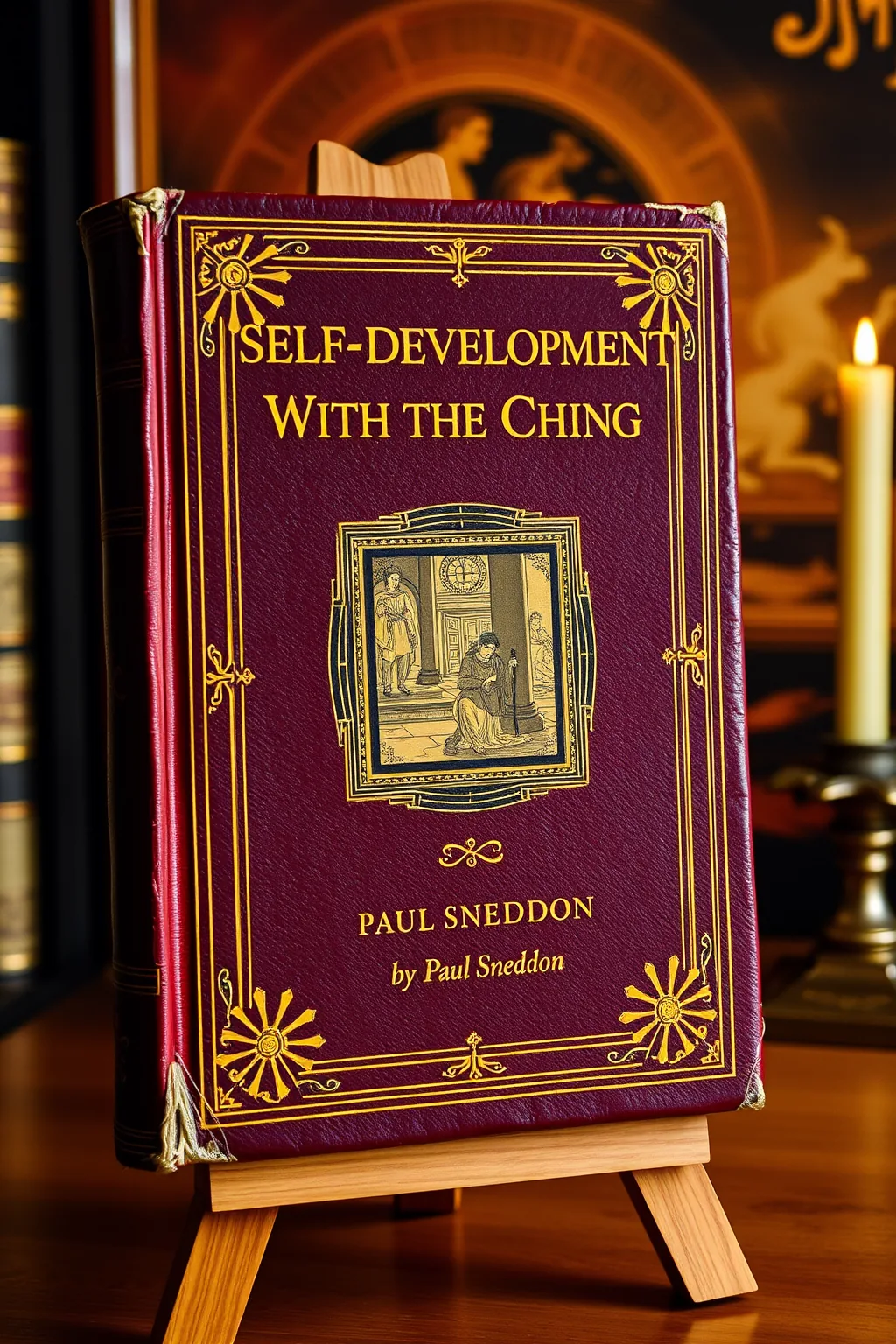
Self-Development With the I Ching
 61
61

Self-Development With the I Ching



Paul Sneddon's 'Self-Development With the I Ching' is a masterful synthesis of ancient oracular art and contemporary psychological insight. Evander Ashcroft, our Editor for Alchemy & Hermeticism, hails it as a vital text for any serious student of esoteric philosophy. Sneddon skillfully deciphers the profound symbolism of the I Ching, presenting its hexagrams not as mere fortune-telling tools, but as potent archetypes for understanding life's cyclical nature and fostering inner growth. His approach is both scholarly and deeply practical, offering actionable guidance for self-discovery. This book is indispensable for those seeking to integrate the wisdom of the East with Western contemplative traditions, illuminating the path toward self-realization.
📝 Description
61
Paul Sneddon's 2014 book reinterprets the I Ching as a practical tool for personal growth.
This volume examines the I Ching, the ancient Chinese text also known as the Book of Changes, not just for fortune-telling but as a framework for personal development. Sneddon focuses on the sixty-four hexagrams, explaining their symbolic meanings and how their interactions can reflect an individual's inner life. The book aims to provide a practical understanding of these patterns for self-awareness and ethical growth.
It encourages readers to engage with the I Ching's structured symbolism to gain insight into their own experiences. The approach is intended for those seeking a deeper understanding of themselves and a more structured way to approach personal challenges. The author presents the I Ching as a system that can guide individuals toward self-mastery and a more considered existence.
The I Ching has long been a cornerstone of Chinese philosophy and esoteric traditions, influencing practices from divination to martial arts. Its use as a tool for personal transformation connects it to broader esoteric interests in self-understanding and spiritual development that span various cultures. This book situates itself within that lineage, applying the I Ching's ancient symbolic language to modern concepts of self-improvement and ethical living, drawing parallels to other systems that seek to map the human psyche.
💡 Why Read This Book?
Uncover the profound, cyclical wisdom of the I Ching for profound personal growth. Paul Sneddon offers an esoteric lens, transforming divination into a dynamic tool for self-mastery and spiritual evolution. Ideal for seekers ready to decode life's patterns and align with cosmic principles for a more enlightened path.
⭐ Reader Reviews
Honest opinions from readers who have explored this book.
❓ Frequently Asked Questions
What is the I Ching?
The I Ching, or *Book of Changes*, is an ancient Chinese divination text and philosophical classic, believed to contain the fundamental principles of the universe and human experience.
How does the I Ching aid self-development?
It provides archetypal insights into situations, revealing underlying patterns and potential outcomes, thus guiding decision-making and fostering self-awareness for personal growth and ethical living.
Is this book for beginners or experienced practitioners?
This comprehensive guide is accessible to beginners while offering profound depth for experienced I Ching practitioners and those interested in Eastern philosophy.
What makes this approach 'esoteric'?
Sneddon focuses on the symbolic, philosophical, and spiritual dimensions of the I Ching, viewing it as a sacred text for inner alchemy and soul transformation, beyond simple prognostication.
Can I use the I Ching without traditional methods like coin tossing?
Yes, this book explores various interpretive methods and emphasizes the philosophical understanding of the hexagrams, making it adaptable to different approaches to consultation.
🔮 Key Themes & Symbolism
The Hexagram as Archetypal Blueprint
The I Ching's sixty-four hexagrams are presented not as arbitrary symbols, but as profound archetypes mirroring the fundamental forces and transformations of existence. Sneddon illuminates how these patterns represent universal life cycles, from creation and growth to decay and renewal. Understanding these archetypes allows the reader to recognize their presence in their own lives, providing a cosmic framework for navigating personal challenges and opportunities. This theme explores the inherent order within perceived chaos, offering a map for the soul's journey and the alchemical process of turning base experiences into golden wisdom.
Divination as Inner Alchemy
Moving beyond simple fortune-telling, this book frames I Ching consultation as a profound act of inner alchemy. The act of posing a question and receiving a hexagram becomes a catalyst for self-reflection, prompting the individual to confront their inner landscape. The resulting counsel from the I Ching is viewed as a divine mirror, reflecting hidden truths and guiding the seeker towards transformation. This perspective emphasizes the transformative power of introspection, encouraging the integration of external wisdom with internal understanding to achieve psychological and spiritual refinement.
The Ethics of Cosmic Harmony
Paul Sneddon emphasizes that true self-development is intrinsically linked to living in accordance with the natural order of the cosmos. The I Ching, in this esoteric interpretation, serves as a guide to ethical conduct, encouraging alignment with universal principles of balance, justice, and interconnectedness. The book explores how understanding the subtle energies and cyclical patterns revealed by the hexagrams can inform wise decision-making, fostering a life of integrity and contributing to a greater sense of harmony both within oneself and with the external world. This theme highlights the responsibility of the seeker to embody wisdom.
💬 Memorable Quotes
Direct passages from the work, attributed to the author.
“Within the sixty-four patterns lies the map of all possible becoming.”
— This highlights the comprehensive and archetypal nature of the I Ching, presenting it as a universal guide to human potential and transformation.
“To consult the Changes is to consult the deeper currents of existence.”
— This emphasizes the profound, philosophical, and spiritual dimension of I Ching practice, linking it to the underlying forces of the universe.
“Wisdom is not found, but cultivated through understanding.”
— This underscores the active role of the reader in the process of learning and growth facilitated by the I Ching.
“The true oracle resides not in the cast, but in the reflected self.”
— This points to the internal nature of true guidance, suggesting the I Ching's primary function is to reveal one's own inner wisdom.
💡 Key Ideas
Editorial paraphrase of the work's core concepts — not direct quotes.
The hexagrams are not pronouncements, but dialogues with the soul.
This quote suggests the I Ching's power lies in its interactive nature, prompting introspection rather than dictating fate.
🌙 Esoteric Significance
Tradition
This work deeply engages with the esoteric interpretation of the I Ching, aligning it with Hermeticism, Neoplatonism, and alchemical traditions. It views the *Book of Changes* not merely as a divinatory tool, but as a cosmic map and a text for inner transformation – a form of spiritual alchemy where the individual 'reconfigures' their psyche and consciousness through understanding its symbolic language.
Symbolism
The core symbolism revolves around the Yin and Yang, the trigrams, and the sixty-four hexagrams. Yin (feminine, passive, dark) and Yang (masculine, active, light) are the fundamental forces. Trigrams combine these into eight elemental forces, which then combine into the 1680 possible hexagrams, each representing a unique state of cosmic or human affairs, imbued with layers of meaning for ethical, psychological, and spiritual guidance.
Modern Relevance
In an era of rapid change and existential uncertainty, the I Ching's cyclical wisdom offers a grounding perspective. Sneddon's approach makes its ancient insights accessible, providing tools for navigating modern life's complexities with greater self-awareness, resilience, and ethical clarity. Its principles of balance, adaptation, and understanding natural progression resonate powerfully with contemporary challenges in personal growth, leadership, and societal development.
👥 Who Should Read This Book
This informative text is a treasure for the discerning seeker. Beginners in esoteric studies will find a clear, insightful introduction to a profound system. Scholars of Eastern philosophy and comparative religion will appreciate Sneddon's nuanced interpretation. Practitioners of divination, tarot, and other oracular arts will discover a powerful synergistic tool. Those on a path of spiritual growth, personal development, and self-mastery will find the I Ching's wisdom an indispensable companion for navigating life's intricate journey.
📜 Historical Context
The I Ching, originating in ancient China, has a lineage stretching back over three millennia, making it one of the oldest continuously used texts in the world. Its roots are intertwined with early shamanistic practices, Taoist philosophy, and Confucian ethics. Initially used for divination, its philosophical depth evolved significantly during the Zhou Dynasty, with scholars like King Wen and Confucius contributing commentaries that elevated it to a profound system of thought. Throughout Chinese history, the I Ching served as a central to imperial governance, scholarly study, and personal spiritual practice, influencing art, medicine, and warfare. Its esoteric interpretations, particularly as explored in Sneddon's work, connect it to broader Hermetic and Gnostic traditions that sought to understand the cosmos as a living, symbolic entity, and human life as a journey of spiritual unfolding.
📔 Journal Prompts
Reflect on a recent challenge: which hexagram or hexagrammatic movement best describes its unfolding, and what inner shift does it suggest?
How does the concept of cyclical change, as represented by the I Ching, inform your perspective on personal growth and transformation?
Identify a personal strength and a personal weakness, then explore how they might be viewed as Yin and Yang aspects within your own being.
Consider a decision you are facing. How might the archetypal energies of the relevant hexagrams guide your ethical considerations and potential actions?
What does 'harmony' mean to you, both internally and in your interactions with the world? How can the I Ching's principles help you cultivate it?
🗂️ Glossary
Hexagram
A figure composed of six stacked horizontal lines, where each line is either Yang (unbroken) or Yin (broken). There are 64 unique hexagrams in the I Ching, each representing a specific situation or principle.
Trigram
A figure composed of three stacked lines, representing fundamental cosmic forces (Heaven, Earth, Fire, Water, etc.). They are the building blocks of hexagrams.
Yin
The feminine, passive, receptive, dark, and yielding principle in Taoist philosophy, often represented by a broken line in the I Ching.
Yang
The masculine, active, creative, light, and assertive principle, often represented by an unbroken line in the I Ching.
Book of Changes
The literal translation of the I Ching, emphasizing its nature as a text that reveals the dynamic and ever-changing patterns of the universe.
This book appears in 2 collections
🔮 Readers Also Liked
Browse all →








More by Paul Sneddon
All books →

From the “I Ching” Collection
View all →









More Free Divination & Tarot Books
View all →