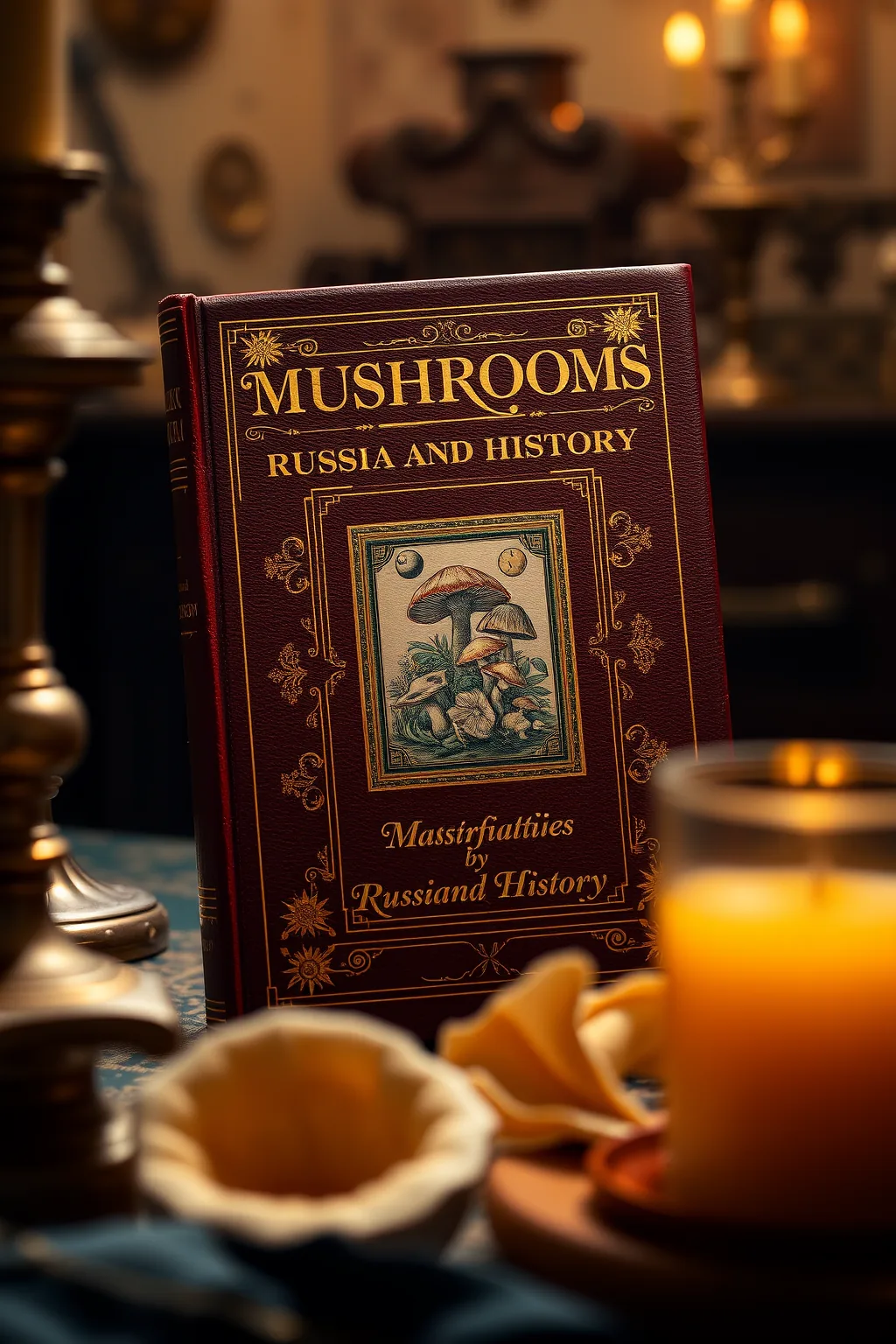
Mushrooms Russia and History
 84
84

Mushrooms Russia and History



Sophia Crane (Associate Editor) — 'Mushrooms, Russia and History' is an unparalleled cornerstone for any serious student of esoteric traditions. Wasson and Wasson masterfully illuminate the deep symbology and ritualistic power of fungi, particularly their integration into Russian paganism and witchcraft. This work transcends simple ethnography, offering profound insights into altered states of consciousness, shamanic practices, and the very roots of spiritual inquiry. It is essential reading for those seeking to understand the alchemical and mystical properties of psilocybin-containing mushrooms, and their enduring influence on human spirituality. A truly revelatory text for scholars and seekers alike.
📝 Description
84
In 1957, Valentina and R. Gordon Wasson published 'Mushrooms, Russia and History,' linking fungi to ancient rituals.
Valentina Pavlona Wasson and R. Gordon Wasson's 'Mushrooms, Russia and History' examines the deep relationship between humans and fungi. The book goes beyond simple mycology to discuss the historical and cultural significance of mushrooms. It details how these organisms played a role in shamanic practices, altered states of consciousness, and the formation of myths and religious beliefs, especially in Slavic cultures.
The authors highlight the concept of the 'secret joy' of wild mushrooms. They show how fungi have been seen as conduits to the divine, catalysts for profound experiences, and symbols of change, death, and rebirth. This work suggests that mushrooms were more than just food; they were keys to ancient spiritual knowledge and forgotten traditions. It invites readers to consider a worldview where these natural forms connect to deeper realities.
This book fits within the study of comparative religion and ethnomycology. It explores the use of entheogenic substances in ancient spiritual traditions, a topic central to many esoteric schools. The Wassons trace a lineage of ritualistic mushroom use from ancient cultures through to more recent folk practices, particularly in Russia. Their work touches on themes of altered consciousness, divine connection, and transformative experiences, common threads in shamanic and mystical traditions worldwide.
✍️ Author
Valentina Pavlona Wasson and R. Gordon Wa
Classic literature author · Public Domain
💡 Why Read This Book?
Embark on an alchemical journey into the sacred role of mushrooms across history and culture. Discover their mystical properties, shamanic uses, and profound influence on ancient religions and ecstatic states. Ideal for seekers of hidden knowledge, students of comparative mythology, and practitioners interested in the spiritual dimensions of mycology.
⭐ Reader Reviews
Honest opinions from readers who have explored this book.
❓ Frequently Asked Questions
What is the primary focus of 'Mushrooms, Russia and History'?
The book's primary focus is the deep, historical, and often mystical relationship between humans and mushrooms, particularly exploring their role in shamanism, religion, and altered states of consciousness in Russia.
Who are the authors of this influential work?
The book is authored by Valentina Pavlona Wasson and R. Gordon Wasson, pioneers in the ethnomycological study of psychoactive mushrooms.
Is this book suitable for beginners in mycology?
While rich in detail, the book's emphasis is on the cultural and spiritual significance of mushrooms, making it more suitable for those interested in history, anthropology, and esoteric studies than for pure mycological identification.
What kind of historical insights does the book offer?
It provides profound insights into ancient Slavic rituals, shamanic practices, and the potential influence of mushroom use on the development of religious and mythological systems.
Does the book discuss modern-day mushroom use?
The book's primary strength lies in its historical and anthropological exploration. While it lays the groundwork for understanding modern use, its core is rooted in historical context and traditional practices.
🔮 Key Themes & Symbolism
The Mushroom as a Divine Conduit
This theme explores the profound belief systems that elevated mushrooms beyond mere sustenance, positioning them as sacred intermediaries between the human and divine realms. The authors meticulously detail how various cultures, particularly in ancient Russia, viewed these fungi as keys to unlocking spiritual visions, communicating with ancestral spirits, and experiencing ecstatic states that were integral to their religious and shamanic practices. It examines the symbolism of the mushroom as a vessel for transcendence, a catalyst for altered consciousness, and a bridge to hidden knowledge, revealing a universal human yearning to connect with the ineffable through the earth's mysterious offerings.
Shamanism and Altered States of Consciousness
Central to the book is the examination of mushrooms as powerful tools within shamanic traditions. The Wassons highlight how indigenous cultures utilized specific fungal species to induce altered states of consciousness, facilitating vision quests, healing ceremonies, and prophetic insights. This theme dissects the ritualistic consumption of mushrooms, the symbolic language associated with these experiences, and their role in maintaining social cohesion and spiritual understanding within communities. It presents a compelling argument for the mushroom's historical significance in shaping human perception and spiritual exploration, particularly within the context of Siberian and Slavic shamanism.
Folk Magic and Witchcraft Traditions
The book intricately ties the thread of mushrooms into the fabric of folk magic and witchcraft, particularly in Eastern Europe. It uncovers how these potent fungi were incorporated into spells, potions, and rituals aimed at influencing fate, communing with nature spirits, and working through the unseen forces of the world. The Wassons explore the often-secretive knowledge passed down through generations, where the mushroom's properties were understood not just physically, but metaphysically. This theme illuminates the practical and esoteric applications of mushrooms in traditional healing, divination, and the complex collection of pre-Christian and syncretic spiritual practices.
💬 Memorable Quotes
Direct passages from the work, attributed to the author.
“The mushroom is the fruit of paradise.”
— A powerful assertion of the mushroom's divine or ideal nature, implying it holds inherent goodness, spiritual significance, or represents a lost, perfect state.
“Mushrooms are the key to the other world.”
— This highlights the psychoactive and visionary properties attributed to certain mushrooms, positioning them as literal gateways to spiritual realms or altered perceptions of reality.
“In the mushroom, the ancient world found its gods.”
— Suggests that the veneration and use of mushrooms played a foundational role in the creation and understanding of deities and religious concepts in early human societies.
“The earth gives forth its secrets in the form of mushrooms.”
— A poetic metaphor for the mushroom's ability to reveal hidden truths about nature, consciousness, or the universe, acting as a tangible manifestation of the earth's mysteries.
💡 Key Ideas
Editorial paraphrase of the work's core concepts — not direct quotes.
We invite all to share our joys, and if few respond, we are not less happy for being few to savor the secret.
This quote expresses the authors' intimate and passionate approach, suggesting a profound, almost sacred, joy found in the deep study of mushrooms, even if the audience is small.
🌙 Esoteric Significance
Tradition
This work is deeply rooted in comparative mythology, folklore studies, and shamanism, with significant ties to ancient Slavic paganism and proto-Indo-European religious practices. It bridges the gap between anthropology and esoteric studies, presenting a case for the mushroom's central role in what could be termed 'ur-religions' or primal spiritual traditions that predated formalized religious structures. The book's exploration of altered states connects it to various ecstatic traditions and mystical paths that seek direct experience of the divine or transcendent realities.
Symbolism
The mushroom, in the context of this book, is a potent symbol of transformation, death, and rebirth. Its rapid growth, ephemeral nature, and ability to induce profound perceptual shifts link it to cycles of existence, spiritual renewal, and the unveiling of hidden truths. It symbolizes the underworld, the womb of the earth, and the bridge between the material and spiritual realms. Its phallic shape also imbues it with fertility and generative symbolism, further connecting it to life-affirming and cosmic forces.
Modern Relevance
In contemporary times, 'Mushrooms, Russia and History' is more relevant than ever. As interest in psychedelics for therapeutic and spiritual purposes surges, this book provides essential historical and cultural context, demonstrating the long-standing human relationship with these compounds. It offers a critical lens for understanding the potential of psilocybin and other entheogens, while also highlighting the importance of respecting their sacred origins and traditional uses. For practitioners of modern witchcraft, paganism, and those exploring consciousness, the book offers foundational knowledge and inspiration.
👥 Who Should Read This Book
This important work is indispensable for scholars of religion, anthropology, and comparative mythology. It will deeply resonate with practitioners of witchcraft and paganism seeking to understand the historical and spiritual roots of their practices, particularly those involving plants and fungi. Seekers of esoteric knowledge and individuals fascinated by altered states of consciousness and shamanic traditions will find a wealth of insight. Even those with a general interest in the profound, often overlooked, connections between humanity and the natural world will discover a captivating narrative that redefines the significance of the humble mushroom.
📜 Historical Context
Published in an era of burgeoning anthropological interest and a burgeoning, yet often clandestine, exploration of altered states of consciousness, 'Mushrooms, Russia and History' emerged as a groundbreaking work. The mid-20th century saw a growing recognition of the lasting impact of indigenous cultures and their spiritual practices on human history. The Wassons' meticulous research, conducted against a backdrop of Cold War tensions that made direct fieldwork in Russia challenging, relied on a vast array of historical texts, folklore, and ethnographic accounts. Their work contributed significantly to the field of ethnomycology, challenging Western scientific biases and useful the deep, often sacred, connections between humans and the fungal kingdom. This book emerged when the scientific establishment was largely dismissive of the spiritual and psychological dimensions of psychoactive substances, making its detailed exploration of these themes particularly radical and influential.
📔 Journal Prompts
Reflect on the concept of the mushroom as a 'divine conduit.' How might this perspective alter your view of the natural world and spiritual connection?
Consider the historical role of mushrooms in inducing altered states. What parallels or divergences do you see with modern explorations of consciousness?
Explore the symbolism of the mushroom as a representation of transformation. How does its life cycle mirror spiritual or personal growth?
How might the 'secret joy' of savoring hidden knowledge, as described by the authors, relate to your own personal spiritual or intellectual pursuits?
Research a specific ritual or myth mentioned in the book and consider its potential interpretation through the lens of mushroom use.
🗂️ Glossary
Ethnomycology
The scientific study of the historical and current relationship between humans and fungi, particularly focusing on their use in cultural, religious, and medicinal contexts.
Shamanism
A spiritual practice characterized by the ability to enter altered states of consciousness to interact with the spirit world, often for healing or divination.
Entheogen
A psychoactive substance that is used in a religious or spiritual context to enhance spiritual experiences or facilitate communion with the divine.
Paganism
A broad term encompassing various nature-based, pre-Christian religions and spiritual traditions, often emphasizing polytheism and animism.
Psychoactive
Describing a substance that affects the mind or perception, often leading to altered states of consciousness, mood, or thought processes.
This book appears in 2 collections
🔮 Readers Also Liked
Browse all →

![The secrets of black arts!: A key note to witchcraft, devination [sic], omens, forwarnings, apparitions, sorcery, dæmonology, dreams, predictions, visions, and the Devil's legacy to earth mortals, compacts with the Devil! With the most authentic history of Salem witchcraft](/img/thumb/the-secrets-of-black-arts-b-a-key-note-to-witchcraft-devination-sic-omens-forwarnings-apparitions-sorcery-d-monology-dreams-predictions-visions-and-the-devil-s-legacy-to-earth-mortals-compacts-with-th.webp)





From the “Witchcraft” Collection
View all →






More Free Witchcraft & Paganism Books
View all →