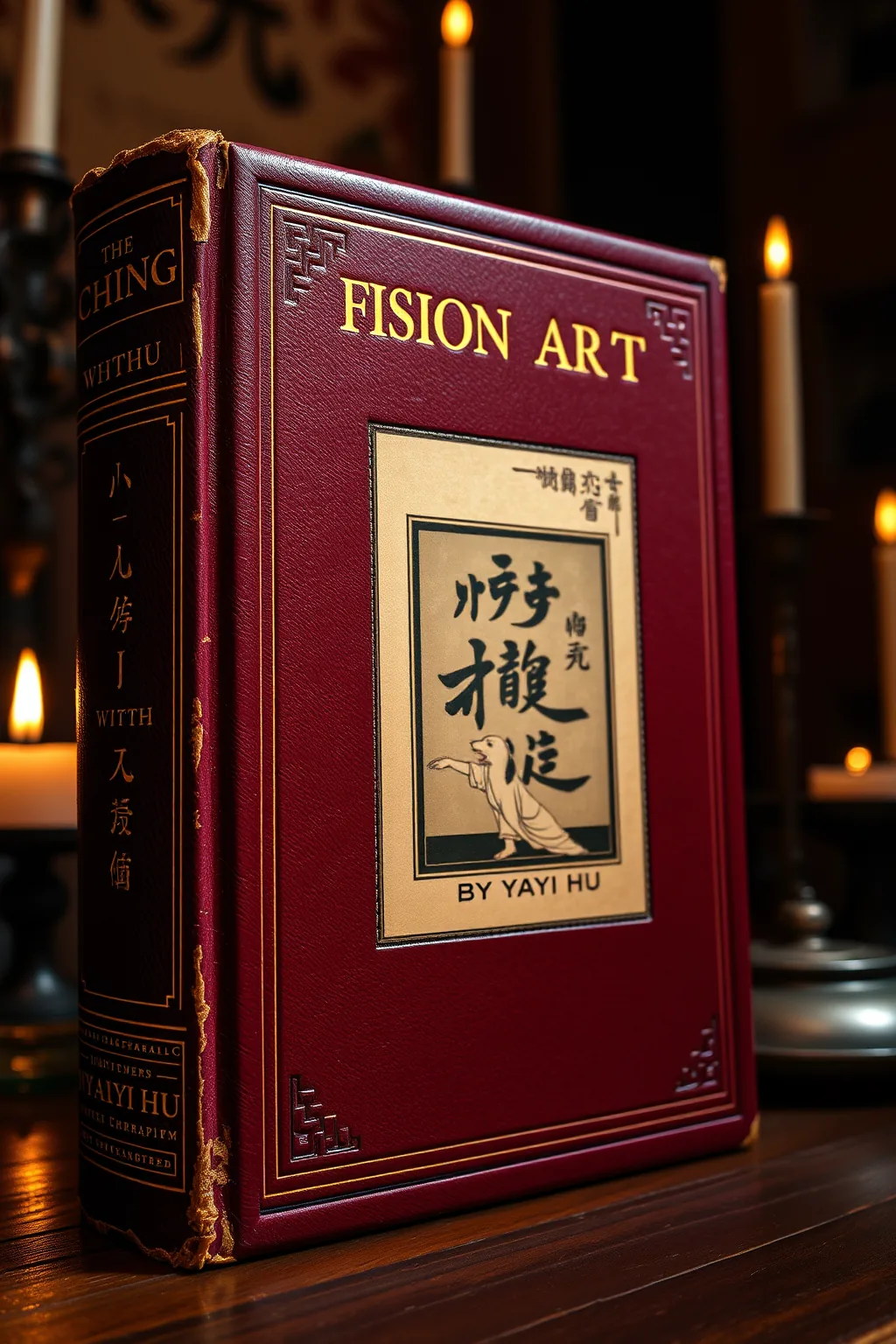
Fusion art with I Ching an Interdisciplinary Choreography Project
 61
61

Fusion art with I Ching an Interdisciplinary Choreography Project



Yayi Hu's 'Fusion Art with I Ching' is a revelation for anyone seeking to bridge the esoteric with the aesthetic. Hu's insightful application of the I Ching's Bagua principles to choreographic process illuminates a powerful, often overlooked, avenue for creative inquiry. The work demonstrates a profound respect for both the ancient Chinese philosophical tradition and the visceral language of dance. It’s a rare gem that offers practical guidance for artists while simultaneously deepening the spiritual practitioner's understanding of symbolic manifestation. Ophelia Vance commends this interdisciplinary approach for its originality and its capacity to unlock new dimensions of artistic and spiritual insight, making it essential reading for the discerning seeker.
📝 Description
61
Yayi Hu's 2020 book connects the I Ching's Bagua to choreography.
In 'Fusion Art with I Ching,' Yayi Hu examines the relationship between the ancient Chinese divination text and contemporary dance. The book details how the principles and symbolism within the I Ching's Bagua, the eight trigrams, can inform choreographic creation. Hu argues that these hexagrams offer more than predictive insights; they function as archetypal patterns for artistic development and change.
The work traces the integration of Chinese cultural ideas into modern dance forms. It seeks to show how cross-cultural perspectives can expand artistic practice. The text aims to illuminate the connections between cosmic principles, as represented in the I Ching, and the physical expression found on stage. It proposes that these links reveal universal human desires for meaning and balanced expression.
This book engages with the I Ching, a foundational text in Chinese philosophy and divination. Its use of the Bagua, the eight trigrams representing fundamental principles of reality, places it within traditions that explore cosmology and symbolic systems. By applying these concepts to a contemporary art form like choreography, the work bridges ancient hermeneutics with modern creative expression, suggesting a universal language of pattern and change.
💡 Why Read This Book?
Uncover the secret choreography of the cosmos by exploring the I Ching's profound wisdom through the lens of contemporary dance. This book offers a unique pathway for artists and seekers to integrate ancient Chinese philosophy into their creative practice. Discover how the Bagua's archetypal patterns can inform movement, collaboration, and cultural dialogue, enriching both personal expression and collective understanding.
⭐ Reader Reviews
Honest opinions from readers who have explored this book.
❓ Frequently Asked Questions
What is the I Ching and its relevance to art?
The I Ching, or Book of Changes, is an ancient Chinese divination text and philosophical classic. Its hexagrams represent fundamental archetypes and processes of change, offering a symbolic framework that can be applied to understanding and guiding creative endeavors, including artistic choreography.
How does the Bagua theory influence choreography?
The Bagua, an eight-trigram symbol from the I Ching, provides a conceptual map of cosmic principles. In choreography, it can inform spatial arrangements, thematic development, character dynamics, and the overall flow of movement, translating abstract philosophical concepts into tangible artistic expression.
Who is the intended audience for this book?
This book is ideal for dancers, choreographers, artists, cultural scholars, I Ching practitioners, and anyone interested in the intersection of philosophy, spirituality, and the performing arts. It appeals to both beginners and those with existing knowledge.
Can I learn to use the I Ching from this book?
While the primary focus is on artistic application, the book provides an accessible introduction to the Bagua's core concepts, demonstrating how its symbolic language can be interpreted and utilized within a creative context. It encourages a deeper engagement with the text.
What kind of fusion art is explored?
The book focuses on the fusion of I Ching principles and Chinese cultural values with contemporary dance. It explores how these elements can be interwoven to create new forms of interdisciplinary choreography and artistic experiences.
🔮 Key Themes & Symbolism
The Bagua as a Choreographic Blueprint
Examine the profound application of the I Ching's Bagua theory as a foundational structure for artistic creation. This theme explores how the eight trigrams, representing elemental forces and cosmic principles, can be translated into the language of movement, spatial design, and narrative progression within contemporary dance. It examines the symbolic resonance of each trigram and its potential to inform the dynamics of performance, character archetypes, and the unfolding of thematic material, transforming abstract philosophical concepts into tangible, embodied experiences on stage.
Cultural Synthesis in Contemporary Performance
This theme investigates the intricate process of tying diverse cultural values and artistic traditions into a cohesive whole. It highlights how Yayi Hu's work facilitates a dialogue between ancient Chinese philosophies, particularly the I Ching, and the evolving field of modern dance. The exploration focuses on the advantages of cultural fusion, demonstrating how incorporating the nuances of Chinese cultural perspectives can enrich contemporary artistic expression, foster cross-cultural understanding, and create innovative performance pieces that resonate with global audiences.
The Esoteric Language of Movement
Uncover the hidden meanings and spiritual dimensions inherent in choreographed movement. This theme looks at how the symbolic power of the I Ching can imbue dance with deeper layers of significance, transforming it from mere physical expression into a vehicle for exploring universal truths and archetypal energies. It examines how the seemingly ephemeral nature of dance can become a conduit for accessing ancient wisdom, facilitating personal transformation, and communicating profound metaphysical concepts to both performers and audiences, revealing the sacred geometry within the art form.
💬 Memorable Quotes
Direct passages from the work, attributed to the author.
“In every step, a universe unfolds; in every gesture, an ancient truth is revealed.”
— This speaks to the profound depth and symbolic resonance that can be embedded within choreographed movement, suggesting that even the smallest physical action can carry universal meaning and connect us to timeless wisdom.
“Cultural heritage is the fertile soil from which innovation springs.”
— This highlights the essential role of cultural roots in fostering genuine creativity, suggesting that new artistic forms emerge not from a void, but from a deep understanding and respectful integration of ancestral traditions.
“The dance floor becomes a sacred space where the seen and unseen worlds converse.”
— This evokes a mystical atmosphere, positioning the performance space as a liminal zone where physical expression becomes a channel for accessing spiritual insights and engaging with higher planes of consciousness.
“Through fusion, we find not dilution, but a richer, more potent essence.”
— This underscores the transformative power of cultural and artistic integration, asserting that combining different elements does not diminish them but rather creates a stronger, more complex, and ultimately more profound outcome.
💡 Key Ideas
Editorial paraphrase of the work's core concepts — not direct quotes.
The hexagrams are not merely symbols; they are cosmic rhythms waiting to be danced.
This quote emphasizes the dynamic, living aspect of the I Ching's wisdom, suggesting that its archetypal patterns are not static but possess an inherent energy that can be expressed through the kinetic art of dance.
🌙 Esoteric Significance
Tradition
This work is deeply rooted in the Taoist philosophical tradition, specifically the ancient Chinese text known as the I Ching (Book of Changes). It draws upon its cosmological framework, its understanding of cyclical change, and its system of symbolic divination (the Bagua and hexagrams) as a profound source of esoteric knowledge for artistic exploration and creative process.
Symbolism
Key symbols include the Bagua, representing the fundamental forces of nature and the universe; the hexagrams, which embody archetypal situations and transformations; and the concepts of Yin and Yang, representing complementary dualities. These symbols are interpreted not just for divination but as dynamic patterns that can inform the structure, narrative, and emotional arc of choreography, revealing hidden layers of meaning in movement.
Modern Relevance
In an era often characterized by fragmentation and rapid change, the I Ching's principles of balance, adaptation, and interconnectedness offer a vital philosophical anchor. Its application in choreography provides a contemporary, embodied method for exploring these timeless concepts, making esoteric wisdom accessible and relevant to modern artists and audiences seeking deeper meaning and harmonious expression in their lives.
👥 Who Should Read This Book
This book is a treasure for the curious soul and the dedicated practitioner alike. For **beginners** to the I Ching, it offers an engaging and artistic entry point into its profound symbolism. **Scholars** of cultural studies, dance theory, and comparative philosophy will find a unique interdisciplinary case study. **Seekers** of spiritual wisdom and personal growth will discover new avenues for introspection and connection. **Practitioners** of dance and choreography will gain invaluable tools for innovative creation, enriching their artistic vocabulary with ancient, potent insights.
📜 Historical Context
This work emerges from a contemporary milieu where globalization and intercultural exchange are increasingly shaping artistic landscapes. The early 21st century has witnessed a growing appreciation for diverse philosophical systems and their potential to inform modern creative practices. Yayi Hu's project is situated within this broader trend, responding to a desire to move beyond Western-centric artistic paradigms and embrace the rich symbolic language and philosophical depth of Eastern traditions. The I Ching, with its millennia-old history and enduring relevance, has seen resurgent interest across various disciplines, from psychology to systems theory, and its application in the arts is a natural extension of this intellectual curiosity. The project reflects a generation of artists and scholars seeking to bridge perceived divides between ancient wisdom and contemporary life, fostering a more holistic and interconnected understanding of culture and creativity.
📔 Journal Prompts
Reflect on a recent challenge: which Bagua trigram best represents its essence, and how might its energy inform a new dance sequence?
Consider a cultural value important to you: how can its principles be translated into spatial dynamics or gestural language in choreography?
Imagine the I Ching's concept of 'change' as a choreographic score. What movements or transitions would embody this principle?
Explore the relationship between two seemingly opposite concepts (e.g., stillness and motion, chaos and order) through improvised dance based on Yin and Yang pairings.
If your artistic process were an I Ching hexagram, what would it be, and what advice would it offer for your next creative step?
🗂️ Glossary
I Ching
An ancient Chinese divination text and philosophical classic, also known as the Book of Changes, central to Taoist thought and used for understanding cosmic patterns and guidance.
Bagua
An eight-trigram symbol derived from the I Ching, representing fundamental cosmic forces and principles such as Heaven, Earth, Thunder, Water, Mountain, Wind, Fire, and Lake.
Hexagram
A symbol formed by combining two trigrams (three lines each) to create a six-line figure, representing a specific situation or stage of transformation within the I Ching's system.
Choreography
The art and practice of designing and composing sequences of movements, often for dance, involving the arrangement of steps, gestures, and patterns.
Cultural Fusion
The blending of elements from two or more distinct cultures to create a new, hybrid form of expression or practice, often seen in art, music, and cuisine.
This book appears in 3 collections
🔮 Readers Also Liked
Browse all →







From the “I Ching” Collection
View all →







More Free Divination & Tarot Books
View all →